
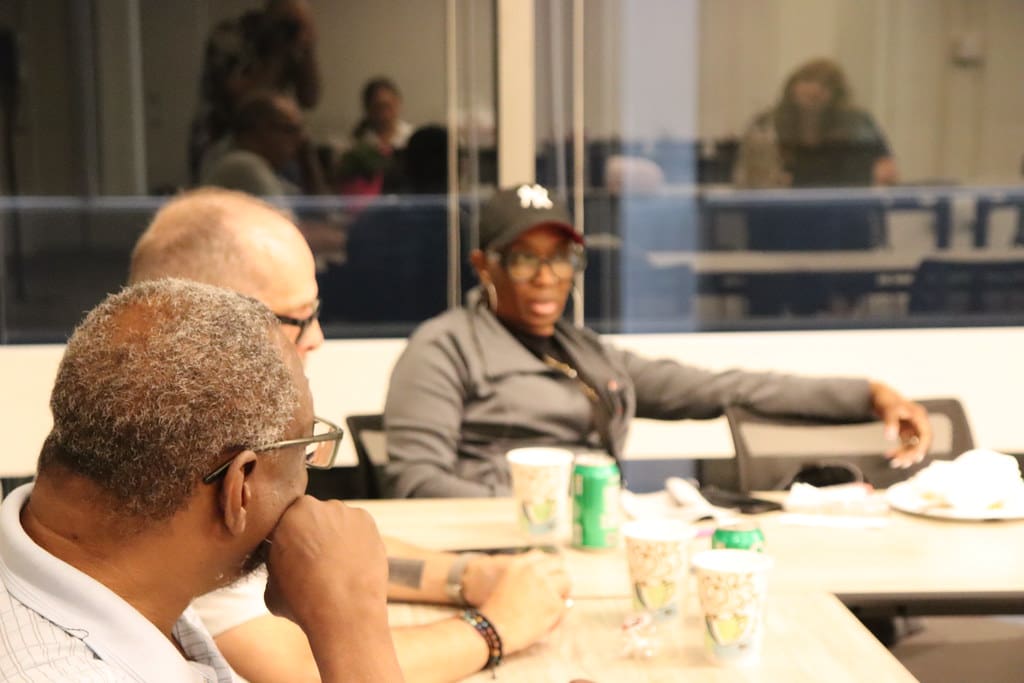
AIDS Foundation Chicago’s (AFC’s) Ryan White Community Advisory Board (CAB) has met at the foundation’s offices every other month since 2010. The CAB does everything from evaluating case management policies and procedures to collaborating with AFC staff to strengthen agency site visit practices, among other things. Toward the end of 2024, they decided to invest in another aspect to help HIV-positive clients: a support group.
CAB Chair Bryan said, “We had noticed in the community where people brought other categories to this CAB—connection in that psychosocial support among people living with HIV.” Then the process of creating the support group developed: “We brainstormed a little bit, and we thought about how we could try to fuel that gap. And we were lucky enough to have AFC, who’s [supported] this group and people living with HIV for many, many years.”
CAB member Carmen added that the creation of a support group was necessary: “It’s a safe place where you can come and be free and disclose, and it’s confidential. People can express themselves. Also, if we all have a similarity, we don’t focus on the differences.” Other CAB members acknowledged obstacles with support groups—such as finding or employing the transportation to attend group meetings in the first place. Zoom has (in most cases) eliminated the need for group members to attend in-person, though some prefer personal contact.
Based on the success of early support-group meetings, members are thrilled—and would like the events to accomplish more.
Several people at a recent meeting indicated that they would like the CAB support groups to expand significantly, with multiple groups not only in the city but throughout the suburbs. In addition, CAB member Louis mentioned hosting a forum—an idea that led several others to offer suggestions, including making the gathering a peer-led event, which would decrease costs, increase relatability and allow for networking, among other benefits.
‘This is my family’
And what has the support group (and those groups, in general) meant to the CAB members?
Louis commented about how he has led other support groups, including at Open Door Health Center in Aurora. He added, “I did a men’s support group with another fellow; it was a men’s only group. We didn’t have food or gift cards, but everybody showed up every week because everybody wanted to talk. I think [a support group is] a great way to educate people and a great way to get rid of some of the falsehoods that people have out there about HIV. You become more knowledgeable, more self-sufficient.
“You begin to feel more positive about yourself—and I think that’s the biggest part of it, for me,” Louis said.
Carmen added, “Supporters are very important to me. When I was first diagnosed, I was still working, so I had never been to [a support group]. And I started going and I felt more comfortable. I have facilitated some support groups in my house. And then you just learn a lot [of things]. I saw this girl on TikTok saying. ‘You can catch HIV sitting on the toilet.’ I wanted to [check her].”
Group member Dee Dee stated, “Support groups are very empowering. When I was diagnosed, I knew it in my heart. I was positive because I was a street worker. I was using drugs. And people were [dropping] like flies.” However, despite many obstacles (such as legal troubles), Dee Dee’s life has turned around, with her adding that despite thinking that no one would want her, she has found love.
B.B., who was diagnosed in 2024, said that support groups “are needed. At first, I didn’t know a thing. Everything’s just so different, and there was a lot of information being given to me. My therapist at the time said, ‘You’ve got to come with us to our group.’ And it was like a weight was lifted off of me. I felt like I wasn’t alone.”
Carmen echoed what B.B. said, especially about the feeling of togetherness: “I walked into a support group, and my life began to change. I started talking and they just gave me hugs. … I gained so much knowledge and I made so many connections. This is my family.”
Bryan agreed that support groups are about “community connection and fellowship,” adding that his friendship with Louis has significantly deepened since their initial meeting a group meeting years ago. “I wouldn’t be where I am here today without that meeting,” Bryan said.
Lee saw a different purpose in the CAB support group, having acknowledged the inclusivity of the group but adding that “there were no support groups for folks who are assigned or designated female birth and who are also trans.” After saying that they had been put in groups that really didn’t fulfill their needs, Lee said that the CAB group has become a “platform of advocacy” for them.
And Joe said that support groups helped him “find his way,” as he has acquired high-school and college degrees, learned to be resilient and is involved in other support groups, including one at Cook County Jail.
Longtime group organizer and AFC Sr. Manager of Intake & Referral Angela Jordan said, “It’s understood that everyone attending the support groups are all dealing with the same health issue. AFC staff are not present in these groups; that allows them to speak freely. It allows for a level of comfortability for attendees to be open and honest.”
When it comes to the CAB support group, it has proven that people are more alike than they are different. Despite the members’ diverse backgrounds and needs, these individuals have shown up for each other and themselves to create a safe space, acquire knowledge, and achieve togetherness.


