By: Omar Martínez González, Sr. Manager, Policy & Advocacy
CHICAGO, IL – On December 29, 2022, President Biden signed a $1.7 trillion omnibus budget bill to fund the federal government through September 30, 2023. The omnibus bill included $858 billion for defense funding and $772.5 billion for non-defense discretionary programs like the Ryan White program to pay for HIV treatment and care for low-income people living with HIV (PLWH), HOPWA which provides housing for low-income PLWH, and HIV/STI testing through the CDC, among many others. The massive funding bill was the final action by the 117th Congress and was signed into law in time to avoid a government shutdown. The following are the provisions that impact those who are living with or who are impacted by HIV:
Elimination of Medicaid continuous enrollment. Flexibilities provided by the federal government during the COVID-19 pandemic allowed states to keep people enrolled in Medicaid without the need to prove eligibility through the annual process known as redetermination/renewal, in exchange for a temporary enhanced federal match rate for Medicaid. The omnibus bill allows states to begin redetermining eligibility of their Medicaid recipients, with people who no longer qualify for the program starting to lose their coverage as of April 1st. It is estimated that 19 million people will lose their Medicaid benefits nationally. In Illinois, it is estimated that just over 500,000 people will lose their Medicaid coverage. If you or someone you know is currently enrolled in Medicaid, you should update your address with the Illinois Department of Healthcare and Family Services (HFS) to avoid benefit disruptions by visiting https://www2.illinois.gov/hfs/MedicalClients/Pages/addresschange.aspx
Overall increases in funding for HIV-specific programs. The omnibus includes the following funding for programs specific to PLWH or those who are vulnerable to HIV:
- $499m in historic funding for the Housing Opportunities for Persons with AIDS (HOPWA) program, a $49m increase over FY22
- $613m for the 4th year of Ending the HIV Epidemic (EHE), an increase of $100m over FY22, with a $25m increase for the CDC’s Ending HIV initiative, $40m increase for the Ryan White program for treatment and care, and $35m increase for the Community Health Centers to focus on PrEP
- $2.571b in funding for the Ryan White HIV/AIDS Program, an increase of $76m over FY22
- $60m for the HHS Minority HIV/AIDS Initiative, an increase of $3.1m, and report language to return the program to its original intent of funding minority-led organizations instead of minority-serving organizations
- $23m for the CDC’s Opioid Related Infectious Disease line, an increase of $5m over FY22
- $10m increase for the CDC’s Division of STI Prevention
The bill failed to include funding for the creation of a national PrEP program despite advocate efforts, although it did include report language in support of expanding access to PrEP to end the HIV epidemic.
Inclusion of the Mainstreaming Addiction Treatment (MAT) Act. The MAT Act was included in the omnibus, which officially waives the buprenorphine X waiver that restricts the ability of medical providers to easily dispense medication-assisted treatment for opioid use disorder. Additionally, the MAT Act eliminates the limit on the number of patients that health care providers can treat for opioid use disorder at any given time, along with removing other barriers that make it harder for clinicians to treat opioid use disorder.
AFC receives $250,000 in Community Projects funding thanks to Rep. Mike Quigley. AFC received a Community Project award of $250,000 in the FY23 omnibus for training and services to better support seniors living with HIV. With improved life expectancy thanks to modern antiretroviral therapy, more people living with HIV are reaching advanced age, which presents unique challenges for clinicians who care for this population. This funding will go towards developing different levels of training to educate Chicago-area HIV providers about the challenges of this growing population.
AFC applauds the 15 Illinois Members of the 117th Congress, which includes all Democrats and two Republicans, who voted to pass this important piece of legislation, as well as our two Senators. Illinoisans living with or impacted by HIV cannot afford to have their well-being jeopardized by politics, and this necessary funding will ensure that service providers in Illinois can continue to care to our communities to ensure we move closer to ending the HIV epidemic in Illinois and the U.S.
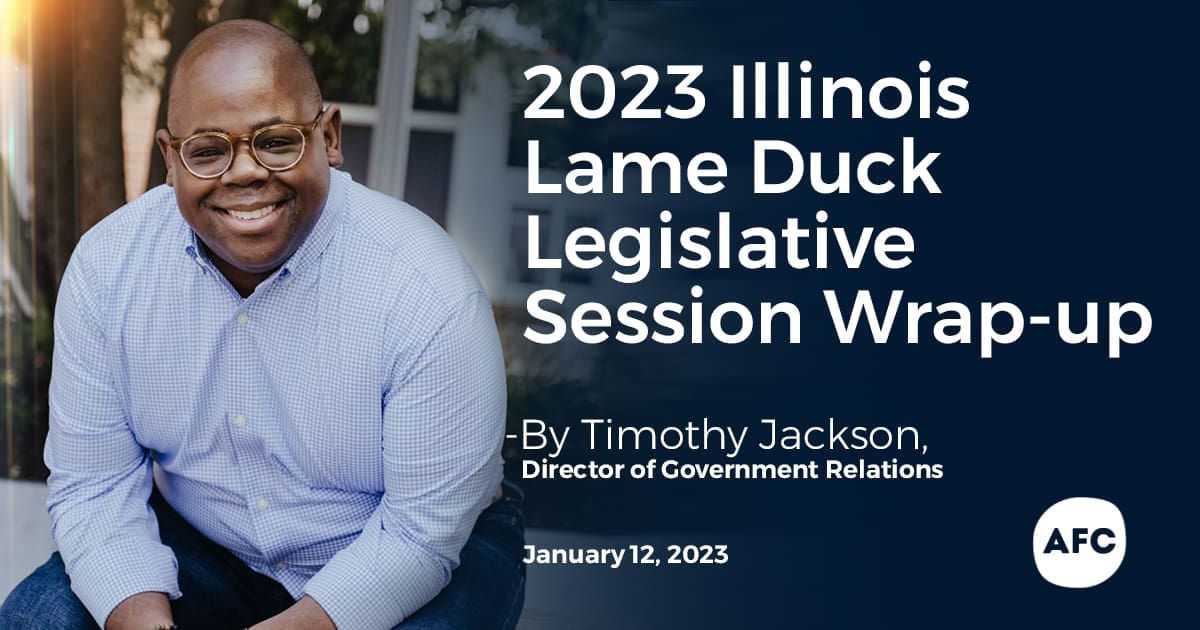
By Timothy Jackson, Director of Government Relations
With the U.S. Supreme Court overturning of Roe v. Wade and the deluge of gun violence across Illinois as the backdrop, the Illinois General Assembly gaveled into the 2023 Lame Duck Session on Wednesday, January 4, 2023. At a time when the rights to access comprehensive reproductive health care are under attack, we should be doing MORE not less to protect and expand these rights, especially for trans and non-binary Illinoisans.
Without question, AIDS Foundation Chicago (AFC) believes that gender-affirming care is reproductive health care. AFC believes that access to PrEP (pre-exposure prophylaxis) and PEP (post exposure prophylaxis) is reproductive health care and is a critical component of the state’s Getting to Zero Illinois plan to end the HIV epidemic by 2030. In the months following the Dobbs decision that overturned Roe v. Wade, AFC worked alongside state lawmakers of the Illinois House Dobbs Decision Working Group and community partners at the ACLU of Illinois, Equality Illinois, Planned Parenthood, and many others to craft HB 4664, the Patient and Provider Protection Act, important legislation that safeguards and expands reproductive and gender-affirming care in Illinois. Specifically, HB4664 provides the following reforms, among others:
- Requires abortifacients (medications administered to terminate a pregnancy), gender-affirming hormonal therapy medications and PrEP/PEP medications to be covered by insurers without cost-sharing.
- Allows patients to receive hormonal birth control over the counter from a pharmacist under a statewide standing order from the Illinois Department of Public Health.
- Provides legal protections for any licensed healthcare professional performing an abortion procedure.
- Allows advanced practice registered nurses and physician assistants to perform aspiration abortion procedures that do not require general anesthesia.
- Protects patients, providers and those assisting patients and providers, from aggressive litigation from states targeting reproductive health care and gender-affirming health care within Illinois.
AFC thanks Representative Kelly Cassidy (D-Chicago), Senator Celina Villanueva (D-Chicago), the Dobbs Decision Working Group and the many advocates for getting this critical legislation across the finish line. HB4664 now awaits Governor Pritzker’s signature where we fully expect him to sign it.
In our policy and advocacy work, AFC understands that our efforts to end Illinois’ HIV epidemic extends beyond increasing access to and uptake of PrEP and the retention of more people living with HIV in care. We know that our efforts must center the communities most impacted by HIV and must be grounded with intersectionality. With this understanding, AFC was proud to work alongside various community partners and state lawmakers to advance numerous other initiatives to Governor JB Pritzker’s desk for his signature including:
- HB9, Birth Certificate Modernization: This legislation modernizes the state’s birth certificate law by allowing a person to self-attest for gender marker corrections on birth certificates, allows an individual exiting incarceration, individuals experiencing homelessness, and youth in care to obtain a corrected birth certificate at no cost, and codifies availability of the gender-neutral (X) designation on birth certificates. This legislation, which goes into effect on July 1, 2023, was sponsored by Representative Jennifer Gong-Gershowitz (D-Glenview) and Senator Laura Fine (D-Glenview).
- HB2542, Name Change Registration: This legislation helps trans and gender-expansive people and survivors of human trafficking live safer and more authentic lives by removing the state’s onerous restrictions on changing your name. This legislation was sponsored by Representative Kelly Cassidy (D-Chicago) and Senator Bill Cunningham (D-Chicago).
- HB3878, Fix the Illinois Rental Housing Support Program: This legislation, sponsored by Representative Curtis Tarver II (D-Chicago) and Senator Cristina Pacione-Zayas (D-Chicago), increases the Rental Housing Support Program (RHSP) fee on the recordation of real estate documents from $10 to $20. This legislation, which goes into effect July 1, 2023, serves about 2,400 extremely low-income households throughout the state and the additional funding will allow the program to serve more people and more parts of the state.
- HB5471, Protect Illinois Communities Act: This law bans assault weapons and high-capacity magazines from being manufactured or sold in Illinois. This legislation, sponsored by Representative Bob Morgan (D-Deerfield), House Speaker Emanuel “Chris” Welch (D-Westchester) and Senate President Don Harmon (D-Oak Park), makes Illinois the 9th state in the nation with an assault weapons ban. Governor Pritzker signed this legislation into law on January 10, 2023, with an immediate effective date.
- SB208, Paid Leave for All Workers Act. This legislation provides up to 40 hours (5 days) of paid time off for any reason (including paid sick time), accrued at 1 hour of leave for every 40 hours worked. This legislation, which goes into effect on January 1, 2024, was sponsored by Representative Jehan Gordon-Booth (D-Peoria) and Senator Kimberly Lightford (D-Hillside)
The 2023 Lame Duck Session of the 102nd General Assembly was a flurry of activity that produced nation-leading reforms to curb gun violence and protect the rights of all Illinoisans to access reproductive and gender-affirming care. Moving forward, AFC looks forward to working with members of the new 103rd General Assembly in the 2023 spring session to advance crucial policy priorities related to addressing the high costs of health insurance premiums, the creation of overdose prevention sites, and increased funding for HIV/STI prevention, testing and treatment.
Undoubtedly, AFC remains committed to protecting the most marginalized in our communities, including people living with or vulnerable to HIV. To stay engaged in AFC’s advocacy work throughout the year, please be sure to sign up for our Mobile Action Network here.
Last month we talked with AFC’s Alex Garcia and Executive Director of Gamaliel of Metro Chicago and Pilsen Neighbors Community Council (PNCC) Juan F. Soto on their work as community organizers and their upcoming event, the 8th Driver’s License Reinstatement Expo.
This past summer, PNCC celebrated the 50th year of Fiesta Del Sol, a community celebration and showcase of the work the organization does throughout the year, such as legal literacy help for immigration, cannabis expungement, driver’s license reinstatement, and workforce employment. AFC is proud to be a sponsor of Fiesta Del Sol.
“I don’t say I want to help the community; I say I want to organize the community,” said Juan F. Soto, who has lived this journey himself as a Mexican immigrant who came across the border without papers . Through his work at PNCC, Juan wants individuals to know that they have the power and the voice to act in the public arena and make an impact in this community.
Alex Garcia is also passionate about investing in the community; he is AFC and Center for Housing & Health’s Controller and is also the Co-Chair of Fiesta Del Sol and the Chairperson for the Driver’s License Reinstatement Expo.
PNCC is the only organization outside of the Traffic Court System to hold an event like this. The Expo is held on a Saturday at Malcolm X College to make it as convenient to the public as possible. Cook County Public Defenders and other volunteer attorneys provide pro-bono legal counsel for those who qualify. PNCC has already helped over 5,000 people over the span of 7 Expos. The upcoming Expo is on February 4th, 2023. Register and learn more about it here: 8th Drivers License Reinstatement Expo – Pilsen Neighbors Community Council
Watch the full interview here: In conversation with Alex Garcia and Juan Soto – YouTube
Interview by Livvie Avrick
AIDS Foundation Chicago thanks U.S. Congressman Mike Quigley (IL-05) for providing $250,000 for training and services to better support seniors living with HIV. “Thankfully, people who are living with HIV and taking medication are living longer. HIV care providers and our supporting partners need training and education to meet the evolving and complex needs of people with HIV as they grow older,” said John Peller, President/CEO of AIDS Foundation Chicago.
The funding for this comes out of the more than $16.5 million secured by Congressman Quigley (IL-05) for community projects in the Fiscal Year 2023 federal budget, which President Biden signed into law right before the holiday.
“Thanks to support from Congressman Quigley, we’ll develop different levels of training to educate Chicago-area HIV providers about the challenges of aging. We’re thankful that Congressman Quigley recognizes the importance of making these culturally responsive training options a reality.”
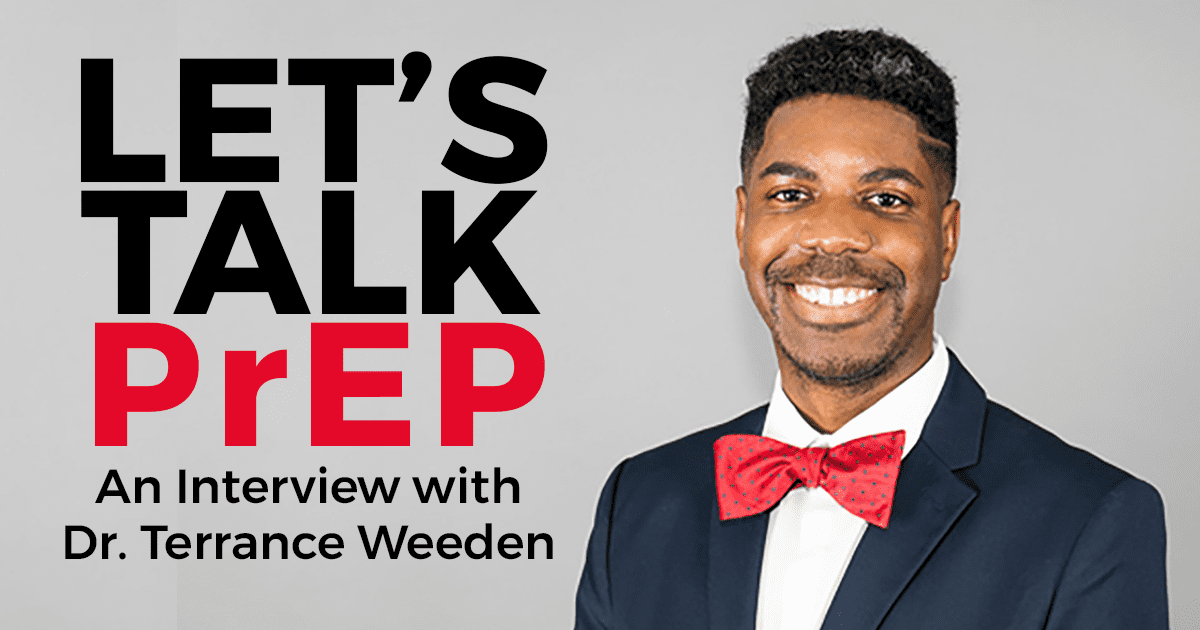
President Biden in his FY23 budget proposal called for the creation of a new mandatory program to make Pre-Exposure Prophylaxis (PrEP) accessible to all uninsured and underinsured people in the U.S., at no cost to them. PrEP is an essential part of the solution to address the impact of HIV, and with existing disparities within the LGTBQ+ community as well as among Black and Latinx people, a national PrEP program could help address some of these disparities and access issues. I sat with Dr. Terrence Weeden, current AFC Associate Board Member, and member of the AFC Policy & Advocacy Committee, to discuss PrEP, the stigma surrounding it, and how a national PrEP Program can help.
Thank you for agreeing to this. What made you want to get into adolescent medicine?
Weeden: I always knew I wanted to go into pediatrics, but I saw a greater need for providing healthcare to adolescents. It also gave me a chance to talk about things that many, though not all, general pediatricians aren’t comfortable talking about such as substance use, sexual health, reproductive health, gender and sexuality. I enjoyed talking about those topics with patients, compared to my co-residents during my pediatric residency. I feel like adolescent medicine is unique in that it bridges the gap between Pediatrics and Adult medicine. You can still make an impact on teenagers’ lives.
For anyone unfamiliar with the subject, how would you describe PrEP and PEP?
PrEP stands for pre-exposure prophylaxis. PrEP is a daily medication taken to prevent HIV. Post-exposure prophylaxis, or PEP, is medication taken if you think you’ve been exposed to HIV, which greatly reduces your chances of acquiring HIV. It’s important to know that PEP is time sensitive and should be taken as soon as possible within 72 hours of a known exposure to HIV, since its effectiveness is reduced the longer you wait to take it.
President Biden wants to make it possible for everyone to get PrEP, including the uninsured and the underinsured. What are your thoughts on this?
I feel it’s important, because the goal is to eliminate HIV, and one way we can do that is to provide not only equal access but equitable access to PrEP, and to PEP.
How does PrEP play into the statewide plan to end the HIV epidemic in IL by 2030, the Getting to Zero Illinois initiative (GTZ-IL)?
One way to get to zero [net HIV transmissions] is to have equal and equitable access to both PrEP and PEP, without having to worry about whether insurance will cover it, or whether your doctor will have bias or judgment towards you or wondering where you can get the prescription. We need to eliminate the economic and social barriers that prevent people from going to their doctor and starting AND continuing PrEP.
What role do physicians play in better promoting PrEP to their patients?
I think it’s powerful when physicians speak up about PrEP and advocate for more access to PrEP. It’s also one thing to start on PrEP, it’s another thing to continue treatment and be engaged with the provider to ensure the person maintains a negative HIV status. We as physicians must be diligent about our follow-up to encourage people to remain engaged in care. Physicians should really speak up more about the need to increase access to PrEP and to have more conversations about PrEP, HIV, and sexual and reproductive health in general. There’s still a lot of stigma and uneasiness around talking about these subjects. There’s still a lot of stigma within Black and Brown communities and healthcare professionals of all races and backgrounds regarding HIV.
1.2 million individuals are estimated by the Centers for Disease Control and Prevention (CDC) to need PrEP, and only 9% of Black individuals and 16% of Latinx people have accessed it by 2020, compared to 66% of White individuals. By end of 2019, White people accounted for only 28% of the estimated total number of people living with HIV in the U.S. compared to 40% for Black people and 25% for Latinx people, despite White people making up 59.3% of the population in the U.S. and Black and Latinx people making up only 13.6% and 18.9% of the population, respectively. Why do you think such discrepancies exist among Black and Latinx communities when compared to the White community?
A lot of factors come into play. There are societal barriers preventing Black and Brown people from having access to a doctor in general, let alone a doctor who is familiar with PrEP, knows enough about PrEP and is comfortable to have conversations about PrEP, HIV, and sexual health. It’s also dependent on whether Black and Brown people have access to health insurance, which is tied to educational attainment and job status, for example. These socioeconomic barriers have been in place for multiple generations and are being mirrored in the inequities in healthcare, specifically regarding HIV.
Do you feel that stigma exists within the medical field, particularly among doctors, when it comes to HIV treatment and care?
Yes, and I think the culture is slowly shifting. When I was in medical school not long ago, we were taught that “certain populations” are considered “high risk,” and so that feeds into implicit bias where you say, “OK, this is a Black gay man, I should talk about these certain things because he’s at risk for these certain things,” regardless of whether it’s true for that person or not. I do think that there is some value to that thought process from the standpoint of preventing disease and death and trying to eradicate health inequities, but I also think that, overall, the Queer experience among people of color is not monolithic. Implicit and explicit biases exist among doctors who may or may not have preconceived notions that patients from Black and Brown and/or Queer communities are at risk for certain illnesses, and that they should only talk to them about these illnesses… this is not entirely true. You can miss the entire picture when you’re laser-focused on one thing.
Apart from a lack of knowledge about PrEP, what else prevents people from seeking PrEP care?
Insurance–or lack thereof. I see it often. Insurance impacts the kind of treatments, the kind of care you get, and where you can get it. There are also concerns of the side effects of PrEP. PrEP is generally well tolerated. However, in rare cases it can affect renal function. This is why regular check-ups with your doctor are important, since they evaluate your renal function and other important health indicators to make sure the medication isn’t harming you.
Are we moving in the right direction in terms of eliminating PrEP stigma?
That’s a good question. I think with time, stigma will go away. I’m grateful that there is a new form of PrEP that is a long-acting injectable, Apretude, so that will provide more options for people who are vulnerable to HIV and who want to start PrEP, but don’t want to take a pill every day. It involves a periodic injection to prevent HIV.
Is PrEP right for everyone?
Any medication can have an impact on your body. Some people may experience issues with kidney function and bone density loss. As stated earlier, those negative side effects are rare and are screened for when on PrEP. Beyond that, PrEP is for anyone who wants to remain HIV negative.
Let’s wrap up by coming back to President Biden’s National PrEP Program proposal, which would make PrEP more accessible for people who don’t have insurance or who are underinsured. What are some key takeaways that you would want a person reading this blog post to walk away with?
There is still bias and stigma that needs to be addressed, both on the patient side and on the physician side. Doctors need to advocate for this national PrEP program. There are disparities that still exist within medicine (including HIV) despite modern technology and all the advances of modern medicine, even when HIV is preventable. I think having a national PrEP program would be a good step–a huge step–towards achieving the goal of Getting to Zero, to essentially eradicate HIV in the United States. Having equal and equitable access to PrEP would ensure that everyone who desires access to PrEP can receive it.
AIDS Foundation Chicago (AFC) will distribute $8.82 million to 40 organizations to deliver high-quality, cost-effective Ryan White HIV/AIDS Program services in Cook County and surrounding Collar counties. In September 2022, AFC released a Request for Proposals (RFP) to local organizations to support eleven service categories under the Ryan White program. The Ryan White program serves people living with HIV and AIDS who are uninsured or underinsured or lack the financial means to obtain the necessary care. All 40 agencies were notified on December 1, 2022, and funding will be available to organizations from the beginning of March or April 2023 depending on source. Funding through this RFP is conditional upon continued funding made available from the Chicago Department of Public Health (CDPH) and the Illinois Department of Public Health (IDPH).
“It was essential to retain agencies providing quality services to the HIV and AIDS community and expand the network of providers geographically to deliver critical services to Black and Latine communities on the South and West Sides. Utilizing a health equity scoring, we put racial equity at the forefront of ending the epidemic and eliminating the barrier to sustained care in historically under-served neighborhoods,” stated Bashirat Olayanju, AFC Vice President of Care.
This funding supports expansion of a network of 114 case managers and peers (specially trained people living with HIV who help clients navigate services) at 34 agencies that in the most recent year provided services to over 5,500 clients. Other examples of services funded through this RFP include medical care, mental health, substance use treatment and housing.
Funding priority was given to agencies with a history of serving older adults, youth, and women in addition to Black and Latine-led organizations and organizations that provide services in the seven neighborhoods with the highest rates of HIV/STIs:
- Edgewater
- Uptown
- Rogers Park
- Washington Park
- South Shore
- Pullman
- Austin
The 40 selected agencies vary in size, type, and geography. They include community-based organizations, community health centers, hospitals, and a health department. AFC chose three new organizations for the network, all of which are Black-led: Chicago Family Health, Taskforce Prevention Services, and Dr. David Mays, DDS, a dentist. AFC also awarded funding for expanded services to Haymarket, Alliance Care 360, Lake County Health Department, and Open Door Health.
You can locate the complete list of organizations and map of services sites here
Approach to Scoring
The reviewers of each proposal included community members, and 2-3 individuals scored each application. The reviewers included experts in the fields of social services, HIV services, community development, and individuals belonging to communities disproportionately affected by HIV/AIDS.
The maximum number of points proposals could be given was 100. AFC used a scoring system that considered panel review ratings, a health equity score, and past performance (if applicable). The Health Equity Score was based on the organization’s location and key health indicators including HIV prevalence, HIV incidence, and other data from the CDPH HIV/STI 2020 surveillance report.
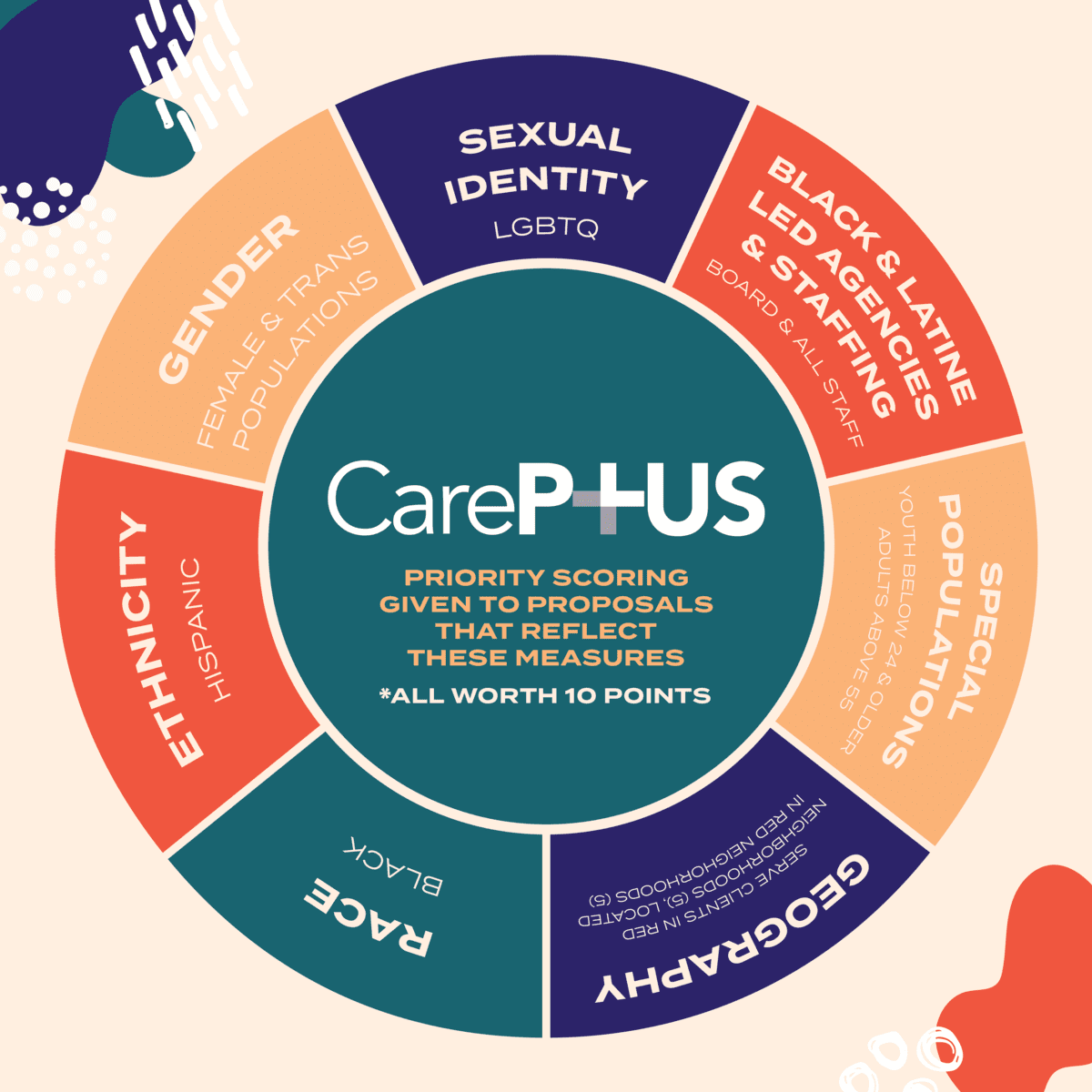
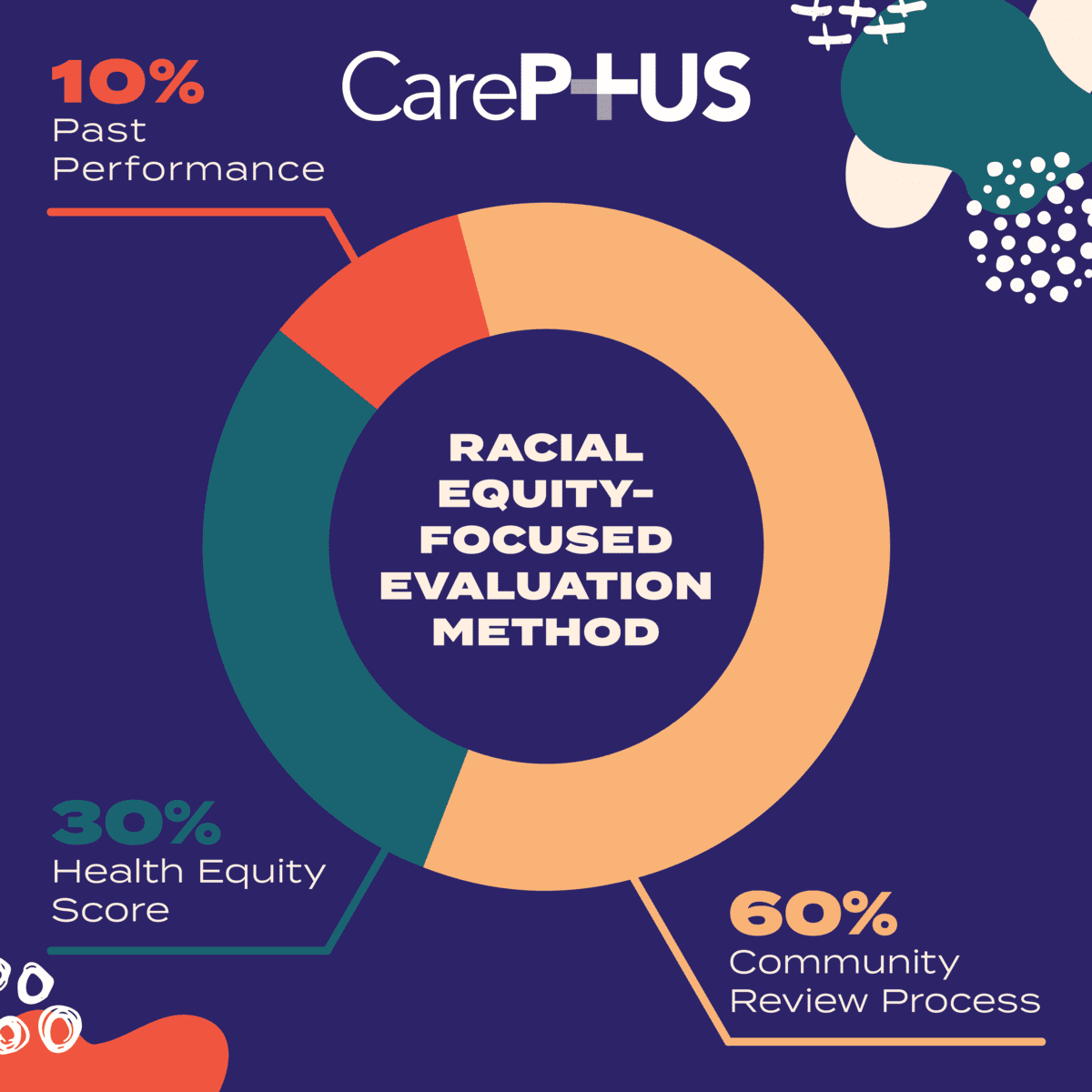
“We feel very proud of the agencies selected in the review process. With the expansion of the network, we are providing our communities with quality care that reflects the diversity and reliability they deserve from providers they can trust. We can get to zero knowing our Black and Latine communities will not be left behind,” said Melanie Cross, Senior Manager of Care Systems Management.
For the full list of awardees, please see below:
| Agency Name | Service Category |
| Agape Mission, Inc. | Corrections Case Management |
| Agape Mission, Inc. |
Medical Case Management
|
| AIDS Healthcare Foundation |
Medical Case Management
|
| AIDS Healthcare Foundation | Ambulatory |
| Alliance Care 360 | Non-Medical Case Management |
| Alliance Care 360 | Food Bank |
| Ascension Illionois Housing & Health Alliance | Housing |
| Ascension Illionois Housing & Health Alliance | Mental Health |
| Ascension Illionois Housing & Health Alliance | Food Bank |
| Ascension Illionois Housing & Health Alliance | Psychosocial |
| Ascension Illionois Housing & Health Alliance | Substance Use |
| Catholic Charities | Medical Case Management |
| Catholic Charities | Medical Case Management MBC |
| Catholic Charities | Psychosocial |
| Catholic Charities | Food Bank |
| Catholic Charities | Mental Health |
| Chicago Family Health Center | Medical Case Management |
| Chicago Family Health Center | Oral Health |
| Chicago House | Medical Case Management |
| Chicago Women’s AIDS Project | Non-Medical Case Management |
| Children’s Place Association | Medical Case Management |
| Christian Community Health Center | Medical Case Management |
| Christian Community Health Center | Non-Medical Case Management |
| Christian Community Health Center | Mental Health |
| David K. Mayes | Oral Health |
| Erie | Non-Medical Case Management |
| Erie | Medical Case Management |
| Erie | Ambulatory |
| Erie | Mental Health |
| Esperanza | Medical Case Management |
| Greater Family Health | Medical Case Management |
| Greater Family Health | Ambulatory |
| Greater Family Health | Substance Use |
| Greater Family Health | Mental Health |
| Greater Family Health | Oral Health |
| Haymarket Center | Corrections Case Management |
| Haymarket Center | Medical Case Management |
| Haymarket Center | Substance Use |
| Haymarket Center | Housing |
| Haymarket Center | Psychosocial |
| Heartland Alliance Health | Medical Case Management |
| Heartland Alliance Health | Food Bank |
| Heartland Alliance Health | Oral Health |
| Heartland Alliance Health | Meadical Nutrition Therapy |
| Hektoen CCHP | Medical Case Management |
| Hektoen CCHP | Corrections Case Management |
| Hektoen CCHP | Non-Medical Case Management Peer |
| Hektoen CCHP | Non-Medical Case Management Retention |
| Hektoen CCHP | Perinatal Case Management |
| Hektoen CCHP | Ambulatory |
| Howard Brown Health | Medical Case Management |
| Lake County Health Dept | Medical Case Management |
| Lake County Health Dept | Non-Medical Case Management |
| Lake County Health Dept | Ambulatory |
| Lake County Health Dept | Medical Nutrition Therapy |
| Lake County Health Dept | Oral Health |
| Legal Council for Health Justice | Legal Services |
| MACA | Non-Medical Case Management Peer |
| MACA | Perinatal Case Management |
| Men & Women in Prison Ministries | Corrections Case Management |
| Men & Women in Prison Ministries | Medical Case Management |
| Michael Reese | Medical Case Management |
| Open Door Health Center | Medical Case Management |
| Open Door Health Center | Non-Medical Case Management |
| Open Door Health Center | Non-Medical Case Management Peer |
| Open Door Health Center | Non-Medical Case Management Retention |
| Open Door Health Center | Ambulatory |
| Open Door Health Center | Medical Case Management Med. Benefits Coor. |
| Proactive Community Services | Medical Case Management |
| Project VIDA | Medical Case Management |
| Puerto Rican Cultural Center | Food Bank |
| Sinai Health Center | Medical Case Management |
| Smiles of Elgin | Oral Health |
| South Side Help Center | Corrections Case Management |
| South Side Help Center | Medical Case Management |
| Taskforce Prevention and Community Services | Medical Case Management |
| TPAN | Medical Case Management |
| TPAN | Non-Medical Case Management Peer |
| TPAN | Non-Medical Case Management Retention |
| U of C | Medical Case Management |
| UIC-COIP | Medical Case Management |
| Will County Health Dept | Medical Case Management |
| Will County Health Dept | Oral Health |
| Will County Health Dept | Substance Use |
| Will County Health Dept | Mental Health |
| Will County Health Dept | Ambulatory |
In June this year, AFC and Pride Action Tank announced the pilot launch of the Connection to Care Learning Collaborative (CCLC), which seeks to work with Federally Qualified Health Centers (FQHCs) and look-alikes in Chicago to increase their capacity to provide LGBTQ+ HIV care for their patients.
This Learning Collaborative is focused on increasing capacity in three key areas: LGBTQ+ culturally responsive HIV Care programming to Black-led and Latine-led health centers, PrEP and HIV treatment, and sustainability through funding and staff retention.
One of these FQHCs is TCA Health Inc., located on the Far South Side of Chicago. This health center is crucial not only to neighborhoods within Chicago, but many residents from suburbs like Dolton and Riverdale. “We offer a full extensive care menu for our community to come in and get exactly what they need,” said Brandon Wright, program coordinator for TCA. “(As) someone who lives and loves in a community that is affected by HIV, (I have an) understanding that there is a need for services and comprehensive care from our physicians to our community.”
Since joining the Collaborative, TCA has had success pushing conversations with community members about sexual health education in order to properly fight stigma and the spreading of HIV. They have also used the collaboration to find staff with passion who are members of these communities, which builds a beneficial level of trust. “I would say one of our biggest successes is being able to find the right people who are committed to the work, who are dedicated to the work, who are able to connect with various people and populations and identities, able to relate to different people, populations and identities, and bridging all that”, said Donisha Reed, Director of Population & Community Health Program at TCA Health. “To create this, I know the word safe space is used a lot, but really it creates a safe space where people are telling us information that they wouldn’t tell their providers or wouldn’t tell their medical assistants.”
This collaborative has not only given TCA Health new opportunities to teach its community members, but to teach and learn from different health centers across Chicago. “Medical providers and nurses from health centers that have had Ryan White funding for a long time, serving large HIV populations (have met with) our Health Center providers so that they can learn from one another,” said Samantha Oliver Mitchell, Chief Operating Officer at TCA. “I think for us, this is new and this is an opportunity to expand. Just learn from other peers.” Wright, when speaking on working with other centers in Chicago stated, “I think that the care collaborative has a unique way of bringing agencies together to have the dialogue and keep the conversation going outside of our monthly meetings. You start to build and cultivate a mutually respected and resourceful network needed for the work ahead.”
When asked what impact should TCA Health have on the community, Reed said, “I was an FQHC baby. I didn’t know it was a FQHC growing up, of course. But you know, me and my whole family went to FQHC’s, and so I want people to know, we’re really here to help them through this process of life or violence or whatever health issue that they’re facing. Really letting people know that we are here for them and we’ll walk them through the different pieces and parts of healthcare outside of going.”
TCA Health is located at 1029 E 130th Street and 8425 S. Cottage Grove. For any information regarding TCA, visit tcahealth.org.
As we commemorate World AIDS Day on December 1st, we remember our loved ones we have lost and honor the 38.4 million individuals who are living with HIV today. Join the important events and conversations happening throughout the week both in person and virtually.
For this year’s World AIDS Day, we dream that everybody has a safe and stable home because we know that housing is a critical part of HIV care. Together, we are changing the story of HIV in Illinois and it starts with a home for everyone.
Please make a donation to AFC so we can continue to provide supportive housing options for all our clients.
Wednesday, November 30
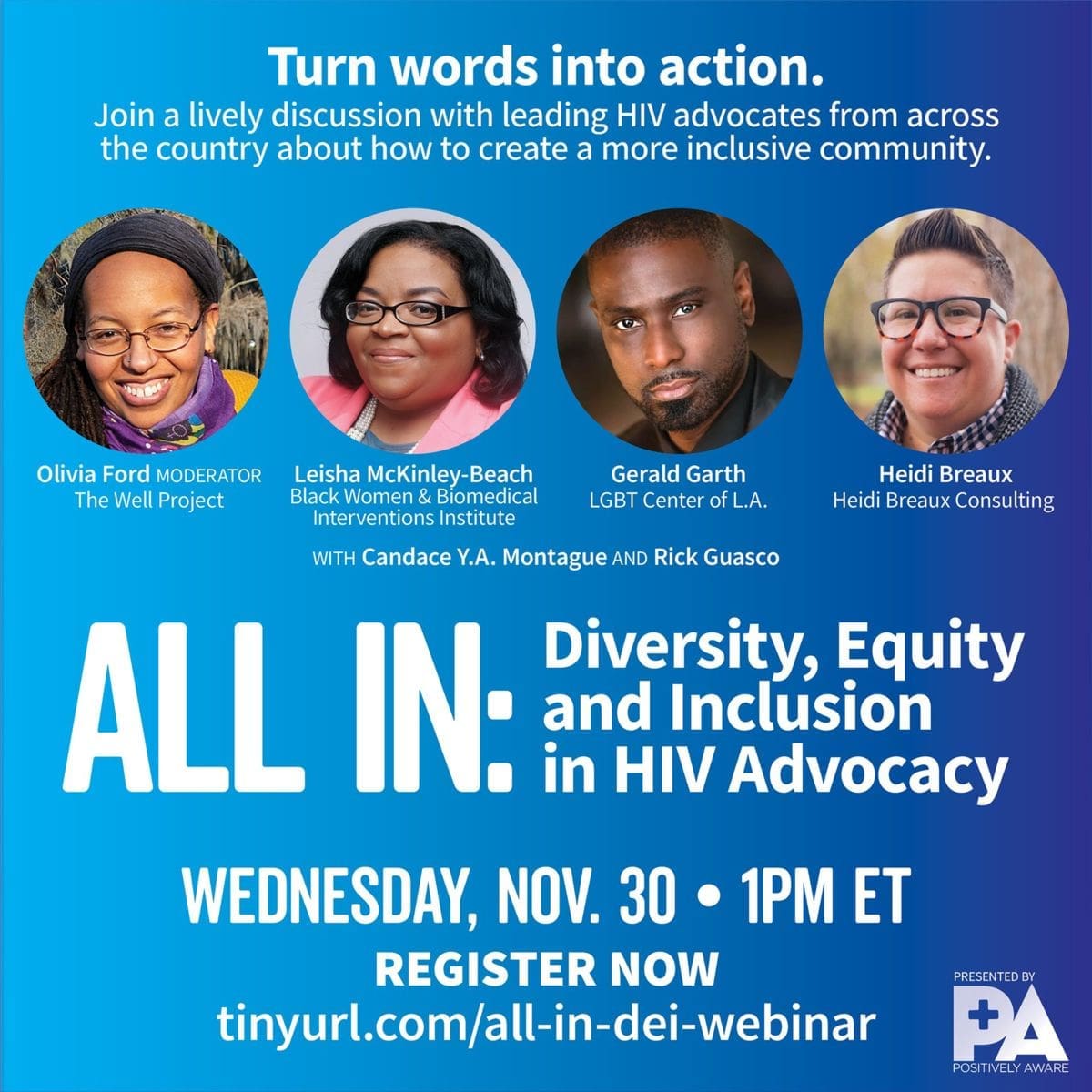
“All In: Diversity, Equity and Inclusion in HIV Advocacy” virtual event on Wednesday, November 30, 12 p.m. CT
A panel discussion hosted by Positively Aware and led by HIV activists on how to turn words into action. What actions can you take right now to become a more inclusive community?
Register here: Webinar Registration – Zoom
Thursday, December 1
In-person commemorative candle light vigil at the TransEmpowerment Center, 2753 West Division at 2:00pm, CT.
The Puerto Rican Cultural Center and VIDA/SIDA invite you to their annual World AIDS Day Commemorative Candle Light Vigil. Beginning in front of the TransEmpowerment Center and ending at La Casita de Don Pedro, 2625 West Division.

Thursday, December 1
In-person community celebration at the Baron Show Lounge at 4713 N. Broadway from 6:00pm – 9:30pm CT.
Join the Puerto Rican Cultural Center for a World AIDS Day commemoration. Free entrance, dinner and entertainment.

Thursday, December 1
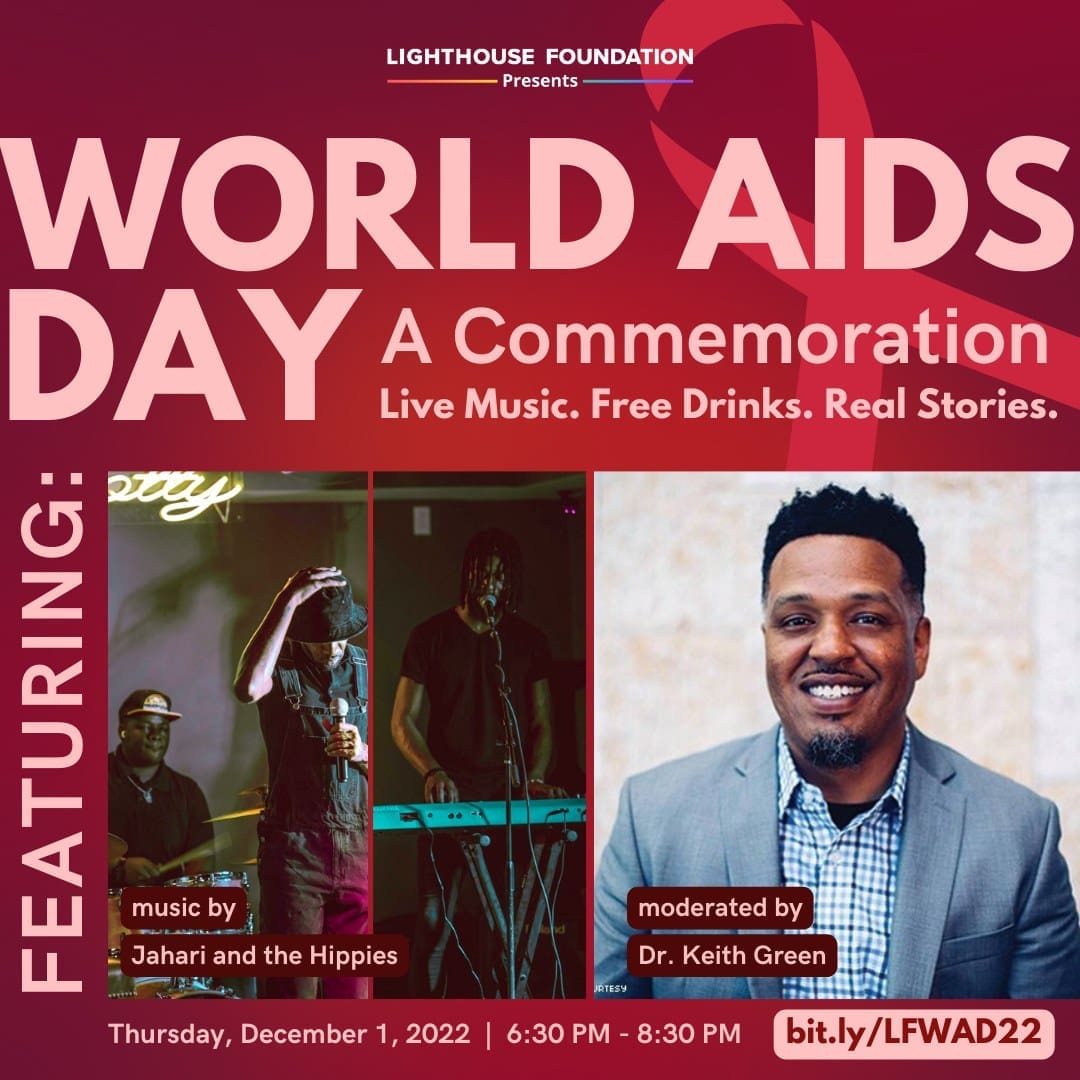
In-person commemoration panel discussion and celebration at Lighthouse Foundation at 2015 S Laflin St from 6:30 – 8:30pm
Join Lighthouse Foundation on December 1 from 6:30 – 8:30 PM as we listen to the journeys of people living with HIV in a panel discussion facilitated by Dr. Keith Green.
While we will commemorate those lost, we will also celebrate the resilience of our community through free drinks, hors d’oeuvres, a balloon release, and live music from Jahari and the Hippies. Registration is free, but space is limited:
Reserve your spot today at World AIDS Day: A Commemoration Tickets, Thu, Dec 1, 2022 at 6:30 PM | Eventbrite
Saturday, December 3
In-person screening and Q&A of documentary series, Equal, at The New Theater, 6746 N Sheridan Rd, from 3:00pm – 6:00pm
Join TPAN for a special screening of two episodes of the acclaimed documentary series, Equal. Following the screening, Stephan Kijak, the producer and director of Equal, will participate in a Q&A with the audience.
Tickets are $10 GA and $5 Students and Seniors
Purchase tickets: TPAN PRESENTS EQUAL AT A SPECIAL CINEMATIC SCREENING | TPAN

Wednesday, December 7
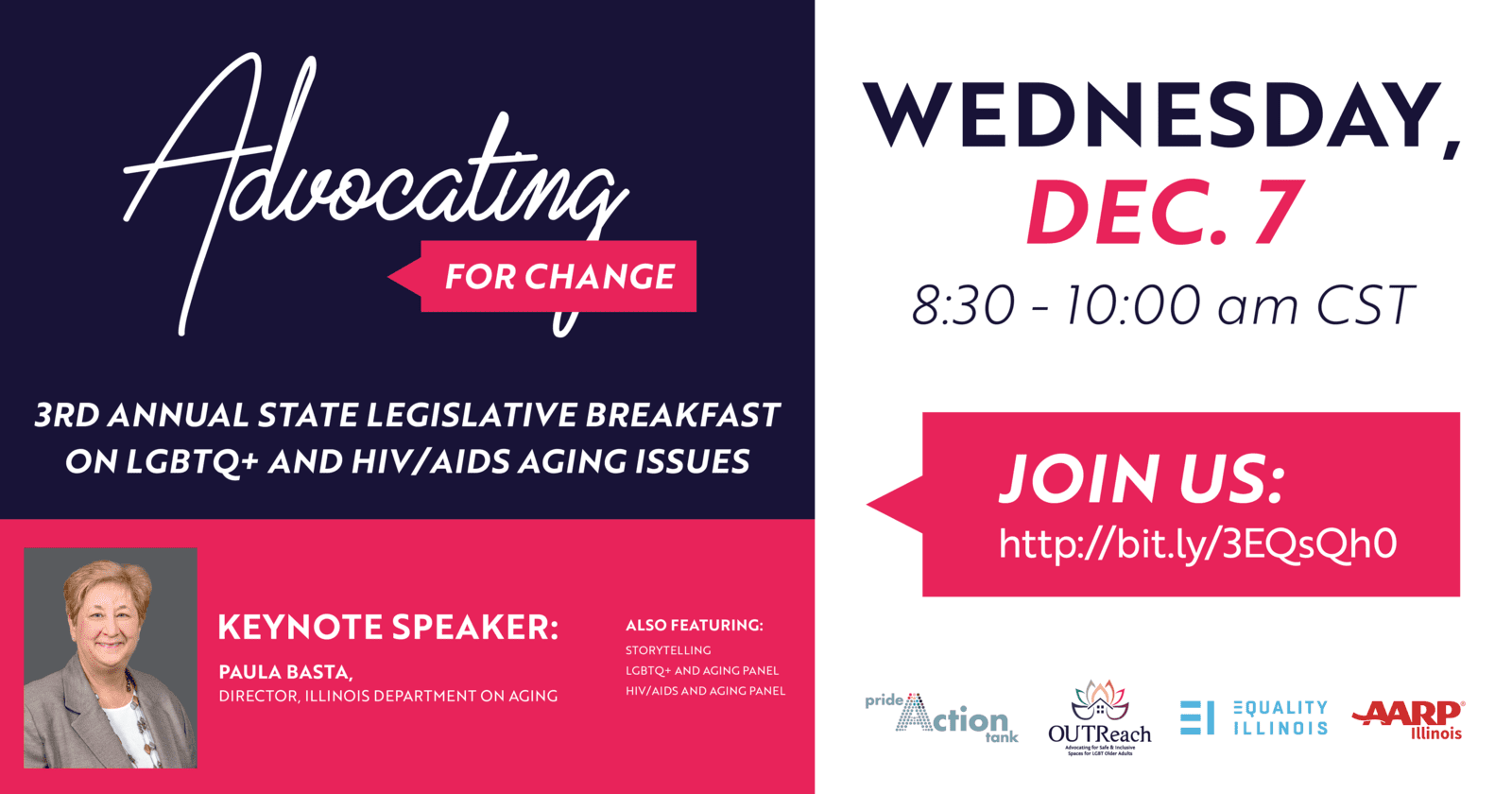
“Advocating for Change: 3rd annual State Legislative Breakfast on LGBTQ+ and HIV/AIDS aging issues” from 8:30 – 10:00 am CT
Join Pride Action Tank, Equality Illinois, AARP Illinois, and OutReach for a discussion led by Paula Basta, Director of Illinois Department of Aging.
Register: http://bit.ly/3EQsQh0
Thursday, December 8
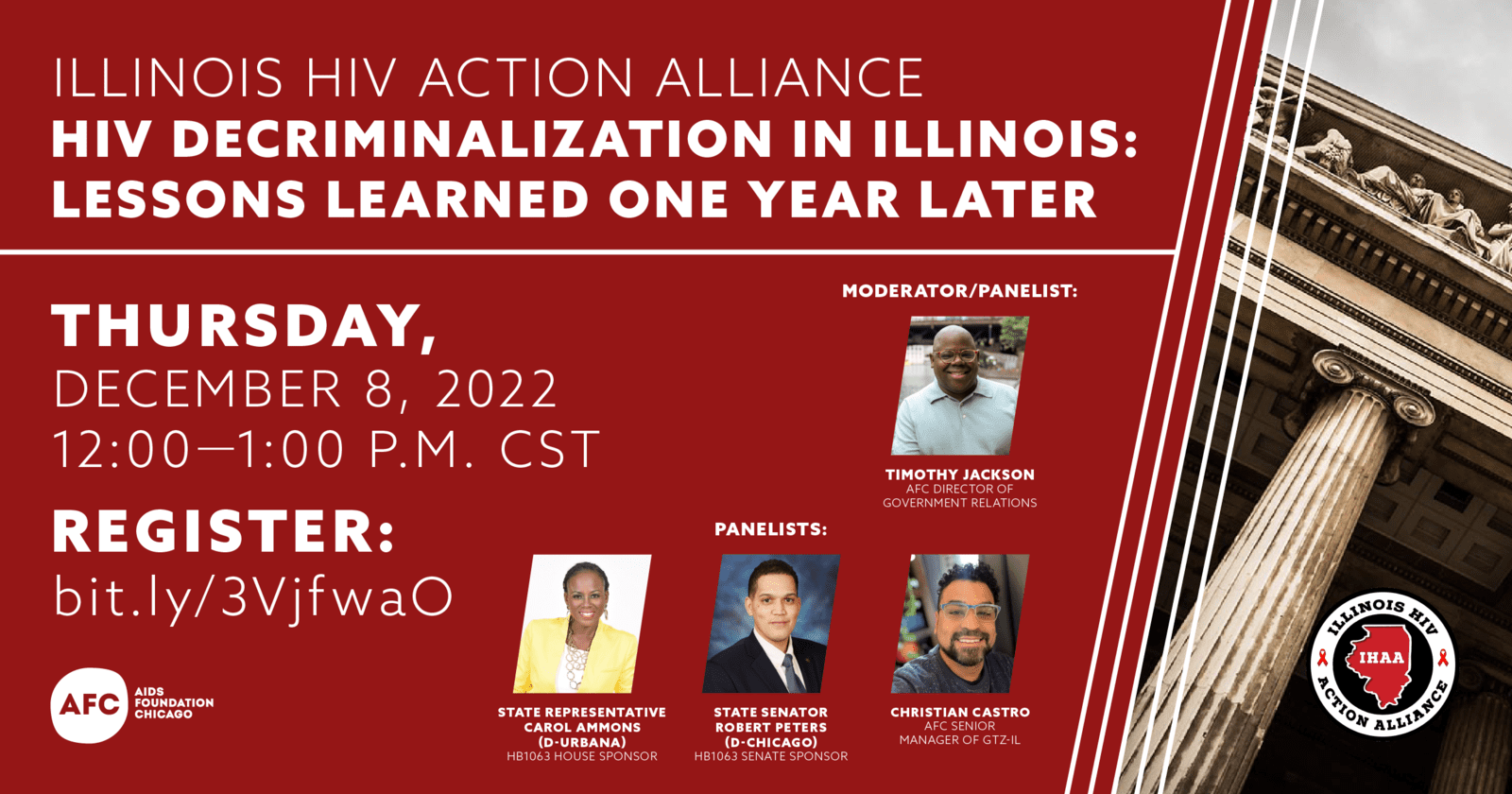
“HIV Decriminalization in Illinois: Lessons Learned One Year Later” virtual discussion sponsored by AFC and the Illinois HIV Action Alliance from 12:00 – 1:00pm CT
During this webinar, moderated by Timothy Jackson, AFC Director of Government Relations, we will discuss repealing Illinois’ HIV criminalization statute and panelists will have the opportunity to share insight and lessons learned in the time following the repeal of the law (HB1063).
Register: bit.ly/3vjfwaO

It is with heavy hearts that we, the AFC family, announce the loss of our colleague and friend Clinton Latimore, but it is with a joyous spirit that we celebrate his life.
Clinton joined the AFC family in 2019 as an intern with the Housing Stabilization Team and Housing Navigation Program. Over the years, he made a significant impact on Chicago and the people fortunate enough to have him in his life. He was later hired as AFC’s first Housing Navigator, helping people living with HIV connect to housing. Not only did Clinton exemplify calmness under pressure, putting the people he helped at ease, he also provided his clients with hope in a world that increasingly felt hopeless.
Clinton was a warm soul with helping others at the forefront of his mind. He constantly made people feel welcomed and joyous in any space. Prior to working at AFC, Clinton was an Americorps volunteer/member working in HIV prevention, a health educator, and a soldier. But beyond that, Clinton was a kid from Chicago, who loved his city, and just wanted to make it better. A goal he clearly achieved.
“Clinton brought passion and compassion to his work at AFC,” said John Peller, President/CEO of AFC. “Over the many years I knew Clinton in the community and during his time at AFC, he had an unsurpassed ability to connect with clients. Clinton approached his work with patience, respect and a deep understanding of the challenges that people living with HIV face. AFC is a stronger organization thanks to Clinton and the deep friendships he made with his colleagues and community partners. And hundreds of people living with HIV in Chicago are better off thanks to the housing that Clinton helped them to find.”
Our hearts go out to Clintons family and loved ones.
Thank you, Clinton. We will never forget you.
By Livvie Avrick
The role of Black women in healthcare often goes unseen and undervalued. At AFC, the impact of Black women cannot be overstated. Take the Care team for example, led by four extraordinary black female-identified leaders, Bashirat Olayanju, Lakethia Patterson, Angela Jordan, and Melanie Cross, these women are critical in keeping the Chicago HIV communities healthy, well, and thriving.
The importance of having Black and Latinx individuals leading teams at nonprofits goes beyond representation. Black Women’s Equal Pay Day measures the point when Black women catch up to what white men were paid the year before. Black women are paid 58 cents for every dollar spent to white men. Yet we know that leaders who are equitability supported at high levels can often result in better decisions and outcomes for the communities we serve. As we work toward ending the HIV epidemic, organizations must have diverse and inclusive staff at all levels. So one of AFC’s Racial Equity Action Plan elements is to increase the number of Black and Latinx staff, leadership, and board members at all levels. Equal pay is vital to AFC, and this year staff salaries were raised by about $1 million to ensure staff is being paid equitably compared to comparable positions in other organizations. Join us in celebrating the Care Team and the impact they have on our communities.
Meet the Care Team
AFC is a system leader and has an entire Care Team devoted to ensuring people living with HIV receive the highest-quality services from the community and from AFC. Led by Bashirat Olayanju, AFC’s Vice President of Care, the Care Team is one of the largest teams at AFC and the largest coordinated HIV case management systems in the country with 130 case managers at 30 different agencies providing culturally competent care to 5,000 plus clients. As Bashirat describes it, care is “having physical bodies who are available to work with clients, hand holding as tight as they want it to be held or as loose as they want it to be held,” guiding them through their HIV journey whether someone is newly diagnosed or has been living with HIV for a long time.
Bashirat’s driving force is quality improvement, and over the last couple of years due to COVID, her team has had to be resilient and innovative in how they operate. They have been able to remove many administrative barriers, which has allowed case managers to be able to spend more quality time with their clients, learning how to best meet their needs. Services like telehealth and Instacart home grocery delivery have been a game changer for their clients. Bashirat is focused on getting better results for her clients, and that means trying new things and finding new ways to support clients.
“I am confident that I am doing the work that I am supposed to be doing; I feel like I am making a difference, and I know the people leading the team with me are the right people for the job, and it so happens to be all Black women, which is really great,” said Bashirat.
For Lakethia Patterson, AFC’s Director of the Ryan White Program, care and social services have always been part of her life. Growing up in Cabrini-Green, Lakethia was always volunteering and part of different community groups and organizations. “Once I started teaching health educational classes, a light went off, and I was like I’m a natural, it’s so fulfilling, it’s so awesome,” said Lakethia. “That made me change my career to social services, and that was almost 20 years ago now.”
Lakethia oversees the direct services team, which consists of care coordination specialists, medical benefits coordinators, and medical and senior services case managers. These case managers can have a caseload of 45 to 100 clients.
“I am very proud that I can educate and help my team as well as the case managers and assistants to grow. I am most proud that I can coach and train others with all my years of experience not only professionally, but also personally,” said Lakethia.
There aren’t many women of color in top positions in the non-profit field, but it is a huge benefit. “We can easily relate to some of the issues that we see in the populations that we serve,” said Lakethia.
Most clients that enter case management go directly through Angela Jordan’s team, who is the Senior Intake & Referral Manager at AFC. “My favorite part of my job is seeing the cycle completed; seeing someone enter case management, go through the referral process, following them through to the linkage of their case manager, reading their case notes to see how they’re progressing, and some of the clients eventually end up no longer needing case management and the cycle is complete; that is rewarding,” said Angela.
One of the most challenging parts of Angela and her team’s role is not knowing what type of call they may be getting or not having a resource that matches a client’s need. Each day, they receive many calls that can range from an informational question to a complex crisis.
“Often, we take calls from individuals where pretty much we are the only people they’ve shared their HIV diagnosis with,” said Angela. “I think about how difficult that could be to not have a support system. I enjoy the fact that they trust us enough to share that information with us; at the same time, it does pull at your heartstrings the things that we hear.”
“I’m most proud of the fact that my team is uniquely diverse and is representative of the communities that we serve,” said Angela.
In Melanie Cross’ role as Senior Manager of Care Systems Management at AFC, she oversees some special projects that the Care team has including training for all 130 case managers in the AFC system and the Department of Rehabilitation Services (DRS) home and community-based care case management program. She ensures that case managers feel supported and that all special projects have a positive outcome.
“There is no wrong door into care navigation,” said Melanie. “Care means to me, simply put, that we actually care. That us as a department, we are intentional and thoughtful in providing services to our clients and that we consider deeply the quality of services that we provide, following up to ensure things are complete and finalized for our clients.”
One of the ways that makes the Care team successful is being collaborative and representative of the populations that they serve. “I’ve been able to lean on my team and have been able to receive the help that I need or the guidance to move forward,” said Melanie.
“To me, the fact that we are a team led by all Black women is a power statement. It’s exciting for me,” said Melanie.