By Omar Martínez González, Senior Manager, Policy & Advocacy

Photo credited to Omar Martínez González
WASHINGTON, DC — Today, The U.S. Supreme Court (SCOTUS) issued a devastating blow to the right of women and pregnant people to access safe abortion services. Not only did it give Mississippi the green light to enforce its harmful 15-week abortion ban, it also struck down the landmark Roe v. Wade decision that established women’s constitutional right to access abortion without excessive government restriction. 13 states have hostile laws on the books known as “trigger laws,” which immediately limited or outright banned abortions in those states when the Supreme Court decision was made public. In an instant, millions of women and pregnant people lost their right to self-determination.
Make no mistake. Today’s decision is the culmination of decades of white supremacist efforts to reinforce systems of oppression against low-income Americans and Black, Latino/a/e/x and Indigenous people of color. In the United States, there is little to no safety net for working parents, access to comprehensive and affordable health care lags far behind other countries, and livable wages are still unattainable for millions of people—this decision will put a crippling economic strain on our poorest communities. Predominantly white, upper- and middle-class people will continue to access safe abortion care while the rest will be forced to have unplanned children or rely on unsafe abortion practices. This SCOTUS decision is the antithesis of racial equity and justice.
Thankfully for Illinoisans, the right to safe abortion was enshrined in state law through the passage and signing of the Reproductive Health Act (RHA) of 2019. This Act reaffirms the right of people who can become pregnant to make the incredibly personal choice to access birth control and abortions. It repeals harmful and outdated abortion laws that were already deemed unenforceable by our courts, and eliminates language that criminalizes abortion care providers. Finally, the Act establishes that insurance companies must provide coverage for abortions. If you are an Illinoisan, your right to abortion services is protected, regardless of the Supreme Court’s decision today.
This is not the end. Our fight will continue to ensure that the right to abortion is protected for all Americans. You can do your part in the fight to protect abortion rights by supporting providers, patients, abortion funds, and clinics on the ground. You can support additional state protections through laws, ballot initiatives, and by demanding that your state and federal elected representatives protect the right of people who can become pregnant to decide for themselves when they are ready to have a baby. The best way to make your voice heard is to vote! Be sure to vote in Illinois’ primary on June 28, 2022, and make sure you are registered to vote in the upcoming November 8, 2022 election.
AIDS Foundation Chicago is committed to protecting abortion rights, because abortion rights are human rights, racial justice rights, women’s rights, and LGBTQ+ rights.
Contact: [email protected]
Pride Action Tank (PAT), a project of AIDS Foundation Chicago (AFC), is excited to announce the pilot launch of the Connection to Care Learning Collaborative (CCLC). CCLC seeks to work with Federally Qualified Health Centers (FQHCs) and look-alikes in Chicago to increase their capacity to provide LGBTQ+ and HIV culturally responsive care for their patients.
To determine which key topics, concepts, and practices need to be prioritized when developing training content for CCLC, PAT partnered with McAlpine Consulting for Growth (MCG) to administer a needs assessment to 22 FQHCs across Chicago. The survey aimed to gain better understanding of Chicago FQHC’s healthcare delivery models; assess the readiness of FQHC’s to provide culturally competent and evidence-based sexual health services; and identify what needs to shift operationally to increase capacity for culturally responsive care. The assessment, from July to December of 2021, was conducted through interviews, surveys and focus groups, and 16 out of the 22 FQHCs participated.
The results revealed opportunities to aid FQHCs in developing universal in-house HIV screening practices, adequate data reporting of their patients’ gender identity and sexual orientation, and maintaining consistent cultural competency training audiences, frequency, and content. Kim L. Hunt, the Executive Director of Pride Action Tank, shared why this project is pivotal in decreasing LGBTQ+ discrimination and ending the HIV epidemic:
“The Connection to Care Learning Collaborative is one of many efforts to end the HIV epidemic in Illinois by 2030. Pride Action Tank is excited about the opportunity to work with the six centers in the pilot year to not only increase their capacity to provide LGBTQ+ culturally responsive HIV prevention and care, but also to reduce stigma and ensure that we are strengthening the network of health care resources for communities of high prevalence and vulnerability to HIV. Our hope is that this will be a multi-year project that will be available to health centers throughout the Chicago region.”
The CCLC pilot program will kick-off with their first virtual meeting on June 21, 2022, and the program will conclude January 31, 2023. The participating FQHCs and look-alikes in Chicago include:
Over the course of the 8-month program, PAT will work with these health centers to increase their capacity for culturally competent HIV care through training, discussions and peer-to-peer sharing. Each FQHC will receive an $80,000 grant and will determine how to best utilize funds based on their organizational needs. Following the grant distribution, PAT and AFC will administer a survey to establish center-specific goals and action plans. The FQHCs will also have the opportunity to join a six-part series of learning experiences and regular one-on-one training sessions hosted by PAT and AFC, Esperanza Health Centers, Erie Family Health and Howard Brown Health.
In tandem with the recent passing of SB3490: Disrupting Disparities for LGBTQ Older Adults and Older Adults Living With HIV, the launch of the Connection to Care Learning Collaborative serves as an additional mode of advocacy and support for LGBTQ communities as they navigate their resource options. While PAT and AFC are only working with six FQHCs and look-alikes during this pilot year, they certainly aim to work with many more centers in the future to ensure that healthcare centers remain culturally competent and accessible.
Learn more about Pride Action Tank and their projects to improve the lives of LGBTQ communities and people living with HIV by visiting their website.
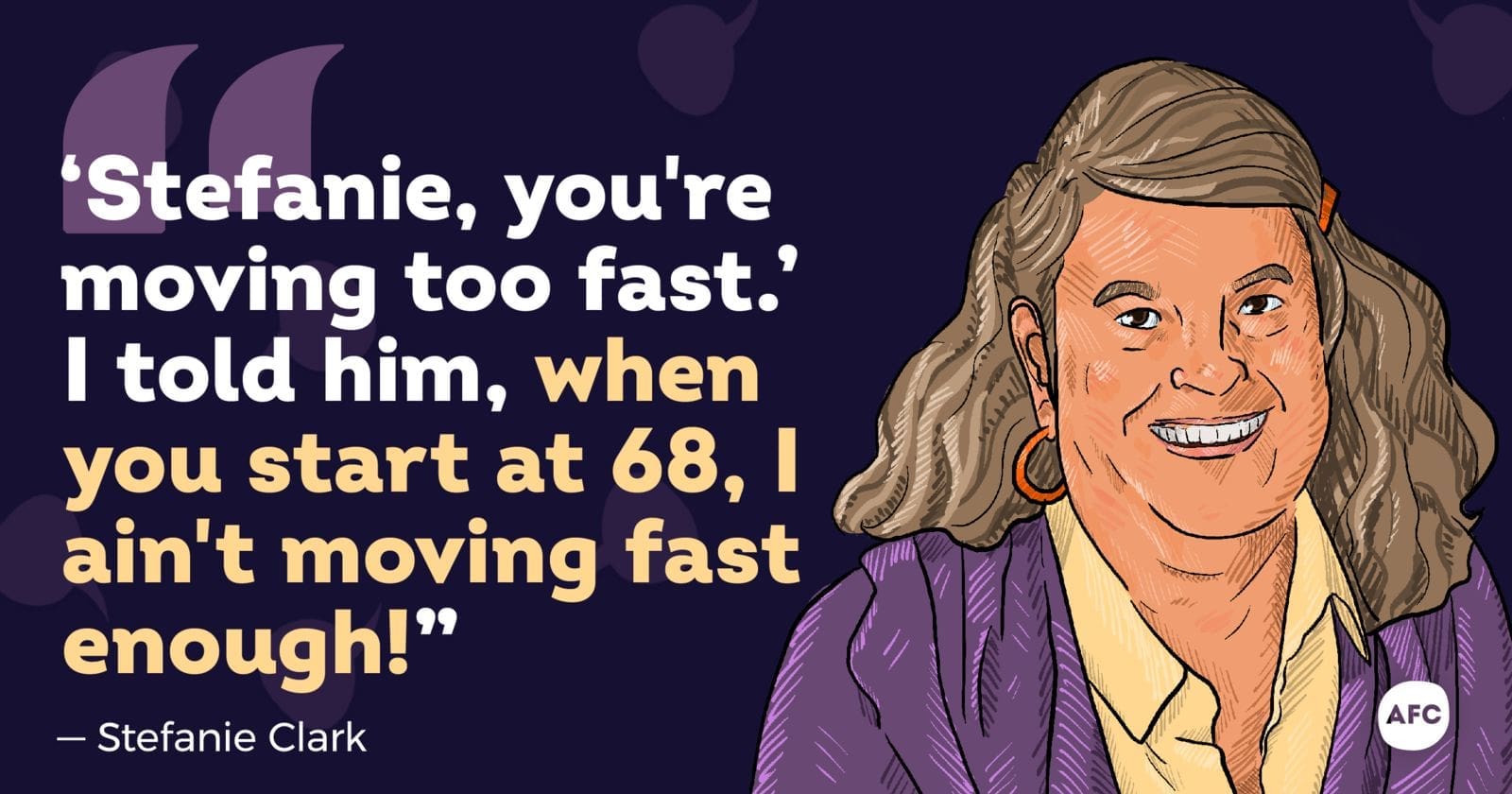 One of AFC’s missions is to continue to amplify the voices of LGBTQ older adults and their experiences navigating advocacy work, healthcare, social stigma, or living with HIV. Stefanie Clark is a lesbian and transgender woman who has spent the past six years advocating for culturally competent care training for all medical professionals throughout Illinois, from clinic receptionists, nurses, PhD specialists, dentists, all the up-to the M.D.
Many know her from Pride Action Tank’s Storytelling for Change, but Stefanie Clark is also connected to many organizations like Howard Brown and Equality Illinois for their advisory boards. As a self-proclaimed “Renaissance Woman,” Stefanie shares her coming-out story, her thoughts about SB3490: Disrupting Disparities for Older Adults, and the resilience required to have unfamiliar conversations about gender identity in medical spaces.
Interviewed and edited by Indigo Quashie
Advocating for lasting change in the futures of LGBTQ older adults and older adults living with HIV in necessary to end the HIV epidemic in Illinois by 2030. Learn how Pride Action Tank has created a platform for these communities through various events and projects by visiting their website.
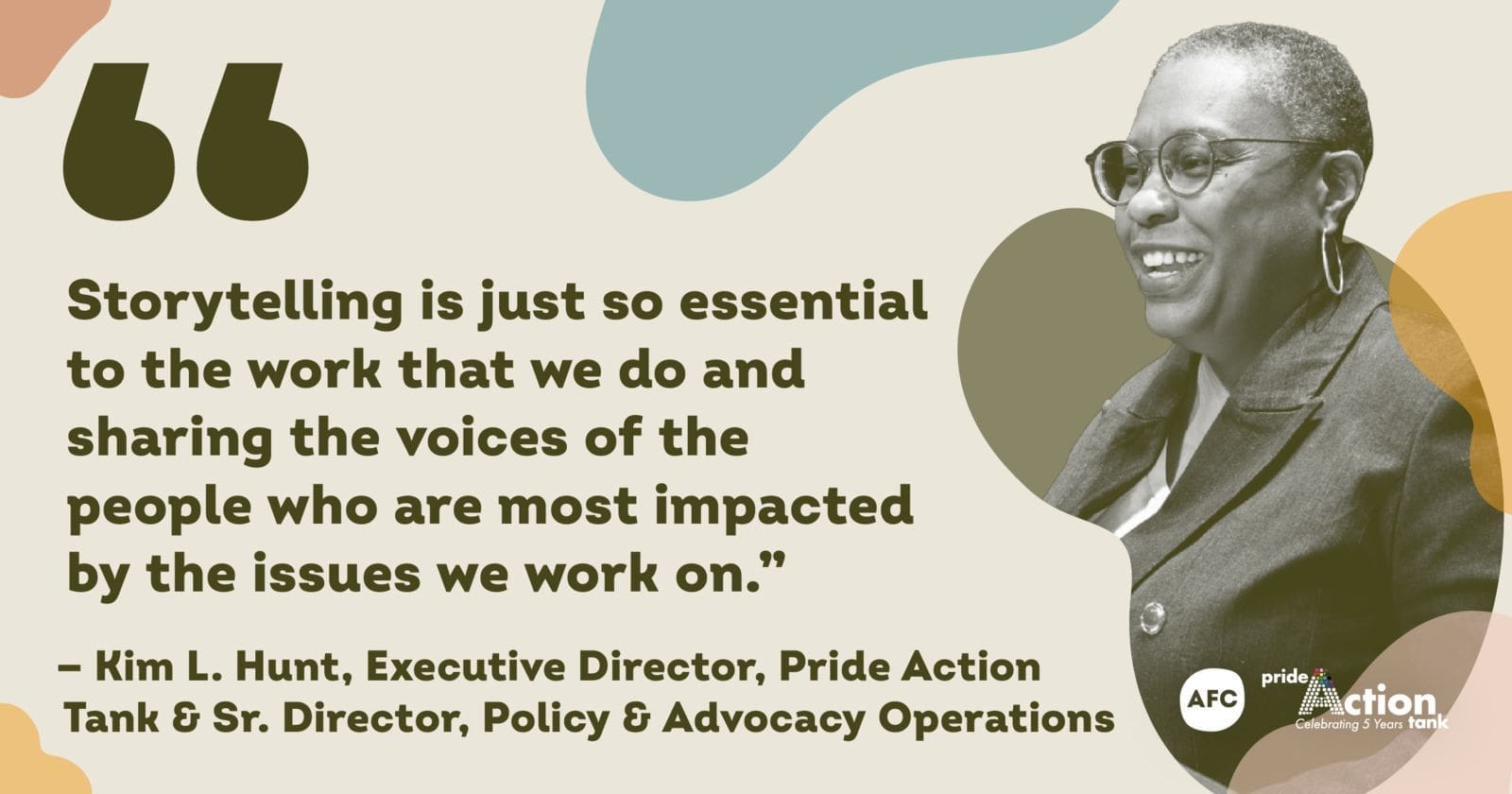
I am excited to introduce my colleague Kim L. Hunt to you – Kim has led AIDS Foundation Chicago’s Pride Action Tank (PAT) as Executive Director since its inception seven years ago and also serves as Senior Director on AFC’s Policy & Advocacy team. I want to share with you how Kim’s innovative approach to storytelling – focused on individual joy and resilience of LGBTQ+ and other marginalized communities – creates lasting systemic change in Illinois and beyond.
What is Pride Action Tank? Established in 2015, PAT is a project of AFC and a think tank focused on action that improves outcomes and opportunities for LGBTQ+ communities in the areas of housing, health, safety, financial security, youth and aging. These goals are achieved through two strategies: first, a collective process of inquiry, storytelling and advocacy wherein PAT acts as a platform for advocates’ voices; and second, by gathering community input through convenings, fleshing out what the community needs and wants. Kim reflects:
“Storytelling is just so essential to the work that we do and sharing the voices of the people who are most impacted by the issues we work on, making space for them to share power in the decisions around what that future could look like for them.”
Kim leads projects that improve the lives of LGBTQ communities, such as systemic change to support LGBTQ+ older adults and LGBTQ+ youth in foster care, and addressing challenges faced by non-binary/transgender individuals in accessing public bathrooms, among other significant issues being experienced by the LGBTQ+ community. Kim ensures that their voices are not only heard, but that the community is engaged from beginning to end, from gathering the gifts of personal stories to actionable legislative changes. Kim admits that the intentionality to be wholly inclusive “can be messy and takes more time, but in the end, serves the population who have been chronically marginalized and stigmatized.”
Kim knows that people with lived experience are the experts on the pressing issues that affect their lives. She encourages people to “name their dreams” and be fully present in their identities when sharing their personal stories and insights. One project Kim has been working on started with a 2-day event covering what it’s like to age as an LGBTQ+ person, called OUTAging: Summit on Our Possibilities. Utilizing the participants’ feedback from the initial summit, she launched the OUTReach for Safe Senior Living project, which addressed the needs for improved culturally competent care for LBGTQ+ older adults in long term care facilities and other settings. This is particularly important as people living with HIV age and need tailored care. Individual storytelling and videos were targeted at policy makers throughout the state in an effort to make change. Kim knows that many LGBTQ+ older adults had to endure a lifetime of discrimination in the workplace and live with stigma and victimization.
“This is the group of folks that is often in need of services and care within the systems that are supposed to be a safety net, but that safety net does not even acknowledge that they exist.”
It is estimated that at least 70% of LGBTQ+ older adults go back into the closet when they enter long term care as there is bullying and mistreatment from both staff and other residents. Thankfully, through PAT’s advocacy work and collaboration with other agencies, the Advancing Equity for Older Adults law (SB 1319) was enacted in 2020 which, in Kim’s words “helps older adults know they can continue to live full, authentic lives no matter where they reside or receive care.” This bill prohibits discrimination against LGBTQ+ and HIV-positive residents of long term care establishments. Illinois is the first state to include people living with HIV in its “greatest social need” definition and only the third state to include LGBTQ+ individuals. And just at the end of this legislative session in March, SB3490, Disrupting Disparities for LGBTQ+ Older Adults and Older Adults Living with HIV, was passed, requiring state-funded providers to complete LGBTQ older adult awareness and competency training, as well as the creation of the three-year Illinois Commission on LGBTQ Aging and an LGBTQ+ Advocate in the Illinois Department on Aging.
What is next for PAT? Kim has found how empowering and healing the story-telling of older LGBTQ adults is and its usefulness when advocating for specific issues. PAT is currently hosting trainings and workshops assisting them with processing their lives through their stories with other like-minded people who, Kim says “are literally cheering you on is rare for older LGBTQ adults. They just don’t get to do this much.”
One participant reflects on the impact of personal storytelling:
By talking about your experiences, you can begin to reflect on them. It also helps you reflect on the challenge of communicating with others. The way each of us understands our experience helps one appreciate the differences in sameness and the sameness in difference. We are all less simple than we appear.
By Livvie Avrick

Introducing Christian Castro, our new Senior Manager of GTZ-IL! Christian comes from a dynamic background of community mobilizing and human rights activism. His most recent work involved coordinating and managing the RADAR project, a NIH-funded study that is the largest longitudinal cohort of YMSM, young transgender women and nonbinary people ever conducted. This was a research study of the Institute of Sexual Gender Minority Health and Wellbeing (ISGMH) at Northwestern University.
Get to know Christian and what led him to the GTZ-IL community – he is excited to meet all of you and begin building relationships.
Q: How would you describe yourself?
A: Hi, my name is Christian Castro. My pronouns are he/him/él. I was born and raised in New York and have been living in Chicago for over 10 years. I would describe myself as a human rights activist and community mobilizer.
Q: What drew you to this role and to AFC?
A: For the last several years, I served as a steering committee member on the Illinois HIV Action Alliance (IHAA). IHAA successfully mobilized to repeal an outdated and harmful HIV criminalization law that discriminated, prosecuted, and incarcerated people living with HIV (PLWH). In July 2021, Governor JB Pritzker signed House Bill 1063 into law, ending criminal penalties for those living with HIV in Illinois. In that capacity, I had an opportunity to build relationships with folks at Howard Brown Health, ACLU and staff from AFC. I was impressed by the commitment and passion IHAA members had towards ending HIV criminalization. It is also in that space, I learned more about AFC’s mission and a bit more about Getting to Zero Illinois (GTZ-IL).
Q: What does Getting to Zero mean to you?
A: As a queer Latinx male who is living with HIV, GTZ-IL is both important and personal. Last June 5th, the world marked 40 years since the first five cases of what later became known as AIDS were officially reported. Today, I see the GTZ-IL plan as inspirational and achievable. GTZ-IL is a world where there are no new HIV infections. We have come a long way with biomedical advancements, the introduction of antiretroviral therapy (ART), including Pre-Exposure Prophylaxis (PrEP). With these important tools and community engagement, we can reach a point of functional zero. To me, that’s amazing!
Q: What ideas or projects are you excited about bringing to your role?
A: I’m excited to get to work more closely with an impressive community of folks from northern, central, and southern Illinois, who are advocating and providing essential, life-saving services that include HIV testing, linkage to care, PrEP and other supportive services to those who are living and vulnerable to HIV. I have several ideas that enhance community mobilization, but an important first step is to build relationships.
Q: What are you excited to learn about the GTZ-IL community?
A: I value and want to center the voices, experiences, and expertise of my GTZ-IL colleagues who are living with and vulnerable to HIV. That means having folks at the table. Unfortunately, if you’re not at the table, you’re on someone’s menu. Or as Audre Lorde perceptively stated, “If I didn’t define myself for myself, I would be crunched into other people’s fantasies for me and eaten alive.”
Q: What is something that people may be surprised to learn about you?
A: While New York and Puerto Rico are 1,600 miles apart, I share a birthday with a cousin that was born on the same day!
So far, I lived in the 3 largest U.S. cities and the nation’s capital (New York, Los Angeles, Chicago, and DC).
Learn more about Getting to Zero Illinois’ initiatives and plan to end the HIV epidemic by 2030 by visiting their site here.
By Omar Martínez González, Senior Manager, Policy & Advocacy

Photo credited to Gayatri Malhotra
AFC is deeply disturbed by last night’s revelation of the U.S. Supreme Court’s draft decision to upend Roe v. Wade, the 49-year-old precedent that protects a woman’s right to choose when to start a family. This decision will disproportionately devastate the lives of low-income Black and Latina/o/e/x women. While the right to abortion is protected by Illinois law, AFC stands ready to mobilize with our local and national partners to support racial health equity.
To stay updated on news about Roe v. Wade in the coming months, sign up for our Mobile Action Network.
By Kennedy Bradley

Hello, GTZ-IL Community!
After nearly 2 years, I have made the decision to resign from my position at AIDS Foundation Chicago (AFC) as Getting to Zero Illinois’ (GTZ-IL) Community Outreach and Education Specialist. My last day is April 18, but before I start my new career journey, I wanted to spend a moment to express my gratitude for this community.
I started working with GTZ-IL in June of 2020, when the pandemic was enveloped with uncertainty and immense fear. At a time when isolation and keeping your distance were common practice, GTZ-IL had a vision of a community coming together. I am thankful to every individual and partner organization who stayed patient and committed to GTZ-IL as we navigated growing pains as a new project through an incredibly difficult and monumental time in history. Thank you for welcoming me with open arms, for showing up, and for continuing the work needed to get us to zero.
From witnessing community members find their voice through Advocacy Day, celebrating wins in coalition meetings, and getting to laugh and unwind with many of you during virtual coffee chats, I have no shortage of good memories from being a part of this community. I’m leaving this role with a fresh perspective on justice, a continued commitment to serve marginalized communities, and a group of lifelong friends that I deeply admire. I will continue to support GTZ-IL and, consequently, all of you for years to come. Thank you for everything.
Best,
Kennedy Bradley
Learn more about Getting to Zero Illinois and their initiatives by visiting their site here.
By Timothy S. Jackson

Concluding a flurry of activity, the 2022 Spring Session of the 102nd Illinois General Assembly was gaveled to adjournment just before sunrise on Saturday, April 9, 2022. Despite an abbreviated session due to primary elections just around the corner, legislators approved a $46 billion Fiscal Year 2023 budget that includes investments in public safety and mental health. State lawmakers were also able to make substantive efforts in helping Illinoisans continue to recover from the COVID-19 pandemic and inflation concerns including a one-time Earned Income Tax Credit (EITC) rebate ($50 per person, $100 per child), the permanent expansion of the EITC and temporary relief from gas, grocery, and property taxes.
Entering the Spring session, AIDS Foundation Chicago (AFC) developed a community-centered state policy priority agenda that increases access to quality health care, addresses racial health inequities faced by Black, Latino/a/e/x, and LGBTQ+ communities impacted by HIV, and advances the priorities and goals of the Getting to Zero Illinois (GTZ-IL) plan.
Despite a truncated legislative session, AFC and our partners were able to secure several victories including increased access for PrEP and PEP through community pharmacies, equitable reforms to the state’s Medicaid program, added protections for LGBTQ+ older adults and older adults living with HIV, and a groundbreaking $10 million investment in the statewide plan to end the HIV epidemic by 2030.
AFC is proud to have advocated for the following bills or budget provisions that have passed both chambers and now await Governor JB Pritzker’s signature:
HB4430, Increasing Access to PrEP & PEP, allows pharmacists to dispense and administer PrEP & PEP under a standing order of a licensed physician to those who are at risk or who may have been exposed to HIV. HB4430 expands access to PrEP and PEP while at the same time advancing the state plan to end the HIV epidemic in Illinois by connecting Black, Latino/a/e/x and LGBTQ+ communities most impacted by HIV to lifesaving preventative care. Championed by State Representatives Kelly Cassidy (D-Chicago), Margaret Croke (D-Chicago) and Greg Harris (D-Chicago), in addition to State Senators Mike Simmons (D-Chicago) and Jason Barickman (R-Bloomington), HB4430 passed the Illinois General Assembly on April 7, 2022.
AIDS Foundation Chicago is proud to have partnered with the Illinois Pharmacists Association, Howard Brown Health, Equality Illinois, the Illinois Retail Merchants Association, Walgreens, Avita Pharmacy, Community Renewal Society, and other stakeholders on this critical legislation. With Governor Pritzker’s signature, Illinois will become the 8th state in the nation to make HIV prevention care more accessible by expanding access through pharmacies.
HB4264, Getting to Zero Illinois Omnibus, requested $15 million in critical investments to help advance the goals and strategies of the Getting to Zero Illinois plan to end the HIV epidemic by 2030. Although this bill did not advance out of the House Appropriations-Human Services Committee, $10 million in funding for Getting to Zero Illinois was included in the state’s Fiscal Year 2023 budget (HB900). The funding will address the health disparities experienced by people living with or vulnerable to HIV—especially among our Black, Latino/a/e/x and LGBTQ+ communities. Championed by House Majority Leader Greg Harris (D-Chicago), State Senators Doris Turner (D-Springfield) and Mike Simmons (D-Chicago), and State Representatives Camille Lilly (D-Chicago), Kelly Cassidy (D-Chicago), Delia Ramirez (D-Chicago), and Lamont Robinson (D-Chicago), the final state budget provides $10 million in state funding for key investments in HIV testing, prevention, and treatment, including access to PrEP as outlined in the Getting to Zero Illinois plan. The state’s FY23 budget passed the Illinois General Assembly on April 9, 2022. The $10 million in new funding will be administered by the Illinois Department of Public Health.
SB3490, Disrupting Disparities for LGBTQ+ Older Adults and Older Adults Living with HIV, ensures Illinois continues as a leader in advancing equity and affirming care for LGBTQ+ older adults and older adults living with HIV by establishing the first-in-the-nation LGBTQ Older Adult Advocate within
a state government, requiring state-funded providers to complete LGBTQ older adult awareness and competency training, and the creation of the three-year Illinois Commission on LGBTQ Aging. An initiative of AARP Illinois, AIDS Foundation Chicago, Center on Halsted, Equality Illinois, Howard Brown Health, Pride Action Tank, and SAGE, SB3490 was championed by State Senator Karina Villa (D-West Chicago) and State Representative Lakesia Collins (D-Chicago). SB3490 passed the Illinois General Assembly on March 31, 2022.
HB4343, Medicaid Omnibus, encourages Medicaid enrollment by making the current practice of Medicaid continuous eligibility for Illinoisans with fluctuating income permanent. HB4343 also requires the Illinois Department of Healthcare & Family Services (HFS) to maximize ex parte renewals, especially among those without employment income, people with disabilities like HIV, and older adults. AFC is proud to partner with Heartland Alliance, Aunt Martha’s, Shriver Center on Poverty Law, Legal Council for Health Justice, the Illinois Primary Health Care Association, and many others on this critical legislation. Championed by House Majority Leader Greg Harris (D-Chicago) and State Senators Ann Gillespie (D-Arlington Heights) and Mike Simmons (D-Chicago), HB4343 passed the Illinois General Assembly on April 9, 2022.
HB4437, Healthy Illinois For All, championed by Representative Delia Ramirez (D-Chicago) and Senator Omar Aquiño (D-Chicago), would have extended Medicaid eligibility to all low-income Illinois residents ages 19 through 54 with household incomes of up to 138% Federal Poverty Level (FPL). Although it did not advance out of the House Appropriations-Human Services Committee, amended language from the legislation was included in the Medicaid Omnibus, HB4343 SA#2. Specifically, this amended language provides medical coverage for all adults regardless of immigration status ages 42-54 with incomes at or below 138% FPL. AFC is a proud steering committee member of the Healthy Illinois campaign that championed this legislation. The Medicaid Omnibus (HB4343), including the amended language, passed the Illinois General Assembly on April 9, 2022.
As we celebrate these legislative victories, we fully understand that we do not do this work alone. AFC is proud to work alongside various coalitions and workgroups to advance legislation that helps the people and communities we serve. Additionally, our lobbying and advocacy work in Springfield is guided by and rooted in the stories, lived experiences, and voices of people like you that bring life to our policy priorities. Thank you for sharing your humanity with us and answering the calls to action time and time again. We are eternally humbled and grateful. THANK YOU.
Although this legislative session has come to an end, AFC’s commitment to protect those often pushed to the margins of our society, including people living with or vulnerable to HIV and people experiencing homelessness, will not waver. We encourage you to stay engaged in our advocacy work over the summer and fall by signing up for AFC’s Mobile Action Network. With your help, we can continue to #ActivatePowerIL to end the HIV epidemic in Illinois by 2030.
By Indigo Quashie
SPRINGFIELD – On April 9th, 2022, The GTZ Omnibus Bill was added into the HB900 Illinois State Budget by the Illinois General Assembly with a $10 million dollar investment in Getting to Zero Illinois (GTZ-IL)! Passed by the Illinois House of Representatives with a vote of 72-42, this budget allotment is historic because this is the most funding AFC and GTZ-IL has received for HIV-related work.
“Without question, ending the HIV epidemic in Illinois is a health equity and racial justice issue that can only be addressed by investing in the effective strategies that will increase access to HIV testing, treatment, and care across Illinois. Prioritizing $10 million in the state’s Fiscal Year 2023 budget for the Getting to Zero Illinois initiative will improve equity and continue the work to address the harmful impact of HIV in our Black, Latinx and LGBTQ+ communities.”
Thank you to House Majority Leader Greg Harris, State Senators Doris Turner and Mike Simmons, and State Representatives Camille Lilly, Kelly Cassidy, Delia Ramirez and Lamont Robinson for championing these critical investments that advance the goals and strategies of the statewide Getting to Zero Illinois plan to end the HIV epidemic by 2030.
To stay updated on the status of this bill, as well as our other 2022 policy priorities, sign up for our Action Alerts!
By Indigo Quashie
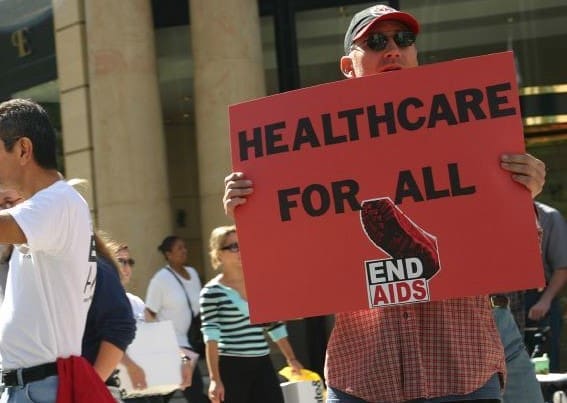
SPRINGFIELD – HB4343, Medicaid Omnibus & Healthy Illinois for All passed out of the Illinois House of Representatives early morning on April 9th, 2022 with a vote of 71-42. This bill calls for the expansion of Medicaid coverage across Illinois, as well as reducing Medicaid churn.
“COVID-19 has lifted the veil on the importance of access to comprehensive health care no matter your race, income, zip code, or immigration status. Each day the most vulnerable in our communities face barriers to health care and we can no longer continue to accept these health care disparities as the status quo. Ensuring that all Illinoisans can access quality, affordable, uninterrupted health care coverage, including Medicaid, is critical especially for most vulnerable Illinoisans.
HB4343 ensures that the communities that need Medicaid coverage the most, including adults 42 yrs. and older regardless of immigration status, will have unencumbered access to the lifesaving health care that keeps them healthy.”
Thank you to House Majority Leader Greg Harris, in addition to State Senators Ann Gillespie and Mike Simmons, for championing this important legislation through the Illinois General Assembly.
Thank you to State Representative Delia Ramirez and State Senator Omar Aquino for championing the expansion of Medicaid for Illinoisans ages 42 and up regardless of immigration status.
To stay updated on the status of this bill, as well as our other 2022 policy priorities, sign up for our Action Alerts!