Legal Council for Health Justice and AIDS Foundation of Chicago (AFC) laud the Illinois Department of Health and Family Services (HFS) announcement today ending the department’s policy of rationing coverage of life-saving drugs to cure hepatitis C (HCV) for Medicaid participants.
As the deadliest infectious disease in the U.S., HCV affects an estimated 3.5 million Americans. Approximately 68,400 of those affected live in Illinois. Prior to the announced policy change, individuals enrolled in Medicaid were required to have severe liver damage before receiving coverage for treatment that would cure them of HCV. Additionally, some Medicaid participants were required to provide proof of sobriety for six months, a further barrier to access.
The expansion of the availability of hepatitis C therapy will have a great impact on the clients that we work with,” said infectious disease doctor Nancy Glick. “Removing the barriers to treatment will not only help the individual infected with HCV, it will have important public health implications for ending the epidemic for us all.”
Because 25 percent of people living with HIV in the U.S. also are infected with HCV, AFC is a strong advocate for the highest quality, most affordable and best access to HCV treatment possible. AFC has partnered with Legal Council during the past several months to help identify and recruit Illinois Medicaid participants for a federal class action lawsuit to challenge Illinois’ unlawful restrictions on coverage for the hepatitis C cure. On Oct. 11, 2018, attorneys from Legal Council, Jenner & Block, LLP, and the Center for Health Law and Policy Innovation at Harvard Law School, sent a formal demand letter to Illinois officials on behalf of those Illinois Medicaid participants, which resulted in the state changing policy for coverage of HCV medications.
“Finally, Illinoisans with hepatitis C will have no longer have to wait until they are near death with major, irreversible liver scarring before being eligible for the HCV cure under Medicaid,” said John Peller, AFC president/CEO. “With this disease affecting an estimated one in every 200 Illinois residents, many of them living with HIV, it was imperative that this policy be changed.”
The new policy makes a recognized hepatitis C cure—Direct Acting Antivirals, or DAAs—accessible for thousands of Illinoisans, many of whom were previously denied treatment until they reached end-stage disease.
“Illinois is taking positive steps to cure HCV, which is huge for the HIV community,” said Tom Yates, Legal Council Executive Director. “It’s just a matter of organizations working together to make change happen.”
Media contact:
Charlie Rice-Minoso, PCI
312-558-1770
[email protected]
On Tuesday, Nov. 6, people around Illinois and across the country went to the voting booth to participate in the most basic right and responsibility in our republic: to duly elect those we shall entrust to represent us at all levels of government. Every two years we as a nation make our voices heard, and in Illinois that voice was a clear and ringing denunciation of the type of politics and governing that has defined our state over the past four years and our nation for the past two.
JB Pritzker, the wealthy businessman and Democratic nominee for governor, handily defeated Republican Gov. Bruce Rauner, who was vying for a second term in office. Governor-Elect Pritzker will begin his four-year term as governor in Springfield this coming January.
The AIDS Foundation of Chicago (AFC) wishes Governor-elect Pritzker and his running mate, Lieutenant-Governor-elect Juliana Stratton, the first-ever African-American women elected to that office, hearty congratulations on their victory. We look forward to working with them and their incoming administration on the issues facing our community, such as ending the HIV epidemic in the state through the Getting to Zero Illinois plan, increasing access to health care, and advancing equitable rights for all Illinoisans.
While we did not always agree with Governor Rauner on issues facing the state and the nation, AFC wishes to express our gratitude to Governor Rauner for his four years of public service and wish him the best of luck in his future endeavors. We are grateful for Governor Rauner’s support of the Getting to Zero Illinois plan, which aims to end the HIV epidemic in the state by 2030.
Also returning to Springfield will be Democratic supermajorities in both the House and Senate chambers of the General Assembly; previously, Democrats were one vote shy of a supermajority in the House, while Senate Democrats held a comfortable margin. Speaker Michael Madigan (D-Chicago) and President John Cullerton (D-Chicago) figure to return as the leaders of their chambers come January. AFC congratulates State Rep.-elect Lamont Robinson (D-Chicago) who will be the first openly-gay African-American man in the Illinois House.
AFC would also like to congratulate Attorney General-elect Kwame Raoul (D-Chicago), Secretary of State Jesse White (D-Chicago), Comptroller Susana Mendoza (D-Chicago), and Treasurer Mike Frerichs (D-Champaign) on their resounding victories. We also offer a very sincere and exciting congratulations to Kevin Morrison, the first openly LBGT person elected to the Cook County Board.
In Congressional elections throughout the country and here in Illinois, the nation has sent to Washington a new Democratic majority in the House of Representatives and retained Republican control in the Senate. Democrats in Illinois have flipped seats in the Illinois 6th with the election of Sean Casten over incumbent Peter Roskam (R), and the Illinois 14th with Lauren Underwood defeating incumbent Randy Hultgren (R).
With the newly divided federal legislature coming to Congress, AFC hopes that a new spirit of bipartisanship can be fostered in Washington so that the many pressing issues facing our nation can be solved, that the spirit of divisiveness can be mended, and that we as a nation can begin to see the humanity in one another so that we can loudly and clearly condemn the politics of conflict that have taken hold of our great nation.
 To co-opt the words of old Kanye, “Donald Trump doesn’t care about transgender people.” This president of the United States has put a target on the backs of our trans-kin, and we cannot be silent about it.
According to the New York Times, the Department of Health and Human Services (HHS) “is considering narrowly defining gender as a biological, immutable condition determined by genitalia at birth.” The article is based on a leaked HHS memo that is clear in its intention to erase the existence of the more than 1.4 million people who identify as transgender in the U.S.
This proposed definition is an abomination and further demonstration of the complete disregard that the Trump administration has for the humanity of transgender people. It also runs counter to the many court decisions upholding the Obama Administration interpretation that “sex” includes gender identity in Title IX of the Civil Rights Act.
Since his inauguration, Trump has been chipping away at the rights of transgender people with his policies, such as the ban on transgender people in the military and attempts to eliminate protections for transgender people in the Affordable Care Act. This administration’s desire to render transgender people invisible is so insidious that it has attempted to remove gender identity from the 2020 US Census questionnaire and the National Survey of Older Americans Act Participants.
Apparently, Trump thinks transgender people in this country can be “disappeared” by simply denying their existence. Not on our watch! Transgender people #WontBeErased.
Pride Action Tank, like many of you, is appalled by this latest step back into the Dark Ages by the Trump administration. We bear witness to the reality of the transgender identity and to the humanness of transgender people throughout this country. We send our love to the local grassroots leaders, groups and organizations that are fighting for trans visibility and justice. We see you, Brave Space Alliance, Trans Liberation Collective, Transformative Justice Law Project, Chicago BTGNC Collective and others. Please support these groups.
On November 6, we have an opportunity to impede Trump’s ongoing attempts the deny the existence of transgender people and other marginalized groups. Let’s show Trump what America really looks like by voting.
Take the Pride Action Tank pledge to commit to vote today: tinyurl.com/PATCommitToVote.
Click here to find out where to vote early and your election day polling location.
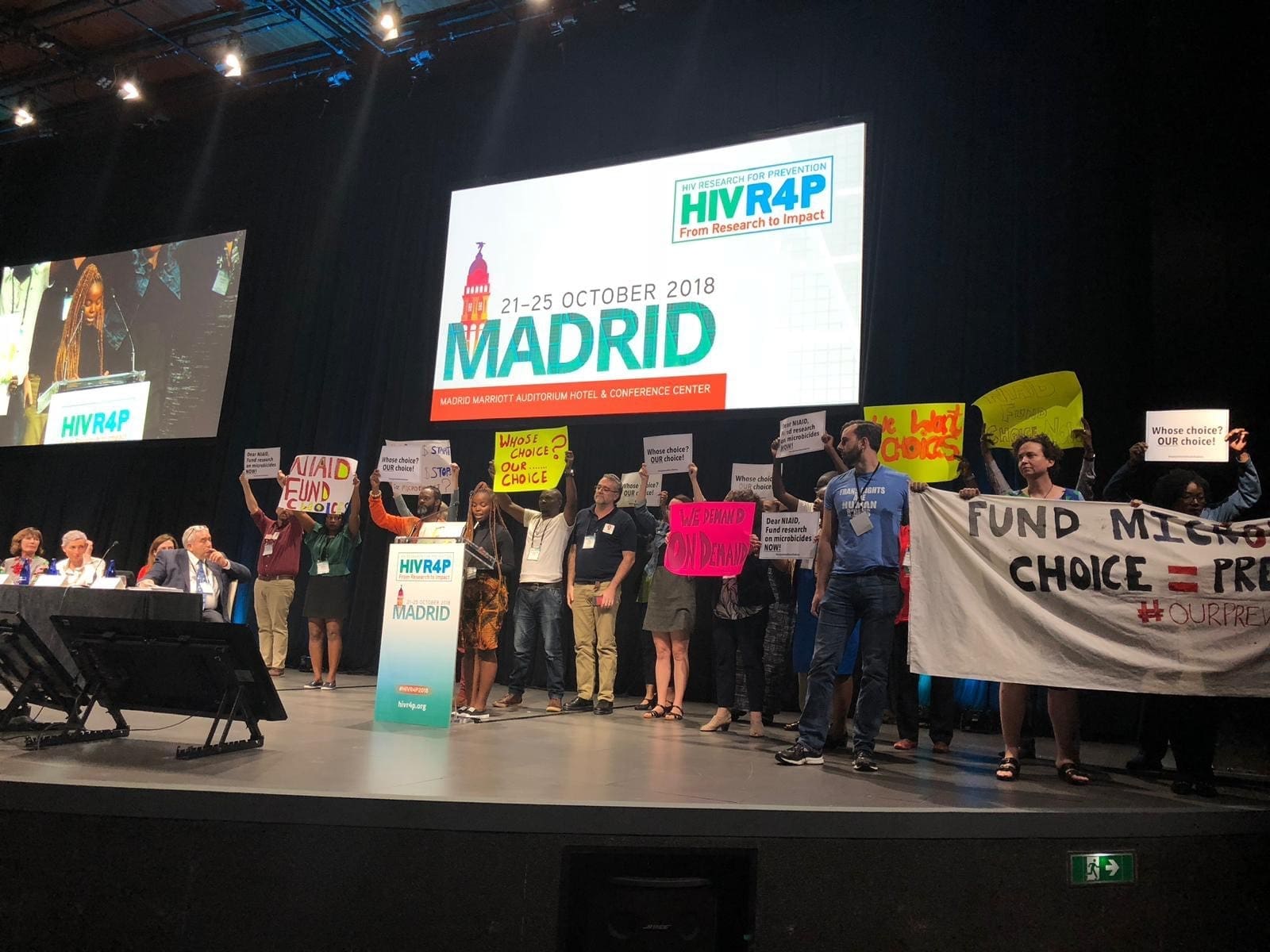
MADRID – A group of advocates and public health professionals challenged the all funders of HIV prevention research in attendance at a global conference on research for HIV prevention (HIVR4P) to explicitly offer support for short-acting, user-controlled methods for HIV prevention via its soon-to-be-funded HIV prevention trial network.
Holding signs that said, “Whose choice, our choice?” And “Dear NIAID, Fund microbicides NOW!”, the group took the stage during the opening ceremony for the meeting, highlighting one of several funders present at the meeting, where there is a strong emphasis on long-acting prevention tools versus daily or monthly tools as solutions.
“We are here because previous calls to ensure that NIAID and USAID continue to support research on microbicides that are short-acting and user-controlled has totally ignored the vast majority of feedback they themselves solicited last year,” said Jim Pickett, Chair, International Rectal Microbicides Advocates, whose group just released the new report Whose Choice is it Anyway?
“NIAID is about to issue its funding opportunity announcement (FOA) that will indicate priorities for the next HIV prevention network. They have a chance to clarify that they respect what women, gay men, and other men who have sex with men, researchers and other stakeholders have been demanding: choices that aren’t all long-acting or systemic. We are here to ensure that research serves the people with products they want, not simply what those in power want to develop.”
In 2016, total global investment in microbicide research and development came to $167m, of which $97m came from the US National Institutes of Health (NIH)—nearly 60 percent of the total. The end of NIH funding for microbicides would devastate much of the promising research on non-systemic HIV prevention options being presented at HIV R4P.
The decision to turn away from microbicides is also self-defeating given the status of dapivirine ring, which is currently under regulatory review, and has demonstrated efficacy among women who use it.
Lilian Benjamin Mwakyosi, a young doctor and advocate from Tanzania, remarked, “We have been preaching that one size does not fit all—in HIV prevention—for quite some time. It is high time that we invest in the options that people desire, which includes microbicides and other non-systemic options.”
Contact: Jim Pickett; [email protected]; +1 773-600-6407
####
Stigma: In and Out is a monthly series profiling the clients, providers and leaders of AFC’s Corrections Case Management program, which helps HIV-positive people emerging from prison or jail get the support they need upon reentry.

Larry Hill is a 50-year-old returning citizen currently residing in Chicago. Hill desires to be an advocate and speak up for those impacted by stigma, whether it is stigma attached to living with HIV or the stigma associated with being a returning citizen after being in prison. Hill was diagnosed as HIV-positive in 2002; he was instantly stigmatized and questioned about being a part of the LGBT community after his diagnosis.
At the age of 36, Larry was sentenced and sent to Hill Correctional Center in Galesburg, IL for 10 years. In prison, he worked as cook, preparing meals for inmates who do not eat meat, eggs or have other dietary restrictions. He also learned different trades while incarcerated like buffing floors and making repairs in the repair shop. These learning opportunities helped him stay productive and keep himself in the right frame of mind and prepare for release.
Upon release in 2011, the stigma of being HIV-positive and formerly incarcerated impacted him, and it became hard for him to manage his HIV. Immediately after release, he was not assigned a case manager to navigate social services or link him to care; he never knew about programs like case management services that could have offered him help. Eventually, Hill was directed to the Corrections Case Management program, administered by the AIDS Foundation of Chicago in partnership with the Austin CBC Initiative, and was assigned a case manager to navigate services for justice-involved people living with HIV.
Hill stated, “The program has uplifted me so much, and basically set me into being a better person in society.”
One element of the program is a specially designed support group, the Returning Citizens Circle. This group helps him stay focused, encourages him to read, and offers computer access, among other things. It’s a safe space led by the population to create a sense of community.
“This group really transitions people the right way and accommodates people really well,” said Hill. He takes the opportunity to go to group sessions and express how he feels very seriously, and he appreciates people asking him how he is doing. “I feel stronger within myself, and my mind is at ease.”
Thanks in part to the Corrections Case Management program, Hill has been able to set a path for himself to move forward in his life. He plans on opening his own business, following in the footsteps of his father, who owned a construction company. He has fully accepted his responsibility and is now an advocate in his community to speak up and tell his story to change the lives of others.
Hill’s hope for the future is also fueled by his love for his family, and his family’s love for him. His sister and his mother consistently fought for his release throughout his sentence. Now, he tackles any job the family needs done. Putting his focus in the right places has helped Hill keep his eye on the prize — and keep him out of conflict. Ultimately, Hill loves to help people. “If there is a way that I see that I can fit in or help, to better a situation for [my family], that’s me! I’m there!”
But Hill feels the struggle of transition. He runs into trouble with finding a job because of his lack of skills. He often feels depressed that he doesn’t have the skills necessary for the jobs that he applies for.
After 13 years of medication and tribulations within the corrections system, Hill is determined not give up. He is striving to keep himself healthy and keep moving. “I push every day, I push hard.”
In the past, Hill has tried to be the “hard” kid and has not always taken advice from the world, but today he knows that you cannot keep making mistakes over and over. “A lot of people do change. We all can change ourselves. And help from others — help that pushes us — changes us.”
The AIDS Foundation of Chicago (AFC) lauds the justice received for the murder of 17-year-old, Laquan McDonald. Nearly four years after the fatal shooting was caught on video, Van Dyke was found guilty on two counts of second-degree murder, sixteen counts of aggravated battery, and not guilty on one count of official misconduct. Van Dyke shot 16 bullets at Laquan McDonald for 14 seconds. He started shooting only 6 seconds after he arrived on the scene, while McDonald was walking away from him.
AFC stands in solidarity with the community’s demand for police accountability and an end to state sanctioned violence on Black lives in this country. Van Dyke’s shooting and killing of Laquan as he walked away was captured on police dashcam video—sparking protests, civil rights investigations, and a conversation on systematic police violence. We are heartened by the murder charges that were brought and secured by Cook County prosecutors against officer Van Dyke for the murder of Laquan McDonald. However, the facts revealed during the trial were not only deeply disturbing but further highlight Chicago’s need for significant reforms to enhance police accountability and officer training to end state sanctioned violence. AFC looks forward to working with our community, policy makers and other key stakeholders to advance this goal.
 The National Female Condom Coalition gratefully welcomes news today that the U.S. Food and Drug Administration moved forward with recommended changes to regulations for the female condom, a sexual health device that protects against STIs including HIV. The FDA’s Sept. 27 release in the Federal Register (Volume 83, Number 188) announces three significant changes to how these devices are regulated by the federal government. This tool is now:
- Renamed as a “single-use internal condom,” a change that de-genders the prevention tool and provides a more inclusive description of who is encouraged to use and benefit from it.
- Transitioned from the regulatory Class III to a Class II, a move that will lessen the burden on manufacturers when seeking FDA approval for existing and newly developing versions of internal condoms.
- Approved for both vaginal and anal intercourse, thus endorsing use of this tool for a wider spectrum of sexual activities.
“We are thrilled to learn about these changes and so grateful for the tireless efforts of sexual health advocates across the globe who worked for years to demand greater access to this prevention method, which truly empowers people to take control of their health on their own terms, ” said Sara Semelka of the AIDS Foundation of Chicago, which serves as the NFCC Secretariat.
“I fought for this because I believe there is power in choice, and I was turned on every time someone said, ‘I didn’t know about [the female condom],’” said Roxanne Lewis, a member of the NFCC since its founding and a key advocate on the west coast. “The FDA made the right decision, and I hope this turns the tide for greater choice in prevention and safer-sex options.”
The female condom debuted in 1993 as a first-of-its-kind device that allowed receptive partners to control the use of a condom and wear it themselves as protection from STIs and unwanted pregnancies. Its successor, the FC2 female condom, was released in 2009. All medical devices not in commercial distribution in 1978 were automatically categorized as a Class III device, and the NFCC is extremely pleased the FDA has evaluated studies conducted over the past two decades and reclassified this device into the same category as male condoms.
This order is effective Oct. 29. For more information, reach out to Sara Semelka at [email protected].
The AIDS Foundation of Chicago (AFC) strongly denounces the Trump administration’s latest attempt to destroy the lives and health of immigrants to the U.S. The administration recently announced an intent to expand the list of criteria that will render someone unable to apply for a green card or change their immigration status. Under the proposed rules, people who do not have a green card but want to change their immigration status in the U.S. cannot use staple programs like Medicaid and SNAP (food stamps).
AFC stands strong with local and national partners; we are ready to fight this appalling proposal. While HIV is not specifically mentioned, the proposed rule explicitly states that any costly medical condition will be negatively weighed in consideration for legal permanent residence, which would likely include HIV treatment. Further, denying or discouraging the use of benefits like housing assistance is inhumane and further increases fear and confusion in immigrant communities. AFC’s fight for health equity for all includes standing alongside immigrants and working toward truly seamless access to health care for all.
TAKE ACTION: Make sure you have the most up-to-date information and stay tuned for opportunities to fight.
- Join Protecting Immigrant Families Illinois at [email protected]
- For more information, go to:
- Watch for opportunities to comment once the rule is officially published.
- Read Protecting Immigrant Families-Illinois Public Charge Fact Sheet:
 By Raven Feagins
McHenry, Illinois, has been Jamie Braxton’s home since she was 8 years old. She loves the familiarity that living in a smaller city brings (McHenry has a population of 26,600). Jamie (pictured at left, in center) grew up in a two-parent household, regularly attended church and describes her upbringing as overall normal. In 1995, when she was 33 years old, she even began planning to grow her family in McHenry when she found out she was pregnant during a routine doctor’s visit. Jamie and her husband were thrilled by the exciting news — until she received an ominous voicemail 3 weeks later.
“I would call home to check voicemail a couple of times a day because, you know, people didn’t have cell phones back then,” said Jamie. “There was a message from my OBGYN’s office … ‘Can you please call the office as soon as possible? The doctor needs to speak with you.'”
A number of things ran through Jamie’s head, but ultimately, she knew something was wrong. She called the office back as soon as she got off from work; the receptionist noted that Jamie’s doctor left for the day, but she said that he would make his way back to meet with her. This only worsened Jamie’s already heightened anxiety, so she called her sister for support. The two met up at the doctor’s office and, upon arrival, Jamie was led into a room filled only with tissue boxes, two bibles and muted paintings on the walls.
“It was a Monday, Oct. 2, about 3:15 in the afternoon. I remember he had on a blue and yellow striped tie. I could cry about it right now thinking about it,” said Jamie as she recounted the moment. “He could not look at me. He kept looking at my chart and he kept swallowing and he kept saying, ‘Your tests were all normal, except for one.’ And I told him, ‘Just tell me … I just want to get it over with.’ He said, ‘What I’m about to tell you is going to change your life forever, and I don’t want to have to be the person to have to do that to you.'”
The doctor diagnosed Jamie with AIDS that day and revealed that her T-cell count was at a shockingly low 76. Although she had been showing symptoms of a weakened immune system for some time, Jamie’s oral thrush and the rash around her mouth were attributed to her use of inhalers for asthma after she was hospitalized a few years back. Jamie believes that because she was a straight, white woman living in a small city, doctors never thought she was “at risk” for HIV. Needless to say, Jamie was distraught.
“I remember I detached from myself. I really did,” said Jamie. “I just started screaming at him, ‘You’re a quack! How long have you been a doctor? Run the tests again!’ … That’s when my sister came into the room, and she said I was wailing like an animal in a trap.”
Jamie started treatment right away, but her options were limited in the mid-nineties. She struggled for months finding the right combination of medications that her body would accept, and after some time she lost all faith and accepted that she was going to die soon. With her AIDS diagnosis and her pregnancy at the forefront of her mind, Jamie eventually had to make the most difficult decision of her life.
“They gave me 3 to 5 years to live when I got diagnosed. I made them tell me how long because I needed to know what to do about this baby. I ended up having an abortion,” said Jamie. “I am avidly pro-choice, but I never thought an abortion was something I would do for myself. That was the hardest part.”
Those first few years after being diagnosed were extremely trying for Jamie. However, her method of healing was to continue living her life and not let her AIDS diagnosis get in the way of (what she thought) were her final years. She continued to work, take care of her home and maintained healthy relationships with family and friends. Eventually, one of Jamie’s friends recommended she seek services at Northwestern University, where they knew lots of other people diagnosed with HIV and AIDS went to receive treatment. Although the trek from McHenry to the Chicago campus was over 3 hours round-trip, Jamie was committed. She attributed the services she received there to saving her life. Later, she was referred to Open Door Health Center’s clinic in Elgin — a much shorter commute to and from her home. At Open Door, Jamie received wraparound case management services for years. She was connected to all the resources she needed, including the help she received last summer from the AIDS Foundation of Chicago (AFC).
Jamie had been experiencing poor balance, fainting spells and ringing in her ear which eventually led her to see a specialist that recommended she get an MRI and a CT scan for her brain to check for a tumor. It turned out that she had a Chiari malformation — a condition in which her brain tissue extends into her spinal canal — that was connected to her history of HIV-related toxoplasmosis, a parasitic brain infection.
“I just didn’t make enough money for the things that the insurance didn’t cover. So Juan Mercado at Open Door said that AFC still had a program where they would give assistance with HIV-related medical bills,” said Jamie.
She worked with Aziza “Zee” Nassar, who was a certification specialist at AFC, and received assistance from the Ryan White Program to pay off thousands of dollars in medical bills. Although Jamie works as a medical assistant for an orthopedic surgeon and is self-supporting, her history of medical conditions both linked and unlinked to her HIV and AIDS treatment can make her medical bills expensive and any assistance she can get with paying those off is a relief.
“I am so grateful to places like AFC. This HIV-related treatment I had to have last summer involved some big, expensive tests. Without help from you guys, those are things I might have let fall by the wayside,” said Jamie. “Even though I’m a hyper-compliant patient, there comes a point where you just don’t have the money to pay for additional treatments. I would’ve been paying off that $4,000 for the next 10 years.”
Jamie is optimistic about what the future holds and gets through each day with support from friends and family. She has also become extremely vocal about her HIV status over the years, and regularly shares her story with others in hopes of spreading awareness and combating stigma.
 On Friday, Sept. 21, 2018, the Office of the Mayor in the City of Chicago issued a proclamation in recognition of the International Day of Bisexual Visibility. This important holiday was created by three bisexual activists in 1999 to celebrate bisexual people in the face of invisibility and stigma.
“There is definitely a need for the holiday,” said longtime bisexual community activist and Northwestern University LGBTQIA health researcher Dr. Lauren Beach. “Bisexual people face stigma and invisibility, not only within society at large, but also within LGBTQIA communities. Bisexual Visibility Day was created by and for bisexual people as a way to affirm and empower ourselves and our communities.”
The Chicago Bisexual Health Task Force (CBHTF) sponsored the proclamation’s development; the CBHTF is a new group of community members, health care professionals and researchers dedicated to improving the lives of bisexual individuals in the Chicagoland area. The task force originated after a November 2017 conference titled “We See You – Countering the Invisibility of Bisexual Health,” hosted by the AIDS Foundation of Chicago (AFC). AFC is providing some resources and funding for various CBHTF events and activities, including a planned community forum this November.
Several AFC staff have played an active role in CBHTF, including Vice President of Prevention and Community Partnerships Cynthia Tucker, who helped move the proclamation to Mayor Rahm Emanuel through the Chicago Department of Public Health’s Office of LGBT Health. The proclamation highlights the striking health disparities that bisexual people face compared to people of other sexual orientations.
Dr. Brian Feinstein, a research assistant professor at the Northwestern Institute for Sexual and Gender Minority Health and Wellbeing, noted, “The health disparities affecting the bisexual community have been consistently demonstrated across numerous research studies. These studies have found that bisexual individuals are at increased risk for negative health outcomes such as depression, anxiety and suicidality compared to heterosexual individuals as well as gay and lesbian individuals, and that these disparities are linked to the prejudice and discrimination that bisexual individuals experience.”
Importantly, the proclamation not only highlights these disparities, but also the tremendous resilience of bisexual communities to thrive despite them. A growing number of community organizations created by and for bisexual, pansexual, fluid and queer individuals (often called bi+ communities) are creating supportive spaces around the city to strengthen that resilience.
The Bisexual Queer Alliance Chicago (BQAC), an independent 501(c)(3) organization whose mission is to educate, empower and provide resources for bisexual and queer persons, provides one of those spaces. Erie Sara, President of BQAC, discussed the importance of strong bisexual community building with CBHTF: “One fact that goes unrecognized is that bi+ people make up the majority of the LGBTQIA community. We are everywhere, but we are forced into the closet due to social stigma and biphobia. The importance of community for us cannot be understated. Since our identity and existence are so constantly erased, standing together for visibility is of vital importance.”
Adrienne McCue, President and Executive Director of the Chicago-based nonprofit Step Up for Mental Health, is working to create inclusive mental health resources for bisexual+ communities in Chicago. “Step Up for Mental Health houses BSN Bi+, which is a special advocacy project dedicated to improving the mental health of bi+ individuals,” says McCue. “We created this project because we believe that the mental health data shows now more than ever, we need to focus on mental health in the bisexual community as a whole. We especially need to improve access to mental health services among bi+ people who are impacted by multiple forms of marginalization. To improve community bisexual+ mental health, we must have a dedicated focus on serving bisexual people of color, transgender and gender nonconforming people, and our youth and elders.”
Bisexual activists from around the country agree. Khafre Kujichagulia Abif, an Atlanta-based author, HIV community organizer and bisexual health advocate who has been supportive of the work of the CBHTF since its inception, called the proclamation “historic, unprecedented and long overdue.” Abif noted the proclamation has far-reaching implications for improving the health and wellbeing of bi+ people: “We always talk about how identity affirmation is important for improving health outcomes of bisexual communities. This proclamation is an example of that affirmation. Bisexual people are here, and we deserve to be recognized.”
Get Involved with the Chicago Bisexual Health Task Force
You can learn more about the Chicago Bisexual Health Task Force by visiting the organization on Facebook, https://www.facebook.com/groups/ChiBiHealthTF/ or by following CBHTF on twitter @ChiBiHealthTF. The full text of the proclamation is posted within the organization’s Facebook page. Electronic .pdf copies of the proclamation are available upon request by emailing CBHTF at [email protected].
To get involved with the work of the CBHTF, you can attend the organization’s Chicago Bisexual Community Forum, which will be held November 12, 2018 from 2:00-5:00 PM at the University Center, located at 525 S. State Street, Chicago, IL 60605. To RSVP for the Chicago Bisexual Community Forum, please visit the following website: https://goo.gl/forms/d1MYB5SDxFKoPeni1
The mission of the Chicago Bisexual Health Task Force is to improve the lives of bisexual+ individuals in the Chicagoland area by mobilizing communities, engaging in research, advocacy, and education, and supporting the development and implementation of policies and programs.
The Vision of the Chicago Bisexual Health Task Force is a thriving diverse bisexual+ community in the Chicagoland area that is visible, vibrant, and healthy.