 SPRINGFIELD, June 1, 2018 – Each year, May 31 marks the end of the Spring Legislative Session in Illinois. The Illinois General Assembly adjourned on Thursday, after a productive and effective Spring Session, a stark contrast to the past years.
The House and Senate passed a bi-partisan budget that received near unanimous support across the aisle and across chambers. There are high expectations for the Governor to sign it into law. The Governor’s proposed cuts to Medicaid and Human Services were overturned. Most importantly, this budget fully funds at Fiscal Year 2018 levels HIV prevention and education services, minority HIV services, Medicaid, and supportive housing.
The “Budgeteers,” a bi-partisan, bi-cameral group of legislators had been meeting frequently and diligently to hammer out this budget deal throughout the Spring Session. The final budget agreement is crafted on $38.5 billion in revenue, roughly $600 million more revenue than the Governor’s introduced Fiscal Year 19 budget at $37.9 billion.
The final budget contains level appropriations for the HIV lump sum at $25.4 million, minority HIV services at $1.2 million, and supportive housing at $13.4 million.
These budget lines support primary care and HIV prevention, education, housing and treatment services throughout the entire state.
“Cuts to these lines would likely lead to fewer HIV tests, fewer HIV diagnoses and increased numbers of new HIV cases – and ultimately, higher costs to the state’s taxpayers from HIV cases that could have been prevented. By continuing to fully fund these lines, the legislature has made clear their support for full funding for HIV and other related services,” says Dan Frey, Director of Government Relations for the AIDS Foundation of Chicago (AFC).
“We, at AFC, thank our champions in the legislature whose hard work at the bargaining table made this budget possible,” says John Peller, President and CEO of AFC. “We will continue to monitor the budget implementation process and encourage the Governor to spend the full amount appropriated by the General Assembly.”
AFC also thanks the hundreds of HIV advocates from across Illinois who have contacted their legislators to urge them to oppose funding cuts for HIV and other vital services. Nearly 130 advocates traveled Springfield during the session to meet with legislators and the Governor.
Stay tuned for a summary of major legislation passed by the legislature during the 2018 session related to HIV and health care access.
By Raven Feagins
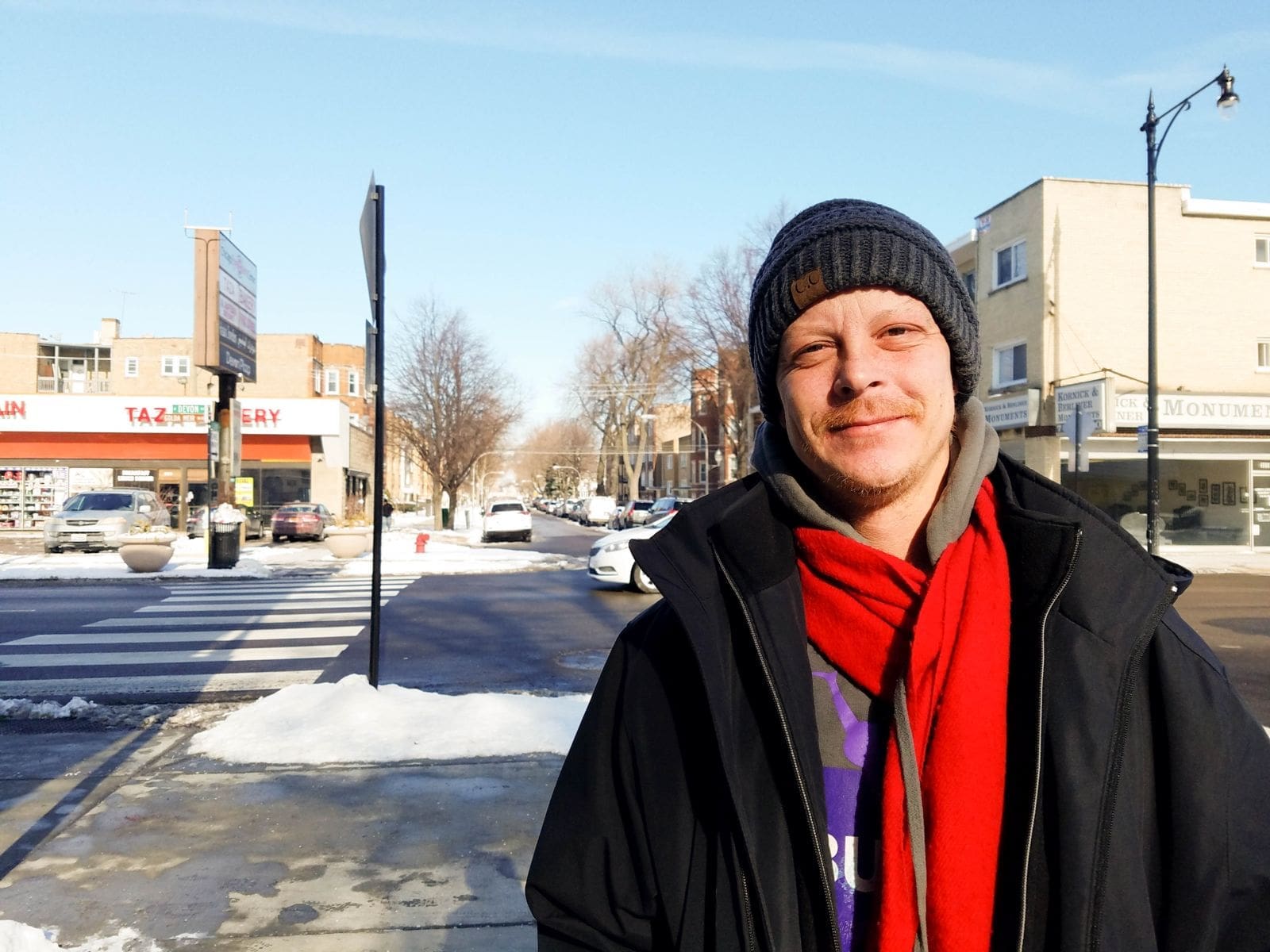 When Rex Gaimari was homeless, he was constantly concerned about his safety. He was in and out of shelters for about 3 years, which was the direct result of losing the home he shared with his mom. Rex had been her caretaker for years, but when she passed away he needed to find a new place to live. He tried several times to move in with extended family, but nothing ever stuck. He found solace at a local shelter in Chicago’s Uptown neighborhood, which also gave him access to numerous social services in the area. However, it took some time for Rex to come to terms with this new way of life.
“The shelters are not a good place to be. Period,” says Rex. “You have to keep an eye on your things and, if you fall asleep, you can wake up with all of your stuff missing, so it’s pretty hard.”
Thankfully, Rex’s openness and care for others allowed him to form bonds with the people he frequently encountered at shelters and on the street. After some time, he became part of a community of people experiencing homelessness who all looked out for one another. Rex and his friends would often hang out near a Mariano’s grocery store and keep warm in their café, and it was a good spot to ask other neighborhood residents for temporary assistance, such as spare change or food to eat. However, one day, someone offered them something completely unexpected.
“One of the kind people out there asked, ‘Hey, do you need a tent?'” says Rex. “And that’s what started it all. There was one person who came by that day who gave everyone a tent.”
This sparked the development of the Lawrence Avenue Tent City community under the Lake Shore Drive viaduct. While living outside means dealing with the harsh Chicago weather conditions and the constant car and foot traffic of people passing by, Tent City residents felt like they had slightly more freedom, independence and even more safety in their unconventional homes than they did in the shelters. This residency allowed them to have more control over who was living around them, have a dedicated place to store their belongings and keep an eye out for one another.
“Of course there were problems, but … there was no thievery. People had their own issues, but it was contained,” says Rex. “It was more of a community over there … We were a family.”
Starting out with only 12 people, the Lawrence Avenue Tent City grew into a community of approximately 40 residents. Soon after, more people began setting up tents under different viaducts in the neighborhood.
While living in Tent City, Rex frequented the nearby Heartland Alliance Health Center, which serves the health care needs of people experiencing homelessness. Having close access to this clinic allowed him to continue managing his chronic health conditions, such as Attention Deficit Disorder, get connected to a counselor at Thresholds and address other health concerns that came up while living outdoors. Rex was unaware that the clinic was working on a partnership to help Tent City residents gain the dignity of a home.
Thresholds partnered with the city of Chicago and the Center for Housing and Health for a program called Better Health through Housing (BHH), which was developed to identify individuals who are living with a chronic health condition and have experienced homelessness for an extended period. Rex was enrolled in a project for people who were living under the viaducts and would regularly use the Heartland Alliance Health Center. The goal of this project was to link individuals to immediate housing to improve their health outcomes.
When the time came for BHH outreach workers to connect with Tent City residents identified as potential candidates for program, Rex was wary. He had heard from other residents that people from social service agencies had come to survey them and never followed up with help, and rumors emerged that made many skeptical of people offering housing solutions. However, the one group Rex agreed to talk to were with BHH; they were connected to Thresholds, whom he trusted.
“They’re the nice people … they’re sincere. They took down our information to get us on the list for housing. They weren’t playing a scam,” says Rex.
One day, unexpectedly, Rex’s case worker from Thresholds stopped by Tent City to bring him to meet with Jamin, his new housing case manager from H.O.W. Jamin consulted with Rex and soon after he moved in to a temporary apartment known as bridge housing. Rex stayed there until finding a permanent apartment and in January 2017, he signed the lease to his first apartment in Rogers Park.
Through a subsidy from HUD, support from H.O.W. and Rex’s own income, he is able to afford for his new place. To this day, Rex still meets with Jamin on a regular basis and says that having his own apartment has given him the freedom to manage his own life. Simply having the ability to lock his front door to leave his house knowing his belongings are safe while he takes a walk has helped him tremendously.
“I love my little safe haven. It’s just a place to be quiet,” says Rex. “I have all kinds of nice people in my neighborhood, so it’s actually good therapy to be able to walk around and say ’Have a blessed day!’ That’s what I do constantly.”
In January 2018, Rex re-signed the lease to his apartment and marked his anniversary of officially no longer being homeless. He will soon be starting a job training program with Inspiration Corporation and further pursue his love of cooking. While he still faces challenges in his personal life, Rex is happy to have a warm bed to sleep in at night, access to healthy food and a caring housing case manager who works with him to help meet his goals.
Do you use a copay card to help pay for name-brand HIV drugs for treatment or PrEP? If you do, watch out: your insurance company might have a new policy that doesn’t let your copay card (a.k.a. your copay assistance card) help you afford your medications.
We’re talking about “copay accumulators” — policies some insurance companies are using that could make your health care more expensive, perhaps unaffordable. Read on for an overview of the problem and some steps you can take to make your medications affordable.
We are very concerned about the impact that these new insurance company policies will have on people’s health. We’ll do everything we can to fight them – but need your help. Are you having trouble getting medications because of insurance company policies? Tell us what’s going on by emailing [email protected]. We also recognized that insurance companies have put these policies in place because brand-name drugs are just too expensive. We’re committed to fighting for more affordable prices for life-saving medications.
What are copay accumulator programs?
Copay accumulators are relatively new policies that some insurance companies are using to stop counting drug company copay cards toward a person’s deductible or out-of-pocket maximum. Note: These policies apply to drug manufacturer co-pay cards only, and not charitable assistance programs like the Patient Advocate Foundation, AIDS Drug Assistance Programs, or state-run programs that help pay for PrEP.
Which insurers are using copay accumulators?
BlueCross BlueShield, Cigna, United Healthcare and pharmacy benefit managers CVS Caremark and Express Scripts have implemented these policies in Illinois and nationally for some plans. Warning: this list could grow.
Which medications are affected?
This new policy can apply to any brand-name drug with a copay program for any health condition, not just HIV for treatment or PrEP.
What does this mean for people in this situation?
Here’s where it gets complicated: Before copay accumulators policies were in place, the value of your copay card could be counted toward your deductible and out-of-pocket maximums. These cards could potentially save you a lot of money and make access to the health care you need easier and less stressful.
But if your insurance company has a copay accumulator policy and you are using a copay card to help pay for your medicine, when you reach your limit on the copay card, the total value on the card will not count toward your deductible or annual out-of-pocket maximum. If this policy is in place with your insurance company, you will need to pay your full deductible out of your own pocket before your insurance actually kicks in. This could mean that you’d be responsible for thousands of dollars to cover the cost of your health care and prescriptions.
Let’s walk through an example.
You start your new health plan year in January and you take a name-brand (non-generic) medication that costs $1,500 a month. Your plan has a $6,000 deductible (the amount you pay before the insurance plan starts paying for some care), and the deal is, you pay the full cost of all care (including drugs) before you meet your deductible. After you meet your deductible, your insurance company kicks in and starts paying for stuff.
The name-brand medication you take has a copay card, and that card is worth $6,000 per year. You use that copay card in January, February, March and April at the pharmacy to pay for your drug. By the time May arrives, your copay card has run out ($1,500 X 4 months=$6,000).
- The old way (no accumulator): Previously, the insurance company would have counted what the copay card paid towards your deductible. In this scenario, your deductible would be fully met by using the card. So, depending on the details of your insurance, you might not have to pay anything after meeting your deductible, or you might have to come up with a small fee for your medication, or a small fee for other things like office visits.
- The new way (with an accumulator): With a copay accumulator policy in place, the insurance company doesn’t count the amount of the copay card towards your deductible. When you go to fill your prescription in May, you will owe the full $1,500 cost of the drug, because your $6,000 deductible has not been paid down. You’ll need to keep paying the full cost of those drugs yourself, out of your pocket, until you pay a total of $6,000 (four more months of drugs) and meet your plan’s deductible.
Will you be ready for an unexpected out-of-pocket cost?
We are very concerned that people may not know their insurance companies have changed their policy and may not be prepared to pay the full cost of their deductibles. While you might have received a letter from your insurer talking about copay accumulators, it may not have been completely clear what this new policy would mean for you.
So what can you do?
- Consult your health plan materials or call your insurer to ask questions. If you have been affected by this type of policy and have had to switch to another drug or have been unable to fill your prescription, tell your insurer. Ask your insurer to waive the policy (it never hurts to ask).
- Apply for help. The Patient Advocate Foundation (www.copays.org), Patient Access Network Foundation (www.panfoundation.org) or similar organizations can help you get your HIV medications for treatment or prevention. If you’re taking PrEP, you can also get help from PrEP4Illinois (www.prep4illinois.com), a state program that provides free PrEP medications.
- Tell us! We want to know about your experience so we can be better informed when we are advocating for you. Contact us at [email protected].
- Tell your employer, too. If you are employed and receive health insurance through your job, tell your employer. They may have adopted this program thinking of it as a cost-savings strategy without truly understanding the negative impact it could have on their employees.
Some helpful definitions:
The term accumulator refers to the running total of a person’s costs that apply toward their deductible and out-of-pocket maximum.
A deductible is the amount a person pays for health care services before insurance kicks in. For example, an individual with a $2,000 deductible would pay for their first $2,000 of care (including things like medications, office visits, lab tests) before health insurance begins to cover costs.
A copayment is a fixed amount a patient pays for a covered health service after they’ve paid their deductible. For example, you might pay a $20 copayment when you pick up medications at the pharmacy. Some insurance plans have copayments; some do not.
An out-of-pocket maximum is the most amount of money a person has to pay for covered services in a plan year. After this amount is spent on out-of-pocket costs (deductibles, copayments and coinsurance), a health plans pays 100% of the cost of covered benefits.
A high-deductible health plan is a plan with a higher deductible than a traditional insurance plan. The monthly premium is usually lower, but people pay more health care costs out of their own pocket before the insurance company starts to pay.
A pharmacy benefit manager is a third-party administrator of prescription drug programs contracted by health plans, employers and government entities to manage prescription drug programs.
A copay card can be provided by a pharmaceutical company (a.k.a. a manufacturer like Gilead) or a charity. These cards help patients afford the cost of their prescriptions. The amount of the patient’s copayment may be reduced or covered completely if they use a copay card.
Thanks to Cancer Support Community and The Arthritis Foundation for providing a version of this information. https://www.cancersupportcommunity.org/blog/2018/04/copay-accumulator-programs-whats-stake-patients
By Kirstin Brockenborough
 Coleman Goode is our new Community Organizer! You may have most recently seen him around Springfield serving as Chief of Staff for long-time HIV advocate State Representative Greg Harris. We’re getting into who Coleman is and how he’s tackling health inequalities.
You can get to know Coleman and his plans for turning up our advocacy work by joining us at Advocacy Day on May 23. Click here to register.
Q: Who are you, Coleman?
A: Hello! Well, I am an HIV-positive gay Black man. I am 37 years old. I am a southern boy living in Chicago. I’ve been in the city since 2004.
Q: How do you bring yourself to the work that we do at AFC?
A: I feel like I’ve always had a passion for people. I like people, I like working with people, and seeing how we all think collectively.
I’m in recovery. I’ve been in recovery since 2006. I’ve been homeless. I’ve been through a lot, and I feel like that’s made me a stronger person. It’s made me an individual that cares about people, and I’m able to understand more where folks are coming from, especially as a youth experiencing homelessness. I was homeless at 25. Experiencing that shaped the way I view and advocate for homeless youth.
I’m a pretty strong person; I’m a family person. Some friends say that I’m resilient, determined … I’m just passionate about what I do. I like leading people to reach to a goal. I want to inspire us to be better, like my mom did for me. My mother was an inspiration for me to be strong, take care of my family and remember my community.
Q: How do you define the role of a community organizer?
A: I define a community organizer as someone who understands that social and political change can come from disruption. It’s my job to not only bring communities together, but to also form coalitions influencing policies favorably playing out in real world.
Q: What do you look forward to in your new position as community organizer?
A: Well, my last job was mainly behind a desk working in policy. It was mainly just learning about Illinois laws, discussing them and reading them. Now, I feel like I get to be on the other side!
I’m excited to work with our advocates because they all come with their own story, passion, and areas of expertise. I’m excited for the opportunity to walk into lawmakers’ offices 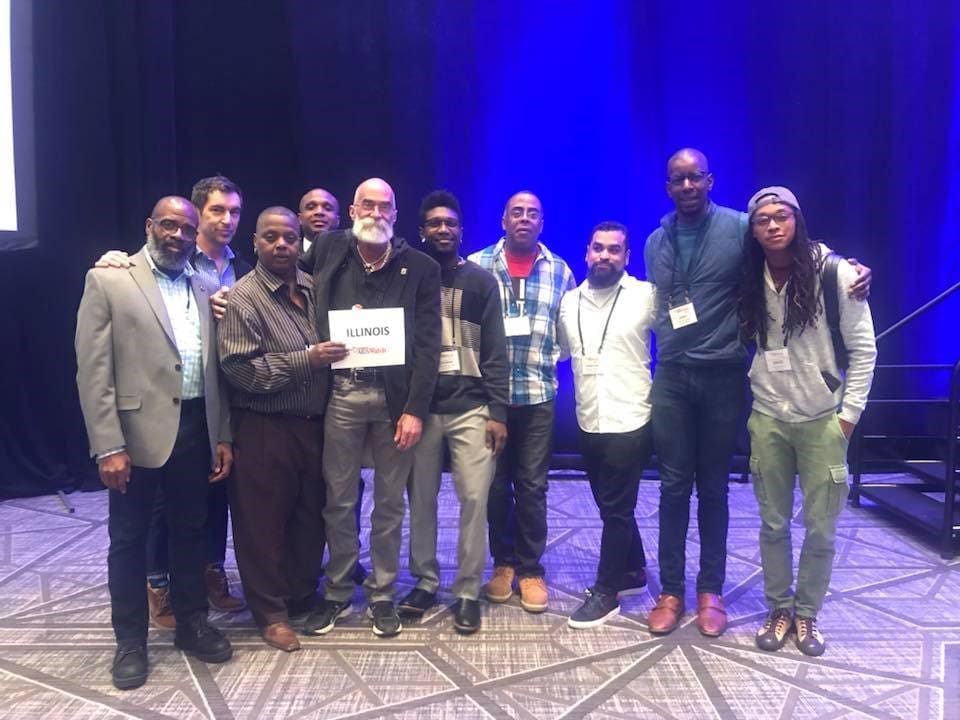 and demand that they support youth, housing and health equity.
I want to affirm that people’s voices matter. You have to speak up or you will be crushed by voices in the forefront — voices that can be very wrong, claiming to speak for our incredibly nuanced experiences.
Q: What is a fun fact about yourself?
A: I am classically trained in the tuba and flute. I also really like to knit. It calms me down, it cools my thoughts. It reminds me of family … and it’s just grounding.
Get pumped to take action with Coleman in Springfield! Advocacy Day is happening May 23. Seats on the bus are going quickly, click here to register. To contact Coleman Goode, please email [email protected].
by Raven Feagins
Having a stable place to live can determine our health, including our vulnerability to HIV. This is especially true for young people who already account for 22% of new HIV diagnoses in the US. In Chicago, an estimated 15,000 youth experience homelessness each year and of those young people, about 3,000 identify as LGBTQ.
Some of the top needs of LGBTQ youth experiencing homelessness, aside from housing, are employment, access to health care services and acceptance and emotional support. Youth Empowerment Performance Project (YEPP) exists to fill in a few of those service and care gaps by supporting young LGBTQ people’s survival in the face of these challenges.
All of YEPP’s programs center around LGBTQ youth, especially those who are or have experienced homelessness. YEPP is best known for the creation of live, theatrical performances based on the experiences of ensemble members. Over the course of a year, ensemble members take part in workshops that help create the theme and dialogue and ultimately perfect the performance for each of their shows.

“I work with a group for about a year where 7 or 8 young people come together once or twice a week,” says co-founder and executive director Bonsai Bermúdez. “We go through a series of exercises that are very intertwined with artistic disciplines like writing, music, acting, theater. We want them to continue to inform trauma and continue healing.”
Prior to YEPP, Bonsai worked at Broadway Youth Center (BYC) as a Resource Advocate and later as the Drop-in Program and Resource Advocacy Manager. There, Bonsai provided referrals for young LGBTQ people seeking access to services like housing, health care and employment. Bonsai also managed the space where young people could come in, hang out and be themselves. The young people who walked through those doors every day inspired Bonsai, but they noticed there was something missing — a space for emotional healing.
Drawing on their background in counseling and the performing arts, Bonsai developed a series of workshops called Proposal for Life in 2010. BYC participants were encouraged to draw on their personal experiences through a variety of artistic mediums to connect more deeply with themselves and each other. This series was beloved by everyone who took part and eventually led to the creation of YEPP in 2011.
“My favorite part of working with YEPP was the constant dedication to healing and relationship building,” says Femmke Shades, YEPP’s former Artistic Assistant. “Every rehearsal, regardless of what we had planned, the healing process always came first, which created an incredibly strong bond between the entire group. If someone was going through it, the priority was to talk to and support them. Everyone was dedicated to loving and supporting one another with the intention to heal and empower.”
In the process of providing LGBTQ youth with the space to heal, connect and express themselves, the performances also allowed outside communities to hear and see these young people as they want to be seen. Bonsai points out, “Being on stage is a safe space. It is a way to own our bodies and own our minds.” YEPP’s performances allow an inside look into the lives of the performers and opens up a dialogue about the varied experiences of LGBTQ youth in the United States, which are experiences not often expressed in media.
“It is important to have spaces like YEPP because the world is an extremely violent, toxic, fast-paced and oppressive place,” says Femmke. “YEPP is a breath of fresh air in which LGBTQIA youth, especially those of color, can be themselves. They are given the space, time and opportunity to experiment, learn, struggle, make mistakes, heal and flourish.”
YEPP continues to stay true to its grassroots framework by supporting young LGBTQ people through not only amplifying their voices and experiences, but also through resource assistance and ultimately providing a physical space where they freely can be themselves.
 By Andrea Callow, Associate Director of Medicaid Initiatives at Families USA
HHS has issued its first two approvals for state Medicaid waivers that make a person’s health coverage contingent on their work status. Kentucky and Indiana are the first states to get approval for waivers that tie coverage to work. Other states that are seeking approval for similar waivers include New Hampshire, Arkansas, Maine, Wisconsin, Utah, Kansas, and Arizona. Visit our 1115 Waiver Resource Center for details.
States can make these changes to their Medicaid program under Section 1115 of the Social Security Act. Section 1115 gives states the ability to modify their programs to pursue demonstrations that promote the objectives of the Medicaid program: that is, to better deliver care to low-income, eligible people. A number of states currently have, or have applied for, Section 1115 waivers to cover their adult Medicaid population.
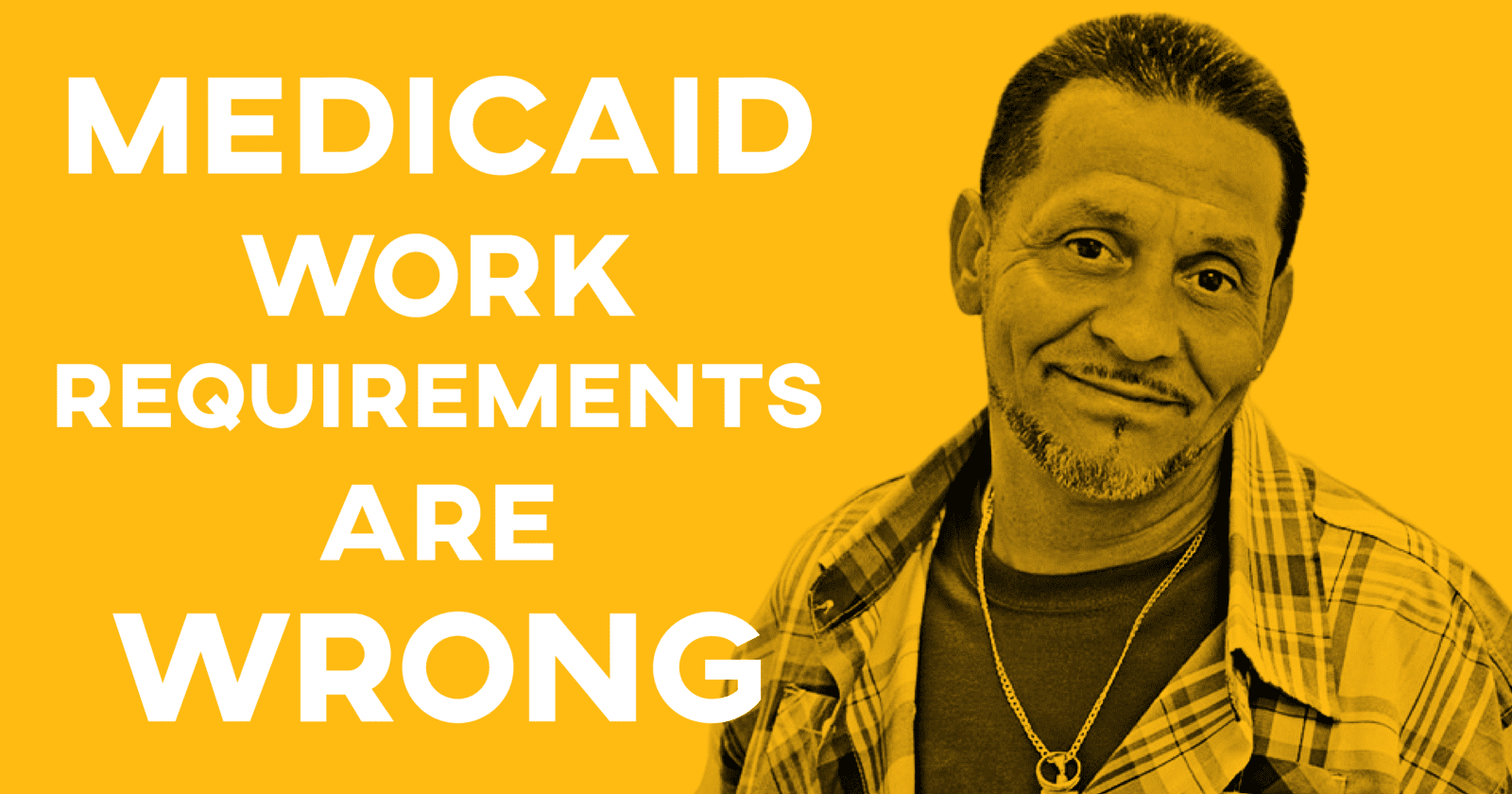
Work requirements don’t help better deliver care to Medicaid enrollees, and are impermissible under Medicaid law. As a matter of policy, work requirements won’t help unemployed low-income people find and keep jobs. Here are six good reasons to keep work requirements out of Medicaid.
A requirement that someone work or engage in unpaid community service in order to qualify for Medicaid is illegal, unnecessary, and bad policy.
1. Work requirements are illegal
As states propose and are likely granted work requirements in their Medicaid programs, legal action will become increasingly important in getting these policies rolled back, and it is important for advocates to be familiar with legal arguments against them. Some foundational legal arguments include:
The Secretary may waive certain parts of the Medicaid Act under 1115 but not create new ones. The Secretary cannot create entirely new Medicaid eligibility criteria under Section 1115- namely that people be working in order to receive benefits.
Work requirements do not promote the objectives of the Medicaid statute. 1115 waivers must promote the objectives of the Title XIX (the Medicaid title) of the Social Security Act. The core objective of Title XIX is assisting low-income people to get medical services. A work requirement would lead to low-income people losing their health coverage, an outcome totally at odds with the purposes of the Act.
Work requirements implicate the civil rights protections contained in the Americans with Disabilities Act (ADA) and section 504 of the Rehabilitation Act, laws which make it illegal for states to take actions that have a discriminatory impact on people with disabilities. Section 1115 does not authorize the Secretary of HHS to waive these laws.
The word “independence” in the Medicaid statute does not refer to “independence” from public programs through work. Some waiver proposals have used this word’s use in Section 1901 of the Social Security Act to suggest the Medicaid statute contemplates work requirements as an acceptable element of the Medicaid program. The statutory context makes clear that independence refers to improved physical functioning through medical rehabilitation.
2. Work requirements aren’t necessary
Nearly eight in ten non-disabled, non-elderly adults live in families where at least one member works, and sixty percent work themselves. In some states, closer to three-quarters of Medicaid enrollees are working themselves. Of those who are not working, more than one-third reported illness or disability as the primary reason for not working. Another thirty percent cited caretaking obligations as an impediment to work.
3. Work requirements would increase the ranks of the uninsured and hurt Medicaid enrollees’ ability to work, rather than promote work
Giving people Medicaid coverage helps them get and keep good jobs. Locking them out could make it harder for unemployed people to find work. In surveying beneficiaries of the Medicaid expansion, Ohio reported that three-quarters of beneficiaries who were looking for work said Medicaid made it easier for them to do so. For those who were currently working, more than half said that Medicaid made it easier to keep their jobs.
4. A community service requirement, is just as bad, if not worse, than a work requirement
Some states have suggested that Medicaid eligible individuals could keep their coverage if they worked or engaged in some hours of community service or volunteer work. Other states have structured this as an exemption from a work requirement for volunteer work. They are the same thing. A Medicaid community service requirement forces low-income people to work for a non-monetary benefit. In economically challenged areas where unemployment is high and jobs are scarce, forcing people to work for free could disrupt fragile labor markets. It likewise may run afoul of labor laws like the Fair Labor Standards Act.
Medicaid gives families a hand up. It helps people working stay at work, and those looking for jobs find them. A punitive work requirement will make it harder for low income people to get ahead.
5. A work requirement won’t move people out of poverty
Some states requesting work requirements have claimed that such a provision will move Medicaid enrollees out of poverty and into employer sponsored coverage and “self-sufficiency.” This claim doesn’t withstand scrutiny. A study of the work requirement in the Temporary Assistance for Needy Families (TANF) program found that work requirements had little or no effect in increasing work or cutting poverty. In fact, the vast majority of people subject to the work requirement remained poor and some became poorer.
6. There are better ways to promote work among Medicaid enrollees
To truly help increase employment rates among people with Medicaid, voluntary employment supports programs are the evidence-based way to go. These programs are not punitive, and do not fly in the face of the legal requirements of the Medicaid Act and Section 1115 of the Social Security Act
This post was originally published on Wednesday, Feb. 7, 2018 for Families USA.
The AIDS Foundation of Chicago (AFC) applauds Governor Bruce Rauner’s proposed $25 million HIV funding allocation in the Fiscal Year 2019 (FY19) Illinois state budget.
“We thank Gov. Rauner for his leadership in not cutting HIV funding,” said John Peller, AFC president/CEO. “Earlier this month, AFC expressed disappointment with Gov. Rauner and the Illinois Department of Public Health’s (IDPH) decision to not spend $10 million of the $25 million HIV funding line. Today we are heartened to see Gov. Rauner and DPH heed our concerns and recommend adequate funding of $25 million in the governor’s proposed budget to combat the HIV epidemic.”
However, AFC has grave concerns about potential cuts for Medicaid, which will be reduced by $150 million, and the supportive housing budget, which Gov. Rauner plans to reduce to $12.7 million from $13.4 million. AFC reminds the Rauner administration that these state funds work in unison to provide an effective safety net for Illinois’ most vulnerable populations.
“With such massive cuts to Medicaid and other programs,” Peller continued, “Many individuals living with HIV, as well as other vulnerable communities in Illinois, will be left without adequate access to lifesaving services.”
The governor has proposed the following amounts be allocated toward HIV, Medicaid and supportive housing in the budget for FY19:
- HIV: The budget includes $25,415,000 for the HIV Lump Sum, the state’s flagship HIV funding stream, which supports HIV prevention, health care and supportive services.
- Medicaid: Gov. Rauner recommended 4 percent rate cuts from combined state and federal funding — a $150 million reduction.
- Housing: The governor proposed an over 5 percent cut to supportive housing services — a $700,000 reduction.
These additional cuts to Medicaid, supportive housing and other safety net programs could have a devastating effect on the estimated 45,000 people living with HIV in Illinois, in addition to other vulnerable populations. This situation could be magnified if President Trump passes his proposed federal budget, which plans to slash funding for social service programs across the board. It’s more important now than ever to fund critical programs at the state level to protect Illinoisans.
“In the governor’s address, he welcomed a call for serious discussion on how to proceed in identifying a responsible solution to our state’s problems,” said Dan Frey, director of government relations at AFC. “We believe that responsible solution includes the proposed level funding for HIV programs, but also urge the governor and members of the Illinois General Assembly to avoid cuts to social service programs that our most vulnerable residents depend upon. Furthermore, Illinois must look for ways to generate revenue needed to put the state on a path toward sustainable prosperity. We look forward to working with Gov. Rauner, his administration, and the General Assembly on a budget solution that will benefit all communities.”
To that end, AFC urges Gov. Rauner and the legislature to identify other fiscally sound sources of revenue to avoid slashing vital programs like Medicaid in Illinois.
Save the date for AFC’s 2018 Springfield Advocacy Day, which will take place on Wednesday, May 23. Stay tuned for more information on aidschicago.org.
About the AIDS Foundation of Chicago
AFC mobilizes communities to create equity and justice for people living with and vulnerable to HIV and related chronic diseases. We aspire to create a world in which people living with HIV and related chronic diseases will thrive, and new HIV infections will be rare. Learn more at aidschicago.org.
The AIDS Foundation of Chicago (AFC) is deeply concerned by the Rauner Administration’s unilateral decision to not spend $9.7 million in approved HIV funding that was appropriated by the Illinois state legislature in FY 18, without any public disclosure or notification of this decision. In its response to a recent Freedom of Information Act request filed by AFC, the Illinois Department of Public Health (IDPH) confirmed that the department only spent $15.7 million of the approved $25.4 million of funds for HIV services.
Read the state’s response to AFC’s Freedom of Information Act request
Read selected pages of Illinois’ FY 18 budget
 “AFC is alarmed that the provision of lifesaving resources has been frozen by bureaucrats and that such a vital decision impacting vulnerable Illinoisans has been made without any transparency,” explained John Peller, AIDS Foundation of Chicago’s president and CEO. “Have other budget priorities appropriated by the legislature been underfunded to such a significant degree? Or was HIV spending singled out for a 38 percent spending cut?”
“Republicans and Democrats in the General Assembly worked in a bipartisan manner to intentionally increase HIV funds during an exceptionally tough budget year,” Peller continued. “The Rauner Administration appears to have ignored the spending priorities of their own party members.”
These vital funds should have been distributed to strengthen the existing foundation of HIV prevention, health care and housing services in Illinois. AFC demands that Gov. Rauner release the remaining $9.7 million in HIV funding, and we implore members of the General Assembly to investigate why these critical resources were not deployed to combat the HIV epidemic in Illinois. The state’s FY 19 budget is due to be released by the governor on Wednesday, Feb. 14; it is imperative that this investigation take place ahead of that budget’s implementation.
Illinois is already making great strides in HIV prevention; new HIV cases have dropped statewide by 28 percent from 2006-2015. In fact, the state is at a pivotal moment in the HIV epidemic, when the technology, knowledge and policies are in place to dramatically impact the course of the epidemic. Ironically, IDPH has fully embraced the goal of the statewide Getting to Zero Illinois project, which would eliminate new cases of HIV in the state by 2027, but expanded funding for treatment, prevention and supportive services are still needed to achieve that goal. Nearly 1,400 people are diagnosed with HIV every year in Illinois, most of whom are members of Black and Latinx communities, which are most impacted by the epidemic.
“It is beyond disappointing to see that the Rauner Administration has left almost $10 million on the table, which could have been used to achieve a goal that will save Illinois untold millions of dollars and improve the lives of thousands of people living with and vulnerable to HIV,” Peller explained. “For example, these funds could have been spent expanding routine HIV testing in health care settings and community-based HIV testing to identify individuals who don’t know they have HIV and link them to care.”
 By Marq
This post originally appeared on January 24, 2017 on Angry Black Hoemo. Marq is an activist based in Chicago who proudly and un-apologetically expresses their truth.
…but not in the way they’d like to think.
So, at the time of this being published, we’re 2 weeks from National Black HIV/AIDS Awareness Day. I think this is as good of a time as any to finally do a piece tackling the subject of HIV/AIDS among Black men who sleep with men (or MSM in scientific terms). I was motivated to write about this after coming across this documentary on the epidemic levels of HIV among Black, Gay men in Jackson, MS. This started as a thread on Twitter, but I felt this topic was more than due the attention of a full post.
Plus, I just recently passed my 3-year “Poz-aversary” (yes…I just made that up), so I’ll always be heavily invested.
When we talk about the HIV/AIDS epidemic among Gay men, in general, there’s often an air of (homophobia-driven) judgement and condescension, dripping with implications that any of us who contract the virus “deserve it” for our “immoral” behavior. And when you add in the racism of addressing Black, Gay men, that attitude only grows…even from other Gay men.
Now, for argument’s sake, let’s entertain that this idea of HIV being an issue of “immorality” among us, might actually have some merit, and isn’t complete and total bullshit. Even if we wanted to go along with that idea, that perhaps, Black Gay men see higher rates of HIV/AIDS due to “immorality,” well…maybe so…but it’s not immorality on our part.
See, by the definition that society has set for what’s “moral” and “responsible” in terms of sex, Black folks have been found to actually be more “moral” than others. Namely, it’s been observed that Black folks are more likely to use condoms than any, other race. So, if we’re more likely to use condoms than white people (thereby falling within this collective idea of what being sexually “moral” or “responsible” is), then why are we still far more likely to be affected by HIV and AIDS?
Well, here’s a few things to consider…
AIDS reached the astronomical levels that it did, in the first place, largely because then-President, Ronald Reagan, and his administration, did fuckall to address the rapidly-rising number of deaths from the virus throughout most of the 80’s. And it’s clearly no coincidence that two of the demographics most heavily affected by the epidemic were the Gay & Black communities (both demographics historically despised by the right-wing)…so, of course, Black, Gay people who fall into the intersection of the two would see figures that much more devastating. By the end of the Reagan Administration, over 25% of all AIDS cases were among Black people…and that figure would continue to rise for over a decade (while rates among white people started on a decline by the mid-90’s).
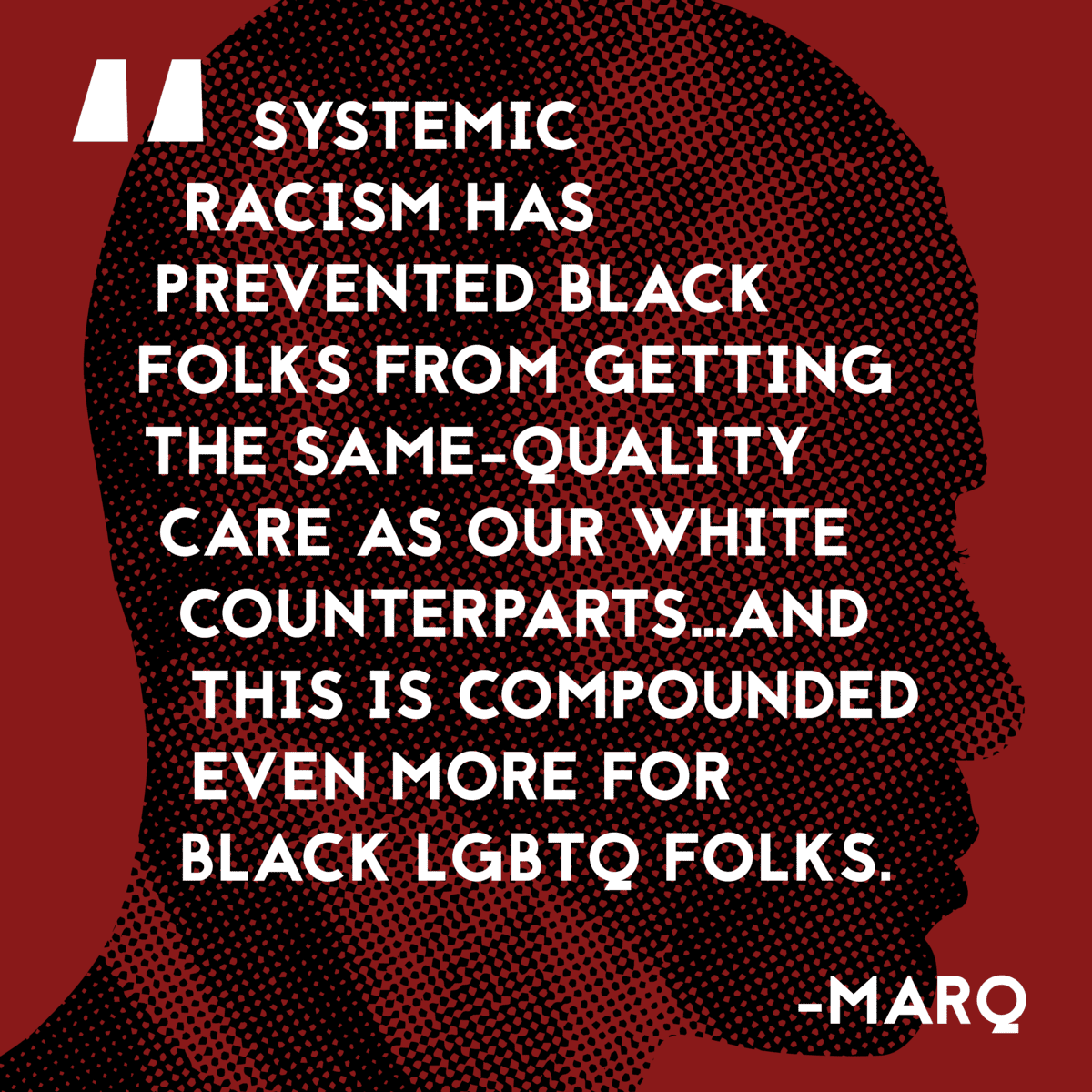
In addition, it should now be common knowledge that systemic racism has prevented Black folks, as a whole, from getting the same-quality care as our white counterparts…and this is compounded even more for Black LGBTQ folks. Having all of our health needs adequately met from most doctors is a challenge…if we even have access to doctors, from the outset. Employment and housing discrimination often keep Black LGBTQ people from even having access to healthcare, at all. That lack of access to care (and the additional roadblock of homophobia from the doctors that we do manage to get to), leads to a lack of awareness around our own sexual health.
Many don’t have the access to proper and regular HIV/STI testing, causing many to walk around with the virus without even knowing it…and this is where the risk for transmitting the virus is highest. And for those who do manage to find out, we often don’t have access to treatment in the event of a positive diagnosis. In addition to the horrible health effects of letting HIV go untreated (namely, the virus being able to develop into AIDS), we know that being on treatment with an undetectable viral load is arguably the most reliable method of preventing transmission (a.k.a. Treatment As Prevention, or TasP).
I mentioned a lack of awareness around sexual health before…this is also a real issue. Sex-ed is terribly inadequate, even for many in the most privileged and centered parts of society. Queer and Trans people (and even more so, Black, Queer and Trans people) get absolutely nothing…at best, we might get told to use condoms or just abstain from such “sinful” activity…*extended eye roll*. Because of this, many of us don’t even have it in our heads to be diligent about sexual health. And this is made even worse by the culture of shame and stigma that’s been put on both HIV and Black, Queer sexuality…never mind that decades of negative propaganda has Black, Queer sexuality being commonly linked directly to HIV and AIDS.
Also, there’s the severe levels of homophobia that we see in the Black community (which is largely fed by white supremacy), which leads some Black men to live in the closet…which makes one even less likely to seek testing and/or treatment due to the aforementioned culture of shame and stigma. This adversely affects Black women…and, of course, the same issues of systemic racism (plus how that intersects with systemic issues around healthcare for women) impact their struggle with HIV/AIDS, as well.
In addition to ignorance, many are fearful to even wanna know that they might have the virus, at least partially, for the reasons mentioned, here.
Ultimately, the issue of HIV/AIDS among Black, Gay men (and other Black men who have sex with men) has nothing to do with whatever our level of morality is, but with proper  access to adequate resources around sexual health. This is why white, Gay men are seeing their rates of HIV transmission on a steep decline, despite the likelihood that they’re using condoms less often than Black people. Condoms are only one, small part of the equation in HIV prevention…it’s about resources. And resources have always been scarce for Black folks, in general, and even more so Black LGBTQ folks…and this is an issue that I don’t think anyone expects to see much improvement on, given who our new U.S. President is…and his VP.
…so, since bible thumpers and homophobes (and racist homophobes) like to dismiss this issue with citing our “lack of morality,” I think it’s more appropriate that we turn this around by properly citing who and what’s truly morally bankrupt: a white supremacist system, which maliciously ignored a nationwide epidemic for years. Then, even after it finally did come around, proceeded to deliberately deny a significant part of the population equal access to resources and care to help prevent and treat the virus, and continues to be dismissive of the issue, to this day. That’s the true moral failing, more so than anything my Black, Gay ass is doing in my bedroom…or someone else’s bedroom…or in a bar…or in a bathhouse…or…wait…what were we talking about?
But seriously, tone-deaf bigots love dismissing the HIV epidemic as an issue of “immorality”…and the thing is, they’re right. It’s just that the immorality is coming from them and the fucked up system that they created and maintain through their ignorance and hatred. So, from here on out, if we’re gonna play this “morality” card, let’s point it where it really belongs.
And one more important note: In these times, Black LGBTQ folks—as always, but now, more than ever—are gonna have to lean on and look out for each other. We’ve never been able to trust this morally bankrupt system to look out for us like it does others, and we obviously can’t expect it to get any better under Trump. So, one way of looking out for own is finding local causes that provide access to resources around HIV prevention and treatment in your area, and finding ways to provide support.
Given that I’m in Chicago, I’ll refer to where I go for my (LGBTQ-centered) HIV care: Howard Brown Health Center. Additionally, there’s the South Side Help Center, which focuses on HIV prevention among Black folks on the South Side of Chicago. There’s also PrEP4Love, which especially focuses on providing access to PrEP (Pre-Exposure Prophylaxis) for more marginalized communities in the city.
Additionally, here’s the page to look into and donate to Grace House, the program in Jackson, MS, featured in the linked documentary.
If you have some programs you’d like to highlight, please don’t hesitate to plug them in the comments…you never know who you might be helping!
There’s many great programs out there doing the good work of turning the tide of HIV/AIDS in our communities…I’m challenging us to be intentional and deliberate in supporting those efforts and each other. If we don’t do it, no one else will.