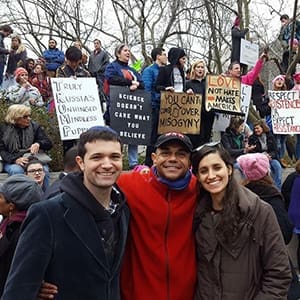
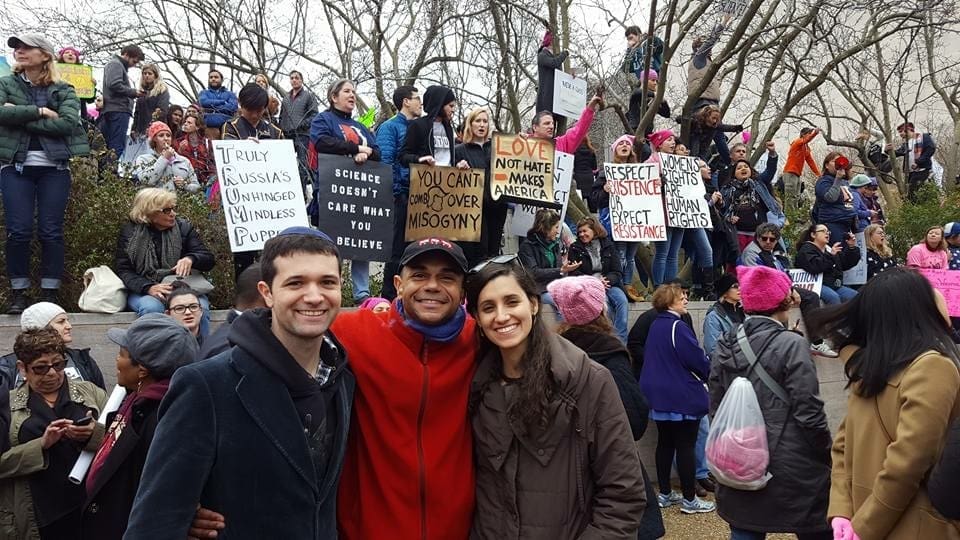
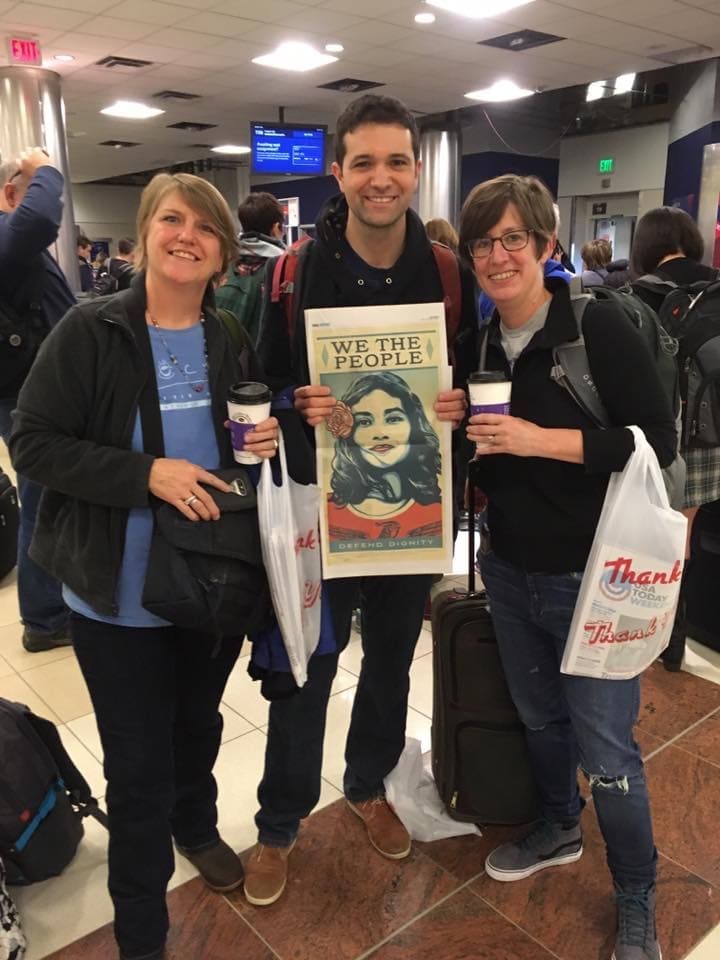
Former AFC graphic design intern Briana Shields and SSI/SSDI Outreach, Access and Recovery Specialist Aaron Voldman reflected on their experiences in last month’s Women’s Marches in Chicago and Washington, D.C.
|
|
|

by Briana Shields

Briana Shields is a former graphic design intern and current volunteer for the AIDS Foundation of Chicago.
I marched in the Women’s March on Chicago for the generations of girls of color to come. Young women need to see that the world is big and full of variety. Now, we’re needed more than ever.
When you’re a young woman of color, most of the time you feel powerless. Growing up in Chicago’s Austin neighborhood, I felt powerless and that my voice didn’t matter.
In high school, I was one of three Black girls in my class. I always felt like the odd girl out and I started to believe I wasn’t important. One morning, I saw yellow papers taped on all the lockers and in all of the girl’s bathrooms. It was a flyer with a picture of a Black girl in my class with bananas and read, “Send this monkey back to the zoo.” I looked at that picture and thought, “My skin is black like hers, so am I a monkey, too.” I was angry, but I also felt uncomfortable because it was obvious we were thought of as un-human. As Black girls, we had no one to talk to about racism in our school or ask why students of color traveled across town attend what was perceived as the better school rather than receive the education we need in our own communities. I gave up speaking and living my truth.
 Working at the AIDS Foundation of Chicago as a graphic design intern in 2016 was an inspiring experience. There, I witnessed what collective power can look like. Seeing people with different backgrounds work together towards justice and equity with love and compassion moved me. I felt acknowledged, valued and supported by the AFC community and motivated to go beyond what I think I’m capable of. They taught me that better relationships improve communities and create equity. The women’s march was a first step to build a stronger community.
The women’s march was one of the most beautiful acts of unity I experienced after Trump’s election. The streets were filled with passion and drive. It felt good to be a part of something bigger than all of us — something that felt like sisterhood. There were so many women standing together, shouting together. We were all on the same page; we had the same needs and wants. This sisterhood must continue.
I believe that feminism isn’t feminism unless it’s intersectional. To eliminate oppression, we must confront the fact that 53% of white women cast their ballots for Trump. When we talk about gender, we cannot shy away from race, class and sexual orientation.
Why now? Why was this the final straw? I haven’t seen this many women at a Black Lives Matter march or any other march. Where is the outrage when women of color experience violence from institutions that should help us or when we are systematically denied health care, sustainable housing and quality education? We must center the specific needs of women of color and commit to addressing them. Real progress will be made when more white feminists challenge racism and stand with women of color in the struggles that are unique to us. In order to create change, we must unite.
“I am no longer accepting the things I cannot change, I am changing the things I cannot accept.” — Angela Davis
By Aaron Voldman
 Aaron Voldman is a SSI/SSDI Outreach, Access and Recovery Specialist at the AIDS Foundation of Chicago.
In a sea of pink-hatted protesters and clever protest signs, I reached toward the metal beams of a Washington, D.C. street light on Independence Avenue and like a Cubs fan after the World Series win I climbed to the top of the street light. Sitting on top of the light with a huge grin on my face, I marveled at the wave of protesters stretching down Independence Avenue, past the Trump International Hotel and toward the Capitol Building. Fellow protestors chanted as they marched towards the White House: “We won’t go away; welcome to your first day!”
On the day prior, January 20, Independence Avenue was one of the main routes of President Trump’s inauguration parade. One day later it had transformed one of the main arteries of the Washington DC Women’s March drawing an estimated 500,000 people. I swiveled on the street light to look toward the White House. A sign outside the DC City Council and Mayor’s Office caught my eye – next to a photograph of Frederick Douglass were his words from 1857: “Power concedes nothing without demand. It never did, and it never will.”
 I work at the AIDS Foundation of Chicago as a representative for clients transitioning out of homelessness and who have wrestled with substance use and mental health challenges. As I marched, I thought of one my clients — earnest and humble with a mischievous sense of humor — who passed away not long before the march, succumbing to cancer. She lived through years of homelessness before finally finding housing and was only fifty years old — a few years older than the average life expectancy of those who experience homelessness in America. People who are unstably housed and homeless have less access to medical care than those who benefit from the support and stability that comes with shelter. They also have substantially higher incidences of chronic and terminal illnesses, including HIV/AIDS and cancer. Had my client not been on the streets as long as she had been and had she had access to better health care throughout more of her life, her young grandchildren may very well had a childhood and young adulthood with their loving grandmother.
Many reasons drew me to the Washington Women’s March: Trump’s outrageous treatment of women prior to and during his campaign, Trump’s disregard for democratic norms and an obligation to resist. I also marched with concern about repeal of the Affordable Care Act. The ACA has a profound impact on AFC’s clients.
As of 2016, at least 12,000 people living with HIV in Illinois had newly gained health care coverage through the Affordable Care Act. The ACA provided many of my clients — a significant portion of whom are frequent emergency room patients — with consistent health care coverage that they did not have during much of their lives.
This allows them to receive preventative care, treat chronic illnesses and to address the behavioral health and substance use challenges that contribute to my clients ending up and staying on the street. Our clients cannot afford for the ACA to be repealed without an alternative that addresses their urgent health care needs.
How can we care for ourselves while also caring for others in need? I joined the Women’s March because I want to live in a country cares about welfare, dignity and justice for everyone — no matter sex or gender, ZIP code, sexual orientation or economic standing. I joined the march because I want to live in a country where our fear of not getting what we need does not overpower the concern we feel for each other. Policies like the Affordable Care Act improved the lives of millions throughout the country. We cannot let fear of change or instability lead to progress slipping away. During the Women’s March we saw a massive outpouring of loving resistance that served as an antidote to the fear that many of us have felt throughout the last several months. Since the march it has been heartening to see that loving resistance shine at airport protests against the Muslim travel ban, in rapid efforts to rebuild after attacks on our Muslim and Jewish communities and at vocal town halls throughout our country. May our love and resiliency only continue to grow throughout this time.
Almost a year ago, AFC readers met Kasey White, an energetic advocate for youth experiencing homelessness in Chicago. Ahead of this year’s youth housing project fundraiser Out in the Open Sleep-In, which White has supported since its first iteration in 2015, we wanted to check in with White to see what she’s been up to, and where she sees herself going in the future.
 What’s new for you, Kasey?
So much! Looking back, in June, I went to the African-American LGBTQ youth summit in Washington, D.C. with AFC, and it was really amazing. It was a totally different experience because I was out there with AFC and I wasn’t out there with the film (The Homestretch, in which White’s story features prominently) I didn’t have to speak to an audience. Instead, I met a lot of young advocates and made great connections. I haven’t done as much advocacy work lately — I had to find me a job and everything! — but my advocacy is starting to pick back up this month.
I’m also trying to get a one-woman show off the ground. People have requested it — “you just need to write a book about your life,” they say. I’m working with a couple of people to get a show off the ground and hopefully it’ll happen this year before my birthday. It’s going to be standup of me talking about my life; a lot of people think I’m funny, and I don’t know why! I want to bring people into my world especially when it comes to me dealing with a mental illness.
That’s great news! Where are you living these days?
I’m living between Garfield Park and Humboldt Park — basically Pulaski and Chicago Ave. I’m doing good with my home, but I’m probably going to have to move again. I have moved almost every single year since I’ve had an apartment! This time, I’m moving because of my neighbors … they can be a little inconsiderate when it comes to the noise level. They also damage a lot of the property. They draw a lot of unwanted, violent attention to the building. I just don’t want someone — my guests or roommate — to get caught in the crosshairs. But I’ve lived in Chicago 26 years of my life, so I’m used to this.
Where are you thinking about moving?
I might move back to the Austin area or toward the Logan Square area. It’ll get me 10-15 minutes closer to my job.
You’re starting to get back into advocacy. What are you fighting for these days?
Well, I just did a workshop last Monday about storage — it’s really a big challenge for youth [experiencing homelessness]. Nobody wants to travel around with all their stuff, or take it into an interview. Homeless youth want to not appear homeless. It makes it easier when they want to reveal that to somebody.
And you’re continuing that fight for youth housing projects at the Out in the Open Sleep In on Feb. 24.
Yep — I’m speaking and I will be sleeping in! It’ll be a little different this year. It’s going to be inside, first and foremost! It was by the lake and freezing cold and it happened to be a snowstorm that year. This year, it’ll be at First Presbyterian Church. We’re going to definitely address changes going on in the presidential office. We’re a target, a very big target. We want to make the Sleep In feel like a sanctuary space, a safe space.
It’s been a year of big changes. How are you responding to our new president and administration?
I’m really scared. President Trump’s views on not just homeless youth but mental health and the Black community alone … those three areas make up such a big part of the LGBTQ homeless community! For me, I’m part of the mental issue community the black community, the youth community, the gay community … it’s kind of hard to ignore anything because I feel like I’m being attacked from every side.
What are you going to do?
Keep doing what I’ve been doing. Get back into my advocacy. I had to make sure I was together before I could keep moving forward and helping everyone else. My mental issues can affect so much of my world … whether it’s speaking or writing letters or marching or speaking up on social media … it’s whatever I have to do! But it’s tough at times, because my main triggers when it comes to my anxiety are political conversations and religious conversations.
So how do you take care of yourself?
I’m getting back into my physical care — I’m trying to exercise more. I’m trying not to eat as much meat. I’m back on my mental meds even though I do not like medication. Sometimes my anxiety or mood swings will get the best of me, and sometimes I will have to take my pills, and it’ll take me down from an attack. Coloring is also great for self-care — colors distract me from my thoughts.
We have more strong-minded people these days. People on the front line are going to need to get on the ball when it comes to that.
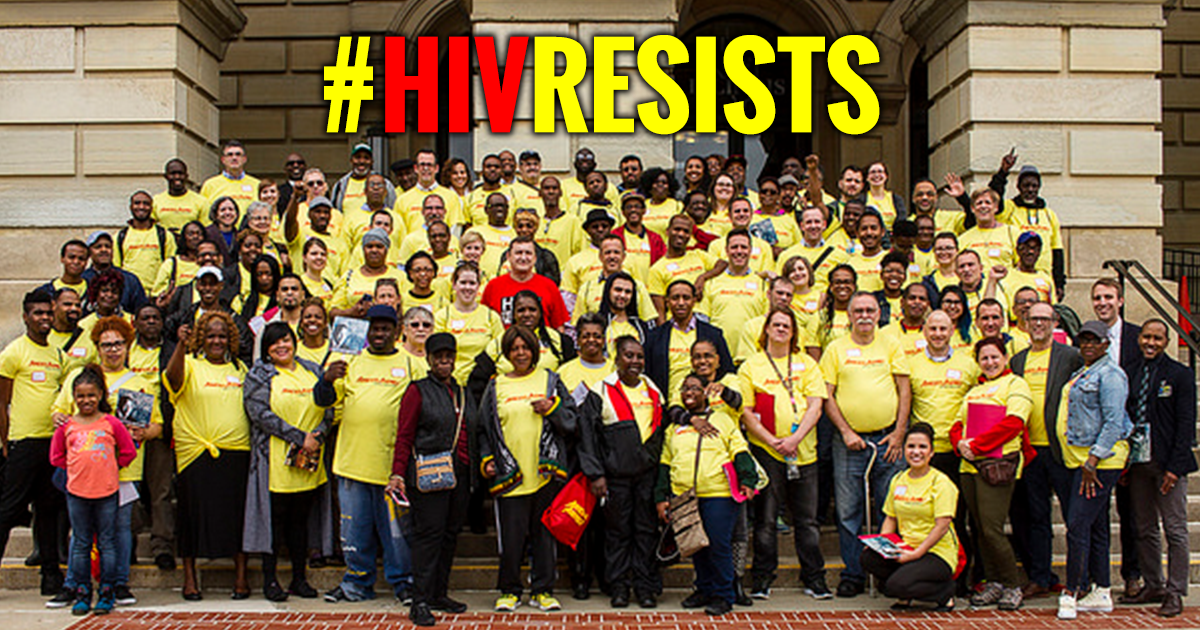 For the third year in a row, Illinois Governor Bruce Rauner failed to present the Illinois General Assembly with a budget that protects the state’s most vulnerable people, proposing a 44% cut to vital HIV funding streams in his budget address on Wednesday.
“The budget proposed today is outright dangerous for people living with HIV and will certainly result in more new HIV cases,” said John Peller, president/CEO of the AIDS Foundation of Chicago (AFC). “And if the U.S. Congress and President Trump have their way, our most vulnerable neighbors will be left without comprehensive health care coverage. Without national health care coverage or adequate state funding for HIV services, Gov. Rauner is setting people in our state up for devastating health catastrophes.”
The governor has proposed the following HIV and supportive housing amounts in the budget for Fiscal Year (FY) 2018:
- HIV Lump Sum: The budget includes a $15 million appropriation for the HIV Lump Sum, the state’s flagship HIV funding stream. This is $3 million less than the Governor’s FY 17 proposal, a $5 million cut from his first proposal for FY 16, and a $12 million, 44% cut from the FY 15 budget passed by the General Assembly and signed by Governor Pat Quinn in May 2014, the last time Illinois had an actual budget in place.
- African American HIV/AIDS Response Act (AAARA): The governor’s budget includes a $200,000 appropriation to the AAARA, which is a $300,000 cut from the Governor’s FY 16 and FY 17 proposals. The last time Illinois had a budget, it was appropriated $1.5 million, though those funds were never spent by the state.
- Supportive Housing services: The Governor proposed a $4 million appropriation to supportive housing services. This is an increase from the Governor’s initial proposal for FY 16, when the line was eliminated, and flat funding from his FY 17 proposal. (AFC will provide information on funding levels for other supportive housing lines when that information is made available in the coming days.)
These additional cuts to health and social service programs will have a devastating effect on the 37,788 people diagnosed with HIV in Illinois. The situation will be even worse if President Trump and Congress repeal the Affordable Care Act (ACA), as 12,000 people in Illinois who are living with HIV could lose their coverage provided by the ACA. While the Centers for Disease Control and Prevention (CDC) reported that new HIV cases have gone down nationally by 18% between 2008 and 2014, the trend is likely to go in the opposite direction in Illinois without a state budget that includes adequate funding for HIV services.
“The General Assembly and governor need to start looking for ways to generate revenue instead of continually cutting from budgets that can’t afford it,” said Daniel Frey, director of government relations at AFC. “Stop doing the same thing and expecting a different outcome. There are plenty of ways the state can generate revenue; we look forward to working with legislators on identifying solutions.”
To that end, AFC urges Governor Rauner and the legislature to identify sources of tax funding to replace the 2011 temporary income tax increase, which expired Jan. 1, 2015. Also, the governor and Illinois politicians need to stop talking about working together and actually come together to pass a positive budget, to ensure that Illinoisans most in need are able to count on the essential services they require.
As the General Assembly begins its debate on this budget, AFC looks forward to working with Governor Rauner, his administration and the General Assembly on a positive budget solution that will benefit all Illinoisans.
Click here to register for 2017 Springfield Advocacy Days, which will take place April 4 and May 17.
by Cotrell Loftin
 2016 was quite the year for HIV and AIDS. Last year, reducing stigma, broadening HIV prevention, and breakthroughs in treatment were all the rage. From research to advocacy to innovation — and even some forays into pop culture — the epidemic was front and center. Cheers to an even more newsworthy 2017 for HIV and AIDS! Here’s a roundup of 10 interesting HIV stories from 2016:
- Zero transmissions in San Francisco PrEP Program (POZ)
Data from the San Francisco AIDS Foundation’s Truvada for PrEP program revealed that none of the approximately 939 men in the study contracted HIV. This is even true for men who reported having condomless sex during that same period. This further indicates that PrEP is an effective tool for safer sex!
- PrEP fails in gay man adhering to daily Truvada
On the flip side, news emerged of transmission of a drug-resistant form of HIV to two PrEP users. For doctors and researchers, the takeaway is clear: no treatment is 100% effective, but with strict adherence, PrEP is over 99% effective in protecting oneself from HIV. This was one transmission among an estimated 100,000 people currently taking PrEP in the U.S., according to JD Davids of The Body.
- Prince Harry and Rihanna get HIV test in Barbados to raise awareness
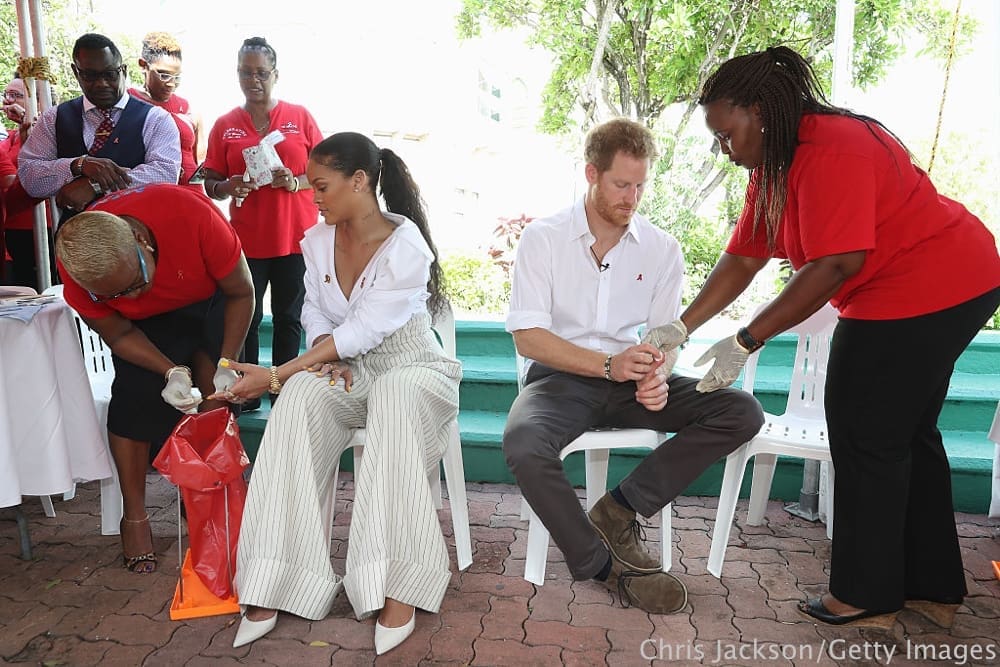
Prince Harry and Rihanna paired up and filmed themselves getting tested for HIV in Barbados in honor of World AIDS Day. These beautiful people showed that getting tested can be a beautiful thing!
- Why it’s time to bury the word “AIDS”
What’s in a name? Writer George Johnson urges us to reconsider the use of the term “AIDS” and draw clearer distinctions between today’s HIV diagnosis and the AIDS epidemic of the 80s and 90s that took so many lives in the U.S.
-
 Young Gay Men at Frontline of AIDS Prevention in China
The primary population for HIV prevention efforts in China is young men. With the LGTBQ community highly discriminated against and frowned upon, these young men avoid recommended testing regimens and treatments. But efforts to reduce stigma surrounding HIV can greatly reduce the number of new infections and encourage these men to seek out treatment and other resources.
- HIV and AIDS in South Africa: How far have we come?
This Daily Vox article takes a look at the milestones and accomplishments of AIDS treatment and research in South Africa. South Africa has seen promising decreases in the number of new HIV infections in recent years, as well as increases in prevention efforts through tools like PrEP.
- Patient Zero
It turns out, there is no “Patient Zero.” It was once believed that Gaétan Dugas, a French-Canadian flight attendant, was the person who introduced HIV to the U.S., but it seems the strain Dugas had was here long before he was. The problem with labeling anyone “Patient Zero” is the stigma and hatred aimed at that person, which is counterproductive in encouraging people to seek treatment.
-
 Harry Potter werewolf condition a metaphor for HIV
A bit controversial in the context of the story — people living with HIV are far from monsters! — but J.K. Rowling opens up about a clever way she addressed a pressing issue in her fictional work.
- Man convicted of intentionally infecting his girlfriend with HIV given second trial
Criminalizing HIV is wrong — and for someone who unintentionally infects another person, the burden likely feels double in weight. We applaud the High Court of Australia for giving this man a more fair trial and prosecution.
- Researchers edit HIV out of infected cells
Researchers conducted a study using CRISPR/Cas9 gene editing to remove HIV from cells, slowing replication and reducing viral load. This is by no means a cure, but it is a promising breakthrough in research and treatment.
May 2017 yield more headlines heralding the end of HIV stigma and increased support for people living with HIV!

by Dan Frey, Director of Government Relations
A quick update on last week’s session days in Springfield.
The Budget Impasse
The Senate’s attempt at a Grand Bargain took a hit last week as one of the component pieces of legislation dealing with pension reform was voted down by the Senate. Senate President Cullerton began calling pieces of the deal for a vote that had been agreed to, though before the entire bargain was in place. Minority leader Christine Radogno then asked her members to vote present on the bills, saying the whole bargain needed to be in place before any of its component parts were voted upon. In order for the Grand Bargain to go forward, all pieces of that package must be passed and signed. Though the bill could be introduced at a later date, this was a setback.
While the suit filed by Attorney General Lisa Madigan appealing the ruling that has been funding state employee pay in the absence on a budget awaits its hearing, Rep. Sue Scherer filed HB 1798 which would provide appropriation authority to pay for state workers through the end of this fiscal year, June 30. The bill passed out of committee on a 4-3-0 vote, and now moves to the full House. Governor Rauner has pledged to veto it should it reach his desk. This issue is seen as important because it is speculated that if state employees stop being paid, there could be pressure brought to force a negotiated settlement to the budget impasse.
Substantive Legislation
Rep. Sara Feigenholtz introduced HB 40, which passed out of the House Human Services committee. This bill removes a trigger within Illinois state law that would criminalize abortions should Roe v. Wade be overturned by the Supreme Court and allows Medicaid to cover abortions. The bill passed along party lines and now moves to the House for a vote before the entire chamber.
Rep. Mary Flowers also filed an AFC initiative, HB 2800, which requires an HIV test in the third trimester of pregnancy. Current law only mandates a first trimester test. That bill has yet to be assigned to a committee.
Rep. Greg Harris has filed HB 1785, the Vital Records Modernization Act, which allows transgender individuals to change their birth certificate designation prior to undergoing surgery. That bill has also yet to be assigned to a committee.
Rep. Thaddeus Jones has filed HR 60, which designates Feb. 7 as National African-American HIV/AIDS Awareness Day in Illinois. That resolution has yet to be assigned to a committee.
Stay tuned for updates on these and other bills of importance as they develop.
Up Next
The House and Senate reconvene on Wednesday, Feb. 15 through Friday, Feb. 17. The governor is scheduled to deliver his budget address and release his budget proposal for FY 18 on Wednesday, Feb. 15.
About the blog
BudgetWatch is a weekly update from the AIDS Foundation of Chicago’s on-the-ground team in Springfield about the state’s longstanding budget impasse. Follow along at aidschicago.org/budgetwatch.
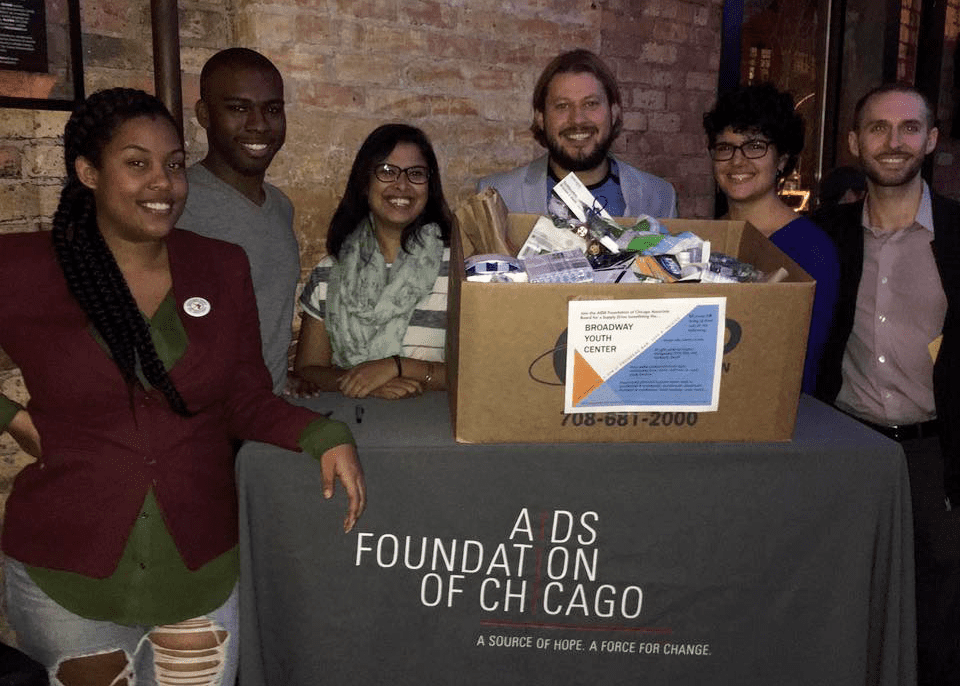
For the AIDS Foundation of Chicago’s Associate Board, a leadership group for people ages 21-35 who want to make an impact on health equity in Chicago, the word of the year for 2016 was IMPACT. Together, this group of young professionals from across Chicago amplified their work and lived into AFC’s mission through a variety of efforts.
“My favorite aspects of being involved with the Associate Board are the direct service opportunities we engage and advocating in Springfield for Advocacy Day,” said Jasmine Tucker, Associate Board co-chair. “It’s always great to be around people with like interests and passions and AFC is truly a great community to be a part of.” Since she and fellow co-chair Kevin Moore accepted their leadership roles in 2015, they have motivated their colleagues to work harder than ever to inspire AFC and take community leadership into their own hands.
“Perhaps the greatest asset of the Associate Board has been our ability to empower and mobilize a diverse group of young people to effect meaningful impact on the city of Chicago,” added Moore. “We remain committed — now more than ever in our current political climate — to meet the needs of our communities with the dignity, integrity and service that they deserve.”
Here are three ways the Associate Board made a lasting impact on people living with HIV and health inequities in 2016. To learn more about their successes, check out their Impact Report.
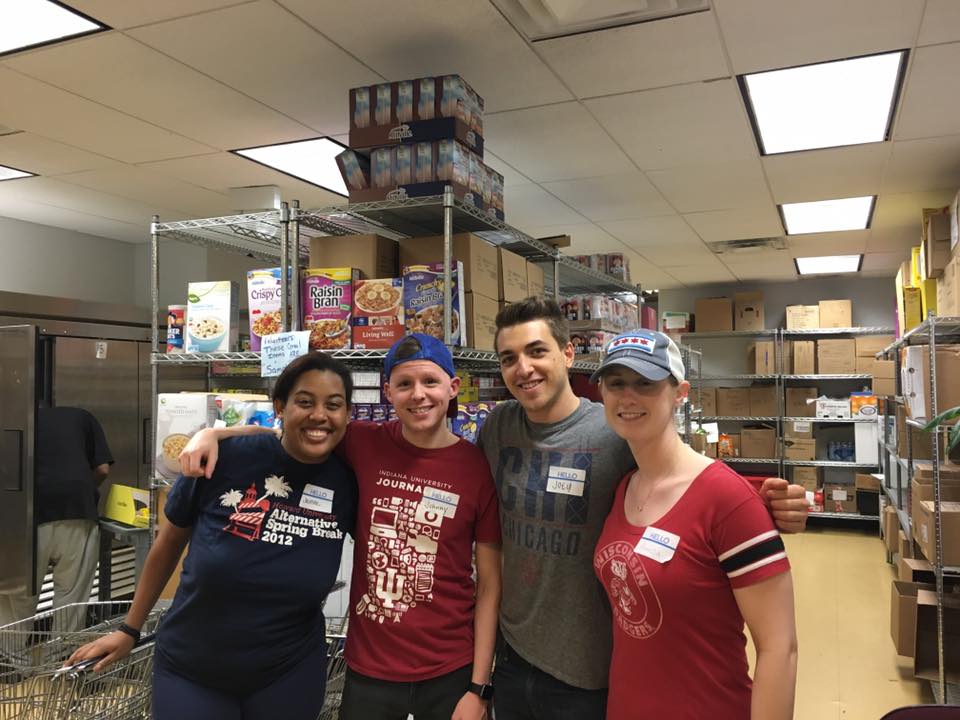 Service
The Associate Board stepped up its volunteerism in 2016, supporting members of the HIV community face-to-face. Several members of the group prepared and served lunch to residents at Bonaventure House, an HIV housing center managed by Alexian Brothers Housing & Health Alliance. They also helped AFC clients shop for groceries at the Vital Bridges Food Pantry, a Heartland Health Outreach program that serves people living with HIV who earn less than $14,000 per year.
Other volunteer efforts that the Associate Board rallied around include AFC’s Advocacy Days, Dance for Life, World of Chocolate, AIDS Run & Walk Chicago’s Ambassador Committee, and the TEAM TO END AIDS (T2) endurance training program.
Fundraising
Giving back to the HIV community doesn’t stop at direct service. The Associate Board also made contributions of dollars and in-kind donations. One of the group’s proudest achievements includes their AIDS Run & Walk Chicago fundraising efforts: They more than tripled their fundraising goal for their team, raising a whopping $3,720 to support AFC’s work to build health equity and justice! The Associate Board also supported the Broadway Youth Center’s supply drive this past winter, collecting more than $800 worth of personal hygiene products and gift cards to local pharmacies.
Growth
In the last five months of 2016 alone, the Associate Board increased their ranks to nineteen members. The Associate Board also decided to grow their leadership team this year, building out positions for treasurer and secretary as well as roles to support membership and PR/social media needs.
Membership growth wasn’t the only upswing the group saw this year; their Facebook follower count has seen a 9% increase since August 2016, thanks to new strategies meant to celebrate the board’s community activities.
Follow the AFC Associate Board on Facebook to see what they’re up to in 2017!

by Dan Frey, Director of Government Relations
Greetings all, I just thought I would provide a quick update on what happened during this week of session in Springfield.
Governor’s State of the State
The governor addressed a joint session of the General Assembly (GA) on Wednesday, Jan. 25, where he highlighted what he believes to be the successes of his first two years in office. The successes he highlighted were mostly centered on government efficiency and education. He called on the GA to pass legislation that would allow term limits and redistricting reform on the ballot, and to come together to end the year and a half-long budget impasse. He did not lift his insistence on reforms – an insistence which has contributed to our 18-month long budget impasse.
Though the speech offered very little that was new, Rauner did go on record as supporting efforts in the Senate to find a comprehensive “Grand Bargain” that addresses the state’s budget crisis and other structural issues such as worker’s compensation reform, increases to the minimum wage, and tax reform and increases. Though he stopped short of endorsing the plan, he implored the senators to keep working to find compromises.
For AFC’s full response to the speech, please click here.
The Grand Bargain
There was a lot of talk of votes on the Grand Bargain taking place in the Senate before the week was out, but as details of the plan emerged, there appeared to be a disappearing of consensus. Because of that, the parties continued to talk, votes were delayed, hearings were held to discuss portions of the deal, and new proposals were put in place. No votes were held on any portion of the plan, though the Senate continued to work to find a compromise. The House and governor are still not taking part in the negotiations.
Committees
With the start of the new GA, the House and Senate took the necessary steps to organize themselves to begin legislative work. Committees were formed and their representation announced. As with the previous GA, Rep. Greg Harris (D-Chicago) will be chairing the House Appropriations – Human Services committee, Rep. Robyn Gabel (D-Evanston) will be chairing the House Human Services Committee, and Senator Heather Steans (D-Chicago) will be chairing the Senate Appropriations – I committee that deals with human services budgets. Replacing Senator Daniel Biss (D-Skokie) as chair of the Senate Human Services committee will be Senator Julie Morrison (D-Deerfield).
State Employee Pay
Following the end of session on Thursday evening, Attorneys General Lisa Madigan (D-Chicago) filed suit challenging the St. Clair County court order that allows state employees to continue to be paid despite the lack of appropriation authority being passed by the GA and signed by the governor. That court order has been in place since the summer of 2015. The case will go to the Illinois Supreme Court, who will decide whether or not to continue paying state employees without a budget in place. Both the governor as well as AFSCME, the union which represents many state employees, decried the action of AG Madigan. How the Court decides this case may have a large impact on the state budget impasse moving forward. Stay tuned.
Up Next
Both the House and Senate are not in session next week. The Senate is scheduled to reconvene on Tuesday, Feb. 7 and the House is scheduled to return Wednesday, Feb. 8. The Governor’s Budget Address, where he delivers his budget proposal for the coming fiscal year, is scheduled for the following Wednesday, Feb. 15.
About the blog
BudgetWatch is a weekly update from the AIDS Foundation of Chicago’s on-the-ground team in Springfield about the state’s longstanding budget impasse. Follow along at aidschicago.org/budgetwatch.
The AIDS Foundation of Chicago (AFC) stands in solidarity with individuals and organizations in strong opposition to President Donald Trump’s executive orders. These orders aim to erode health care for 20 million people, including hundreds of thousands living with and vulnerable to HIV, and create an environment of prejudice and discrimination against people of color, immigrants, Muslims, LGBT people, women as well as members of other ethnic and geographical groups.
 AFC opposes President Trump’s efforts to dismantle the Affordable Care Act (ACA), ban refugees, build a wall along the Mexico-U.S. border, suspend visas for anyone from certain Middle-Eastern and African countries as well as cut federal funding for sanctuary cities. These policies are contrary to sound HIV policy as well as civil and human rights.
President Trump’s executive orders further racial and ethnic discrimination and hinder progress for millions in this country by denying them basic elements of equality and non-discrimination. Such fueling of ethnic and religious hatred that leads to intolerance, racism and injustice is unacceptable. Comprehensive health care coverage and eliminating racism and discrimination are top priorities for AFC. Immediate and ongoing action is critical if we are to resist President Trump’s dangerous and discriminatory policies. Every person and every voice is needed. Please join us.
Here are three steps you can take to support communities targeted by the Trump administration:
I. Call your elected officials
Contact your senators and representatives. Call the Congressional switchboard at 202-224-3121 and ask to be directed to your senator or representative. Tell the operator why you are calling and what issue you’re concerned about. Urge them not to repeal the Affordable Care Act and to protect immigrants, Muslims and refugees.
Not sure who your representative is? Find out here (aidschicago.org/findyourlegislator). Keep calling them. Add them to your speed dial!
II. Sign up for our advocacy network and respond to action alerts
Visit AFC’S Action Center and sign up for our Online Action Bulletin. AFC provides quick facts and background on a variety of issues impacting people living with HIV and the communities hardest hit by the epidemic. Stay educated on the issues that matter most to our community, and then relay your concerns back to your elected officials via Step 1!
III. Engage: join and/or donate to local efforts and initiatives
Many of the efforts protecting health care and minority communities will be on the local level, so find organizations and coalitions in your community doing great work. Donations are always welcome and can be made at aidschicago.org/donate, but if that’s not possible, take time to learn about the organization, its active campaigns and volunteer your time. Below are a few examples to get you started:
- AIDS Foundation of Chicago: www.aidschicago.org – 312-922-2322
- American Civil Liberties Union of Illinois: www.aclu-il.org/ – 312-201-9740
- EverThrive Illinois: www.everthriveil.org/ – 312-491-8161
- Heartland Alliance: www.heartlandalliance.org/ – 312-660-1300
- Illinois Coalition of Immigrant and Refugee Rights: www.icirr.org/ – 312-332-7360
- Legal Council for Health Justice: www.legalcouncil.org/ – 312-427-8990
- Protect Our Care Illinois: organizations can join the coalition here: http://tinyurl.com/PoCIL-organization; individuals here: http://tinyurl.com/PoCIL-individual
- Shriver Center: www.povertylaw.org/ – 312-263-3830