In his annual State of the State Address, Gov. Bruce Rauner discussed the accomplishments of the past year, goals for the year ahead and how lawmakers must work together. Unfortunately, we’ve heard this before. Illinois’s most vulnerable residents can’t afford another year of empty promises and battles between the governor and the General Assembly, while those in need continue to feel the negative effects of the state’s financial crisis. Passing a positive budget that supports people living with and vulnerable to HIV and other chronic illnesses is more important now than ever.
From unfunded education, testing and treatment initiatives in Cook County neighborhoods to downstate Jefferson County laying off vital HIV prevention staff, every corner of the state has become victim to the governor’s inability to compromise with the General Assembly.
Though the speech offered very little new information, Rauner did go on record as supporting efforts in the Senate to find a comprehensive “Grand Bargain” that addresses the state’s budget crisis and other structural issues, such as worker’s compensation reform, increases to the minimum wage, and tax reform and increases. Though he stopped short of endorsing the plan, he implored the senators to keep working to find compromises.
Where is the compromise? A common thread throughout the governor’s statement focused on how Democrats and Republicans must come together and value what’s important to Illinoisans. One place to start is the state budget, as the stopgap spending plan put in place in June 2016 has expired and our state is in the exact same place we were before. What’s worse, we now have the added uncertainty surrounding the new Trump administration and concerted efforts to repeal the Affordable Care Act and limit Medicaid.
Among the many successes of the ACA is the expansion of Medicaid, which has been extraordinarily beneficial to the state’s HIV community. The AIDS Foundation of Chicago has estimated that more than 12,000 Illinoisans living with HIV gained high-quality, more affordable health care coverage through the ACA’s Medicaid expansion or in the insurance marketplace. Those 12,000 individuals comprise nearly 32% of the approximately 37,788 people living with HIV in Illinois — that’s one in three people living with HIV in our state.
Concerned Illinoisans must make their voices heard. Gov. Rauner must know how important vital services like Medicaid are, not only to those living with and vulnerable to HIV, but to alarmed taxpayers as well. The governor’s and General Assembly’s lack of action will only continue to hurt our state’s financial and human wellbeing.
AFC looks forward to seeing the governor’s constitutionally-mandated proposal for a balanced budget on Feb. 15 during the governor’s budget address and calls on the governor to preserve essential services that Illinoisans in most need depend on, including those living with HIV. A balanced budget that generates revenue to support the essential services and programs that Illinoisans demand is long overdue.
To see more on how the ongoing budget impasse has affected the HIV sector and HIV services in Illinois, as well as read about the causes of the impasse and proposals for ending it, please click here to read AFC’s Budget Impasse Policy Brief.
The lifelines supporting Illinois’ vulnerable communities are under attack at both the state and federal levels. Illinoisans in need don’t need another year of delay. They need leadership focused on saving lives.
 by Cotrell Loftin
Over the past year, it’s been a pleasure to amplify the voices of so many HIV advocates, and to be heard by thousands of readers throughout 2016. The audience has spoken —here are the ten most viewed News and Inside Story posts from 2016. Share your favorites with a friend!
1. Que No Estas Solo: Beto Comes out as an Undocumented Person Living with HIV
“After a few years of sharing my story with people, I started to change the way I was dealing with my own status. I don’t know exactly when it happened, but suddenly I stopped thinking of HIV and started living. Now I live positively.”
Through all the difficulties Beto Soberanis faced as an undocumented immigrant living with HIV, he chose to take control of his life. Read his story in English or listen to him read it en espanol.
 2. Citywide campaign transmits love and shows the sexier side of HIV prevention
The amazing PrEP4Love public awareness campaign is equal parts informative and sexy! The sex-positive and body-positive ads spread tingle and awareness about PrEP, a once-a-day pill that greatly lowers the chance of spreading HIV, throughout the city.
3. AFC joins human and social service agencies in lawsuit against Gov. Rauner and state agencies
97 agencies joined together to tell Illinois Gov. Bruce Rauner, “Pay us for our work!” in a lawsuit for breach of contract. The damages? More than $130 million in unpaid work. Since then, we have moved our case to the Illinois Supreme Court; stay tuned for more updates.
4. AFC denounces Gov. Rauner’s proposed cuts to HIV and related programs and services in budget for FY 2017
With a multi-billion dollar state revenue shortfall, Gov. Rauner in February of 2016 proposed cuts in the FY17 budget to vital HIV programs like the AIDS Drug Assistance Program. In response, we called for a budget that protects the most vulnerable people in the state, and for Democrats and Republicans to come to the table to negotiate a responsible budget solution that includes adequate revenue. Still, there’s no full-year budget in sight as of January 2017.
 5. #TeamJessica walks toward hope and away from stigma
“I was only 22 when I was diagnosed. I was young and I felt it. But everyone’s just trying to learn how to live, and now I’m just learning how to live a little differently.”
Jessica shares her story of staying hopeful while living with HIV. Despite less-than-positive reactions to the news of her diagnosis, Jessica invited her family to openly ask her questions about living with HIV and even brought them all together to participate in AIDS Run & Walk Chicago!
6. 10 movies about HIV/AIDS recommended by AFC staff
For all you movie buffs, the AFC staff rounded up the top ten movies about HIV and AIDS to add to your hibernation watch list! From Philadelphia to RENT, you’ll laugh and cry when watching these classic movies.
7. Jeanette seeks a place to call home
“Every time I put my key in this door, I feel grateful, because I still remember the times when I wasn’t sure where I was going to sleep at night … It’s amazing, the difference that can come from having somewhere to stay.”
Jeanette struggles with recovery, experiencing homelessness and a cancer diagnosis but maintains a positive outlook while waiting for secure and stable housing. Her story is a much-needed reminder that “housing first” is the first step to treatment of any kind.
8. AFC and national partners file complaint against discriminatory health insurance plans
We called out Humana and other health insurers for discriminatory practices against people living with HIV. Everyone deserves affordable and equitable health care; unaffordable health care is only a tiny step above not having health care at all. The great news is that Humana listened, and this year, the cost of HIV medications in their health insurance marketplace plans is in line with other insurers in the state. To make access to their care more equitable, they’ve rectified their formulas to include more people in need of coverage!
9. Next to — or better than — normal
“He said to me, ‘You gotta make a choice today: are you going to be ashamed of it, or are you going to go forward and live your life and be proud of you are and not let it hold you back?’ Well shit, that was an easy choice!”
Jeff realized that leaving his teaching career meant leaving behind his health coverage — which could throw his HIV medication access into question. Rather than feel defeated, Jeff chose to live a better-than-normal life as an advocate and crushed it as a member of the TEAM TO END AIDS (T2) in 2016.
 10. The metamorphosis of recovery
“I often get asked the questions, ‘Why do you do this work?’ ‘What is your personal stake in this work?’ ‘Are you in recovery?’ I don’t normally go into detail about my journey, because sharing my stories will turn the focus on me …”
Jennifer, AFC’s former recovery counselor, cares about the people we serve and held a personal stake in helping others on their journey to change their relationship with drugs and alcohol. Learn why metamorphosis is her favorite word!
Editor’s note: Supporting people through telling their stories is not always easy, nor is it always celebrated. AFC wishes to thank the following people for their role in shaping, recording, writing and sharing the Inside Story pieces you have read in 2016: Mirhanda Alewine, Raven Feagins, Cotrell Loftin, Eryn MacNeil, Elijah McKinnon, Ashley Slupski, and Brian Solem.
The AIDS Foundation of Chicago has debuted its first issue brief to kick off a new series covering statewide issues related to HIV prevention, education and care in Illinois.
The brief, titled “The Illinois state budget impasse and HIV services: A case of governmental dysfunction,” illuminates Illinois’ current fiscal landscape and examines the state’s recent descent into its budgetary crisis. Ultimately, the brief identifies the state budget crisis as the roadblock preventing Illinoisans from life-saving HIV-specific healthcare and services.

by Dan Frey, Director of Government Relations
Good morning everyone, I just wanted to take a moment and update you all on the developments that transpired in Springfield last week as the 99th General Assembly (GA) came to a close and the 100th GA got started.
Budget Update
In the Lame Duck session, there were multiple efforts to address the budget situation in each house of the General Assembly. In the House, Rep. Greg Harris (D-Chicago) proposed a supplemental budget bill to address Higher Education and Human Services funding that, as of Jan. 1, 2017, has no budget in place. In the budget lines we are most concerned with, the bill, SB 2051, there was included a $10 million increase from the stopgap spending plan to the HIV lump sum, a nearly $500,000 increase in the African American HIV/AIDS Response Act (AAARA), and nearly $5 million increase in supportive housing services. The bill passed the House by a vote of 63-49-0, but was not called for a vote in the Senate before the GA expired.
In the Senate, Senate President John Cullerton and Minority Leader Sen. Christine Radogno pursued a so-called “Grand Bargain” on spending, taxes and non-budgetary reforms (such as workers compensation reform and an increase in the minimum wage), but did so in a manner that left no possible way for the House to take up those bills. It is unclear if Speaker Michael Madigan or Gov. Bruce Rauner would have supported the plan that the Senate put forward, as neither of those parties participated in the deal’s negotiation. It is believed these pieces of legislation will be introduced again for the 100th GA.
Substantive Legislation
The House did pass a property tax freeze (HB 6630) and reforms on the Workers Compensation system (SB 2901), both top priorities for Gov. Rauner. The Senate did not pass either of those pieces of legislation, however.
Up Next
The 100th GA was inaugurated after the Lame Duck concluded. They begin working in earnest starting next Tuesday, Jan. 24, when both the House and Senate convene. On Wednesday, Jan. 25, Gov. Rauner will deliver his State of the State address to both houses of the General Assembly.
About the blog
BudgetWatch is a weekly update from the AIDS Foundation of Chicago’s on-the-ground team in Springfield about the state’s longstanding budget impasse. Follow along at aidschicago.org/budgetwatch.
Every Dec. 1 marks World AIDS Day, an annual opportunity for people to unite in the fight against HIV and show support for those living with and lost to HIV and AIDS-related illness. Many took to social media to voice their support and raise awareness. Check out World AIDS Day in seven posts from our friends and partners!
1. This World AIDS Day, we launched a pledge campaign urging Congress to not repeal the Affordable Care Act, which makes health care more accessible to people living with HIV. Thanks to our supporters who already agreed to fight back with us. Will you stand with us?
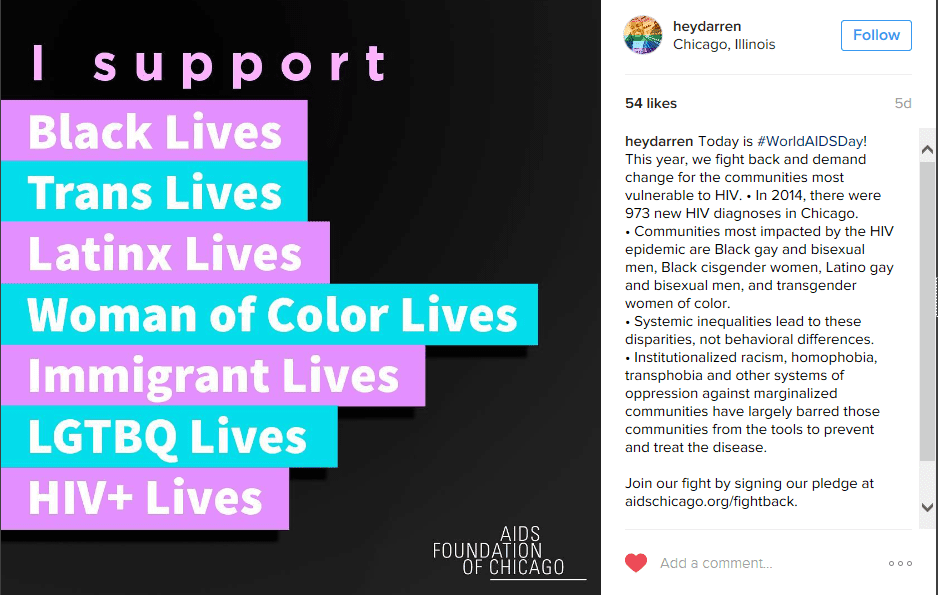
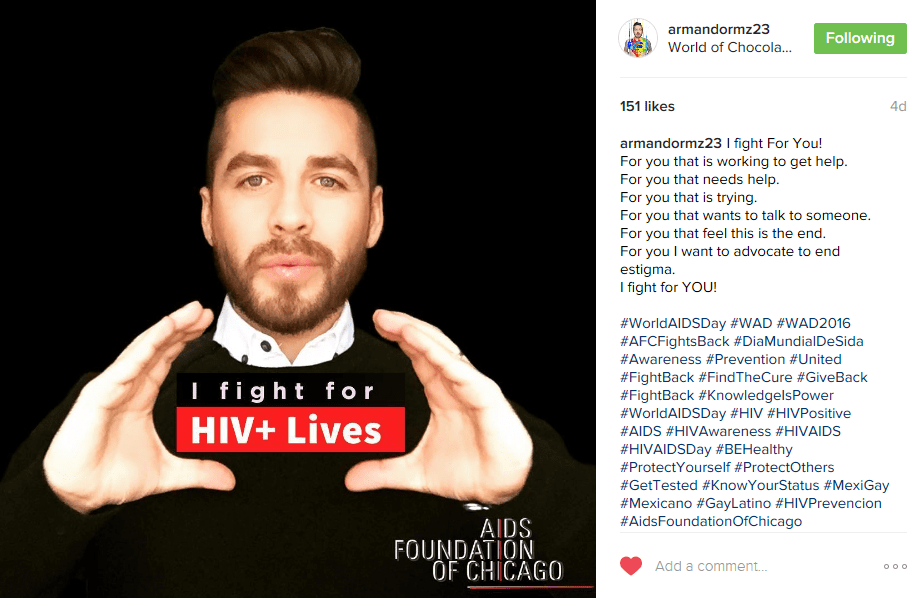
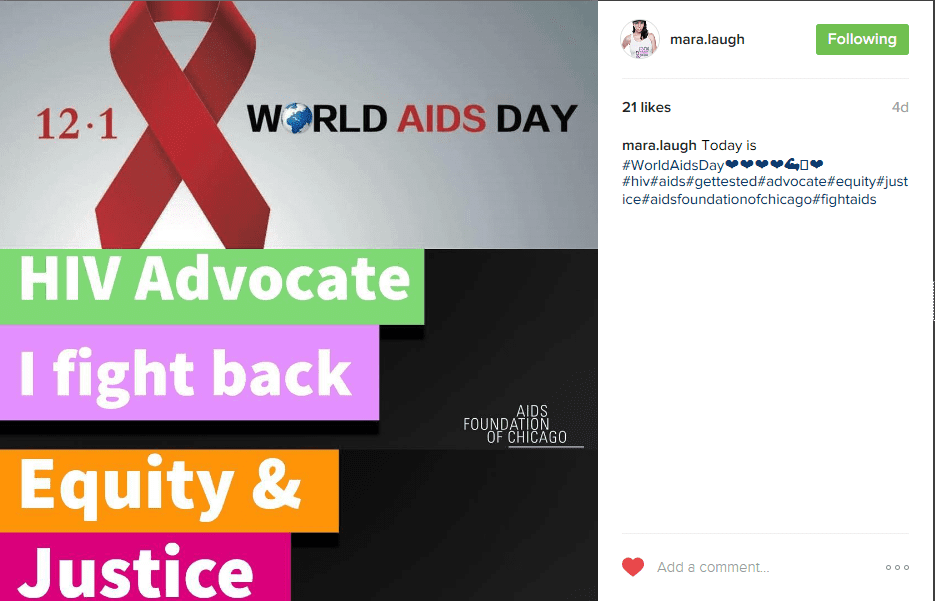
2. Blue Cross Blue Shield of Illinois lit up the skyline by dedicating their building lights to World AIDS Day.

3. Gilead Sciences rocked the red ribbon in solidarity with the fight against stigma!

4. United Airlines shared their commitment to equality and supporting people living with HIV. 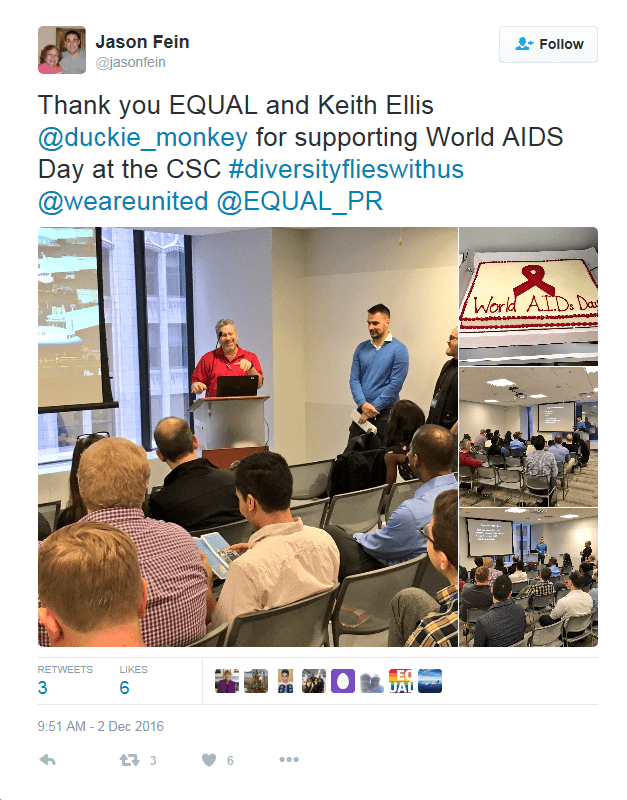
5. Wendy’s rolled out the red carpet on World AIDS Day and generously donated $2,796 from sales on Dec. 1.

6. ViiV Healthcare partnered with Greater Than AIDS to create this awesome video series giving voice to the stories of transgender women and their narrative of HIV. Check it out and share with your friends!

7. Excitement was in the air – along with the smell of dessert – at AFC’s fundraising event World of Chocolate!

We celebrated despite freezing temps and had a blast with over a thousand partygoers!

 Darren is 56 years old. He walks with the assistance of a walker – the toll that physical labor and illness has had on his wiry frame is obvious, but it does not dampen his energy. Behind his smile are years of hardships. Born and raised in the Chicago area, Darren was one of ten children. His parents divorced when he was three, after his sister was kidnapped walking home from school. As a child he strived for attention, but he was emotionally and sexually abused.
A lifelong hard worker, Darren got his first job at age ten and his first actual paycheck at 15. He has worked as a salesman, bike messenger, furrier, a cable man, and a fork-lift operator. Many of his physical jobs have left their mark; he now has permanent damage to his knee and rotator cuff.
Darren talks wistfully of the past and frankly states, “I am basically alone.” His parents have both been deceased over 20 years. He was married and has two adult children, but no longer speaks to his ex-wife. Diagnosed with HIV in 2005, Darren says, “communicating with people that I have HIV is a problem I have every day.” In fact, only one of his siblings knows his HIV status. Darren has been through so much since then: he’s been homeless, he lost one of his closest friends to HIV, he’s struggled with anxiety and depression, and he has had a series of life-altering strokes in recent years.
Darren’s life has been changed in a myriad of ways through his relationship with an AFC partner organization, the Cook County Health and Hospitals System Ruth M. Rothstein CORE Center, where he receives his medical, dental and psychiatric care. When he enters the CORE Center’s airy, open lobby, it is like watching a celebrity interact with fans — everyone in the building knows Darren, and he exchanges many friendly greetings. Darren proudly states, “the CORE Center became my family.”
The person Darren is happiest to see is Bukola, his case manager.
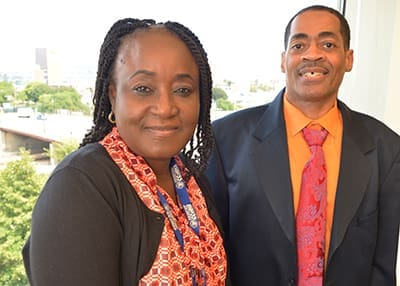 Since December 2014, Darren and Bukola have been working together to make sure Darren stays healthy. Bukola is warm and conveys both practicality and patience, which have been well-honed in her 21 years of experience as a case manager. She and Darren joke about how difficult he was in the beginning of their professional relationship. Every day was a challenge, he states: “The devil is always working to pull you back in.” Darren was frustrated — and self-admittedly, his style of interacting with others was aggressive. Bukola has helped him learn how to approach people, to listen, to ask questions. And when he can’t find the answers, he can rely on Bukola to help him.
With Bukola, Darren was able to move to a new HIV medication after he built up a resistance to the old medication. He takes 11 medications in the morning and three at night, and stresses how important it is that he adheres to medication schedule to stay healthy. Darren also lives in a third-floor walk-up apartment, which is incredibly burdensome, given his limited mobility and walker. Bukola is working with housing partners to find Darren a first-floor home so that he can leave his apartment more easily and be less isolated.
Most notably, Bukola is more than a case manager; she is Darren’s friend. When Darren was in the hospital after his most recent stroke, Bukola visited him and brought him his favorite treat. She recognizes how important their relationship is to Darren’s progress, and emphasizes, “when he comes in [to the CORE Center], I work my schedule around so at least I can spend some time with him.”
Roman Buenrostro, AFC Director of Special Projects, and his team make this support system possible. Together, they refer, coordinate and oversee care for over 5,000 HIV-positive people in the Chicago metropolitan area each year – including Darren. They also ensure that case managers like Bukola have the training, support and resources to help their clients flourish.
The system works, and Bukola and Darren’s story is an example of its success. “Bukola has a passion for case management and connects to her clients in a deep and meaningful way,” said Roman. “The fact that she can take her learning and professional development from one position and transfer those skills to another organization means that there is a certain level of stability and consistency in the system.”
 Darren’s story has a lot of heartbreak, but he is still optimistic. He explains, “Trial and error has gotten me here — but I’ve learned that I want to reach out and help people. I have to let them know I survived.” Even telling his story is cathartic, as he is open about his HIV status. As Darren moves forward, Bukola is there. She encouragingly tells him, “One thing that inspires me is that you never give up. You are still pushing on.”
Jeff Tomlinson is what you might call a “normal guy.” He was born and raised in rural Illinois; he has worked as a teacher in the U.S. and in other countries; he goes out and dates and volunteers. But he worries about things that some don’t have to worry about: as someone living with HIV who depends on vital, threatened programs like ADAP, he knows that his health care future is uncertain.
For many, health insurance is provided by an employer, but Tomlinson needed to leave his job as a teacher — and potentially leave his health care in the lurch. “I was in a pretty tough situation in my old school. I was really stressed out, and my body was telling me it wasn’t right.” He gathered some information and discovered that Illinois’ AIDS Drug Assistance Program would be able to help him start his new career in real estate and not have to worry about health insurance.
“I met with Marina Kurakin at TPAN, and she explained all my options around ADAP and the Illinois Marketplace.” His health insurance is now secure, but he still feels uncertainty around it. “I want to make sure I have the financial ability to take care of myself. [People living with HIV] have higher rates of cancer, and if I got that, I want to be covered. I don’t ever want to not be able to take my pill every day.”
 He’s grateful for ADAP and the services provided by and fought for by Chicago’s health advocacy community. That’s part of the reason he chose to give back to the HIV community this year by joining the TEAM TO END AIDS (T2) and training to complete a half-marathon in September. “I needed something to commit to during this transition in my life. I wanted something to help me get involved beyond the race.” He saw a poster for T2 in a Starbucks he frequented and joined. Tomlinson ended up raising more than $1,200 for T2 and the AIDS Foundation of Chicago — and he also met some great people along the way.
The other reason he joined T2 was to continue his passion for standing up, speaking out and ending the stigma around HIV. Tomlinson describes himself as a “safe sex poster-boy” in his twenties; he spent time handing out condoms at LGBTQ events and talking about ways to protect yourself. That’s why, when he was diagnosed with HIV at 31, he was shocked.
“After I got tested, the tester came back and said I was positive. ‘That’s not true; there’s no way! I told him. ‘I always use condoms.’ I was taken out of my body for a moment; I was very calm. But then I got into my car and started bawling.”
The next day, Tomlinson met with an HIV case manager who shook him out of his shock, his fear, his depression. “He said to me, ‘You gotta make a choice today: are you going to be ashamed of it, or are you going to go forward and live your life and be proud of you are and not let it hold you back?’ Well shit, that was an easy choice!”
Tomlinson slowly began telling more and more people about his status. He spoke about his status at a large event in the Castro District in San Francisco. He came out — as gay, as person living with HIV — to his students at his school. “Everyone has their own gifts to provide, and mine is being comfortable and open about my status.”
As “normal” as Tomlinson may be, he knows about discrimination, too. Back when he was teaching in Texas, he applied for a job that sounded like a dream — more money, better school. But after the school made him a job offer, the school ghosted, without explanation. Tomlinson thinks they found an article about his HIV status in search engine results and were scared off. “I think I just got discriminated against,” he recalled sadly, frustrated. But then his mood shifts. “If I can’t be all of me, then I shouldn’t work there. I just let it go. But dammit, some people aren’t going to get jobs at that school because of their HIV status.”
The future of health care in the U.S. is uncertain, and Tomlinson worries about how those changes will impact him as he transitions into real estate. But that worry is balanced out by volunteering for AFC, writing and videoing for a blog he’s started, going out with MeetUp groups across Chicago, and telling his story.
 Like many of you, the AIDS Foundation of Chicago (AFC) was disheartened by the news earlier this week that a South Carolina jury failed to convict Michael Slager for the shooting death of Walter Scott. Cellphone video showed Slager, a police officer at the time, shoot at Scott eight times as Scott ran away during a stop for a broken brake light. Five of those bullets hit Scott in the back. During the trial, Slager, who is white, testified that he experienced “total fear” before shooting Scott, a Black man, who was unarmed and already several feet away from Slager when he fired the first shot.
Guns and racial bias never produce good outcomes.
It has been reported that many people who followed this case are disappointed with the result — but are not surprised. Such deep distrust and cynicism about the U.S. justice system is understandable, but should not be our expectation. Walter Scott and his family deserve better, as do the many victims of gun violence in this country.
Moved by the ongoing tragedies produced by police-involved violence and community shootings, AFC released a position statement on gun violence this fall. We treat gun violence like the epidemic it is as we work to mobilize communities to create equity and justice for people living with and vulnerable to HIV and related chronic diseases.
One thing that we can do for Walter Scott and other victims is to continue to hold our institutions and elected officials accountable. Sign up for our action alerts to learn how you can be involved.
 To support Medicaid-eligible people in Illinois living with HIV make informed decisions about their health care, the AIDS Foundation of Chicago (AFC) has released an overview of HIV medication coverage in selected Medicaid Managed Care plans.
“Navigating the complex world of Medicaid Managed Care plans as a consumer can be confusing, frustrating, or just plain scary,” said Matthew Frahm, medical benefits manager at AFC. “This is especially true if the medication you need isn’t covered, requires prior authorization, or is subject to strict prescribing limits.”
This resource is a map of Medicaid Managed Care companies’ prescription drug coverage and will help people living with or at risk for HIV and other chronic health conditions to make informed decisions about their health insurance coverage. Individuals can use the formulary review to compare the availability of medications across the various managed care plan options and work with their providers to find the best coverage for their unique situation. Please note: These formularies apply only to Medicaid plans; they do not apply to Affordable Care Act-powered Illinois Marketplace health insurance plans.
Insurers can make changes to their drug lists at any point, so AFC encourages clients and advocates to check before choosing a Medicaid MCO plan. For health insurance enrollment assistance, contact AFC’s Medical Benefits Coordinators at 312-784-9060. For questions related to this document, contact AFC Medical Benefits Manager Matt Frahm at 312-784-9071 or [email protected].
Click here to access the IL Medicaid Managed Care guide for people living with HIV.

by Dan Frey, Director of Government Relations
Good morning everyone, I just wanted to provide a quick update on the now completed Veto Session that wrapped up last Thursday evening.
Substantive Legislation
There was little movement on the budget, as expected, during Veto Session. However, a House resolution sponsored by Rep. Dave McSweeney that stated the House was opposed to passing an income tax increase in any Lame Duck Session (which is now scheduled for Jan. 9 & 10), was passed by the House. Though this does not mean the General Assembly (GA) is legally prohibited from passing a revenue enhancement in order to facilitate the passage of a budget before the start of the next GA on Jan. 11, the chances are slim.
Some legislation did in fact pass the GA this past week, though none of it budget or revenue related. A highlight was the passage of Rep. Lou Lang and Sen. Kim Lightford’s legislation, SB 261, that protects people with disabilities and their personal assistants from service restrictions and limitations that the governor is attempting to impose by administrative rule. You can see the legislation here.
Lowlights of the session included failed override attempts of several of Governor Rauner’s vetoes, including, but not limited to:
- HB 4351 to prevent cuts to community and home based services for 40,000 senior citizens;
- HB 5931 to increase minimum wages of service providers to people with disabilities;
- SB 250 to expand access to voter registration and expand voting rights;
- SB 730 to increase child support for low-income families on TANF; and
- SB 2536 to increase minimum wages for child care providers and require training standards.
Budget News
On the budget front, while no legislation was proposed for a state budget (reminder, the state’s Stopgap Appropriations bill was designed only to go through the end of December), the governor and legislative leaders from each party, as well as Speaker Madigan’s designated Chief Budget Negotiator for House Democrats, Rep. Greg Harris, have been conducting meetings centered around the budget, but reportedly largely focused on the governor’s legislative agenda. It was reported that the governor demanded legislation on Workers’ Compensation Reform and Term Limits before allowing a budget to go through, and also that he would not support any further stopgap appropriations. These talks will continue through the break.
Up Next
Both the House and Senate are scheduled to reconvene for a Lame Duck Session (the last session days of the current, 99th GA) Jan. 9 & 10 of 2017, with the inauguration of the new, 100th GA taking place on Jan. 11.
About the blog
BudgetWatch is a weekly update from the AIDS Foundation of Chicago’s on-the-ground team in Springfield about the state’s longstanding budget impasse. Follow along at aidschicago.org/budgetwatch.