
by Dan Frey, Director of Government Relations
Good afternoon, everyone! This week in Springfield was the last of the House’s session days before the March 15 primary and an elongated spring break. While there was some movement surrounding an appropriations bill for human services and higher education, ultimately it appears that we are no closer to a resolution to our current fiasco than at the beginning of the week.
HB 2990
While the air of tension and mistrust still permeated the proceedings, House Democrats were able to pass HB 2990, an appropriations bill that funds for FY 16 the human services and higher education budgets at the levels passed in the GA’s budget last May. House Republicans were vehemently opposed to the legislation, equating passage with providing only “false hope,” calling attention to the fact that the appropriations were not fully funded. In regard to line items that most affect the HIV sector, the bill includes:
- $23 million for the HIV Lump Sum
- $1.25 million for the African American HIV/AIDS Response Act
- $13 million for Supportive Housing
The bill now moves to the Senate, who are in session the next two weeks, where it is expected to pass. The governor, however, is expected to veto the legislation. Unfortunately, this appears to bring us no closer to an end to the FY 16 budget impasse (now in its ninth month), and does not seem to bode well for the process surrounding the FY 17 budget.
FY 17 Budget Hearings
Hearings on the Governor’s proposed budget have yet to be set in either house of the legislature, but we will provide that information when it becomes available. Stay tuned.
Advocacy Days
AFC is hosting Advocacy Days! We have a Virtual Advocacy Day set for March 23 and Springfield Advocacy Days on April 13 and May 10. Please click here to register and make your voice heard as we tell Governor Rauner and the General Assembly that we need to Pass a Positive Budget!
Elections Matter
Please be sure to pass along that the Illinois Primary election is Tuesday, March 15. Click here to register to vote. Elections matter, and votes have consequences. Please be sure to register and get to the polls on Election Day.
Up Next
The House is scheduled to be in session next on Tuesday, April 6. The Senate reconvenes next Tuesday, March 8.
About the blog
BudgetWatch is a weekly update from the AIDS Foundation of Chicago’s on-the-ground team in Springfield about the state’s longstanding budget impasse. Follow along at aidschicago.org/budgetwatch.
The AIDS Foundation of Chicago (AFC) applauds Get Covered Illinois and the Illinois Department of Insurance for reducing Illinois’ uninsured rate from 17.8% to 10.6% among 18-64 year olds between 2013 and 2015. This feat is one of the largest uninsured percentage drops in the nation, according to the Centers for Disease Control and Prevention. Medicaid is now the largest payer of HIV care in Illinois, and thousands of people living with HIV have gained coverage thanks to the Affordable Care Act.
As an organization that has long advocated for health equity through the expansion of health care access, AFC recognizes what this achievement means to people living with HIV and those vulnerable to contracting the disease, who now have access to comprehensive health care services, including vital prevention resources like PrEP and HIV/STI testing. And as early detection and early treatment have been identified as the most impactful method for controlling HIV, it also marks another positive step toward the vision of an AIDS-free generation.
by Mirhanda Alewine
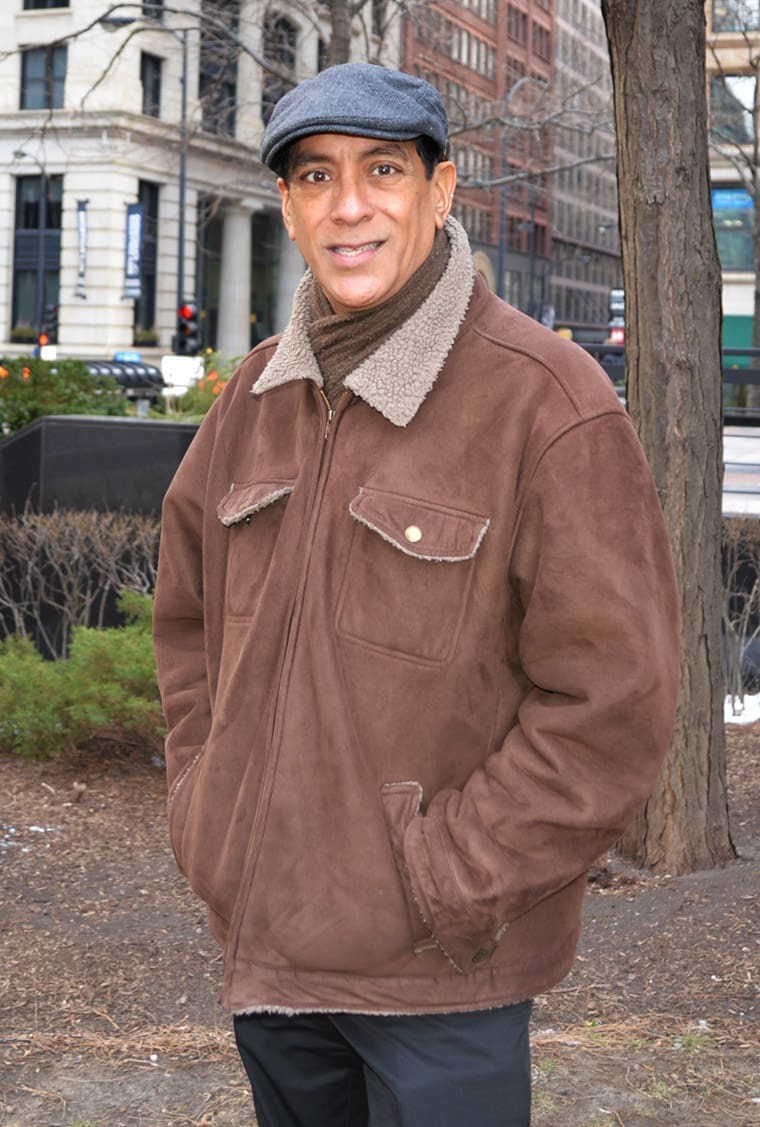
John Pizaña, the Promotor of the Salud y Orgullo Mexicano (SOM) campaign, uses his unique position to encourage and mentor other Mexican men living with HIV.
 “We knew that HIV was something that was going to continue to grow.”
In September 2014, John Pizaña accepted the position of Promotor of Salud y Orgullo Mexicano (SOM). The educational campaign’s name translates to Mexican Health and Pride, and it was launched through a collaboration between the AIDS Foundation of Chicago (AFC) and Erie Family Health Center as an attempt to reach out to Mexican men living with HIV. After hearing about the purpose and goals of SOM, Pizaña’s case manager immediately suggested his client for the position, highlighting Pizaña’s experiences living with the virus and his passion for HIV education.
Pizaña immediately embraced the opportunity; it would allow him to help people living with HIV, something about which he has long been passionate. “I got involved because of the early 1990s when the virus was not even referred to as HIV, when it was predominantly AIDS.” Pizaña is a native of Chicago’s Pilsen neighborhood, and he remembers the directors of the local youth center where he worked losing friends to the epidemic. “They wanted us to learn and to get educated. It really broadened my horizons to want to know more about HIV.”
In the months and years to come, Pizaña did learn about HIV, but in often devastating ways. “I saw my friends literally die, go from being a strong human to being a skeleton.” Not only did people living with HIV have to contend with the physical consequences of the virus, they also faced many social and emotional consequences as well. Pizaña remembers how pervasive the stigma surrounding HIV was in the early 90s. “Back then, HIV was a really new illness, a plague that took over. Everyone was just in fear. Nobody wanted to be bothered with individuals with HIV. We weren’t educated.”
“When I first found out I was positive, it was a shock.”
22 years ago, Pizaña’s doctor informed him that he was HIV-positive. Pizaña became worried that people would treat him differently, wondering, “How are people going to look at me? Treat me? Are they still going to care for me because of who I am?”
For Pizaña, learning to live with HIV, rather than viewing his diagnosis as a death sentence, “was a five-year roller coaster, an emotional roller coaster.” However, a short conversation with a friend dying of an AIDS-related illness eventually changed Pizaña’s outlook on living with the virus.
“My best friend, who had AIDS, said, ‘Don’t allow this to control you.’ I didn’t understand what he meant that day, but that kind of stood out to me. One day, I had this AHA moment: HIV is a part of me, but it does not identify who I am as a person.” Pizaña’s experiences made him want to help others diagnosed with HIV, and he now devotes his time and energy to spreading a message of self-acceptance to his clients living with HIV.
“Sometimes, as individuals, we think that no one knows what we’re going through and that we’re alone on this big globe.”
Because Pizaña struggled with fear and guilt after being diagnosed, he often understands what his clients are feeling. Pizaña is sometimes the first mentor living with HIV his clients have met, and he willingly shares his personal experience with them, ultimately building relationships on trust, mutual understanding and affirmation. “I always hear individuals say, ‘You have no idea what I’m going through because you’re not walking in my shoes.’ When I meet with them and tell them I know exactly what they’re going through, it makes them feel really, really comfortable.”
The trust that Pizaña builds with each of his clients helps make the SOM program more effective. SOM aims to reach out specifically to Mexican men living with HIV because they are disproportionately vulnerable to contracting the disease compared with white Chicagoans. The five-year project is funded through the Health Resources and Services Administration’s Special Projects of National Significance division.
Roman Buenrostro, AFC’s director of special projects, including the SOM campaign, and one of Pizaña’s supervisors, says, “John goes above and beyond the call of duty, making sure he allays all fears his clients may have about HIV primary care. He is a great resource and a compassionate provider for his clients.”
While the program dictates that Pizaña meet with each participant for 5 one-on-one educational sessions, the relationships he has built extend his reach beyond presentations on medication adherence and disclosure. Because participants feel so comfortable talking to Pizaña as a peer, they often “ask questions they normally wouldn’t ask a health provider.” Pizaña answers these questions openly and honestly, even referring them to a doctor if necessary, because he knows that “once they get educated, once they really learn what HIV is, they will say, ‘This is not who I am.'”
“In due time, you can pick your head up, look to the horizon and see that the sun is shining.”
Pizaña hopes that each of his clients will eventually “understand that HIV is not something they should allow to consume them,” but he recognizes that this realization will take time. In the meantime, he guides them toward this understanding by creating a safe space for his clients to heal.
“In the Mexican culture, it’s a disgrace to be gay. When they have to carry that, being still in the closet, being secretive, being told all their life that it’s a moral sin and then they find out they’re HIV-positive, it’s really a double whammy. The Mexican culture is so prideful, and they’re scared to tell their families.”
To counteract this influence, though, Pizaña reminds his clients that they have people in their lives who truly care for and love them. “I tell them, ‘If I asked your friends, they’re going to say you’re funny, you’re humorous, you’re caring, you’re grumpy, whatever. That’s what defines you, not your health status.'”
Ultimately, Pizaña’s goal is simple: help the individual. “I know I can’t save everyone. If I can just change at least one person, just help one person feel comfortable in their own skin, then my job is completed and it’s all worth it.”
To learn more about Salud y Orgullo Mexicano, please visit http://saludyorgullo.org/en/.
AFC urges passage of a positive budget to ensure essential services continue
On Wednesday, Illinois Governor Bruce Rauner once again presented the Illinois General Assembly with a budget that fails to protect the most vulnerable people in the state. Eight months into the fiscal year and without a budget in place that funds essential services, Governor Rauner proposed a budget for the next fiscal year that failed to invest in the states’ human services.
 The Governor’s proposed budget for Fiscal Year 2017 contained an $18 million appropriation for the HIV general HIV funding line. This is a $2 million cut to the general HIV funding line from the Governor’s FY 16 proposal, and an $8 million or 28% cut from the FY 15 budget passed by the General Assembly and signed by Governor Pat Quinn in May of 2014.
Governor Rauner also proposed allocating just $500,000 to the African American HIV/AIDS Response Act (AAARA), a 60% cut from the proposed FY 16 level. The AAARA remains unfunded by the state after the governor vetoed a FY 16 budget passed by the General Assembly that would have provided $1.25 million for this vital program. At a time when nearly 50% of new HIV infections are in the Black community, AAARA is a critical tool to ensure funds go to targeted organizations working in the hardest-hit communities by the epidemic, such as the Black community.
“The AIDS Foundation of Chicago (AFC) strongly opposes these proposed cuts,” said Ramon Gardenhire, AFC’s vice president of policy and advocacy. “We will vigorously work with the General Assembly, people living with HIV, service providers and community members to restore funding for these and other vital programs.”
An estimated 43,500 Illinoisans are living with HIV. The proposed budget, if enacted, would severely limit the ability of this population to access and maintain the vital medication and supportive services needed to keep their condition manageable.
The State’s HIV funding line supports HIV housing, prevention, supportive services and health care programs for people living with HIV. This funding also supports the AIDS Drug Assistance Program (ADAP), which provides life-saving medication to people living with HIV.
These proposed cuts would drastically affect HIV prevention in the state of Illinois. In FY 15, ADAP, the largest portion of the HIV funding line, received $18 million of the $26 million appropriation. The Governor’s proposed budget, by reducing total spending to $18 million, may completely defund HIV prevention services administered through this funding line.
“The responsible solution to the state’s budget fiasco is to generate the revenue needed to put Illinois on a path to sustainable prosperity,” said John Peller, AFC’s president/CEO. “We know there are many options for the state to generate adequate revenue. To say that there is ‘no choice but to make cuts’ is cynical and false.”
 AFC calls on Governor Rauner and the legislature to identify sources of tax funding to replace the 2011 temporary income tax increase, which expired Jan. 1, 2015. It is also now well past time that the Governor and the General Assembly come together to pass a positive budget for both FY 16 and FY 17, to ensure that Illinoisans most in need are able to count on the essential services they require.
“The reality is that the General Assembly and Governor have already made significant cuts to these programs in the past,” said Daniel Frey, director of government relations at AFC. “The programs simply cannot sustain funding decreases on the level the governor is proposing. We look forward to identifying solutions to the state budget that include adequate revenue, not just cuts.”
As the General Assembly begins its debates on this budget, AFC looks forward to working with Governor Rauner, his administration and the General Assembly on a positive budget solution that will benefit all Illinoisans.
“Governor Rauner’s budget is just a proposal,” said Frey. “It’s our job as advocates to work with our champions in the General Assembly, including members of the Black and Latino caucuses, to restore vital services for people living with HIV and other vulnerable populations. We look forward to that partnership.”
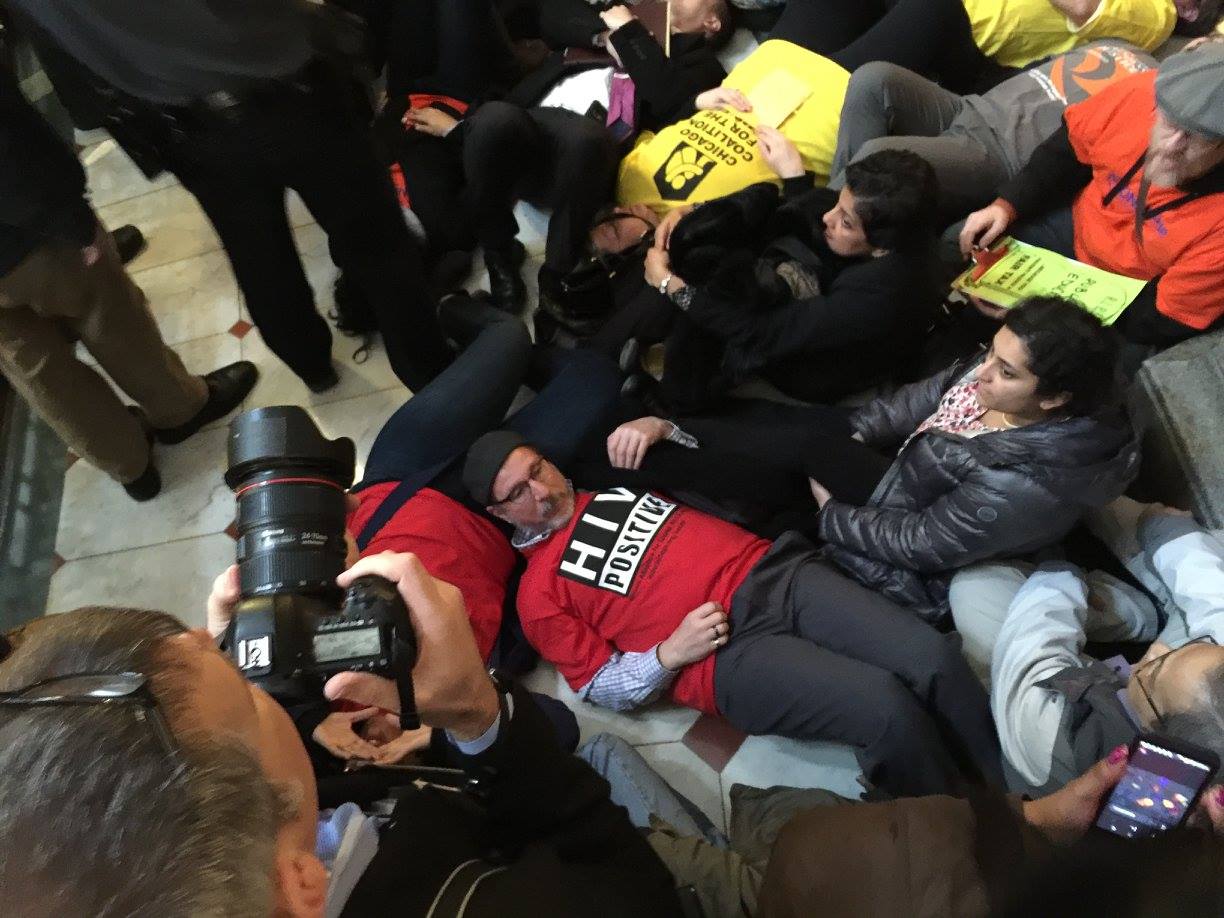
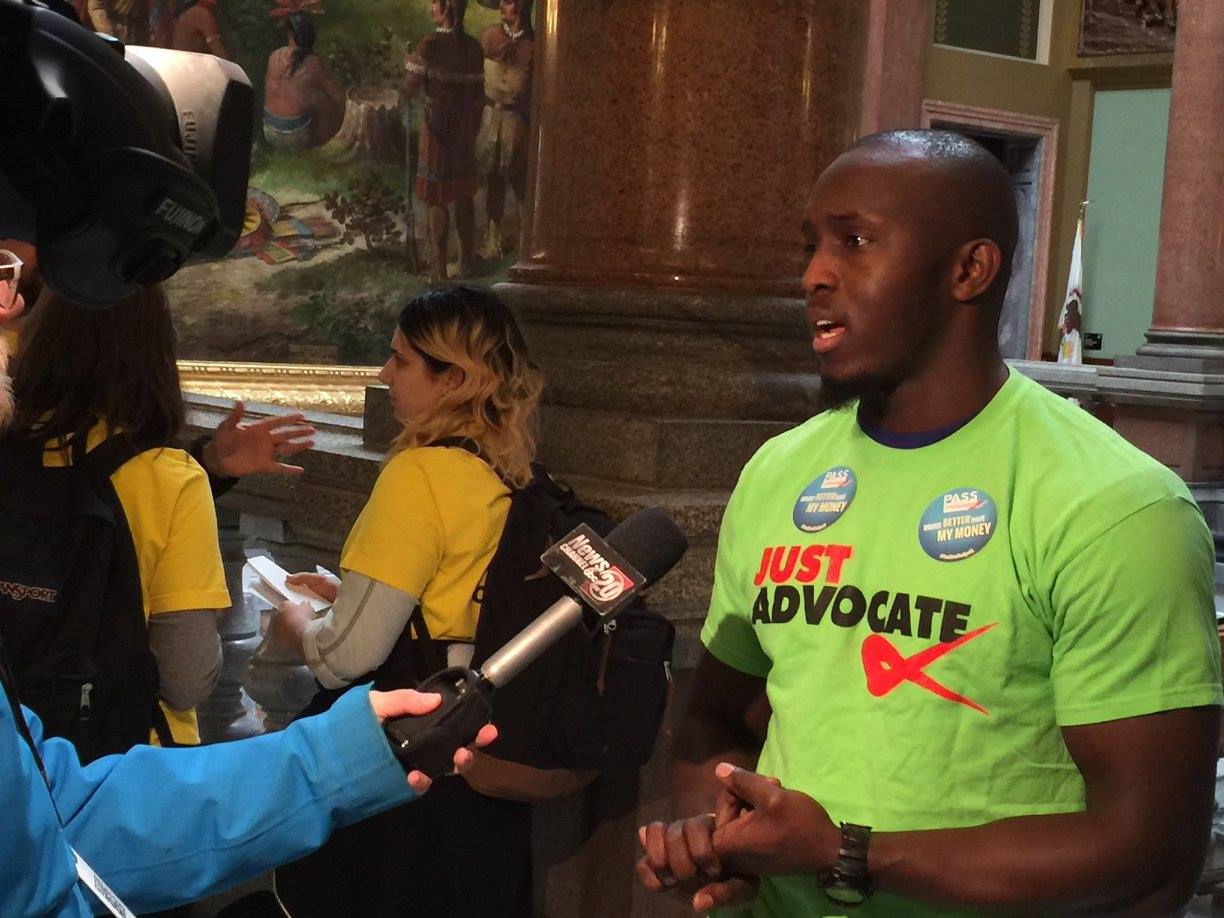
Chanting “Rauner, Rauner, you’re the worst, time to put the people first” as the governor entered the chambers of the Illinois House to deliver today’s address, nearly 250 advocates staged a die-in in the rotunda to illustrate the human toll of the budget impasse.
AFC urges advocates to save the dates for 2016 Springfield Advocacy Days, which will take place Wednesday, April 13, and Wednesday, May 10. Stay tuned for more information on aidschicago.org.
Given Illinois’ state budget woes, the AIDS Foundation of Chicago (AFC) seeks to protect and preserve vital HIV/AIDS prevention, education, housing and treatment services, and ensure that providers are fully paid for services rendered under contract with the state during the budget impasse.
Furthermore, AFC aims to ensure adequate funding for critical services including mental health and substance abuse treatment, supportive housing and child care. In addition, AFC is working with coalition partners to build support to solve Illinois’ budget crisis, prevent harmful cuts to essential services, save jobs, eliminate the state’s long-term structural deficit and make taxes fairer.
With the statewide rollout of Medicaid managed care, Medicaid is the largest payer of HIV care in Illinois, and thousands of people with HIV have gained coverage thanks to the Affordable Care Act. We are advancing innovations in health services and contemporizing regulatory structures to improve the lives of people living with HIV in the Medicaid program.
Lastly, we’re proposing new innovative ways to prevent new HIV infections and increase better health outcomes for people with HIV.
Fund HIV prevention and care services
Governor Bruce Rauner and the General Assembly have not passed a budget in eight months (and counting). The budget impasse continues to devastate the HIV and social service sector, ripping holes in the safety net that serves the needs of the state’s most vulnerable citizens. The AIDS Foundation of Chicago (AFC) seeks to protect and preserve vital HIV/AIDS prevention, education, housing and treatment services, and ensure that providers are fully paid for services rendered under contract with the state during the budget impasse. Furthermore, AFC aims to ensure adequate funding for critical services including mental health and substance abuse treatment, supportive housing and child care.
Mandated insurance coverage for HIV prevention medication (HB 4554)
PrEP is a once-a-day HIV prevention pill that is up to 99% effective when taken consistently. This bill would mandate Medicaid and private insurers provide coverage for all drugs that are approved for HIV prevention by the federal Food and Drug Administration and the clinical program associated with the administration of PrEP including medical monitoring,labs and counseling to reduce HIV infection.
Re-establish funding for PrEP41L
Gov. Rauner’s proposed budget for FY 2016 also cut funding for PrEP4111inois, a program aimed at increasing access to pre-exposure prophylaxis (PrEP) to help HIV-negative people remain uninfected.
Extend the Quality of Life (Red Ribbon Cash) scratch-off lottery (SB 2397 I HB 4987)
The bill would extend the expiration date of the Quality of Life (Red Ribbon Cash) scratch-off lottery for an additional eight years. The Quality of Life Ticket is sold at Illinois Lottery retail locations across the state. Net revenue from the sale of Quality of Life tickets is awarded to organizations in Illinois for the purpose of funding HIV prevention, education and treatment programs in communities.
Empowering Meaningful Patient Choice in Medicaid Managed Care (HB 6213)
The statewide rollout of Medicaid managed care has interrupted health care access for vulnerable Illinoisans because of low health literacy and incomplete information from plans. The bill would improve health literacy of Medicaid managed care enrollees and make provider directories and prescription drug lists reliable, useful and accurate.
Medicaid access monitoring act (HB 5559)
Many Medicaid recipients report problems finding doctors and specialists. The bill requires the state to directly test a sample of each Medicaid managed care plan’s provider network to ensure contact information is accurate, that the providers listed are participating and accepting new patients, and determine the wait time to obtain an initial appointment.
Reporting on HIV Quality Metrics in Managed Care (HB 5524)
Medicaid is the largest payer of HIV care in Illinois, and thousands of people with HIV have gained coverage thanks to the Affordable Care Act. As recommended by the federal government, the bill requires Medicaid managed care plans to report annually on the percentage of their members with undetectable viral loads, meaning their HIV is successfully treated. National reports indicate that up to half of Medicaid recipients are not virally suppressed, leading to poor health outcomes and more new HIV cases.
Access to affordable medications
A coalition is seeking to remove barriers to lifesaving medication in Illinois due to skyrocketing out-of-pocket costs. The bill would limit a patient’s copayment and coinsurance for their prescribed specialty drugs.
Join our community of activists. Go to aidschicago.org/stayinformed to sign up for our Online Action Bulletins!
The AIDS Foundation of Chicago (AFC) thanks the Illinois Department of Public Health (IDPH) for adding hepatitis C medications to the list of drugs available under the state’s AIDS Drug Assistance Program (ADAP), which ensures that people living with HIV have access to life-saving treatments. The IDPH decision is especially significant given that about one-third of people living with HIV are co-infected with HCV.
 The five drugs added to the ADAP formulary, effective Feb. 10, include:
- Harvoni (ledipasvir/sofosbuvir)
- Viekira Pak
- Sovaldi (sofosbuvir)
- Ribavirin
- Zepatier
Making these medications accessible to people living with HIV is a major step forward in the effort to cure hepatitis C infection, prevent chronic liver disease and halt the transmission of the hepatitis C virus (HCV). These five new medications will be available to 100 ADAP-eligible clients in a pilot program after they complete an IDPH approval form that will be posted on the IDPH website.
According to the National Alliance of State and Territorial AIDS Directors, 31 ADAPs in the U.S. currently cover some form of HCV treatment, while up to 14 cover some form of the newer, curative treatments.
As we applaud IDPH for increasing access to these new drugs, we urge the Illinois Medicaid program to review and change their hepatitis C access and treatment guidelines, which are the most restrictive in the nation. We also urge pharmaceutical companies to address astronomical drug pricing that too often keeps life-saving medications out of reach for people who desperately need them. The high cost of pharmaceuticals forces states and private insurance plans to place deadly, restrictive guidelines on who can get their HCV cured.
To find out if you’re eligible for coverage under ADAP, call 800-825-3518 for more information.
The AIDS Foundation of Chicago (AFC) applauds President Barack Obama’s commitment to reaching an AIDS-free generation in the U.S. as reflected in the proposed federal budget for the 2017 fiscal year.
Thanks to the Obama administration’s dedication to the National HIV/AIDS Strategy, the proposed budget advances progress toward making HIV infections rare by:
- Supporting the Ryan White HIV/AIDS Program. The budget invests $2.3 billion in the Ryan White HIV/AIDS Program to provide treatment and care completion services for people living with HIV, and includes $900 million for the AIDS Drug Assistance Program to ensure that people living with HIV have access to life-saving antiretroviral (ARV) treatments.
- Increasing funding for HIV/AIDS treatment and prevention. The budget expands access to highly effective prevention and treatment services, including $20 million to increase access to pre-exposure prophylaxis (PrEP) shown to reduce the risk of HIV infection by up to 92 percent in people who are at high risk.
- Supporting housing assistance for people living with HIV and AIDS. The budget provides $335 million for Department of Housing and Urban Development’s (HUD) Housing Opportunities for Persons with AIDS (HOPWA) program to address housing needs among people living with HIV/AIDS and their families.
- Increasing support for our veterans living with HIV and AIDS. The budget includes $1.13 billion within the Department of Veterans Affairs (VA), including a $57 million increase for medical care, to ensure that veterans living with HIV and AIDS receive high quality, comprehensive clinical care, including diagnosis of their infection and timely linkage to medical care.
In 2010, President Obama became the first President to release the nation’s first comprehensive National HIV/AIDS Strategy (NHAS), updated last year with 2020 goals. We are pleased to see that the proposed federal budget reflects the NHAS call to prioritize HIV/AIDS resources within high-burden communities and among high-risk groups, including gay and bisexual men, transgender women, African Americans and Latino Americans.
As we thank the Obama administration for its commitment to promoting the health and well-being of our nation’s most vulnerable groups, we urge the Illinois General Assembly – on the day of President Obama’s Feb. 10 visit to Springfield – to follow this federal example by passing a responsible budget that serves the needs of the state’s most vulnerable citizens.
Pride Action Tank and Polk Bros. Foundation will host a Tiny Home Summit April 18-19, 2016, to bring together experts from across the country to address the issue of youth homelessness and new solutions to house this vulnerable population in Chicago.
 The Chicago Tiny Home Summit will be at the University of Illinois at Chicago on Monday, April 18, 9 a.m.-5 p.m. and Tuesday, April 19, 9 a.m.-noon.
The tiny home movement has already been part of housing solutions in a dozen U.S. cities. The two-day summit will bring together experts to discuss utilizing lower-cost, quicker solutions to meet the demand for homes for the unstably housed in Chicago, especially focused on the youth homeless population, estimated to be more than 20,000 in the city of Chicago.
The tiny homes movement can also offer creative solutions for dignified housing that comes with services and resources for those seeking a path to independent living.
“There are many types of solutions needed to address the complex issue of homelessness in Chicago,” said Debbie Reznick, Senior Program Officer with the Polk Bros. Foundation. “We can learn from the experiences of experts in other cities, and then create innovative solutions that make sense here.”
The Pride Action Tank, a project of the AIDS Foundation of Chicago, and the Windy City Times, along with lead sponsor Polk Bros. Foundation, joined by UIC’s Gender and Sexuality Center and Alphawood Foundation, are summit hosts. Topics will include financing, housing as HIV prevention and public policy issues.
Experts from around the country — including from Seattle, Dallas, Austin and Memphis — will share their experiences creating tiny home communities. During the summit, a model of the winning design of the Tiny Homes Competition — hosted by the American Institute of Architects–Chicago, Pride Action Tank, Alphawood Foundation, Landon Bone Baker Architects and Windy City Times — will be on display.
“I am extremely excited to bring together a wide range of people to explore the tiny home movement in Chicago,” said Summit Chair Tracy Baim, publisher of Windy City Times and founder of Pride Action Tank. “This is not a one-size-fits-all solution to homelessness, but it can work for certain populations, and also open up myriad opportunities to bring tiny homes to many segments of the Chicago population, including those who want to downsize and live more cheaply.”
Early bird registration is $45. After March 15, registration is $65. Breakfast and lunch will be provided on the 18th, breakfast only on the 19th. Register here: http://chicagotinyhomes.com
AIDS Foundation of Chicago Applauds Passage of HOPWA Program Formula Change
February 3, 2016
We thank the U.S. House of Representatives for unanimously passing the Housing Opportunities for People with AIDS (HOPWA) program formula change in an amendment to the Housing Opportunity Through Modernization Act (H.R. 3700) yesterday. This much-needed change will modernize the manner in which the funding for HOPWA is distributed throughout the country.
While we praise the House for passing the bill, there’s more work to be done as the legislation and amendment head to the Senate for consideration. “We still need to call on the Senate to tackle this issue as soon as possible and urge the President to sign this legislation immediately. Given the political climate and upcoming elections we need to demand action and make sure this change to HOPWA gets through,” said Suraj Madoori, AIDS Foundation of Chicago’s associate director of the HIV Prevention Justice Alliance and Federal Policy.
“The security HOPWA provides to vulnerable families is a proven and effective tool in the fight against HIV/AIDS,” said Rep. Mike Quigley, who spoke on the House floor urging the bill’s passage. “Studies show individuals in stable housing have improved health, are less likely to transmit the virus, and are more likely to adhere to their medications and stay out of emergency rooms. But HOPWA’s outdated funding formula no longer reflects the current HIV epidemic and is leaving many Americans with HIV without the housing support they desperately need. It is time to change the HOPWA distribution formula from one based on cumulative HIV/AIDS cases to a formula based on current HIV/AIDS cases that reflect today’s needs.”
Thanks to all the legislators that voted to pass the HOPWA program formula change:
Mike Bost (R) (12th district)
Cheri Bustos (D) (17th district)
Danny K. Davis (D) (7th district)
Rodney L. Davis (R) (13th district)
Robert Dold (R) (10th district)
Tammy Duckworth (D) (8th district)
Bill Foster (D) (11th district)
Luis Gutierrez (D) (4th district)
Randy Hultgren (R) (14th district)
Robin Kelly (D) (2nd district)
Adam Kinzinger (R) (16th district)
Dan Lipinski (D) (3rd district)
Michael Quigley (D) (5th district)
Peter Roskam (R) (6th district)
Bobby Rush (D) (1st district)
Jan Schakowsky (D) (9th district)
Darin LaHood (R) (18th district)
John Shimkus (R) (15th district)
Elijah McKinnon, Digital Communication Coordinator
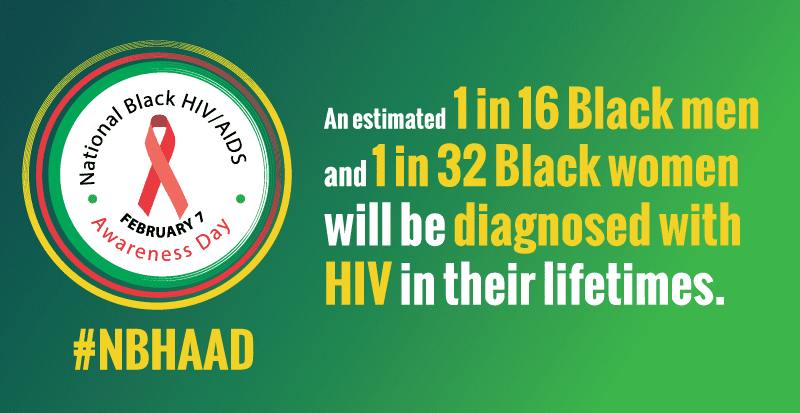
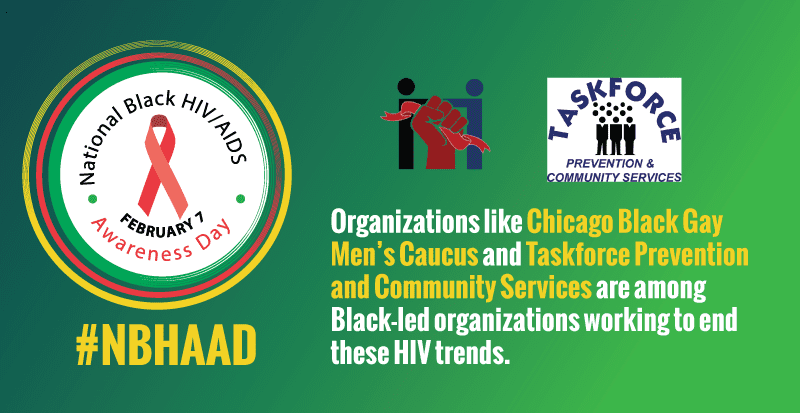
An estimated 1 in 16 Black men and 1 in 32 Black women will be diagnosed with HIV in their lifetimes. It’s time to put an end to these sobering statistics. Help us spread the word about National Black HIV/AIDS Awareness Day (NBHAAD) on Sunday, Feb. 7th.
Below is a roundup of 6 things you can do for #NBHAAD:
- Get tested for HIV. You can find a testing center in your area on http://hivtest.cdc.gov, or by visiting one of our featured HIV testing sites in Chicago.
- Attend a community event like #PrEP4Love LIVE presents CRAZYSEXYCOOL or Black Lives Matter: Research, Policy and Program. Visit the official NBHAAD website for events happening near you.
- Help promote HIV and testing by lending your voice and sharing information about NHBAAD on social media. Here are some sample posts and images to use leading up to and on #NBHAAD:
- 1 week till Nat’l Black HIV/AIDS Awareness Day! Get the facts. Get tested. Get involved. Get treated #NBHAAD
- Feb 7 is Nat’l Black HIV/AIDS Awareness Day #NBHAAD. Help us end HIV in black America. http://bit.ly/1f3mkju
- Today is National Black HIV/AIDS Awareness Day #NBHAAD. Help us end HIV in black America. http://bit.ly/1f3mkju
- African Americans bear greatest burden of HIV in US. Get the facts. Get tested. Get involved. Get treated #NBHAAD
- On National Black HIV/AIDS Awareness Day, get tested. If you have HIV, get treated #NBHAAD http://bit.ly/1f3mkju
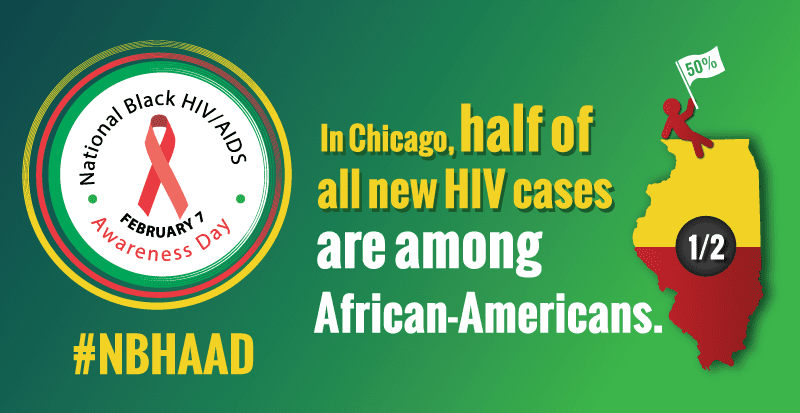
- In Chicago, half of all new HIV cases are among African-Americans. Get the facts. Get tested. Get involved. Get treated #NBHAAD
-
-
-
-
-

- Join the conversation on Facebook, Twitter and Instagram using #NBHAAD. Share/retweet/repost awareness day messages.
- Read and share Inside Story’s from Aidschicago.org about the impacts of HIV in the Black community of Chicago.
- Fighting for Black Liberation in Chicago
- We stand with Black lives
- A shared vision is a vision shared: Caprice Carthans discusses trans healthcare
- Beverly elevates young women and transwomen in new youth led STI prevention campaign
- This is me. This is who God created. An interview with Rev. Charles Straight
- Budget Cute target organizations supporting Black MSM including a vital link to care
- Stay up to date on NBHAAD information by visiting http://nationalblackaidsday.org/