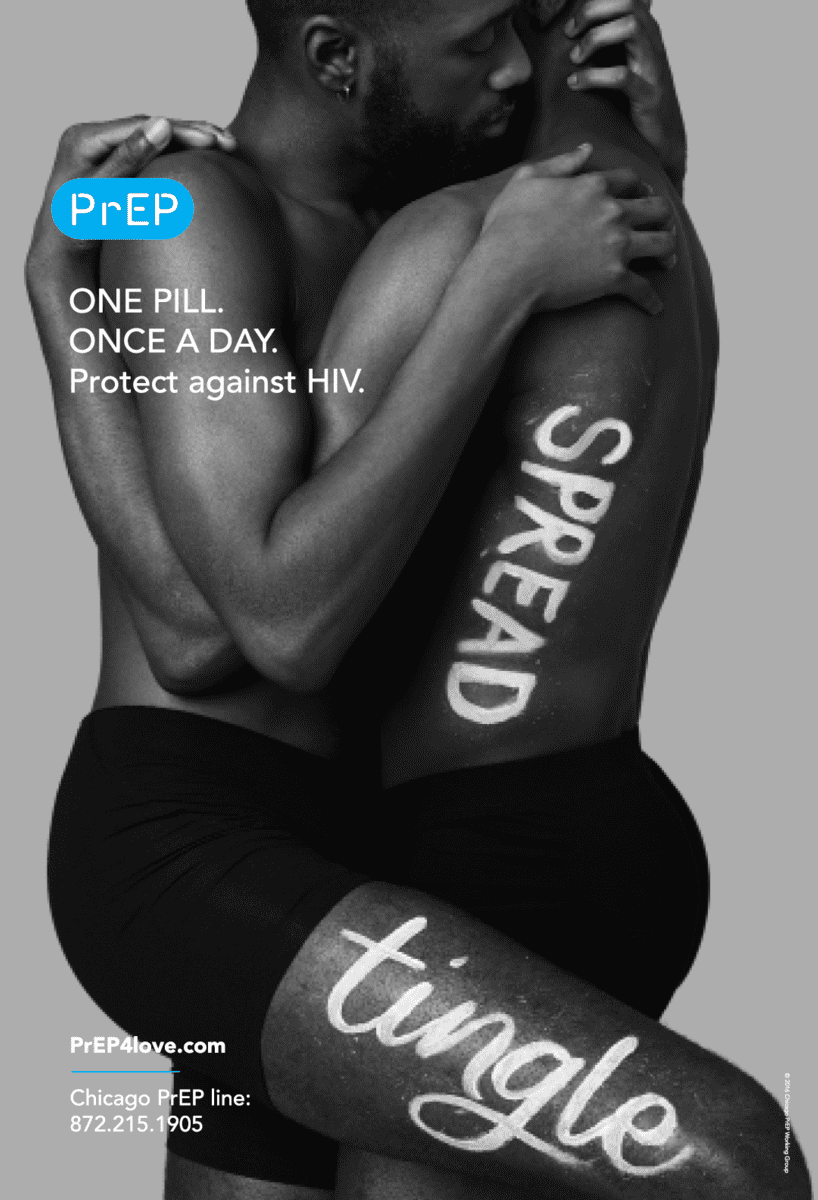
Chicago, February 1 — Today, the Chicago PrEP Working Group (CPWG) launched PrEP4Love, a citywide, sex-positive media campaign designed to increase awareness of PrEP (pre-exposure prophylaxis), a daily HIV prevention pill for HIV-negative people. Honest and visceral photography with a simple tagline — “One pill. Once a day. Protect against HIV.” — is displayed in ads throughout Chicago on CTA trains and buses, as well as in an interactive, heated bus shelter at State and Lake. The campaign also includes a large online advertising component anchored by the prep4love.com website.
PrEP was approved by the U.S. Food and Drug Administration in 2012, is recommended by the U.S. Centers for Disease Control and Prevention, and is endorsed by the White House. PrEP is an extremely important new tool to prevent new HIV transmissions, especially for people who don’t always use condoms in communities where the burden of HIV is great.
PrEP4Love focuses on Chicago communities that are especially vulnerable to HIV, including young gay and bisexual Black men, transgender women of color and Black heterosexual women. The four pairs of models featured in the campaign were discovered through a community model search.
“When people see the campaign, they are going to see real people who are relatable, people they may know personally,” said Beverly Ross, a Chicago-based transgender advocate who is featured in the campaign.
The campaign pairs words often used when discussing HIV transmission like “spread,” “transmit,” “contract” and “catch” with the reasons we enjoy sex — things like love, desire and tingle.
“The campaign message is simple: With PrEP, you can catch desire, contract heat, spread tingle, transmit love and enjoy your sexuality while protecting yourself against HIV,” said John Peller, AIDS Foundation of Chicago (AFC)’s President/CEO. “With just one pill, taken once a day, PrEP lowers your chances of contracting HIV up to 99%. That level of protection offers extraordinary peace of mind, which is incredibly sexy.”
The PrEP4Love campaign is an effort led by AFC and the CPWG, who secured pro bono and volunteer services from four creative agencies: Leo Burnett, Starcom, Spark and Razorfish. These sibling agencies provided creative services, media strategy and website development for the campaign under the auspices of Égalité, the LGBTQIA business resource group of Publicis Groupe. Chicago-based, world renowned photographer Sandro shot the campaign.
The campaign is supported by a generous grant from the Alphawood Foundation and the thoughtful contributions of numerous individuals. Extensive community input, including focus groups, helped shape the campaign.
Said CPWG member Dr. John Schneider, a University of Chicago researcher and physician who prescribes PrEP for his patients, “Our coalition spent over a year developing PrEP4Love, and we’re all very enthused about its debut during Black History Month, a month that also includes National Black HIV/AIDS Awareness Day (Sunday, Feb. 7) and Valentine’s Day.”
Schneider’s group at the University of Chicago manages the Chicago PrEP line [872-215-1905], a phone service designed to help people access PrEP, including linkages to health care providers across the city, health insurance and low-cost or free medication. The PrEP line is highlighted on all campaign materials.
About 1,000 people are diagnosed with HIV every year in Chicago. PrEP is a promising tool that can help slow the epidemic, along with other safer sex practices, ongoing HIV testing, and linkage to culturally competent care and treatment for people living with HIV.
###
About Chicago PrEP Working Group
The CPWG is a coalition of more than 150 individuals representing dozens of Chicago organizations and clinics that provide PrEP services, conduct PrEP education and navigation, perform PrEP research, and engage in PrEP advocacy. The goal of the CPWG is to improve awareness of, and access to, PrEP for those most vulnerable to HIV.
About the AIDS Foundation of Chicago
AFC mobilizes communities to create equity and justice for people living with and vulnerable to HIV and related chronic diseases. We aspire to create a world in which people living with HIV and related chronic diseases will thrive, and new HIV infections will be rare
The AIDS Foundation of Chicago (AFC) is soliciting grant applications for its FY 2016 Sustainability and Organizational Development Program. The Program is based on an approach to capacity building that emphasizes agency effectiveness and impact and seeks to enhance the ability of organizations to achieve their missions. Qualified community-based organizations that want to improve agency infrastructure in order to achieve organizational goals are encouraged to apply.
Micro-grants are made possible by funding from the WellCare Innovation Institute. AFC, in partnership with WellCare Innovation Institute, will support HIV direct service organizations by assessing agency infrastructure and addressing specific capacity building needs. The purpose of the non-monetary grant is to strengthen local organizations and assist them in maximizing organizational effectiveness. This opportunity is intended for AFC Challenge Grantees that provide direct services to vulnerable populations.
Awardees will be paired with a consultant who will work with the agency to address identified needs. Consultants will assist organizations in one of the areas outlined below. The following capacity-building activities are eligible for support and include the assessment and planning for:
- Strategic Planning and Leadership Development
- Fundraising and Financial Management
- Mergers and Strategic Alliances
- Communications and Advocacy
Through the WellCare Innovation Institute Application process, AFC will award up to 5 grants for up to $1,500 each in non-monetary, capacity building consulting time.
The proposal deadline is February 19, 2016 at 5 p.m.
Applications must be submitted through WellCare Innovation Institute’s online application website at:
http://www.thecommunitycommitment.org/micro-grant-request-submission
Award Notification Date: By March 15, 2016
Project Period: March 15, 2016, through June 15, 2016
Amount Available: A total of $7,500 in non-monetary grant awards are available, ranging from $500 to $1,500 each.
Eligibility: Applicants must meet all of the following conditions:
- Is a current AFC Challenge Grant recipient
- Total organization budget between $50,000 and $1 million
Selected awardees will be required to complete the AFC Nonprofit Organizational Assessment and Readiness Assessment.
Outcomes: The organization will determine the outcomes to be achieved. Outcomes may include but are not limited to:
- Cultivate a strong sense of leadership vision, mission, style and values
- Identification and framework for financial and fiscal management
- Initiate creative communication projects that align with organization priorities and promote community mobilization, engagement and increased partnerships
- Identification and increased knowledge of financial management and how to best optimize funding streams
- Support agencies in analyzing and building a strong framework for organizational partnerships, mergers or dissolution
Application: Access the RFA and application for these Micro-Grants at http://www.thecommunitycommitment.org/micro-grant-request-submission
Deadline for submission: Friday, February 19, 2016, 5 p.m.
If you have any questions, please contact:
Cynthia Tucker, Vice President of Prevention and Community Partnerships
312-334-0965 or [email protected]
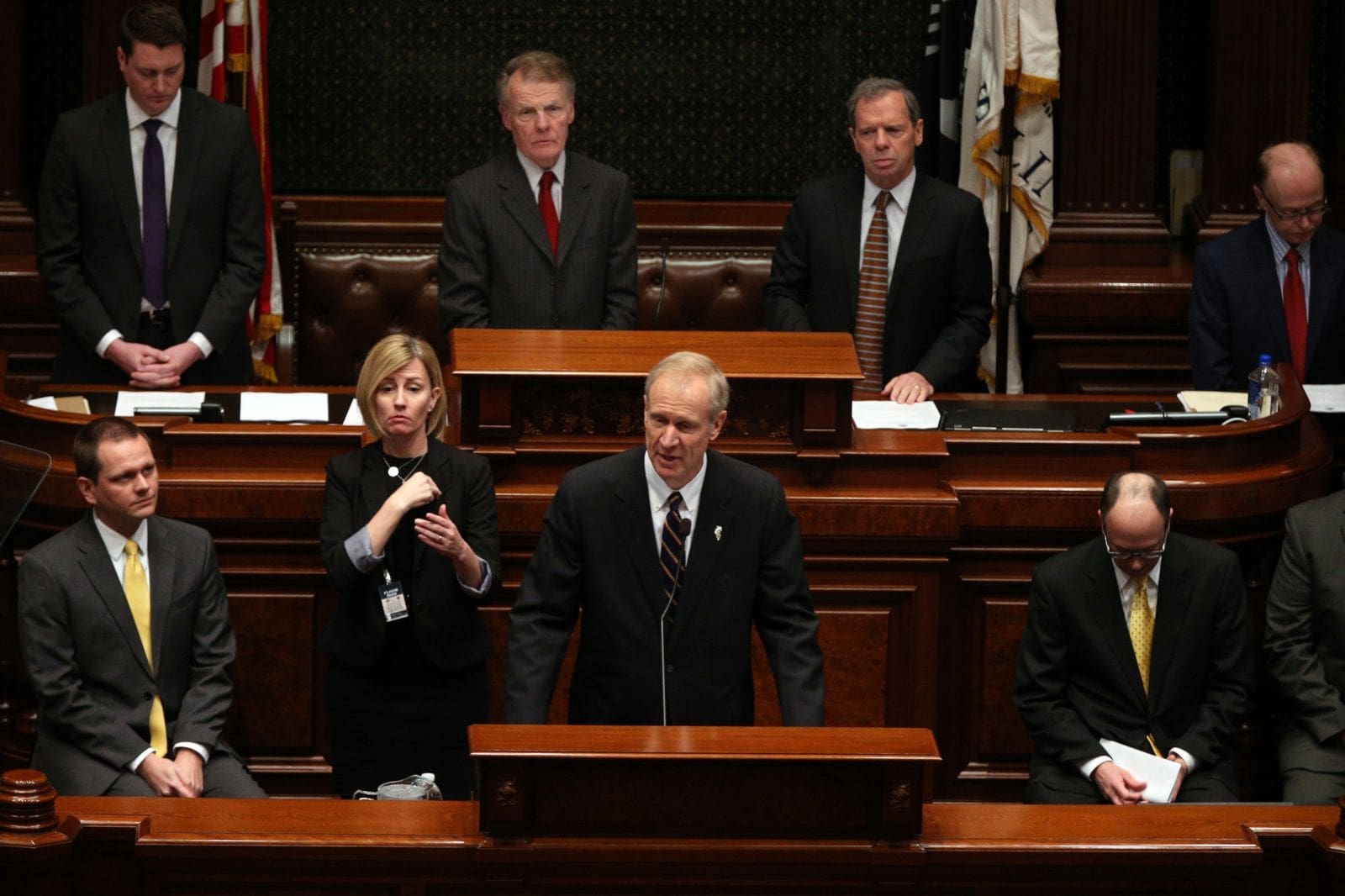 In his annual State of the State address, Gov. Bruce Rauner talked about a myriad of policy initiatives, from worker’s comp and pension reform to economic development and term limits that he claims will improve the quality of life for all Illinoisans and make the state both “compassionate and competitive.”
Here are the top three things the AIDS Foundation of Chicago didn’t hear Gov. Rauner address:
1. Help for Illinoisans who need vital human services
Gov. Rauner didn’t address the human suffering playing out across the state as the seven-month budget impasse between himself and the General Assembly continues to devastate the social service sector, ripping holes in the safety net that serves the needs of the state’s most vulnerable citizens. Just last week, Lutheran Social Services of Illinois (LSSI), the largest statewide provider of social services, announced program closures and staff cuts due to the state’s inability to pay its bills. In all, more than 30 programs are closing, and more than 750 positions are being eliminated – 43 percent of LSSI’s total employees. These closures mean that nearly 4,700 people will no longer receive vital services, including seniors who need home care.
2. A plan that supports people living with HIV
How can the governor claim to be committed to improving the lives of all Illinoisans when his budget cuts are hurting nonprofit human services and providers? His actions are undermining HIV/AIDS programs like the Pediatric AIDS Chicago Prevention Initiative (PACPI), which works with medical providers statewide to ensure that pregnant women who are HIV-positive deliver HIV-negative babies. The 16-year-old program stands to lose $500,000 in state funding but saves the state $35 million a year, will have to close its doors by October if the state fails to pass a responsible budget. The result could very well be an increase in the number of babies in Illinois born with HIV, the virus that causes AIDS.
Rauner’s proposed budget for FY 2016 also cut funding for PrEP4Illinois, a program aimed at increasing access to pre-exposure prophylaxis (PrEP) to help HIV-negative people remain uninfected. PrEP is a once a day HIV prevention pill that is up to 99% effective when taken consistently. Many HIV activists, service organization leaders and medical professionals remain disappointed and angry at this lack of commitment to ending AIDS in Illinois.
3. A way forward
Gov. Rauner spoke of using “mutual respect” to move the state forward, but what’s needed is compromise. His “transformation” and “turnaround” agenda fails to improve public health and bolster effective prevention and treatment programs. In a United Way of Illinois survey of human service agencies in every state county that receives state funding, 85% of respondents reported cutting the number of clients they serve, up from 34% in July 2015. This is not the way forward for Illinois.
We stand with transgender and gender nonconforming students in Illinois and denounce the blatantly discriminatory bill recently introduced in the Illinois House by Rep. Tom Morrison (R-Palatine). HB-4474 would force transgender and gender nonconforming students to use separate bathrooms and locker rooms and that’s plain wrong.
Not only does this bill promote fear mongering, but its sponsor, State Rep. Thomas Morrison, appears to be out of touch with what is happening in education. More schools across Illinois, and across the nation, are adopting humane policies that respect and affirm all students, including students who are transgender and gender nonconforming. This practice has been endorsed and encouraged by noted researchers and leading authorities on education and student development, all of whom encourage the recognition and support of transgender students and how they wish to express their gender identity in a safe, responsible and dignified manner.
HB-4474 would compel many schools who are dealing with this issue in a sensitive way, educating their schools and the public about what it means to be transgender, and fostering a sense of community and acceptance on their campuses to reverse those policies and create unnecessary division and segregation.
The Department of Education recently issued a set of very strong findings, in a complaint brought against suburban Chicago District 211, which found that denying a student who is transgender access to an appropriate restroom or changing area is in violation of federal law, specifically Title IX. Rep. Morrison’s bill would force schools to operate in conflict with that finding, at the risk of losing critical federal funding. With these factors in mind, this does not result in sound and responsible public policy, especially considering the budget challenges facing the state.
The real harm is not just for transgender students but all students regardless of their gender identity. It promotes bullying, gender policing and body shaming – all practices that hurt all students and can be devastating for transgender students trying solely to get the good quality education they deserve.
This bill also feeds into the false narrative that sex and gender fit neatly into a binary model and it should not see the light of day. As organizations that work exclusively or significantly with LGBTQ communities, we encourage the State of Illinois to use its resources to advance supportive and inclusive work that moves all Illinois residents toward full equality.
Sign-On Organizations
Affinity Community Services
AIDS Foundation of Chicago
American Civil Liberties Union of Illinois
Association of Latino/as Motivating Action (ALMA)
Center on Halsted
Chicago Black Gay Men’s Caucus
Chicago House and Social Service Agency
Chicago Youth Storage Initiative
Equality Illinois
Howard Brown Health
Illinois Caucus for Adolescent Health
Illinois Safe Schools Alliance
La Casa Norte
Lambda Legal
Pride Action Tank
The deadline to enroll in health care coverage is approaching fast.
The AIDS Foundation of Chicago and Harvard Center for Health Law and Policy Innovation recently published a collaborative health marketplace analysis that identifies this year’s best health plans for people living with HIV and other chronic conditions in Illinois.
Quality Health Plan Assessments were conducted in eleven states throughout the nation to better understand each individual state’s insurance plan. Specifically in Illinois, over 40 health plans were analyzed. The report found the majority of the state’s plans provide “robust” coverage of HIV medications in 2016. Of all the insurers evaluated, Ambetter was considered an outlier, providing coverage for only 15 out of the 24 observed HIV medications. In contrast, the remaining plans covered at least 20 of the medications.
Overall, the assessment illuminates how some insurers do not cover common and newer treatment regimens — or offer high cost sharing and adverse tiering for HIV and hepatitis C (HCV) medications.
Overall findings
Several areas of concern for people living with HIV and HCV) seeking coverage emerged. These areas include unreliable coverage of commonly prescribed and newer treatment regimens, as well as cost sharing. One alarming cost-sharing approach used by some insurers requires co-insurance to access medications and placing HIV and HCV drugs in the highest formulary tier.
Illinois findings
- 42 silver-level health care plans were assessed in Illinois.
- The vast majority of silver-level health care plans offered in 2016 for Illinois for people living with HIV provide fairly robust coverage of HIV medications. The outliner was Ambetter, which covered only 15 of 24 assessed medications. The remaining 39 plans in Illinois covered 21-24 of the available medications, with 38% of plans covering all 24.
- 67% of Illinois marketplace plans cover all three of the new HCV medications (Sovaldi, Harvoni and Viekira Pak). The remaining 33% of silver-level plans only cover Sovaldi and Harvoni.
To learn more and read the full report, click here.

Maxx Boykin on stigma, Laquan McDonald and the end of state and community violence
A steady fire is burning in Chicago. The flames of racial injustice have licked the edges of one of America’s largest and most powerful cities since long before the Great Chicago Fire.
Almost one month ago, that fire was fed by the release of a video — a video showing one more example of police-led brutality against people of color in the city of big shoulders. Chicagoans have taken to the streets to call for resignations, for justice, for change.
Maxx Boykin is stoking those flames of action. He serves as a community organizer with the AIDS Foundation of Chicago (AFC) and Black Youth Project 100 (BYP100), which mobilizes youth to create justice and freedom for all Black people. Boykin leads communities to improve access to health care, end state violence, erase HIV stigma and liberate Black lives in Chicago and across the nation.
“What we’re fighting for is black liberation,” said Boykin. “That is something that has never truly been seen in this country, but something we’ve always been fighting for.”
AFC sat down with Boykin earlier this month to discuss the apparent coverup of the murder of Laquan McDonald and how it relates to the larger intersection of the movement for Black lives and HIV.
AFC: You’re from Stockbridge, Georgia, near Atlanta. What brought you to Chicago?
Boykin: I came up during the Affordable Care Act implementation and worked with Enroll America to do outreach and education. I helped get people signed up and helped keep them signed up. We touched in my region over 400,000 people. The city of Chicago has a lot of people, and the South Side in particular [which was in Boykin’s region] has a lot of uninsured, including in my neighborhood, Washington Park.
What inspired you to get into the health insurance arena?
Health insurance was really important to me because I’ve seen how it impacted people’s lives. My aunt, who had cancer for four years, was not able to get treated — not because she didn’t know about the cancer, but because she couldn’t pay for the treatment. And to see that happen made it really important to me. I also have seen people stigmatized and die from stigma of being a Black gay or bisexual man or being a person that’s living with HIV and not get the help that’s out there. People don’t know about the treatment options out there — and that’s why I thought this work was important.
You’re also deeply engrained in Chicago’s youth empowerment movement.
Yes — I’m part of Black Youth Project 100. It’s a group of activists and organizers throughout the country who are working toward Black liberation. We operate under a Black queer feminist lens, so that the most marginalized people in our community are uplifted. We do direct action to bring awareness of the wrongdoings of those who are in power — not just awareness, but to push those people of power to not just recognize the situation but to move forward on new legislation or hear from those people who are typically silenced.
In the wake of what appears to be a high-ranking cover-up of the now-infamous video of Laquan McDonald being shot to death by a Chicago police officer, what is BYP100 doing to fight back?
We’re putting the spotlight on the fact that the city of Chicago spends 40% of budget on the Chicago Police Department. That means 40% of our taxes go toward funding the police, which is the city’s largest agency, rather than Black futures. The city has taken away mental health clinics in the city, as well as child care, our school system, after school programs and more. Those were taken away because of the failure of our state budget and the failure of our city to bulk up funding for those services, and then spend more money on programs like the police.
How does that disproportionate police funding affect Black communities?
Increased police funding can amplify state violence. State violence then perpetuates community violence. For instance, if the state takes away money from a neighborhood or fails to invest in neighborhoods that are Black and communities of color by taking away schools, etc., and then continue to over-police Black lives, they are taking value away. They’re taking away resources so people are doing things we consider illegal because they’re just trying to survive. They’re taking value away from those neighborhoods, because from the outside looking in, people don’t see value, so then from the inside looking in people don’t see value in the lives of people in their community and are just trying to do things to survive. If you’re not doing anything to keep those communities safe, you are perpetuating community violence.
When we take away people’s chance for success, then how is the state doing its job? And also in a city where Black people make up a third of the population and people of color make up two-thirds of the population, then the city as a whole is having an issue, because two-thirds of the people are not getting the resources they need.
Now that the video has been released, where do we go from here?
The police must be accountable to the people. They have not been for multiple different reasons. If you look at the death of Laquan McDonald; if you look at the death of Rekia Boyd in 2012, there is a lack of accountability and justice.
Curtailing the powers of the entity that has continually oppressed people is a start. The U.S. Department of Justice and federal government should not have to step in when these problems happen. The city and Cook County should be able to say, “We are not going to let you be a police officer when you do these things; we are not going to let you run rampant against folks, and we will shut down these systems.”
Over the last five years, Chicago Police Department officers have killed more people than any other city in the country. The police officers that have killed or done wrong in this city must be dealt with. The majority of complaints against Chicago police officers come from Black people. Only 2% of those actual complaints end up in any type of reprimand against the accused officers. Clearly, the systems in the police department have to change, and the people in charge of them need to change, because they have failed our communities on a regular basis.
One aspect of community violence is stigma, especially against people who are living with or vulnerable to HIV. How do you see stigma in the Black community around HIV and AIDS?
Stigma killed my uncle, being a Black man who wasn’t able to live a free life to be himself. As long as that is also a problem, then you also can fall into very risky behaviors because you’re not allowed to be your full self. Stigma was one of the reasons that HIV and AIDS weren’t treated earlier, and we’ve also seen that perpetuated in our own communities where people aren’t able to be themselves. What are we doing to have a support group for people who are going through these different things?
And then people aren’t getting tested for HIV; they’re like, “oh, if I’m getting tested for HIV I must be gay and doing risky things, let me not ever get tested.” That’s how we have many people who do not know their status. If we continue to stigmatize people around it, people won’t be free to deal with those things. AND if we keep criminalizing people with HIV, then people can be like, “well, I’d just rather not know [to avoid prosecution for HIV-related crimes].”
What can be done to change that?
Having more transformative and less stigmatizing sexual education is a good starting point, but also continued sex education. I think you should start sex ed very young but also continue it on through high school and college.
I was talking to one person at a conference, and he said when he came out to his mother, she said, “I don’t want you to get HIV and die.” As we know, HIV is not a death sentence, but that’s not what their parent thought. There’s been a lot of changes and new technologies since then, including highly advanced treatments to allow a person living with HIV to live a near-normal lifespan and prevent almost any chance of transmitting the virus.
Where can an organization like the AIDS Foundation of Chicago and its projects, like Pride Action Tank and HIV Prevention Justice Alliance, play a role in ending state violence?
We are embracing the fact that ending the HIV epidemic is part of greater social justice issues. Our Policy and Advocacy team is developing a health equity framework to find ways in which our work intersects. HIV and AIDS is part of a greater movement for a complete health justice. Health is a social justice issue, and HIV and AIDS as an epidemic has grown in the Black community because of those social and economic determinants of health. If you don’t have jobs or hospitals in your neighborhood, it’s hard to live a healthy lifestyle. So we’re coming together to build paths toward health justice. So we’re talking about getting people proper housing and jobs, attacking stigma, making sure that people who are trans have easier access to change their IDs, making sex safer in prisons — these are all things that can lead to better health in communities.
What can individuals do to support Black liberation?
We need to speak up when we see wrongs in communities. We need to consider how state violence affects everyone, especially young Black queer people. We must hold people’s hands to the fire when necessary and let those in power know when things aren’t right. We have to make sure that the police are accountable to civilians. We need to build communities where people can speak up when they see wrongdoing.
The AIDS Foundation of Chicago (AFC) lauds the U.S. Congress in their relentless work to negotiate and pass a domestic budget that continues to strengthen and support critical HIV/AIDS services and programs into 2016.
Under the budget deal, Congress has made several noteworthy bipartisan commitments in their support for domestic HIV/AIDS programming, including:
-
 Ensuring integrity of all aspects of Ryan White funding with no cuts or consolidation
 - Restoring proposed cuts to Special Projects of National Significance (SPNS) and the Minority AIDS Initiative (MAI)
- Funding increases to hepatitis C (HCV) prevention, Housing Opportunities for People Living With HIV/AIDS (HOPWA), and MAI
- Groundbreaking language that supports the use of federal funds for syringe exchange activities that do not involve the actual purchase of syringes
More importantly, many of these commitments strongly back the newly-released National HIV/AIDS Strategy Updated to 2020 and its implementation plan by legislatively supporting a robust and well-funded domestic response that aligns with the goals of the strategy.
Despite the positive budget, advocates note a disappointment in the failure for Congress to modernize the formula on how funds are disbursed through HOPWA for high-need areas such as the Southern U.S. Moreover, advocates express uncertainty on how a $2 billion increase for National Institutes of Health (NIH) will translate to an HIV/AIDS research portfolio that is currently under threat. These areas, among others, will continue to be the focus of federal advocacy by AFC and its partners.
Additionally, while there is encouraging progress on HIV/AIDS funding for 2016 on the federal front, which will support communities impacted by HIV in Illinois, there continues to be a budget impasse in Springfield that drastically affects access to both HIV/AIDS programming and social services. AFC continues to call on Illinois state legislators to urgently pass a positive budget that can be complemented by federal dollars from this latest federal budget deal to fully address the epidemic in Illinois.
by Ernesto Flores
HIV Prevention Justice Alliance Fellow
Since the introduction of the Affordable Care Act (ACA) in March 2010, reports show that 11.4 million people became newly insured between 2010 and 2014, and the number of uninsured dropped to about 11% in 2015. Of those people, about 48,000 people living with HIV and AIDS (PLWHA) are among those who recently enrolled.
Section 1557 is a part of the ACA that bans discrimination on the basis of race, color, national origin, sex, age or disability. While Section 1557 brings anti-discrimination regulations into the 21st century by prohibiting discrimination based on gender identity and sex stereotyping, it offers a slim definition of what it considers a disability and poorly defines discrimination and discriminatory practices. It also employs vague language in general, which opens up the opportunity for plenty of loopholes.
Section 1557’s protection against disability also falls short of covering many major chronic conditions associated with HIV. Although HIV is currently classified as a disability, other chronic conditions like hepatitis C are not. Hepatitis C can be asymptomatic, which means symptoms might not be noticeable until later stages of the disease. But waiting for the worst of the symptoms to appear in order to be protected by Section 1557 is not only discriminatory but cruel. By not including chronic diseases as disabilities, a large population in need is left out, like injection drug users and other people at risk.
There is an even bigger need to clarify the guidelines of what are considered discriminatory actions against PLWHA. One of the biggest issues in obtaining insurance coverage for PLWHA is insurance tiering, which is the intentional practice of making insurance plans that cover HIV medication far too expensive for most PLWHA.
For example, 63% of qualified health plans put HIV medication in the most expensive insurance tier. Not only is that a problem, but 28% of all HIV drugs are not even covered at all. In other words, PLWHA are unable to afford an insurance package that covers their prescribed medications, and if they want them, they have to pay out of pocket. This is perhaps the cruelest form of discrimination and the biggest battle to fight with proposed recommendations for Section 1557.
The most important part of these regulations is that it allows for private rights of action, which means it allows regular people to bring civil action, or essentially sue the marketplaces in federal district court, and sue insurers who have acted in a discriminatory manner. This is a chance to stand up for what is right!
Having these comments heard is crucial for PLWHA. After all, this is precisely what the Affordable Care Act was made for: to grant access to health care coverage to people who were unable to afford it, regardless of their health condition or income.
Want to get some quick background info on 1557? Check out a Center for Health Law and Policy Innovation (CHLPI) webinar about Section 1557 here.
Updated Dec. 22, 2015 with finalized report from the AIDS Foundation of Chicago (AFC) and Center for Health Law and Policy Innovation of Harvard Law School
To help people living with HIV and hepatitis C (HCV) choose health insurance marketplace plans, the AIDS Foundation of Chicago (AFC) and Center for Health Law and Policy Innovation of Harvard Law School have collected information on HIV and HCV medication coverage for each plan.
Provided are examples of what a person living with HIV might pay for HIV medications and coverage. Keep in mind:
- Do not rely solely on the information in this document to choose a plan — it is only a guide.
- Need help choosing a plan? Consult a trained enrollment assister for help in selecting a plan. People with HIV and co-infected with HCV in the Chicago area can reach AFC’s navigators at 312-784-9060. People living with HCV only or people with HIV living outside the Chicago area can call 1 (866) 311-1119 and visit www.getcovered.illinois.gov.
- Always verify medication coverage directly with a plan before enrolling. Insurance companies can change their coverage without telling consumers.
- We only looked at the cost and coverage of a few HIV and HCV medications. Contact the plans directly if you take medications that are not listed here.
- Act fast! You must enroll by Tuesday, Dec. 15, 2015, for coverage to begin on Jan. 1, 2016. The deadline for enrolling in a marketplace plan for 2016 is Friday, Jan. 15, 2016.
- The Illinois Medication Assistance Program (MAP) (formerly ADAP) and the Premium Assistance Program (PAP-formerly CHIC) can help! If you sign up for the MAP and/or PAP and enroll in a coordinating plan, you won’t pay premiums or any out-of-pocket costs for HIV medications. Read more about MAP below. Please be reminded that MAP pays for the medication portions, PAP pays for the premiums.
| 2016 plan assessments by insurance provider | ||
|---|---|---|
| Aetna | Ambetter | Blue Cross Blue Shield |
| Coventry Health Care | Harken Health | Health Alliance |
| Humana | Land of Lincoln Health | UnitedHealthcare |
The Illinois Medication Assistance Program (MAP) can help!
Fortunately, the Illinois Medication Assistance Program (MAP-formerly ADAP) and the Premium Assistance Program (PAP-formerly CHIC) can help people with HIV afford medications on plans purchased through the marketplace. MAP covers these costs because successfully treating HIV has significant benefits for individuals with HIV, as well as the community. People with HIV who have an undetectable viral load have better health outcomes. Moreover, they are far less likely to transmit HIV in the community.
People enrolled in MAP and PAP won’t pay monthly premiums or any out-of-pocket costs for HIV medications that are part of the MAP Formulary. However, to benefit from these programs, you must select a silver plan from one of these insurance companies:
Ambetter – Silver Plans Only
Aetna – Silver Plans Only
BlueCross BlueShield – Silver Plans Only
Health Alliance – Silver Plans Only
Humana – Silver Plans Only
United Healthcare – Silver Plans Only
PAP can help individuals pay up to $750 per month toward monthly premiums.
If you are eligible for MAP or PAP, you must select one of these plans in order to receive any benefits. To apply or for more information about the programs, including eligibility requirements, contact MAP/PAP at 800-825-3518 or visit iladap.providecm.net.
MAP does not cover HCV treatment or assist people who are mono-infected with HCV.
Pre-Exposure Prophylaxis (PrEP)
People who are not infected with HIV may be able to take a medication to help prevent infection. Currently only one medication, Truvada, is approved for this use. To date, AFC has not heard reports of insurance companies denying coverage of Truvada as PrEP. The monthly cost of Truvada can be found in AFC’s PrEP plan assessment, found here.
Important notes
The medications we chose to examine make up the “recommended” and “alternative” regimens according to the Department of Health and Human Services’ Guidelines for the use of antiretroviral agents in HIV-1-infected adults and adolescents.
All coverage information was accessed between Nov. 1 and Dec. 7, 2015, using the marketplace website (healthcare.gov), the health insurance companies’ websites, and via calls to insurance companies’ customer service representatives. This information can change at any time and should be verified with the insurance company before enrolling in any plan.
Actual prices will vary between pharmacies, and consumers should check with pharmacies before purchasing medications or selecting a plan that relies on coinsurance. Consumers should consider selecting a plan that requires a copay rather than coinsurance. A copay is a fixed and predictable amount of money and is typically considerably less than a coinsurance when applied to the costly medications used to treat HIV.
More than 1,100 guests, some decked out in their finest 1920s costumes, came together at Union Station to celebrate the AIDS Foundation of Chicago’s (AFC) 14th annual World of Chocolate gala on Thursday, Dec. 3.
 The larger-than-life celebration really was the bee’s knees — offering guests the chance to try chocolate inspired creations from 27 of Chicago’s top chocolatiers, chefs and caterers. Held annually in commemoration of World AIDS Day, this year’s event raised $120,000 net in support of AFC’s continued care, policy, advocacy and education work.
Treats ranged from sweet bites to savory selections, and attendees also flocked to the speakeasy-inspired bars for some scrumptious chocolate cocktails. An expert panel of judges, including local celebrities and renowned Chicago-area chefs, judged the participating vendors in five categories:
People’s Choice: InterContinental Chicago Magnificent Mile
Best Sweet: Kendall College of Culinary Arts
Best Savory: Chicago Athletic Association Hotel / Cindy’s Rooftop
Best Libation: CH Distillery & Cocktail Bar
Best Small Business: Fred’s at Barneys New York, Chicago
Best Large Business: The Peninsula Chicago
The judges’ panel included: A Cook’s Canvas food writer Veronica LePinske; Alliance Bakery owner and executive pastry chef Peter Rios; Chicago Chocolate Tours founder Valerie Beck; Just Like U Like It Catering founder Andrea Alexander; Tastemaker for Mariano’s Lorin Adolph; former Clinton Administration White House Social Secretary Laura Schwartz; and WLS (ABC)’s franklyHANK, Hank Manheim.
Throughout the evening, as molls and dolls tired of treats or dancing, they could wander over to a lavish punchboard or raffle in the hopes of winning one of three luxury vacations or a variety of other extravagant prizes.
“This event gives the community an opportunity to come together not only to celebrate our successes, but to refocus on the year ahead and the work we will do together to make HIV infections more and more rare,” said AFC President/CEO John Peller.
Funds raised through World of Chocolate support AFC’s work to end new HIV infections in Chicago and beyond. Proceeds from the event will:
- Help more than 5,000 people each year know their HIV status
- Support efforts to house 1,100 Chicagoans who are experiencing homelessness
- Enable more than 5,300 clients to receive case management services
- Fund trainings for hundreds of medical professionals about PrEP
Generous vendors participating in World of Chocolate included: the Brass Monkey, CH Distillery, Chicago Athletic Association Hotel, Chocolat Uzma Sharif, Dove Chocolate Discoveries, Fred’s of Barneys New York Chicago, Hilton Chicago, Intercontinental Hotel, Italian Village Restaurants, Kendall College School of Culinary Arts, Le Cordon Bleu College of Culinary Arts, Life’s Sweeter Side, Loews Chicago Hotel, Mercat a la Planxa, the Peninsula Chicago, Prasino LaGrange, Riques Cocina Mexicana, RL Restaurant, Sofitel Chicago Water Tower, Starbucks, Summer House Santa Monica, Uptown Brownie, Vanille Patisserie, Virgin Hotels Chicago, Walgreens, Wow Bao and ZED451.
This year’s World of Chocolate sponsors and media partners included:
A&U Magazine; Aetna Better Health of Illinois; AFR Furniture Rental & Event Furnishings; Barry-Callebaut; Bell Litho; BestGayChicago.com; BMO Harris Bank; Chicago Magazine; ChicagoPride.com; Food for Thought; Gilead; GRAB Magazine; Harmony, A WellCare Company; Humana; IlliniCare Health; Kehoe Designs; Lady Gregory’s Irish Bar & Restaurant; Macy’s; McDonald’s; Michigan Avenue Magazine; MillerCoors; Northern Trust; Northwest Speech & Hearing Center, Ltd.; Orbitz; PepsiCo; Public Communications Inc.; Rise Interactive; Stoli; Walgreens; Whole Foods; Wilde Bar & Restaurant; Windy City Media Group; and Winebow.