And on Sundays, they have softball — not just America’s pastime, but theirs, too.
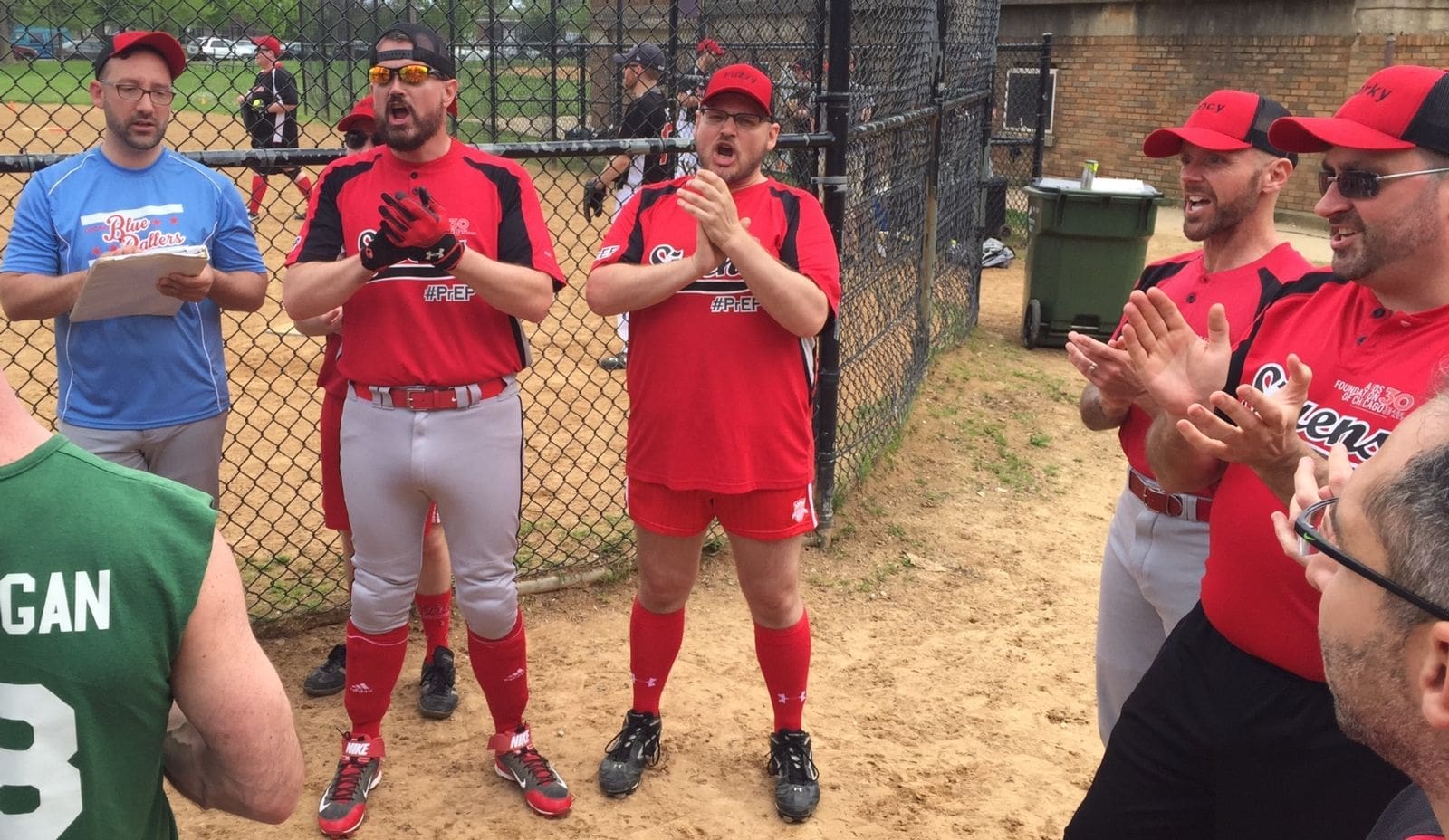
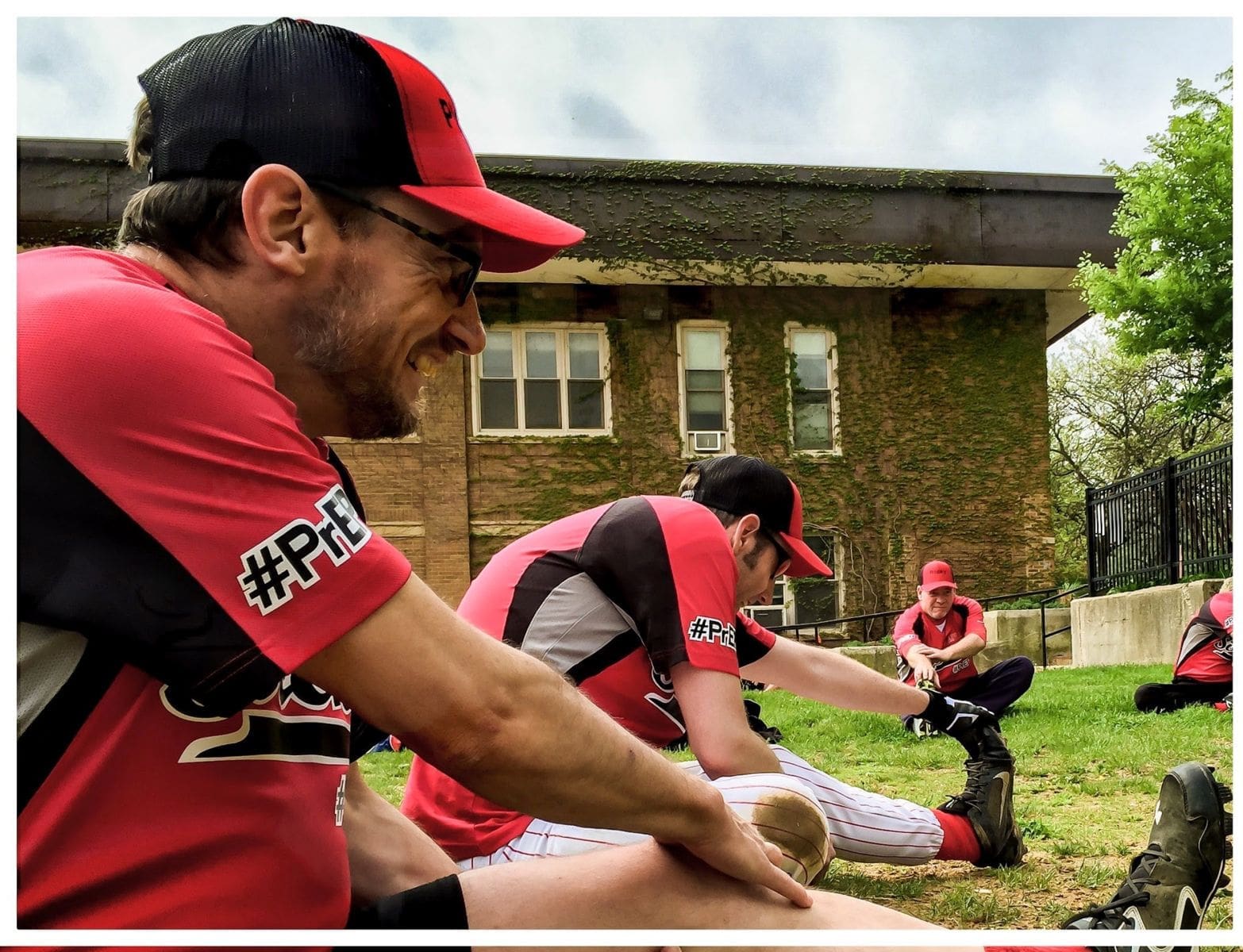 LT and Vinny are two of 17 teammates on the AFC Sirens, an intramural LGBTQ softball league that’s part of the Chicago Metropolitan Sports Association.
While LT and Vinny live in Chicago now, they met in 2007 in Palm Springs, CA, at a resort while Vinny was taking a break from visiting every baseball stadium in the U.S., a project that took him two years.
“It was intended to be a summer fling, but it ended up being … more than that!” mused LT. The couple married in California in August 2013 (and had a marriage ceremony before that, in 2011).
This is their fifth summer of softball. They joined a team with two other Chicago Gay Men’s Chorus members and later formed a team sponsored by the chorus itself, the Sirens.
“We are really aggressive about saying, ‘If you’ve never played softball before — if you’ve never played sports before — it doesn’t matter,’” said Vinny. “People who were told early in their lives, ‘you’re a theater kid; you’re not allowed in the sports world,’ never went back to that. But those people really enjoy this space [the Sirens] to try something different — and some of them discover they’re really good at it!”
“A lot of people, particularly in our age bracket, wrote off sports because they felt excluded by the hyper-masculine, locker-room stuff,” continued LT. “A few decades later, they discover they like team sports!”
 In 2015, the Sirens became sponsored by the AIDS Foundation of Chicago (AFC).
“We were stoked about the AFC sponsorship because we wanted the team to have a face that stood for something important,” said LT. “And Joshua [Oaks, AFC’s Digital Policy Manager and the team’s scorekeeper] really wanted to have PrEP as part of the mission, and we felt that mission fit really well in our team.”
In fact, many members of the AFC Sirens proudly take PrEP, a pill and a program to prevent new HIV infections, and talk about it with people who see the large “#PrEP” on their jerseys. And at one of the team’s preseason practices, Jim Pickett, AFC’s director of gay men’s health, gave the Sirens a brief lesson about PrEP.
“Hearing some of the advantages that PrEP offers gets you into a systematic way of thinking about your health — you see a doctor quarterly; you are being more proactive about your own health,” said Vinny. “That makes people healthier and helps them avoid getting HIV.”
Both men have been touched by HIV — in love and in life. LT and Vinny each lost a partner to AIDS-related complications; LT even wrote a musical about being with his partner who died called All That He Was.
Vinny contracted HIV in 1993. “I’ve been very lucky to be diagnosed right when the antiretroviral medications came out. I’ve been undetectable pretty much since I was diagnosed.”
Being a serodiscordant couple hasn’t always been easy, said LT, but they have maintained a strong optimism throughout their relationship. “I’m not a person who lives in fear. When Vinny told me he was HIV-positive, I knew it was going to be fine. I know people who would run from that, but I knew it was going to be fine.”
 LT has been using PrEP for two years now. “My being on PrEP has taken the small weight that there was off my shoulders.”
Those shoulders now focus on swinging bats and throwing a softball in a north-side softball field each Sunday. The AFC Sirens will compete for first place in the playoffs this weekend; LT and Vinny are hopeful that the winning streak the team has experienced will help them pay off on Sunday.
“It’s not all about winning, but wining is better than losing!” joked LT.
Stigma: In and Out is a monthly series profiling the clients, providers and leaders of AFC’s Corrections Case Management program, which helps HIV-positive people emerging from prison or jail get the support they need upon reentry.
While visiting the Austin Health Center of Cook County CBC Initiative, you may come across Derrick Burris, a volunteer peer educator working with the Corrections Case Management program as a part of the Returning Citizens Circle. He has managed to take a challenging past and turn it into a promising future.
Born the youngest of four children at Cook County Hospital, Derrick had no idea the struggles that he would overcome in his lifetime. It was in his early twenties that Burris’ long battle with drugs began. Being young and gay brings about many struggles, especially for a young black male on the west side of Chicago.
Burris’s consistent struggle with cocaine continued for years and introduced him to sex work, which led to his seven-month prison sentence in 2004. While in prison Burris was confronted with ignorance regarding his sexual preference from other inmates that made his stay very challenging at times. When Burris was released from prison and surrounded with insurmountable discrimination and isolation, he returned to his drug use and sex survival work.
Derrick Burris has been HIV-positive since 1995; he found out when he was in his early twenties, during the same turbulent time in his life when he was experimenting with cocaine. Being HIV-positive, a returning citizen and past drug user, Burris is no stranger to stigma. While incarcerated, Burris discontinued the use of his treatment medications to avoid being seen as different from his fellow inmates and to maintain his privacy. With all of the struggles that Burris has faced in his lifetime, today he still finds himself struggling with the feeling of not being worthy of being loved.
Burris uses all of his life experiences to better his community. It started within himself, finding the strength to do the hardest thing in his life: break free of drugs. Burris has refrained from the use of drugs for the past eight years now and has no plans on returning to the habit.
Burris has been an active member of the Returning Citizens Circle for 2 years now, and he looks forward to coming into the sessions with an optimistic frame of mind. The returning citizen’s circle is perfect for people like Burris because he is able to not only maintain his sobriety easier, but he is able to share viewpoints, and help others sort out their own feelings. Burris through growth and resilience often makes encouraging declarations during the group sessions like, “I have HIV — HIV doesn’t have me!”
He is seen as a mentor and role model to many of his peers, which is how he earned his position as a peer educator at Austin CBC. Burris helps facilitate support groups, conducts HIV testing and more. Having worked in this position for the past nine months, Burris has begun to make plans for his future career in the HIV field. He plans to return to school to begin courses to be a drug counselor.
As a community advocate, Burris has taken on responsibilities as they come. He annually produces a World AIDS Day program at his church, Harmony Community Church, where he is a member. During the program, preventive skits are performed, HIV testing is administered and members are educated about HIV as a whole. Recently married to his partner, Derrick is changing his life for the better, and not looking back unless it is to inspire and teach.
In the case of Burris vs. Stigma, Burris is winning and plans to keep winning. “Do not let people label you; you are worth more than they say you are,” he declared. Stigma has two sides: the side that can break you, and the side that can inspire you to stand up against letting imposed untruths win against you.
For decades, Walgreens has supported the AIDS Foundation of Chicago in its quest to make HIV infections rare and support people living with HIV and related chronic diseases.
Walgreens’ Senior Director of Virology Glen Pietrandoni shares his story of serving the HIV community for 30 years. He also explains how Walgreens is uniquely positioned to support people living with HIV and AIDS across the Chicago area and nationwide.
The program started three years ago when Vida/SIDA noticed the high percentile of clients they were helping who were between the ages of 18 and 24, LGBTQ and more importantly, homeless. In the beginning, El Rescate was with no funding at all, but with help from the Chicago Department of Public Health, the project was funded for its first year, and now is successful. Currently housing 21 residents with a capacity for 25, El Rescate is taking on the responsibility of teaching youth residents basic living skills.
“Our intent is to make these kids successful,” says Jorge Cestou, director of programs and services with Vida/SIDA. Working with two in-house advisors, residents are shown the basic skills — like grocery shopping, cooking and household chores — needed to live alone and be self-sufficient. Given a curfew of midnight on weekdays and 1 a.m. on weekends, the residents are able to stay focused and well-rested for the work or school day ahead while maintaining a healthy social life as well. Residents not in school are allowed to work full-time jobs if they stick to a mandatory savings plan, setting them up for a smooth transition into their own space, with two months’ rent and deposit saved already.
Other community partners have also come in to conduct trainings with residents as well: The University of Illinois at Chicago, Roberto Clemente High School and most recently, Groupon, which offered mock job interviews for the youth.
AFC is excited about enriching the partnership with Vida/SIDA by working with El Rescate to build a continuum to the program for youth who are HIV-positive, with the ultimate goal of transitioning them into permanent housing.
“We are excited to be working with our partner, who has experience working with youth, so that we are able to provide services to our youth,” said Dave Thomas, director of supportive housing partnerships for AFC.
With the current focus of funding being on homeless families and people 55 years old and up, there are few vacant beds available for this specific group of people in the system. But with the help from the Chicago Department of Public Health this can be a shift in housing for not only AFC but the Chicago community as a whole.
Together Continuing 30 Years of Action to Change the Story of HIV
In advance of National HIV Testing Day on June 27, 2015, the AIDS Foundation of Chicago (AFC) is pleased to announce a community outreach partnership with Harmony Health Plan of Illinois, a subsidiary of WellCare Health Plans, Inc. The campaign, “Together Continuing 30 Years of Action to Change the Story of HIV,” aims to build awareness of HIV testing, care and holistic health services in Chicago communities.
“Harmony is very excited to partner with the AIDS Foundation of Chicago and Step Up. Get Tested. in June to heighten awareness around National HIV Testing Day,” said Dr. Robert Hilliard Jr., president of Harmony Health Plan of Illinois. “Additionally, this partnership will promote holistic health and wellness by providing routine testing and screenings for hypertension, hepatitis and diabetes. The goal of our partnership with AFC is to meet people where they are in their health care needs to positively affect their quality of life and provide sustainable support and services for communities.”
WellCare coordinates health care services for people eligible for government-sponsored coverage, such as Medicaid and Medicare. The plan focuses on vulnerable populations, such as those who are elderly, low income, disabled as well as people with complex medical issues. The overall goal is to help them lead better, healthier lives.
The AFC and Harmony campaign will launch in conjunction with a Harmony sponsorship of Step Up. Get Tested., which is a Chicagoland HIV Testing Collaborative—a group of 34 community and public health organizations that have joined forces to promote HIV testing in the city’s most vulnerable communities since 2012.
During the month of June, Harmony’s sponsorship of Step Up. Get Tested. will support an HIV testing and linkage to care campaign for Cook County residents. The campaign goal is to test over 5,000 community members.
“AFC is thrilled to be partnering with Harmony to build awareness of HIV testing and care. In our 30th year of action, we have an unprecedented opportunity to prevent new cases of HIV and provide even greater support to those living with and vulnerable to HIV,” John Peller, AFC’s President/CEO, said. “Harmony’s partnership will help support our efforts to realize this opportunity.”
The initiative will include bus shelter, print and radio advertisements that feature a collaborative campaign message and call-to-action to drive HIV testing and participation in targeted communities.
About the AIDS Foundation of Chicago
Founded in 1985 by community activists and physicians, the AIDS Foundation of Chicago (AFC) is a local, national and international leader in the fight against HIV/AIDS. AFC collaborates with community organizations to develop and improve HIV/AIDS services; fund and coordinate prevention, care, and advocacy projects; and champion effective, compassionate HIV/AIDS policy. To learn more, visit www.aidschicago.org. .
About WellCare Health Plans, Inc.
Headquartered in Tampa, Fla., WellCare Health Plans, Inc. (NYSE: WCG) focuses exclusively on providing government-sponsored managed care services, primarily through Medicaid, Medicare Advantage and Medicare Prescription Drug Plans, to families, children, seniors and individuals with complex medical needs. The Company serves approximately 3.8 million members nationwide as of March 31, 2015. For more information about WellCare, please visit the Company’s website at www.wellcare.com or view the company’s videos at https://www.youtube.com/user/WellCareHealthPlan.
In honor of National HIV Testing Day on June 27, Chicagoland’s Step Up. Get Tested., presented by Harmony, A WellCare Company, will host a monthlong series of events designed to engage the city and surrounding areas around HIV testing.
Events:
Each year, May 31 marks the end of the Spring Legislative Session. Typically, Illinois’ House, Senate and governor come to an agreement on a state budget and any substantive changes that will go into effect at the beginning of the new fiscal year on July 1.
This May 31, however, was anything but typical.
The House and Senate last week passed budgets for state agencies — but without a single Republican vote in favor and a $3 billion hole between the appropriations and the state’s revenues.
Governor Bruce Rauner promises to veto it. With his election in November on his promise to “Shake up Springfield,” there was always the possibility that partisan gridlock would prevent state government from functioning in the usual fashion. Since the start of the spring legislative session, that prediction has held true.
The governor had been conducting private working groups, looking to leverage the budget to get his “Turnaround Agenda” of substantive changes passed in exchange for revenues and a manageable fiscal year budget. House Speaker Mike Madigan, D-Chicago, and Senate President John Cullerton, D-Chicago, have refused to give in, and it appears that legislators are back to the drawing board. Governor Rauner has promised an aggressive public relations campaign over the summer and an extended extra session after July 4 to combat the Democratic supermajorities in the legislature.
While much remains up in the air, what is certain today is the same as when the governor proposed his draconian budget in February: Illinois needs revenue to support the essential services that many Illinoisans rely on.
The budget passed by Democrats contains a $3 million cut to the HIV lump sum and a $250,000 cut to the African American HIV/AIDS Response Act Fund (AAARAF) — an improvement over the governor’s original proposals for a $6 million cut to the HIV lump sum and a $1 million cut to the AAARAF. Supportive Housing, eliminated in the governor’s proposal, was appropriated $11 million.
“These funding levels are certainly better than the governor’s proposal from February,” said Daniel Frey, director of government relations for the AIDS Foundation of Chicago (AFC). “But this budget still underfunds these and other essential programs.”
These budget lines support HIV prevention, education, housing and treatment services throughout the entire state. Cuts to these lines will likely lead to fewer HIV tests, fewer HIV diagnoses and increased numbers of new HIV cases — and ultimately, higher costs to the state’s taxpayers from HIV cases that could have been prevented.
As Illinois moves into the summer months without certainty and clarity on where the fiscal year budget will land, AFC will work with legislators, community partners and public officials to reach a revenue solution that allows Illinois to fund all essential services.
House and Senate Human Services Appropriations Committee chairs Rep. Greg Harris, D-Chicago, and Sen. Heather Steans, D-Chicago, have fought and continue to fight to protect the interests of the state’s HIV/AIDS community, along with champions like Reps. LaShawn Ford, D-Chicago; Lisa Hernandez, D-Cicero; Rita Mayfield, D-Waukegan; and Sara Feigenholtz, D-Chicago. AFC greatly thanks them for their advocacy and exemplary leadership. They will continue to be key champions in the fight to pass a positive budget and fund Illinois’ essential services.
AFC also thanks the hundreds of HIV advocates from across Illinois who have contacted their legislators to urge them to oppose funding cuts for HIV and other vital services. Nearly 700 advocates took part in our direct advocacy actions including Virtual Advocacy Day, an HIV budget town hall and organizing workshop, and two daylong trips down to Springfield during the session to meet with legislators and the governor.
Stay tuned for a summary of major legislation passed by the legislature related to HIV this session.
For the latest information about HIV funding in Illinois, sign up to receive email notifications via AFC’s Online Action Bulletin: aidschicago.org/advocate. Read more about AFC’s state budget advocacy at aidschicago.org/positivebudget.
This article is the third in AFC’s Cuts to the Cascade series, which focuses on the people, programs and communities representing columns of the HIV treatment cascade. All of the Cuts to the Cascade subjects are under threat of losing vital state support as a result of Governor Rauner’s proposed cuts to the Illinois budget.
Behind thirty front doors in Chicago live families that have stability — perhaps for the first time — thanks to the Housing, Health and Independent Living (HHIL) program. The heads of these households are living with HIV and have experienced homelessness, which has kept them on the fringes of society and prevented them from being able to take care of their health.
But people living in these 30 homes through HHIL — along with an estimated 10,500 other individuals across Illinois — could be devastatingly impacted by across-the-board cuts to the supportive housing budget in Illinois under Governor Bruce Rauner’s proposals for FY 2016.
For FY 2015, Illinois spent almost $14 million on supportive housing services for people experiencing homelessness and/or substance use issues. In Governor Rauner’s initial budget proposal, which is currently being debated among legislators in Springfield, that line item was cut completely.
Housing equals empowerment
HHIL is one of four supportive housing programs administered by the AIDS Foundation of Chicago (AFC) that faces drastic cuts if Rauner’s budget cuts stand. Like most supportive housing programs, HHIL aims to provide affordable housing and support services for people and families who would otherwise be homeless. These services can include medical care, behavioral health support, transportation help, food services and more.
“Supportive housing helps clients stabilize their lives,” said Angelique Miller, senior director of Housing and Supportive Service Programs at AFC. “Programs like HHIL help people go to work, to maintain stable employment.”
Without programs like HHIL, people with one or more chronic illnesses who lived on the streets for years, waiting to get into housing, could be forced back to square one.
HHIL serves a spectrum of people living with HIV, including pregnant, HIV-positive women who are referred through the Pediatric AIDS Chicago Prevention Initiative (PACPI). In total, 76 percent of HHIL’s homes are led by female heads of households.
Nancy, an HIV-positive HHIL client, has experienced a dramatic shift in her quality of life, health and pride thanks to her 12-year participation in the program. Read her complete story here.
“It feels great, not only that I am taking care of my home, but I am paying my rent — something I couldn’t do since years back,” said Nancy. “This program has made me very responsible.”
Helping Illinoisans gain control over their health
Supportive housing is one of many social services slated for life-altering cuts in Illinois, but research shows it is a uniquely successful strategy for helping retain people in medical care.
“Supportive housing is critical,” said David Sinski, Executive Director of Heartland Human Care Services and Vice President of Heartland Alliance, which partners with AFC to administer HHIL and also leads supportive service programs that aid over 500,000 people in Illinois and Michigan.
“Our participants affected by HIV often experience mental health or substance abuse issues occurring at the same time, as well as perhaps other medical issues. Supportive services help people navigate the health care system and gain control over their lives.”
For people living with HIV and other chronic illnesses, Sinski believes this navigational support can help them manage their care much more effectively.
“Housing first leads someone to have stability because they have a place to receive medication in the mail, store their meds confidentially, have the same place to make meals and sleep in their own bed every night. The threats to supportive services put all of that at risk.”
Remaining in consistent care is an essential step of the HIV treatment cascade, a model for measuring success in treating people living with HIV. Without regular doctor appointments, blood tests and adherence to HIV medications, a person’s level of the infection-fighting white blood cell CD4 could drop, letting the stage of one’s HIV progress to AIDS — or worse.
Dollars and cents
In the long term, supportive housing services save Illinois thousands of dollars, and cutting them would ramp up emergency room, nursing home and prison costs.
Clients who, when homeless, may have turned to expensive options for health care like emergency rooms, have a stronger connection to cost-saving medical care through their supportive housing programs. A 2009 study performed by the Heartland Alliance found a 39 percent reduction in the total cost of services from pre- to post-supportive housing, amounting to a savings of $2,414 per resident per year and up to $9,000 in savings annually for individuals impacted by HIV.
“The solutions proposed by Governor Rauner might be feasible for the short-term, but they really impact the families and partner agencies severely,” argued Miller. “The clients will end up responding to health crises [rather than staying in regular care] because that’s all they’ll have time to respond to. We won’t be able to work with them to access health care, treatment services, and so on, meaning they will resort to expensive emergency room care.”
On top of rising costs associated with supportive housing cuts is the threat to federal matching dollars the state receives to maintain these programs — essentially “free” money that is passed through Illinois and into supportive housing programs.
“For every $100,000 from the State Supportive Housing Fund, there is a $367,000 match in annual leasing costs, which would serve 40 households, and $78,000 in annual program support funding,” said Miller. “That is more than a $1-to-$4 dollar match that would be lost.”
The immediate impact of the loss of funding is real — not just for people who benefit from services through supportive housing, but for the case managers and administrators who hold their clients’ hands as they gain control over their lives.
“I have to stay optimistic,” said Miller. “We need to continue to do advocacy. The governor is looking at the dollars, but the agencies who oversee these programs — we’re looking at the people who will be impacted.”
 The AIDS Foundation of Chicago (AFC) commemorated its 30th year of action in the HIV/AIDS community with a celebratory gala on Saturday, May 16, at the Hilton Chicago. The milestone event hosted 680 guests and raised significant funds for ongoing prevention, care and advocacy services in the fight against HIV epidemic nationwide. Actress Amy Landecker, of the Golden Globe award-winning series Transparent, served as the master of ceremonies for the event.
As the evening began, guests mingled in the Hilton’s Continental Ballroom and enjoyed cocktails and appetizers, participated in AFC’s popular punchboard, and purchased raffle tickets from volunteers to win luxurious vacations to Aruba and New York City.
Following the reception, guests moved into the elegantly decorated International Ballroom, with towering gold centerpieces at every table, ravishing red lighting, and “30” sculpture, in commemoration of AFC’s 30 years of service, at center stage. Kehoe Designs kindly donated their creative decorating talent for the evening.
President/CEO John Peller set the tone for the evening with powerful remarks about the evolution of the HIV/AIDS community.
“New cases have been cut by 40 percent in the past decade, but with that progress came apathy. We have made great strides over the years but AIDS is still a problem and we must not lose this moment to continue the fight,” Peller stated.
 Two longtime Board members were honored for their contributions to AFC: Ernie Rodriguez of Gilead was presented with the Lori Kaufman Volunteer Award, and Thomas Kehoe of Kehoe Designs was presented with the Community Impact Award.
Landecker, a former AFC staff member, addressed the crowd about the importance of the organization and what it means to her. She connected her experience at AFC to her current role on Transparent — a show about a retired professor transitioning late in life from male to female and the reaction of her dysfunctional family.
“I’m so thrilled that my pursuit of being an actress paid off with my dream job on Transparent, which combines my love of acting with my love of social activism, which started 20 years ago when I worked at AFC,” said Landecker.
After dinner, Landecker and Gary Metzner, senior vice president of Sotheby’s, led a live auction for vacations to Hawaii, Las Vegas and Coronado Island. That followed with a “Paddle Raise for PrEP,” a live auction supporting efforts to build awareness and access to a groundbreaking new HIV prevention method, PrEP (pre-exposure prophylaxis), in Chicago.
To close the event, guests grooved on the dance floor to music by DJ Kiss, whom The New York Times referred to as “one of the fashion world’s most sought-after DJs.”
This year’s sponsors included Abbott Laboratories; AbbVie Pharmaceutical Research; Aetna Better Health; BellLitho, Inc.; Chicago Cut Steakhouse, Cigna-HealthSpring; Gilead Sciences; Harmony, A WellCare Company; the Hilton Chicago; Janssen Therapeutics; Kehoe Designs; Lady Gregory’s Irish Bar & Restaurant; Michigan Avenue Magazine; MillerCoors; Orbitz; Pepsico; Public Communications Inc.; Roscoe’s; Wilde Bar & Restaurant; and Walgreens. Media partners for the event include A&U Magazine, BestGayChicago.com, Chicago Magazine, ChicagoPride.com, GRAB magazine and Windy City Media Group.
This press release was produced by Public Communications Inc.
This article is the second in AFC’s Cuts to the Cascade series, which focuses on the people, programs and communities representing columns of the HIV treatment cascade. All of the Cuts to the Cascade subjects are under threat of losing vital state support as a result of Governor Rauner’s proposed cuts to the Illinois budget.
As Illinois legislators struggle to balance the state’s finances this spring, Governor Bruce Rauner’s proposed budget has put HIV programs that serve highly vulnerable populations on the chopping block.
In particular, the African American HIV/AIDS Response Act Fund (AAARAF), which supports programs that target HIV prevention, testing, linkage to care and treatment for African Americans, is slated for a 66% percent reduction in FY 2016, down to $500,000.
African Americans account for a full 50% of new HIV infections in the state, making this cut a devastating blow to the most vulnerable community in the HIV epidemic.
A unique role
The Chicago Black Gay Men’s Caucus is one of 14 agencies that applied for and were awarded money from the AAARAF for FY 2015 but never saw a cent; funds were included in the budget but were mistakenly left out of the budget implementation plan, which authorizes bodies to actually spend the money.
Since 2005, the Caucus has attended to the long-term health outcomes of Black men who have sex with men (MSM), a group that is particularly vulnerable to HIV infections, in part due to limited access to health care resources.
“We cultivate community spaces where men are able to gather, share resources, develop strategies and learn about care that is accessible to them,” said Erik Glenn, the Caucus’ program manager. “There is such a lack of space for black gay, bisexual and same-gender-loving men to congregate, even socially, that our charge is to help fill that gap.”
That space has proven valuable to Caucus members like Aaron Parker Jr., who has found both a brotherhood and a valuable health resource in the Caucus.
“It’s a place to meet, talk and really get all the information about where to get tested and how to keep yourself healthy,” said Parker.
Many of the young men Parker has met through his involvement with the Caucus don’t have supportive families, and he has been able to help mentor young men who are still figuring out how to embrace who they are.
“I didn’t have outlets like this when I was young to go and get advice and learn. I feel like this such an important thing we need in our community,” he said. “It gives me the chance to say, ‘You don’t need to be ashamed or walk around with your head down. Even if you are positive. You can live, you can survive.’”
The Caucus is more than a space; it’s also a resource for Black MSM who need to access to medical services in a health care system from which they have been historically excluded. This is especially important as Illinois’ recently expanded Medicaid program and marketplace insurance plans now offer new health coverage to this population.
As racial and sexual minorities, Glenn said the Caucus’ clients often don’t have families or peers that have successfully navigated health care systems. Even men who have insurance and money to pay for care often don’t discuss sexual behavior and risk with their doctors, who may resist those conversations.
“We encourage our guys to be their own health advocate, but when they have to fight and struggle and claw and climb to find services they are entitled to, that is a sad state of affairs,” Glenn said. “So for us to be expert guides to the system is valuable.”
One of the Caucus’ most important roles is engaging men who are HIV-positive in medical care that is culturally competent and sensitive to their unique needs. Facilitating that connection to care, especially for young Black MSM, is a critical step along the HIV treatment cascade (this is a link to the cascade page, though you can’t see it with track changes formatting), which aims to achieve viral suppression for all people living with HIV.
What was lost
Just as the Caucus provides targeted services for a population uniquely impacted by the HIV epidemic, the AAARAF provided specific funding to support that work, funding programs that specialize in fighting the HIV epidemic among African-American communities, which bear the brunt of the HIV epidemic.
Glenn said the Caucus applied for, and was awarded, funding for FY 2015 through the AAARAF. With award letter in hand, the Caucus began to plan for the next phase of work — individualized sessions for clients.
“Maybe someone expresses a concern they are at risk for HIV from a recent sexual episode,” he said. “That’s not always something we can handle in a group. How do we give them individual attention?”
Two weeks after that phase began, Glenn said there was an emergency conference call among AAARAF grant recipients explaining that the funds for the awards had not been allocated.
“We were all prepared, we had staff that we hired to be supported by this grant and it just … evaporated,” Glenn said. “The rug was pulled out from us an organization. All our guys are looking to us, in this case for HIV testing and individualized sessions for care.”
Glenn said the Caucus had to quickly re-manage expectations.
“We don’t have the same capacity now,” he said. “It changes the expectation of the guys we serve. We will have to re-earn their trust.”
Partner agencies that the Caucus had built relationships and referral agreements with were also dealt a blow when the AAARAF money did not come through. This has made it difficult for the whole community, which is trying to do more with less, to meet the needs of black MSM vulnerable to or diagnosed with HIV, Glenn said.
Ripple effects
Though the HIV community is just one of many vulnerable communities facing tough times ahead with proposed budget cuts, Glenn says HIV impacts the broader society in unique ways.
“The individual will have to deal with [their diagnosis], but in the long run, we will all have to shoulder that burden,” Glenn said. “These are our teachers, our firemen, our police officers that will not be able to realize their full potential. Those are assets the community will never know.”
HIV in particular often causes people to suffer in isolation because of the stigma still associated with this disease.
“[HIV] can impact people in ways that happen in the dark. If people are not able to talk about their HIV status, they suffer alone. And when people withdraw, we lose them,” Glenn said. “People that we love, that we care about, people we grew up with, many times they struggle in silence.”
Slowing the work of organizations like the Caucus, which helps link individuals to accessible care, also stifles the sense of momentum for the larger HIV movement.
“We have a real opportunity,” Glenn said. “We are making progress. People are being empowered. We’re finding new interventions like PrEP (pre-exposure prophylaxis). But that progress won’t continue without support. And that support is not only federal and not only from the city, but that comes from the state.”
Despite the setbacks, the Caucus is committed to doing what it can for its clients with whatever resources are available.
“It’s just emotional. I know these guys. It’s hard to get to know people, and really listen to them, hear them when they honestly say what they need, and you are almost in a position to help them, but not all the way,” Glenn said. “But we will still listen, we will still learn, so that one day when we have the support, we’re able to make good on our promises.”