 This week marks Governor Bruce Rauner’s 100th day in office. The AIDS Foundation of Chicago (AFC) has issued a “report card” grading his work on issues affecting those living with and vulnerable to HIV during his first 100 days.
In Illinois, less than 50% of people living with HIV are linked to care and virally suppressed. HIV continues to ravage communities of color, and new HIV infections continue to grow among youth.
Governor Rauner received a grade of “F” in all categories except one, receiving a “B” for community engagement and dialogue. Recently, the governor met with HIV and LGBTQ advocates about his proposed budget cuts. During his meeting with advocates, Rauner stated he was willing to continue to engage in dialogue about the issue.
“We hope he is serious about educating himself on how his devastating cuts would affect the HIV community,” said Joshua Oaks, AFC’s policy communications coordinator. “And we hope he won’t fix Illinois’ fiscal problems at the expense of those living with HIV.”
On April 15, 50 advocates traveled to Springfield to speak to their elected officials and demand a stop to Governor Bruce Rauner’s proposed budget cuts to HIV funding, Medicaid and the African American HIV/AIDS Response Act Fund. These funds provide essential programs and services that keep HIV-positive individuals and those vulnerable to HIV healthy. The governor’s proposed cuts are a serious threat to the HIV community in Illinois.
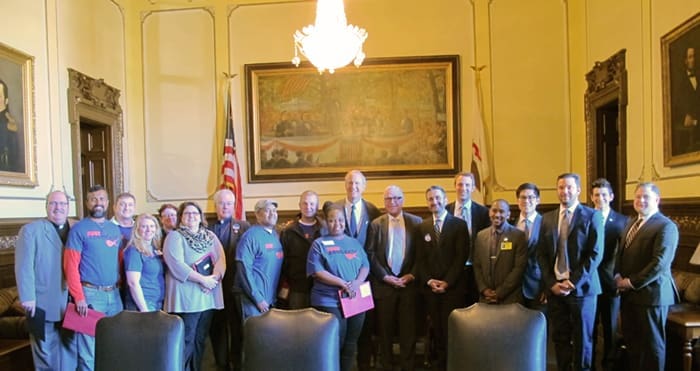 During their time at the capitol, several advocates and AFC staff were invited to meet with Governor Rauner and his LGBTQ Liaison Marcos Peterson to talk personally about how these cuts will impact their lives and the lives of others living with HIV in Illinois.
Governor Rauner heard personal accounts from members of the community who struggle to access fair and affordable care. Advocates provided information on the importance of HIV prevention services as treatment for the epidemic. Governor Rauner was also provided information about the positive outcomes of pre-exposure prophylaxis, or PrEP, a prevention option for those who are HIV-negative. Funding for a PrEP drug assistance program, PrEP4Illinois, was cut by Governor Rauner early this year.
While Wednesday was a great day of action, there is still work to be done. Sign up for May 13 Advocacy Day today!
This article is the first in AFC’s Cuts to the Cascade series, which focuses on the people, programs and communities representing columns of the HIV treatment cascade. All of the Cuts to the Cascade subjects are under threat of losing vital state support as a result of Governor Rauner’s proposed cuts to the Illinois budget.
If one pill could help bring an end to the HIV epidemic, affecting thousands of Illinoisans per year, what is a government’s responsibility to ensure its distribution among the most vulnerable populations?
This question was answered — albeit temporarily — in December 2014 when the Illinois Department of Public Health (IDPH) publicly unveiled a program aimed at increasing access to the drug Truvada for pre-exposure prophylaxis (PrEP) to help HIV-negative people remain uninfected. Scientific studies have shown that when Truvada is taken daily by HIV-negative people, the risk of HIV infection is dramatically lowered by well over 90%.
The Illinois PrEP assistance program, PrEP4Illinois, was designed as a pilot project. Funded initially with $1 million set aside in state general revenue funds, PrEP4Illinois would fill in any remaining coverage gaps around the cost of Truvada once an individual’s health insurance and the drug manufacturer’s copay program were tapped.
And end before the beginning
On Jan. 28, the AIDS Foundation of Chicago (AFC)’s Director of Prevention Advocacy and Gay Men’s Health Jim Pickett and others were invited to a pre-launch walk-through of a PrEP4Illinois online portal. Consumers would have been able to visit the site and enter their personal information, and then the back-end database would have billed their insurance for whatever it would cover, added the Gilead copay and sent the remaining bill to IDPH.
“Overall, the site was awesome, and [the IDPH] team was very open to hearing feedback,” said Pickett.
The IDPH team did share that PrEP4Illinois was still in “approval channels” as of the Jan. 28 meeting and was still waiting for an official green light from the director.
But shortly after Governor Bruce Rauner took office, he issued an Executive Order that halted all “nonessential” spending in Illinois, which included PrEP4Illinois. This turned the green light bright red. Rauner’s proposed budget for FY 2016, which was released on Feb. 18, reiterated the cut in funding for PrEP4Illinois.
Many HIV activists, service organization leaders and medical professionals remain disappointed and angry.
“Illinois was set to be the second state in the nation, after Washington, to provide this level of PrEP support,” said Pickett. “We were going to be national leaders, and we were going to keep people healthy and save money doing so, but that vision was tossed in the garbage. “
Dr. John Schneider is another outspoken critic of the governor’s decision to pull the plug on PrEP4Illinois. He’s an associate professor in the departments of Medicine & Public Health Sciences at the University of Chicago. Schneider is involved in citywide PrEP studies and clinics, and sees growing trends in new cases of HIV in Chicago.
“Even with Medicaid expansion and the Affordable Care Act, there are groups of people who … don’t have the right coverage to cover for PrEP,” said Schneider. He believes that people who are earning too much money to qualify for Medicaid programs but don’t have adequate insurance or financial resources to cover the cost of Truvada will miss out on this vital prevention tool. “South Shore, middle-class Black neighborhoods and Black men who have sex with men — this is going to impact their ability to stay HIV-negative.”
Others have lamented the loss of PrEP4Illinois’ planned streamlining of a complicated payment process for an expensive drug (currently, the average wholesale price of Truvada is $1,539.90 per month, according to the 2015 Positively Aware HIV Drug Guide).
“I have been shocked by the number of times people have contacted me to inform that their insurance was causing so much grief, said Bryan Bautista-Gutierrez, PrEP Coordinator for Howard Brown Health Center, which established a demonstration PrEP clinic in Chicago in 2014 and prescribed PrEP to many patients before that. “This program would’ve taken care of that right away.”
“The major benefit was it was going to be a state-run program like ADAP that theoretically could have been easier [for consumers],” said Dr. Dave Barker, medical director at the Ruth M. Rothstein CORE Center. The CORE Center focuses on treating patients living with or vulnerable to HIV and launched its own PrEP clinic this past Friday. “It would have been a streamlined, single source of PrEP medication for patients.”
The next step for PrEP
Separate from the state’s proposed program, several strategies have emerged from the HIV community to improve PrEP access in Illinois. PrEP clinics, including clinics at Howard Brown Health Center, the CORE Center, the University of Chicago and ACCESS Grand Boulevard Family Health Center offer assistance in navigating the complicated dance between PrEP, insurance plans and Gilead’s assistance program.
The CORE Center’s new PrEP clinic aims to get more vulnerable Chicagoans access to PrEP, especially young gay men of color and transgender women. “[We provide] access to young gay men of color who may have other health problems and need a primary care physician,” said Dr. Margo Bell, Director of Inpatient Pediatrics for the Cook County Health and Hospitals System, which oversees the CORE Center. As part of the Cook County Health & Hospitals System, the CORE Center accepts all residents of Cook County regardless of their ability to pay.
Additionally, the Chicago PrEP Working Group, led by AFC and the Chicago Department of Public Health, fosters collaboration and coordination between local PrEP researchers, prescribers, programmers, educators, trainers and advocates in support of improving PrEP access to all who would benefit from this important intervention. The group is working to add PrEP clinical capacity throughout Chicago and will be launching a citywide social marketing campaign later in the year.
IDPH continues to champion PrEP as a needed resource in ending the HIV epidemic in Chicago, which affects 43,500 people across the state. In a statement released on March 26, IDPH Medical Director of the Division of Infectious Diseases Dr. Craig Conover writes, “The Illinois Department of Public Health supports the provision of PrEP as an evidence-based biomedical intervention to prevent HIV infections.”
The open letter cites an estimate from the Centers for Disease Control and Prevention that as many as 275,000 HIV-uninfected gay men and 140,000 HIV serodiscordant heterosexual couples in the U.S. could benefit from this intervention — many of whom likely live in Illinois. But without PrEP4Illinois, that support is compromised.
“I hope that Governor Rauner’s administration thinks about [HIV-vulnerable people] and mentions them when they talk about these budget cut proposals, said Bautista-Gutierrez. “I hope they tell voters and residents that their legacy will be that they are singlehandedly creating a public health disaster in the state of Illinois, and that they directly contributed to the rise of new HIV infections in some of most underserved communities in state.”
by Anne Statton, PACPI Executive Director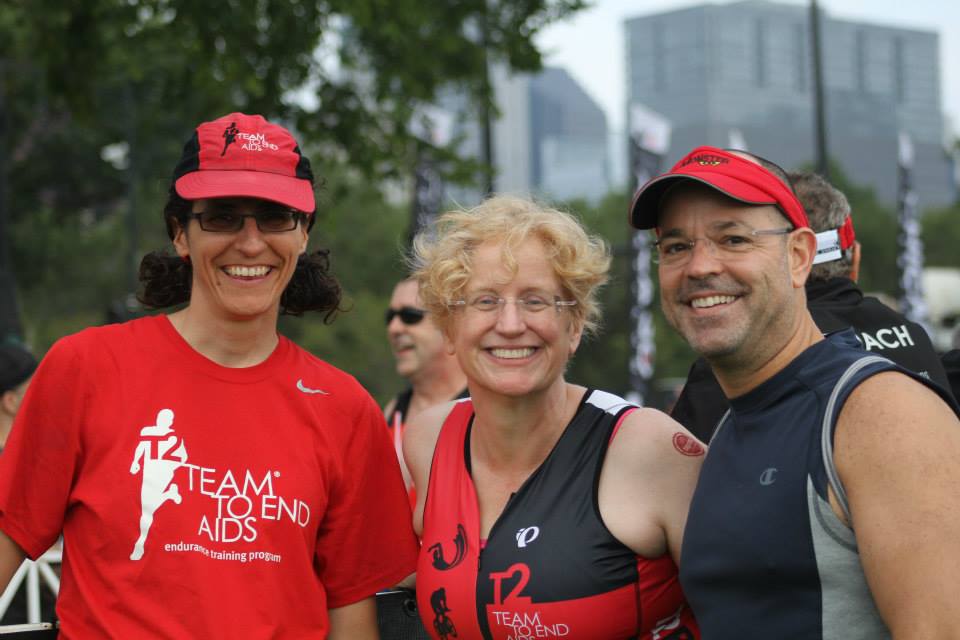
This essay first appeared on the Pediatric AIDS Chicago Prevention Initiative (PACPI) website.
This year, for my birthday, I decided to give myself the gift of triathlon. Sounds funny, I know. I really enjoy competing against myself and with my friends and family.
I come from a swimming background. As a kid, I swam and competed in events with my sisters. One of my sisters, Laurie, was recruited to Kenyon College on a swimming scholarship. Another sister, Amy, is a coach of the Evanston Masters team. Sister Kersti continues to swim and encourages her lovely daughters to swim and they often rank high enough to compete in regionals and state championships.
My mother was the first woman referee with Illinois Swimming and when she passed away, TOPS (The Oak Park Swimmers team) put together a memorial swim meet in her honor, the Claire Statton Memorial Invitational. That meet is so popular that it can no longer be held at Oak Park High School and it’s now held at the University of Illinois at Chicago each January. Teams raise money to compete in the meet and the funds help pay swim fees for their own team members who need assistance. In 2009, my nieces swam for the first time in their grandmother’s swim meet and the local paper, the Oak Leaves, wrote an article on them and the family. It’s such a terrific legacy to have a swim meet named after my mother. My sisters and often consider ourselves “Illinois swimming royalty” because of it!
About five years ago, in January 2010, I accepted a challenge to join a group that would train for 12 weeks and complete an indoor triathlon at the end of the training. I felt it would help me to get active again, and as long as swimming was involved, I could do it! I went to almost every single training session. The amazing coaches (Scott Hutmacher and Chris Navin) helped adjust the workouts to my ability – basically I can’t run because my knees can’t take the pounding. The training was HARD.
On race day, my nieces made me a big banner and came to cheer me on. I was mostly pleased that I finished the race. Later when I got my results, they told me I placed first in my age group! The coaches told me that they thought I could compete in an outdoor triathlon and they would make sure I could cross the finish line. So I registered for the Chicago Triathlon in August 2010 and signed up to train with the Team to End AIDS so that I could raise money to help people living with HIV.
Let me say again that training was hard. What really helped were all the amazing people who trained with me. All ages, all levels of fitness. In May of 2010, my doctor told me that I needed abdominal surgery and worked with me to make it as least invasive as possible, so that I could continue to train and race in the triathlon at the end of August. That same month, I also lost a very dear friend to HIV. I decided at that moment to dedicate my race to that friend, Ann Dunmore.
Somehow, I wasn’t sure I’d cross the finish line until I actually did! Much to my surprise, a reporter approached me moments after crossing the finish line and a small blurb ended up in the newspaper about my first triathlon and the fact that I was raising money for women and children with HIV.
Each year since then, I’ve competed. I’ve also had more than my share of injuries (mostly minor knee surgeries) and, in spite of those setbacks, I’ve competed in at least two triathlons every year. This year, 2014, I was determined to be injury-free, surgery-free and compete in FIVE triathlons as a way of celebrating my 50th birthday!
Despite my best determination, I still ended up with a small knee surgery in late May 2014. However, I completed the first of my five triathlons, just NINE days later. My orthopedist (basically my primary care doctor at this point) met with me and, knowing my goals, supported me in my racing, advising me to walk the “run” portion of the triathlon. One of my oldest friends from high school, Brett, and her husband Jeff, flew back to Chicago to surprise me at the race with a banner and cheered me on to the finish line! That first race was over my birthday weekend. The first of five triathlons to commemorate my 50th was in the bag!
I went on to complete four more sprint triathlons, one super sprint triathlon and two of those triathlons were back to back – just one day apart.
Every race completed in 2014 had some sort of personal record and triumph I can count. It helps encourage me to work on my form, recover better, hydrate better and race smarter. It may be at least 20 years before I come out tops in my age group again; however, I’m not giving up!
Other people’s stories, like the incredible life of my friend Ann Dunmore who died at the beginning of my journey, or the valiant Joy Morris-Hightower who lost her battle with cancer this month, keep me focused on raising funds for HIV, and on the particular struggle of women in this fight. To me, it all comes down to compassion for the cause. I’ve often said that I’m putting my body on the line, I’m out there in the lake swimming, riding [and falling off of] my bike, and doing my best to walk as FAST as I can to help raise awareness, understanding, compassion and funding for programs serving women and children facing HIV.
I’m incredibly humbled by the generosity of my friends and family over the years that have helped me raise more than $20,000 to support PACPI programs.
This holiday season, we welcome any additional gift. Unfortunately, many PACPI clients face loneliness and isolation in their diagnosis. They struggle to put food on the table, coats and boots on their children, and to keep working for a better future. PACPI works hard to get donations into the hands of our families in the moment of need. Thank you so much for your help, your compassion and your support.
This week, Coventry Health Plan announced that it would dramatically reduce out-of-pocket costs for HIV medications in individual plans purchased on Health Insurance Marketplaces established under the Affordable Care Act (ACA). The change comes in response to requests from advocates, including AIDS Foundation of Chicago (AFC) and AIDS Legal Council of Chicago (ALCC).
“We thank Coventry for recognizing that placing all HIV medications on the highest cost-sharing tier makes it nearly impossible for most people with HIV to afford life-saving medications,” said John Peller, president/CEO of AIDS Foundation of Chicago. “Coventry is being a good corporate citizen by voluntarily improving their coverage policy.”
Thanks to this change, instead of paying as much as $1,500 a month for medications, people with HIV will pay a much more reasonable cost of $5-$100 per prescription.
In December 2014, AFC released an analysis of plans offered by Coventry and other companies on the Illinois Health Insurance Marketplace. AFC found that Coventry and two other plans placed all commonly-used HIV medications on specialty tiers, making medication extremely unaffordable for individuals living with HIV.
AFC and ALCC sent a letter to Coventry urging the company to immediately amend their formulary to make HIV medications more affordable. AFC and ALCC believe placing all HIV medications on specialty tiers may deter people living with HIV from enrolling and may be discriminatory.
“We deeply appreciate the open dialogue we had with Coventry. We shared our concerns, and they listened and talked with us,” said Tom Yates, Executive Director of AIDS Legal Council of Chicago. “We are thankful that they are changing their coverage policies in Illinois and the other states in which they offer Marketplace plans. This change will have a national impact.”
In 2014, National Health Law Program and AIDS Institute filed a federal civil rights complaint against Coventry and three other insurance companies offering plans in Florida. The complaint alleged that Coventry and the other plans discriminated against people with HIV by putting all HIV medications on the highest co-insurance tier. In a settlement brokered by the Florida Department of Insurance, Coventry admitted no wrong-doing but significantly reduced out-of-pocket costs for HIV medications for its Florida members. AIDS Healthcare Foundation also played a role in the Florida policy change.
“We urge the federal government to take immediate enforcement action against other national plans that are placing all HIV medications on the highest cost-sharing tiers,” continued Peller. “Such coverage policies impede access to care for people with HIV and may be discriminatory.”
Coventry’s new HIV drug coverage policy will be effective June 1, 2015.
Gilead Sciences recently awarded the AIDS Foundation of Chicago (AFC) $100,000, becoming the first member of AFC’s Corporate Partnership Program. Through the Corporate Partnership Program, AFC is engaging companies across the US to make major contributions to HIV/AIDS programs and services in Chicago and beyond.
Corporate partners, such as Gilead, make unrestricted contributions that help AFC reach thousands of people living with or vulnerable to HIV. Each year, within Chicago alone, there are an estimated 1,100 new cases of HIV, which disproportionately impact communities of color, youth populations, gay men and other men who have sex with men. The Corporate Partnership Program fuels AFC’s care, prevention, advocacy efforts that aim to meet the needs of individuals impacted by the epidemic throughout the community.
“During AFC’s 30th year of action, we have an unprecedented opportunity to prevent new cases of HIV and provide even greater support to those living with and vulnerable to HIV,” John Peller, AFC’s President/CEO, said. “The corporate community plays an essential role in helping us to realize this incredible opportunity. We are grateful for our corporate partners’ extraordinary generosity.”
AFC launched its annual Corporate Partnership Program in 2015 in honor of its 30th year of service. Companies that give a significant contribution in unrestricted, charitable gifts to AFC are eligible for this program. Members of the program have opportunities to build deeper partnerships with AFC and Chicago’s HIV/AIDS service community through employee volunteerism, education opportunities, outreach, and promotion.
Testimony presented by the AIDS Foundation of Chicago (AFC) last week before the Illinois House Human Services Appropriations Committee aimed to show how Illinois’ Medicaid redetermination efforts could have a significant impact on people living with HIV across the state.
Director of Government Affairs Dan Frey presented his testimony on March 3 and argued that Medicaid redetermination efforts are needed, but warned against the process “erecting unnecessary barriers that prevent eligible recipients from accessing care.”
Frey argued that making Medicaid services easily accessible and barrier-free in Illinois would not only help individuals living with HIV stay in care more easily, but it would also prevent new HIV infections, as modern HIV medications can reduce the chance of an HIV-positive person sharing the virus with someone who is HIV-negative by 96%.
 This January, the Illinois Department of Healthcare and Family Services (HFS) released a final concept paper outlining its intention to establish Medicaid Health Homes. In a huge victory, the final paper explicitly included HIV as one the conditions that can be managed by a Health Home. In December 2014, AFC submitted comments urging Illinois to included HIV as one of the chronic conditions eligible for management in a Health Home.
As background, under the Affordable Care Act, Health Homes allow state Medicaid programs to receive increased federal funding to coordinate care for people with two or more chronic diseases, or one chronic disease and increased vulnerability. Health Homes seek to deliver care through a team approach that brings together primary care providers, specialists, social workers and other team members to address a patient’s holistic needs.
AFC lauds Illinois submission of a state plan amendment to the federal government to seek approval to establish Health Homes, we look forward to working with Governor Rauner’s administration on shaping and implementing this transformation measure aimed at ensuring people living with HIV and other chronic diseases are provided the utmost care.
In honor of National Women and Girls HIV/AIDS Awareness Day (March 10), the AIDS Foundation of Chicago (AFC) and several of its partners in Chicago will present opportunities for women to learn about HIV, get tested and obtain condoms.
Saturday, March 7
Confidential HIV testing and counseling
TPAN will provide instant HIV testing and condom distribution at Glitter Nail Salon (912 Madison Street, Oak Park) from 8 a.m. – 1 p.m.
Saturday, March 7
“Rock the Red” event for teens
Diamond in the Rough Inc. invites teens to dress in their freshest red gear at the Empowerment Zone II (7421 S. South Chicago, Chicago IL) from 12 – 3 p.m. Music, performances, workshops, speakers, HIV tests, makeovers and raffles will take place. For additional information, call Octavia Richmond at 773-617-2949.
Sunday, March 8
Chat and Chew 2015
The South Suburban HIV/AIDS Regional Coalition presents a candid discussion about HIV/AIDS, substance abuse and domestic health titled “Protect, uplift and save: Affecting positive change in the lives of women.” The conversation will run from 4-8 p.m. at the South Suburban Council (1909 Cheker Square, East Door Entrance, East Hazel Crest, IL). A light meal will be provided. Register at eventbrite.com/chat&chew
Tuesday, March 10
Female condom advocacy training
In honor of the Chicago Female Condom Campaign’s fifth birthday, AFC and Planned Parenthood of Illinois will host an event highlighting the need for prevention options for women and girls, offering an overview of CFCC’s first five years of advocacy, and providing training on female condoms. The event will take place from 6 – 8 p.m. at AFC’s headquarters (200 W Jackson Blvd., Suite 2100, Chicago). Contact Sara Semelka to register for this event.
Tuesday, March 10
Educational presentation at Young Women’s Leadership Charter School
TPAN presenters will be facilitating a discussion with 36 young women in the school’s senior class about HIV myths versus facts, HIV transmission, HIV prevention, HIV risk factors and various harm reduction techniques from noon – 1:10 p.m. (Closed to the public)
Friday, March 13
All-day program for women
The TPAN offices (5050 N. Broadway Ave.) will provide confidential HIV testing and counseling, condom distribution, FC2 female condom demonstrations, holistic and sexual health seminars, an HIV and Women lunch presentation, and more from 10 a.m. – 3 p.m.
Wednesday, March 18
Virtual Advocacy Day
People of all genders will be encouraged to use Facebook, Twitter, email and phone to contact Illinois state legislators and urge them to support a fair budget from 9:30 a.m. to 2 p.m. Click here for more information, to register, or to learn about AFC’s in-person Advocacy Days on Wednesday, April 15 and Wednesday, May 13.
Friday, March 27 – Sunday, March 29
Black Women’s Expo
Christian Community Health Center will be partnering with Lurie Children’s Hospital to provide HIV testing, education and referrals for participants at the Black Women’s Expo at McCormick Place. More information about the expo can be found here.
Women of color and trans women disproportionately impacted by epidemic
National Women and Girls HIV/AIDS Awareness Day aims to highlight the ways HIV impacts women and girls, including trans women and girls. According to the U.S. Centers for Disease Control and Prevention, women 13 and older account for one out of every four HIV infections in the U.S. (approximately 217,000 women). In Chicago, approximately 4,550 women are living with HIV as of September 2014.
Just as the HIV epidemic disproportionately affects men of color, it also impacts predominantly African American women and Latinas. The CDC reports that HIV diagnoses among Black women are nearly 15 times higher than among white women, and HIV diagnoses among Latina women are four times higher than among white women.
Most impacted by HIV are transgender women; while few definitive studies exist to account for the number of trans women living with HIV, a study published in The Lancet in March 2013 reports that trans women were almost 50% more likely to be HIV-positive compared with women and men who are cisgender, or whose experiences of their gender match the sex they were assigned at birth.
“We need to focus more attention on outreach to women and girls — and transgender women and girls in particular — to ensure that they understand their risk for HIV,” said Simone Koehlinger, senior vice president of programming for AFC. “Resources like pre-exposure prophylaxis (PrEP), male and female condoms, and testing around Chicago and Illinois are there to minimize the impact of the HIV epidemic altogether.”
 The year 2015 ushers in significant changes in political leadership in Illinois, with Governor Bruce Rauner taking office as the state’s first Republican chief executive officer in 12 years. He has proposed a reckless budget with devastating cuts to HIV funding and Medicaid, and supportive housing is under attack.
In the midst of these troubling changes, the AIDS Foundation of Chicago (AFC) is committed to continuing, creating and advocating for sound HIV policy. In this vein, we have released our 2015-2016 policy priorities. These priorities were formed in consultation with community members across the state, and outline the focus of our legislative advocacy and policy work for the coming years.
Policy and legislative priorities include:
- Protection of funding and support of HIV prevention and care services;
- Continued promotion and support of the implementation of health reform in Illinois;
- Support for legislation, which reduces the cost of HIV medication; and
- Maintenance of state funding for mental health and substance use programs and services.
You can read the full list of policy priorities here.
Advocacy for and support of these issues is more important now than ever. Governor Rauner has proposed the most destructive budget that the HIV community has seen in years. It contains a $1.6 billion cut to Medicaid, a $6 million slash to HIV funding and a 66% reduction to the African American HIV/AIDS Response Fund.
Join us for our annual Advocacy Days and tell your legislators they must not support this budget! Details and registration information for all three 2015 Advocacy Days can be found here.