Now approaching its fourth anniversary, the HUB is a community partnership between AIDS Foundation Chicago (AFC) and the Center on Halsted to expand access and reduce the friction of linkage to healthcare, housing, and support services in the Chicago area. Since launching February 2020, the Resource HUB has provided comprehensive information, direct connections to HIV and Housing services, and emergency financial assistance to over 1,500 individuals living with and vulnerable to HIV. The HUB is funded by the Chicago Department of Public Health (CDPH).
To expand awareness of this vital resource in the South and West communities, the HUB’s fall campaign “Navigating Healthcare Sucks” is on and in CTA buses, trains and stations citywide! Made possible with support from CDPH and GILEAD Sciences, this bi-lingual campaign can be seen prominently at 21 “L” train stations on the Red, Green, Pink, and Orange lines and 200+ train cars and bus banners in South and West Side neighborhoods.
We’re excited to share the news of the campaign with you and our partners in the network! Access the social media folder for graphics to share with your community – and don’t forget the hashtag #HIVhub!
How do I connect to the HUB?
-Call 1-844-HUB-4040 to connect you to the Center on Halsted HIV/ STI Call & PrEP center to reach a rapid response team to support you in navigating services that you need.
-Visit hivhub.org to access Your Resource HUB portal where you can apply for financial assistance programs and communicate directly with a Rapid Response team member via our new chat functions. In addition, use our provider locator! With your zip code, you can search for service providers citywide including HIV prevention, treatment, healthcare navigation, housing and PrEP support.
We now offer HUB 101 Presentations that provide an understanding of the services offered, client enrollments, and special activities. To schedule a virtual session or for questions on accessing care, reach out to:
Ana Garcia, HIV Resource Coordination HUB Manager at [email protected]
Melanie Cross, Senior Manager, Care Systems Management at [email protected]
Windy City Times is seeking to recognize 30 more outstanding LGBTQ+ individuals (and allies). Nominees should be 30 years or younger as of June 30, 2024, and should have made substantial contributions to the LGBTQ+ community in the fields of entertainment, politics, health, activism, academics, sports or other areas.
The awards ceremony will take place Thursday, June 6, 2024 at 6 p.m. The venue will be revealed at a later date.
The deadline to nominate individuals is Friday, April 5.
Hundreds of people have been honored by the paper in the 20 years since the awards were established. Many honorees have gone on to great success in their professional and educational endeavors. One past honoree became the mayor of a major U.S. city, and many others have achieved success in the arts, law, academia and other areas.
Individuals, organizations, co-workers, etc. can nominate a person by emailing Windy City Times Senior Writer Andrew Davis at [email protected] . (Be sure to put “30 Under 30” in the email’s heading.) Self-nominations are welcome.
The nomination should be 100 words or fewer, and should state what achievements or contributions the nominee has made. Nominators should include their own names and contact information as well as the contact information and the age of the nominee.
Note: Following the policy instituted in 2005, individuals can only win once. Past winners are ineligible.
Windy City Times, AIDS Foundation Chicago and Pride Action Tank are sponsoring the event. Those individuals and corporations interested in sponsoring should contact Edward Wagner at [email protected] .
Honorees will be notified in May.
Commemorated in 1990, National Homeless Persons’ Memorial Day takes place each year on December 21st, the longest night of the year. Vigils, memorial services, and events to honor those we’ve lost take place all over the country and are often organized by the National Coalition for the Homeless and local organizations.
According to a report from the Chicago Coalition for the Homeless, there are an estimated 68,440 people experiencing homelessness in Chicago. This number reflects people who are living on the street, sleeping on trains, staying in shelters, and are doubled-up (doubled-up is temporarily staying with others). AFC and CHH both provide services for people experiencing homelessness and housing instability who are living with HIV or other chronic conditions through direct client services, and programs like the Flexible Housing Pool.
To honor those we’ve lost in 2023, we encourage you to demand change through your vote in the upcoming primary elections. By voting for the Bring Chicago Home initiative on March 19, , you can support creating a dedicated revenue stream for affordable housing rooted in what is known as a permanent supportive housing model. Permanent supportive housing ensures that participants receive housing in addition to wraparound services needed to facilitate long-term housing stability.
AFC and CHH are proud to support Bring Chicago Home, which would create this dedicated revenue stream for ending homelessness in the city of Chicago by increasing the real estate transfer tax (RETT) on properties selling for over $1 million. Between now and March 19, 2024, if you’re interested in supporting the work of Bring Chicago Home, you can contact Dominique Chew, Housing Policy & Advocacy Manager at [email protected] or Justine Allenbach, Senior Program Manager of Special Projects at [email protected].
Every year, the U.S. Congress must pass appropriations bills to fund the federal government, including agencies that carry out vital services that our communities depend on, such as public education, food and drug safety, and access to health care services, among others. Not only has Congress failed to carry out this basic function on time over the last few decades, it has also injected partisan division into the process to such an unfathomable degree that even programs which have traditionally enjoyed bipartisan support are under threat of being eliminated. Many of these programs offer critical services we rely on, and we are thrown into a state of perpetual crisis as politicians play with our lives for political points.
Earlier this year, House Republican leadership released proposed funding bills far below the levels agreed to by their own leadership and the White House during the debt ceiling negotiations, undercutting the trust under which that negotiation took place. Now, we are disheartened and disappointed to learn that Republican members of the Illinois Congressional delegation have submitted amendments to the Labor Health and Human Services funding bill to further erode funding and protection for communities most impacted by HIV and social inequity.
Amendments introduced by Republican Representatives Mike Bost (IL-12) and Mary Miller (IL-15) attack protections for LGBTQ students, and would defund key leadership roles within the Education and Health and Human Services agencies, which oversee programs that Illinoisans depend on such as public education, occupational safety, Medicaid and Medicare, Ryan White for HIV care, family planning services, STI prevention services through the Centers for Disease Control and Prevention, and more. At a time when we need robust leadership at the helm of these agencies as we unwind pandemic-era protections, these representatives are proposing policy and budget changes that would drag us into further chaos.
Meanwhile, Democratic members of the Illinois delegation are introducing amendments to eliminate harmful anti-LGBTQ provisions, ensure civil rights offices are funded across various agencies, fund the office of refugee resettlement, and to protect reproductive rights. Democrats from Illinois are sponsoring amendments that promote research integrity at the National Institutes of Health, and support programs like Healthy Start, which addresses the growing infant mortality rate.
Make no mistake: the harmful amendments being sponsored by Representatives Bost and Miller are political theater—pure and simple. They are dead on arrival in the U.S. Senate, and waste precious time that could be better spent working in a bipartisan manner to avoid a government shutdown (which may happen as soon as Friday, November 17). It is vital that they know Illinoisans will not stand for this. We urge you to contact your federal Member of Congress to tell them to vote NO on amendments that are harmful to the LGBTQ community, erode civil rights work, attack reproductive care, and cut HIV funding. You can also take quick action today by participating in our mobile action to send a letter to your elected representatives in Congress to urge them to support full funding for HIV programs. It’s as simple as entering your contact information and clicking send!
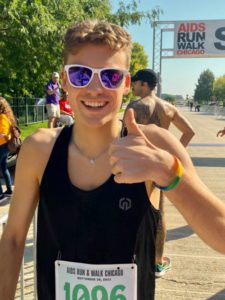
JD Barret: 10k Men’s 1st Place Winner
Q: Could you share the personal impact that this journey of running, advocacy, and fundraising has had on you?
A: Running has had a profound impact on my self-confidence. Growing up in an extremely rural community, I didn’t encounter many people who identified similarly to me. This made me incredibly shy and closed off. However, when I discovered running in high school and found that I was quite proficient at it, it allowed me to take pride in myself and feel confident in my own skin. Since running is a passion of mine, I decided to use this skill to advocate for the causes I am passionate about.
Q: With LGBTQ+ History Month ending, could you provide your thoughts on the purpose and importance of celebrating and commemorating LGBTQIA history?
A: LGBTQ+ History Month is a special occasion that invites us to pause and reflect, to learn, and to join in celebration. It plays a vital role in nurturing our understanding of LGBTQ+ history, fostering an appreciation for diversity, and contributing to the ongoing effort to create a society where every person, irrespective of their sexual orientation or gender identity, can feel confident and live authentically!

William Pettway 5k Non-Binary 1st Place Winner
Q: Why did you make the choice to participate in AIDS Run & Walk Chicago?
A: AIDS Run & Walk Chicago is a safe community of people who are working to end new HIV transmissions and name racism as a public health crisis. I enjoy being a part of that collective, and it gives me an environment to wave my non-binary flag proudly.
Q: With LGBTQ+ History Month ending, could you provide your thoughts on the purpose and importance of celebrating and commemorating LGBTQIA history?
A: This community has been underappreciated for a long time. Historically humans that push boundaries of expression help us all learn more about ourselves and the breadth of human experiences. I’m inspired by: Lorraine Hansberry, James Baldwin, Janelle Monae, Adrienne Maree Brown to name a few. I am gifted boldness standing on these icons’ shoulders. It is our duty to continue their justice seeking legacies.
It’s not enough to celebrate history, we have to affirm and support history that we’re living and making each day.
I appreciate AIDS Run & Walk Chicago as a platform to be loudly queer. I wear my flag to honor my younger tumultuous self who held shame for not living up to gender expectations. I strive for excellence each day as an apology to that young one. Being any part of the LGBTQIA+ community, we’re not new to being told to shrink. I live to show that we’re allowed to thrive, and we’re quite good at it when supported.
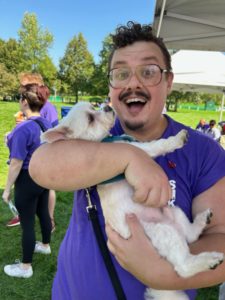
Christopher Pazdernik: 1st Place Fundraiser
Q: Why did you make the choice to participate in AIDS Run & Walk Chicago?
A: After I had been living with HIV for a few years, and had grown more comfortable with it, I wanted to start giving back to the community in some way. I saw an ad on the CTA for AIDS Run & Walk Chicago and decided that was it—and now it’s been ten years!
Q: Could you share the personal impact that this journey of running, advocacy, and fundraising has had on you?
A: I’ve learned that it takes a village, and it’s a marathon, not a sprint, and that’s true of my journey with HIV/AIDS as well. Just like I have had so many friends supporting me in different ways—especially during the early days of my diagnosis—it takes as many people as possible working together to make an impact. And there’s no easy solution, it’s something you have to keep working at: the progress in front of you may seem small, but when you look behind and see how far we’ve come, it’s astonishing!
Q: With LGBTQ+ History Month approaching, could you provide your thoughts on the purpose and importance of celebrating and commemorating LGBTQIA history?
A: That’s another reason I do AIDS Run & Walk Chicago every year—to give back to those who came before me! I know that I have the quality of life I do because so many people fought in the early days of the AIDS crisis, and I feel called to continue their work in any way I can.
The Chicago 400, with support from AIDS Foundation Chicago and the Center for Housing and Health, is working to end housing banishment laws in Illinois with a bill in the IL Senate, SB2158. Housing banishment results from unjust laws that trap people in a cycle of homelessness and incarceration. In Illinois, people who are listed on a public conviction registry and are experiencing homelessness are required by law to register, each week, in-person, at a police station. Failure to do so can result in arrest, reincarceration, and further damage to their ability to access housing. In addition to these challenging, frequent registration requirements, registrants also must seek housing at least 500 feet from regularly spaced places like parks, schools, or daycares, severely restricting available housing options. Because people cannot meet the impossible standards of current registration requirements, and struggle to find housing under such restrictions, they can be caught in a revolving door between homelessness and incarceration.
Illinois laws on housing banishment and registry are among the harshest in the country. Chicagoans impacted by housing banishment and unjust registry laws have organized as The Chicago 400 to advocate for abolition of housing banishment. Upon examination, the impact of these laws is strikingly cruel and inequitable. These laws do not make communities safer, but instead cause homelessness, disrupt families, and reinforce structural racism. The laws disproportionately impact Black men. One in 42 Black men in Illinois is listed on a conviction registry and 80% of the homeless men listed on the sex offense registry are Black men.
Illinois Senate Majority Leader Kimberly Lightford has proposed a legislative end to this practice in SB2158, a bill being led by The Chicago 400 and supported by AIDS Foundation Chicago and the Center for Housing and Health. Supporters of SB2158 urge Illinois voters to contact their state senators and representatives and signal support for the bill. SB2158 would reduce registry requirements from weekly to quarterly or annually in frequency, increase housing access by reducing banishment from 500 feet to 250 feet, and reduce “failure to register” from a felony to a misdemeanor. To learn more about The Chicago 400, the Chicago 400 Campaign, and SB 2158, visit chicago400.net.
Image Credit: https://chicago400.net/drawing-center | The Drawing Center. Winter Term 2020: Meet the Chicago 400, The Drawing Center, New York. January 21 – 26, 2020.
I attended this year’s Congressional Hispanic Caucus Institute (CHCI) Hispanic Heritage Month Leadership Conference alongside my AFC Colleague, Dominique Chew. This was my first time attending this event since the start of the COVID-19 pandemic and I was SO excited to reconnect with old friends and colleagues. For those who aren’t familiar with CHCI’s Hispanic Heritage Month programming, this annual event and associated gala are the highlight of the year for us Latinx policy nerds. In fact, in D.C. we refer to the gala as Latino prom.
The leadership conference is an opportunity for thousands of Latinx leaders from all over the U.S. to come together to learn about and discuss the major policy issues facing our communities, for us to elevate these issues to federal lawmakers and administration officials, and for several days, we are immersed entirely in all things Latinidad.
The theme this year was “Our Moment in History.” Sessions ranged from such themes as “The Power of the Latino Vote,” “From Island to Mainland: The Vital Impact of Puerto Rico’s Small Businesses on the U.S. Economy,” to more intimate conversations with the four Latinx Presidential cabinet members (the most we’ve ever had at one time), as well as with Vice President Kamala Harris. However, none was more enticing to me than the session entitled “Strong, Healthy Latino Communities: Addressing Chronic Health and Autoimmune Issues.” Given the disproportionate impact of the HIV epidemic on the Latinx community, surely this session would touch on that topic. If not this session, perhaps it might be mentioned at some point during this conference.
Imagine my complete and utter surprise when that moment never came. You can trace my involvement in the HIV field all the way back to my high school years when I started volunteering for community organizations that provided testing, education and support services for people impacted by HIV. At this point, I’ve known for well over half of my life the outsized impact the HIV epidemic has had on the Latinx community—a point of discussion that is gaining ever more attention within the larger HIV field as we work to end the HIV epidemic by the year 2030. Yet, the topic was nowhere to be found throughout this major Latinx policy conference.
All the policy issues facing the Latinx community converge to determine our predisposition for HIV. Access (or lack thereof) to economic stability, quality education, familial and social support systems, health care, housing and our interactions with the criminal justice system can determine whether we remain HIV negative or not. When Latinx people become HIV positive, a fundamentally life-altering event, they are thrown into a world of mandatory medical care from a system not designed to best serve our people, the mind-numbing bureaucracy of the HIV safety net, and the profound stigma still embedded in the Latinx social fabric.
According to the 2020 U.S. Census, the Latinx community accounted for 18.77% of the U.S. population. According to the Centers for Disease Control and Prevention (CDC), in 2019 the Latinx community made up 29% of all new HIV diagnoses in the U.S. and accounted for 25% of all people living with HIV. Pre-Exposure Prophylaxis (PrEP), a highly effective medication for HIV prevention, has been approved by the Food and Drug Administration (FDA) for that purpose since 2012 and yet, by the CDC’s own estimate, only 14% of Latinx people who could benefit from it were prescribed PrEP in 2019. The Latinx community must contend with social and structural racism, xenophobia, language barriers, medical mistrust, and lack of access to quality and culturally competent health care, all of which continue to drive the disproportionate rate of HIV transmission amongst Latinx people.
Realizing that HIV would not be acknowledged at the conference, I made it my mission to bring it up as much as I could during the sessions I attended. At best, I was met with blank stares and half answers from the panelists, and at worst I was outright told by one panelist that HIV is a niche issue that should be discussed in other spaces. I disagree. HIV is not a niche issue. HIV is a life-changing outcome when structural and societal barriers converge, which allow a condition which has been highly preventable for over a decade to continue to disproportionally impact us.
At a time when the U.S. House of Representatives is proposing to slash over $747 million in domestic HIV programs, threatening to undo the progress we have made to end the HIV epidemic in the U.S. in our lifetime, now more than ever, we need to bring this issue to the forefront. Even within the larger HIV field, the Latinx community is treated like a monolith and discussions about the impact of HIV on our community feel almost like an afterthought. This isn’t all too surprising given the disproportionate representation of White individuals in the field, but why, then, aren’t we as national Latinx policy leaders talking more about it? If you’d like to get involved in our advocacy work, sign up through our Mobile Action Center to receive alerts whenever we have an opportunity for action, or reach out to me directly at [email protected] for more information.
Q: How would you describe yourself?
A: I am a multifaceted, deeply empathic person who fervently believes in the boundless potential of the human spirit, a champion of diversity and inclusivity, and a lifelong learner. As a gay Black man, I have often navigated spaces that were not created with me in mind, so I am deeply committed to nurturing spaces where every story is heard, every voice is valued, and every individual feels appreciated, valued, seen, and heard.
For fun, I enjoy my daily fitness classes at Barry’s, dancing to house music on the weekends, traveling, and eating as many desserts and sweets as I can put my hands on. My family and my faith grounds me, and it needs to be said that Beyonce is the G.O.A.T. We can always argue about it in my free time.
Q: What drew you to this role and AFC?
A: First and foremost, what drew me to the role and AFC is the unwavering commitment of the organization to lead the fight against HIV/AIDS and improve the lives of people affected by the epidemic. AFC leads – – it does not follow. I was also profoundly impressed with AFC’s multifaceted approach to addressing the HIV/AIDS epidemic, which encompasses advocacy and policy work and extends to housing, case management, and a range of other services that holistically address the needs of people affected by HIV/AIDS.
Marrying my passion for cultivating environments where talent can flourish and bringing in the best talent in service of the mission of AFC is an ideal fit.
Q: What does your role mean to you?
A: It’s not just a job for me.
This role represents an opportunity to nurture the greatest asset of AFC – its people. I see myself as a custodian of the organization’s culture, working tirelessly to ensure that our work environment is safe and supportive and that we have the right conditions that foster innovation, collaboration, and growth. It is about creating spaces where our team can flourish professionally while finding personal fulfillment in the knowledge that their efforts make a tangible difference in the community.
Furthermore, this role is about attracting and sculpting future leaders. Talent management is a visionary endeavor where I have the privilege of spotting potential, nurturing skills, and fostering leaders who carry the mantle of AFC’s legacy forward with integrity and passion.
The role is more than a position or a job; it is a call to serve.
Q: What ideas or projects are you excited about bringing to your role?
A: I am enthusiastic about leading the people initiatives of AFC’s Racial Equity Action Plan, specifically bolstering our recruitment and retention strategies to ensure a workforce that is not only diverse but also inclusive and equitable. I’m also excited about all the great technology in the HR space that helps streamline our HR processes, allowing us to devote more time to strategic initiatives and less on administrative tasks.
Q: What are you excited to learn about the AFC and the community it serves?
A: I am genuinely excited to delve deep into the rich tapestry of narratives, experiences, and history that the AIDS Foundation of Chicago encompasses. AFC has a storied history of advocating for people living with HIV/AIDS. I am eager to learn more about the journey, the milestones achieved, and the strategies employed in navigating the complex landscape of healthcare advocacy over the years.
Moreover, I am keen to learn about the internal culture at AFC — the traditions, the values that guide our team, and the stories of individual team members who dedicate themselves to the mission of AFC. Understanding the organizational culture will be vital in nurturing a work environment where everyone feels seen, heard, and valued.
Q: What may people be surprised to learn about you?
A: I’m a classically trained pianist. I started playing piano at age 5, but I started investing in my other talents when I attended college. My father was convinced that music was not a sure bet and that there was safety, financially, in going to a well-respected college and becoming an Accountant. In his mind, music was a side hustle. My mother, a CPS teacher, thought otherwise and encouraged my musical pursuits in adulthood. Ultimately, I did listen to my dad and started a career in Finance/Accounting, but it’s no surprise I got bored quickly and landed in HR shortly after.
Being a pianist, I always knew talent is made and not born. People with expert abilities have almost always acquired it through deliberate practice, obtaining the necessary feedback, correcting past mistakes, and focusing on the process and the outcome. This belief empowers the work I do every day in HR. Finding and retaining great talent takes work. The investment is expensive, but there’s nothing that great talent can’t achieve once it’s in the right environment. My music training taught me that!
At the AIDS Foundation Chicago, we are thrilled to embark on an exciting journey of growth and empowerment as we welcome our new Vice President of Care, Freddie Shufford. With a wealth of experience and an unwavering commitment to health equity and the HIV community, Freddie brings with her a legacy of transformative care from her previous role as the Director of Social Services at the renowned Ruth M. Rothstein CORE Center. At the CORE Center, Freddie served as Director of Social Services. In that role, Freddie led a team of AFC-funded case managers. She has deep and extensive knowledge of the HIV case management system.
In the spirit of getting to know Freddie a little better, we sat down with her for a brief Q&A session:
Q: How would you describe yourself?
A: I would describe myself as an easy going, approachable person. I am a life-long learner and appreciate listening and learning about others. I am a team player, collaborator and solution oriented.
Q: What drew you to this role and to AFC?
A: I have a long history working with the current and past AFC staff. My personal values align with those of the organization, and I believe this is an environment that can foster change and growth that expands across professionals, clients, community leaders, and all levels of government and the nonprofit sector.
Q: What does your role mean to you?
A: That I am in a position of responsibility to embody the values of the organization in all circles of influence. To be a voice for those that have been oppressed and have yet to be able to use their voice. Also, to be intentional about relationship development to have a greater impact on those I interact with.
Q: What ideas or projects are you excited about bringing to your role?
A: I am excited about the opportunity to work with some of the most dedicated and gifted individuals in the field. My hope and desire will be to look closely at our successes, challenges and opportunities and determine where we have room for growth and enhancement. I would like to reserve my first year to observe and explore to not make premature changes.
Q: What are you excited to learn about the AFC and the community it serves?
A: I am excited to continue to grow my knowledge from the community about how AFC can best serve its four priority populations (communities most impacted by HIV) through care/case management, among other areas of support.
Q: Finally, what is something that people may be surprised to learn about you?
A: That I have a couple of books in my head that need to be put on paper.
By Aleah Vega, Editorial Intern
Eight years ago in 2015, AFC welcomed two of its strongest assets: Pride Action Tank (PAT) and its executive director, Kim L. Hunt. In celebration of Kim’s journey, recent promotion to Vice President at AFC, and the success of PAT, let’s take a look at how it all began.
“Pride Action Tank came to AFC with me, eight years ago in October,” Kim says, “It’s a think and action tank focused on LGBTQ+ issues, where the ultimate goal is to improve outcomes and opportunities for LGBTQ+ folks.”
A think tank is a group of experienced thinkers who come together to trade and examine ideas on current political and economic problems. Similarly, an action tank is defined as an organization dedicated to the progression of changes in policy.
According to Kim, “Pride Action Tank has six issue areas: aging, security, health, housing, safety, and youth. We look at these as intersectional issues, all of which came out of the 2012 LGBTQ+ needs assessment that was commissioned by the Chicago Community Trust as they were about to launch their LGBT fund.”
“We use LGBTQ as the lens,” Kim affirms, “but a lot of the work that we’re doing is also helpful for other marginalized communities. All the work we’re doing is helpful for other communities.”
Pride Action Tank is all about bringing these different communities together through a vision for change. “We’ve done a lot of work that brings regular folks to the advocacy and public policy space,” Kim says, “and there are many tools we use to achieve this. Some of it’s done through storytelling. Some of it is done through training, and some of it is done through public policy change. But it all starts with convenings, like summits or roundtables, where we’re bringing many folks together, those who are impacted or touched by the issue, or who are already part of the planning.”
Some of these PAT projects and summits include the How I see myself, How I want to be seen: LGBTQ+ Older Adults Photo Project, the Community Restroom Access Project (C.R.A.P), The Connection to Care Learning Collaborative, which improves LGBTQ+ and HIV cultural awareness in Chicago health centers, and Co-Creating Futures: A BIPOC LGBTQ+ Policy and Practices Summit.
“That’s our secret sauce,” Kim explains, “to co-create these spaces where folks can show up as who they are and help us develop solutions together, to some pretty gnarly problems.”
With Pride Action Tank’s rich history, it is difficult to believe that Kim L. Hunt has not been in the policy and advocacy game her whole life. However, “I’ve been on a long journey,” Kim says, “there were a lot of zigzags. I started out in urban planning, transportation planning specifically. Then, I decided to go back to school at the age of 40, at University of Chicago’s Harris School for Public Policy Studies. I also had a stint as an entrepreneur – I had a consultancy that focused on community and economic development for about five years. And then I went into the nonprofit world through becoming the executive director of Affinity Community Services, which is on the South Side of Chicago. That brought me into partnerships with a lot of different organizations. But also, we were one of the organizations that were part of the marriage fight.”
Throughout her career in the nonprofit field, the fight for marriage equality remained a priority for Kim. She recalls the moment friend and colleague Tracy Baim, publisher of the Windy City Times, invited her to aid in the 2013 March on Springfield for the cause. “I was on the planning committee, and me and twelve or thirteen others just started mapping it out and executing and doing the thing. We were filling up buses and ordering more and then, when the day came, there were 5000 people participating in this March. It was certainly the largest LGBTQ demonstration Springfield had ever seen. To see something like that come to fruition and to see the joy, see people wanting to be engaged, to see people have such an emotional response – I mean, that was just amazing.”
After marriage equality was officially the law of the land, Kim remained determined to contribute to change, and began planning her next steps outside of Affinity Community Services. It was here that the construction of Pride Action Tank began.
“I was working with Tracy Baim. We did this summit in 2014 on LGBTQ youth homelessness, and that became the model for Pride Action Tank. We were focused on lifting up people’s experiences, but also their dreams for the future and how to get there.”
Also in 2014, Kim met AFC’s current CEO, John Peller. “We had a couple of meetings with some leaders in Chicago, and John Peller was in one of those meetings,” she says, “John heard about what we were trying to create, and at the time, he was the interim CEO at AFC, soon to become the CEO. And he said, ‘I think this would be great under AFC.’ So, we had several conversations over what felt like a long time. Next thing I know, we’re at AFC!”
Pride Action Tank is not the first project Kim has helped create. As an entrepreneur, Kim built a consultancy from the ground up alongside her business partner, which continues to exist today. “To take something from your head and put it out into the world,” Kim says, “I’m blessed to have been able to do that a number of times, and to have had people around me who believed in me and the idea and its ability to move forward. John Peller was one of those people with Pride Action Tank.”
To Kim, these friends, peers, and partners are crucial. In reference to PAT’s Community Restroom Access Project, which utilized both AFC lobbying and support from her community, Kim says, “It takes a lot of people to make change. If you look at our restroom work – that started around people’s homes as a discussion, meeting every month around dining room tables. It was an eight-year fight, but we succeeded! The Chicago Human Rights Ordinance was changed, and a bill passed at the state level requiring all single stall restrooms to be gender inclusive. And then this past Legislative session after a couple of tries getting a bill passed, that was signed by the governor last Friday to allow businesses and other entities that want to have all gender multi stall restrooms to have them. That project inspires me over and over again.”
In taking on multiple fights for her community, however, Kim also dedicates her life to joy. “I talk about joy whenever I do trainings or presentations, because it’s important to note that even in the midst of all of this, people are laughing. People are sharing stories. People are connecting. People are helping each other and that’s part of what we call resilience,” Kim says, “But I think we need to go to the joy and not talk so much about resilience, because that’s always the picture – that your back is against the wall and you have to fight, which happens too. But we’re complicated beings, and we can laugh in the midst of horrible things that are happening and still be serious about them.”
Kim has found joy, love and kinship at every stop of the path she’s taken, and encourages others to “go on that journey to figure out what you want. Know that life isn’t static.”
As for where Kim’s journey will take her next, she reveals that, “We’re slowly working on Pride Action Tank 2.0. We haven’t quite figured this out, and that’s the thing about creating something that’s so near and dear to your heart. How do you sort of pull out the parts that make the thing unique? They are parts of who you are. But these are things that I want to pass on. Eventually, I won’t be around, and I would like Pride Action Tank to continue, for the next person to build upon what has been created. I don’t think it has to stay exactly the same, but what that looks like, I just don’t know yet.”
To learn more about Kim L. Hunt, Pride Action Tank, and the rest of the PAT crew, visit https://prideactiontank.org/projects/.