FOR IMMEDIATE RELEASE
Media contact: Ramon Gardenhire
Tel. 301-379-3024
Email: [email protected]
General Assembly Budget Supports Vital HIV/AIDS Services
Appropriations Chair Harris Restores $3.25 Million, Caps Banner Session for AIDS Advocates
SPRINGFIELD — In a major victory for AIDS advocates on Memorial Day, the Illinois House released a final state budget for fiscal year 2014, reversing nearly all of Governor Pat Quinn’s proposed $4.27 million cuts from HIV services.
“It is unprecedented for the General Assembly to reverse an HIV funding cut of this magnitude,” said Ramon Gardenhire, Director of Government Relations for the AIDS Foundation of Chicago (AFC). “In particular, we thank House Human Services Appropriations Committee Chair Greg Harris (D-Chicago) for his tireless work to put HIV funding back in the budget.”
Under Governor Quinn’s proposed budget released in March, total state HIV spending would have dropped from $26.23 million in FY13 to $21.75 million in FY14. This week’s action by the House will restore $3.25 million of the proposed cut, allocating $25 million to HIV services.
Yesterday, the House also passed SB 26, sponsored by State Rep. Sara Feigenholtz (D-Chicago) and Sen. Heather Steans (D-Chicago), which would authorize Illinois to take advantage of the Affordable Care Act by providing Medicaid to about 342,000 low-income Illinois citizens who are currently uninsured. The bill would also cover thousands of Illinoisans who are living with HIV/AIDS and now rely on the AIDS Drug Assistance Program (ADAP) for life-saving HIV medications.
“Thanks to President Obama, many people with HIV will gain new health insurance coverage through the ACA, including an expanded Medicaid program made possible by SB 26,” continued Gardenhire. “The ACA will provide partial relief to ADAP, but we are concerned it will take longer than expected for people with HIV to transition to new coverage. Thanks to this state funding restoration, we are confident that ADAP will have adequate support to ensure that people can switch to new programs without interrupting their health care services.”
“We are grateful for the leadership of State Sen. Heather Steans (D-Chicago), who heads the Senate Appropriations Committee,” said Gardenhire. “In addition, State Reps. Lisa Hernandez (D-Cicero), Thaddeus Jones (D-Calumet City), Camille Lilly (D-Chicago), and Rita Mayfield (D-Waukegan) were instrumental in protecting HIV funding.”
“This year’s success would not have been possible without over 150 advocates who traveled to Springfield on five different days to fight for HIV funding,” said Lucy Baglin, AFC’s Policy Coordinator. She organized these trips in an event known as Lobby Days. “These advocates have the courage to stand up publicly and tell their legislators what it means to live with HIV in communities large and small across Illinois. They speak truth to power and bring it home to legislators.”
For the first time in many years, House and Senate Democrats worked together to assemble the final budget. As a result, the Senate is widely expected to pass the budget by the May 31 deadline. It must then be signed into law by Governor Quinn.
For more information on the state budget, visit www.aidschicago.org/hivbudgetcentral.
####
Founded in 1985 by community activists and physicians, the AIDS Foundation of Chicago is a catalyst for local, national, and international action against HIV/AIDS.
FOR IMMEDIATE RELEASE
Media contact: Ramon Gardenhire
Tel. 301-379-3024
Email: [email protected]
Illinois Senate Approves Medicaid Expansion Bill with Concurrence Vote
AFC Urges Governor Quinn to Sign SB 26 into Law
SPRINGFIELD —The Illinois Senate passed a Medicaid expansion bill (SB 26) today by a vote of 39-20. The measure first passed the Senate on February 28 but since the House made amendments before approving the bill on May 27, it needed to return to the Senate for a concurrence vote.
SB 26 is now heading to Governor Pat Quinn’s desk; AIDS Foundation of Chicago (AFC) urges him to sign it into law.
“We have a lot of people to thank for this,” said Ramon Gardenhire, AFC’s Director of Government Relations. “Among them is Sen. Heather Steans, who did an amazing job leading the bill through the Senate earlier this year and again today. This landmark legislation will have a major impact on people living with HIV, as well as individuals who experience poverty and have difficulty accessing health care.”
SB 26 will allow Illinois to extend Medicaid coverage to adults ages 19 through 64 who earn less than about $16,000 per year, including thousands of individuals living with HIV. Previously, people with HIV had to be totally disabled before they qualified for Medicaid.
“We’re hopeful that Governor Quinn will sign SB 26 into law,” Gardenhire said, “and we encourage him to act as quickly as possible. Passing a measure like this is necessary in fighting HIV/AIDS, and it will empower everyone who earns low wages across the state to take control of their health care.”
To learn more about the ways health care reform will benefit people with HIV, visit www.HIVHealthReform.org, a partnership between AFC and a number of national organizations.
####
Founded in 1985 by community activists and physicians, the AIDS Foundation of Chicago is a catalyst for local, national, and international action against HIV/AIDS.
FOR IMMEDIATE RELEASE
Media contact: Ramon Gardenhire
Tel. 301-379-3024
Email: [email protected]
Medicaid Expansion Bill Passes Illinois House
AFC Urges Illinois Senate to Act Swiftly before Session Ends
 SPRINGFIELD – On May 27, the Illinois House of Representatives voted 63-55 to pass a key measure that will expand Medicaid in 2014 under the Affordable Care Act (ACA). The AIDS Foundation of Chicago (AFC) applauds the House vote and urges lawmakers in the Senate to act swiftly with a concurrence vote before the General Assembly concludes this session on May 31.
The bill (SB 26) first passed the Senate on February 28, but since the House amended it, this legislation needs to return to the Senate before landing on Governor Quinn’s desk.
“I would like to thank Rep. Sara Feigenholtz (D-Chicago, pictured right) for being the chief sponsor of this bill in the House, and for House Speaker Mike Madigan (D-Chicago) for his leadership on this bill,” said John Peller, AFC’s Vice President of Policy, who testified on May 21 before the House Human Services committee in support of SB 26. “Medicaid expansion is one of the key provisions of the ACA. With this vote, we are one step closer to ensuring that nearly everybody with HIV in the state has an opportunity to receive lifesaving medical care.”
SB 26 will allow Illinois to extend Medicaid coverage to adults ages 19 through 64 who earn less than about $16,000 per year, including thousands of individuals living with HIV. Previously, people with HIV had to be totally disabled before they qualified for Medicaid.
“Today’s vote shows Illinois is working hard to fully implement the ACA,” said Ramon Gardenhire, Director of Government Relations for AFC. “Low-income, uninsured people are already accessing emergency rooms, hospitals and clinics across the state, but they’re unable to receive preventive care or medications that will allow them to achieve optimal health. SB 26 is an important step toward transforming our health system by focusing on preventive care.”
“New science provides the tools necessary to effectively treat HIV and make significant headway against the AIDS epidemic in the United States,” said David Ernesto Munar, AFC’s President/CEO. “Research clearly shows that, with early access to treatment like that provided by SB 26, people with HIV stay healthier and have less risk of transmitting the disease.”
Under an expanded Medicaid program, the state would provide health care to 342,000 more Illinoisans who currently don’t qualify for coverage because of income level or health condition. The federal government will pay 100 percent of the cost of coverage for the new Medicaid population for the first three years, then tapering between 2017 and 2020, until it reaches 90 percent. SB 26 will bring an estimated $4.6 billion in new federal spending to Illinois, resulting in tens of thousands of jobs and new economic security for families.
SB 26 moved out of the House and Human Services committee on May 21 with a vote of 8-6-1.
To learn more about the ways health care reform will benefit people with HIV, visit www.HIVHealthReform.org, a partnership between AFC and a number of national organizations.
####
Founded in 1985 by community activists and physicians, the AIDS Foundation of Chicago is a catalyst for local, national, and international action against HIV/AIDS.
HIV BUDGET CENTRAL
What’s going on in Illinois? … On March 6th, 2013, Governor Pat Quinn proposed a budget for 2014 that would reduce state funding for HIV/AIDS services from $26 million to $21 million, a 16 percent cut. However, thanks to your advocacy, the Illinois General Assembly overturned Governor Quinn’s proposed cuts, restoring $3.25 million for a total of about $25 million in HIV/AIDS services!
Click on the Read More button to learn about the proposed cut and our analysis of the impact.
- The Governor’s Budget
- Our Analysis
- Advocacy and Events
- Resources
- News and Media
- Outside Budget Solutions
If the Governor’s proposed 2013 budget is enacted, HIV funding would be cut for the third year in a row. Since 2011, Illinois has reduced state HIV funding by $9 million, or 30 percent.
These diminished state investments in HIV services have dire consequences, destabilizing desperately needed health care and prevention services for thousands of Illinoisans affected by HIV. Undiagnosed and untreated HIV adds to the state’s already costly burden of managing preventable chronic medical conditions.
Read AFC’s response to the Governor’s proposed budget cut here.
Illinois must continue to invest $26 million in HIV services!
With a sustained investment of $26 million in state HIV services, we have the opportunity to help HIV-positive, uninsured Illinoisans transition smoothly into the new health care plans offered in 2014 WITHOUT ANY DANGEROUS INTERRUPTIONS IN TREATMENT.
State support will be needed to complete coverage for newly insured Illinoisans with HIV to ensure they obtain and remain in care.
Sustained state support is also needed to expand community-based HIV prevention, education and housing services. By maximizing insurance coverage and state services, Illinois can decrease the cost and burden of HIV on future generations.
Consider:
- Around 2,000 Illinoisans become infected with HIV every year.
- An estimated 8,500 Illinoisans are living with HIV and do not know it.
- An estimated total of 40,729 people are living with HIV in Illinois
- 50 percent of people living with HIV in Illinois are not in care.
- Every new HIV case prevented by ADAP or other HIV services saves the state $380,000 per person in lifetime medical costs.
Previous HIV funding cuts have resulted in dramatic decreases in the availability of HIV prevention, housing and supportive services across the state. It’s time for Illinois to stop this trend and fund targeted investments that will help lower the burden and cost of HIV upon the state.
Had enough and want to do something about it?JUST ADVOCATE.
Here are 4 ways you can take action to stop the detrimental 16 percent cut to HIV funding in Illinois …
- Got one minute? …
- Download and sign a petition to your state representative and senator. Click here.
- Got another minute? …
- Send an online message to your state representative and senator. Click here.
- A must do…
- Call your state representative and senator (Everyone’s doing it!) Find your state legislators here. Sample Call Script.
- Are you a superstar advocate? …
- Arrange a call-in day at your agency. Download flyers here, and read these
5 Steps to Arrange a Call-In at Your Agency
- Arrange a call-in day at your agency. Download flyers here, and read these
- HIV Budget Cuts Fact Sheet
- Find your state legislator.
- Petition for ‘No HIV Funding Cuts!’
- Sample Call Script for Legislators
- 5 ways to arrange a call-in day at your agency
- The governor’s budget also affects supportive housing. Read an action alert by clicking here and click here for a fact sheet to send to target legislators.
Governor Reduces State HIV Funding (AFC Press Release)
Check out pictures for HIV lobby days in Springfield this year April 10th, May 8th, and May 22nd. Want to join other advocates on lobby days? Contact [email protected]
VIDEO: Chris Wade Speaks about Budget at Rally for Human Care 05/08/2013
It is also important that we offer budget solutions to legislators. Other than your advocacy efforts, what else could help the state budget?
- House Bill 390 would close wasteful corporate tax loopholes.
- Read more about HB 390!
- Support HB 390 here: http://www.closeloopholesnow.org
- Download one of the images below and share on Facebook or Twitter! (right click to download)
- Share one of these messages on Facebook or Twitter!
- Tell the politicians in Springfield to get their priorities straight. Send a message at www.CloseLoopholesNow.org.
- Illinois taxes should support schools, public safety and paying our bills – not handouts for big corporations. Send a message to legislators at www.CloseLoopholesNow.org.
- Every dollar lost to corporate tax loopholes is a dollar less to spend on kids, seniors and the things that matter. Send a message to legislators at www.CloseLoopholesNow.org!
- Did you know corporations in Illinois can get tax breaks for creating jobs in other states – or even overseas? Visit www.CloseLoopholesNow.org and tell legislators to get their priorities straight.
- What’s your priority—kids, seniors, a thriving middle class? Or more profits for big corporations? Tell your legislators at www.CloseLoopholesNow.org.
This bill could buffer the state budget, and help restore HIV funding!
For more information, please contact: [email protected]
FOR IMMEDIATE RELEASE
Media contact: Ramon Gardenhire
Tel. 301-379-3024
Email: [email protected]
Illinois Senate Passes Bill to Repeal HIV Student Notification Law
AFC Applauds Senate, Encourages Governor to Sign HB 61
SPRINGFIELD —The Illinois Senate passed HB 61 today, amending the Illinois Communicable Disease Prevention Act by a vote of 38-13. The House previously passed this measure on March 7 with a vote of 61-55-1.
“We’re grateful that Sen. Iris Martinez (D-Chicago) served as the chief sponsor for this bill in the Senate, and we thank House sponsor Rep. La Shawn Ford (D-Chicago) for his unrelenting work on HB 61.” said Ramon Gardenhire, Director of Government Relations for the AIDS Foundation of Chicago (AFC). “We know that HIV infections are on the rise among adolescents, and this measure will work to reverse this trend by removing a barrier to testing.”
HB 61 repeals an outdated law from the 1980s that requires local health departments to report a child’s HIV status to the school principal, whenever a young person tests positive for the disease. Under this antiquated legislation, principals then have the authority to share a child’s HIV status with other school personnel.
“AIDS and HIV research and treatment has grown considerably over the past 25 years since the original bill was passed,” Sen. Martinez said. “Unfortunately, the stigma and fear that has always been associated with AIDS and HIV still exists and there is a lot of misunderstanding of the disease.”
“We have been lobbying since 2008 to have this law eradicated from the books,” said David Ernesto Munar, President/CEO of AFC. “Illinois is the only state that has a law like this, and having HB 61 pass both chambers of the General Assembly brings us one step closer to bringing us up to speed with the rest of the country.”
“This has been a difficult measure to pass through both chambers,” Gardenhire said, “because there’s still a lot of misinformation about how HIV is transmitted. The fact is, however, that schools take universal precautions to ensure student safety, regardless of HIV status.”
“This outdated law does nothing to deter the spread of HIV,” continued Gardenhire. “It only encourages stigma and discourages youth from being tested because they fear their status will be disclosed at school, if they test positive. The current law puts a barrier between young people and potentially life-saving treatment.”
AFC strongly urges Governor Quinn to sign HB 61 into law.
Download this press release  .
.
####
Founded in 1985 by community activists and physicians, the AIDS Foundation of Chicago is a catalyst for local, national, and international action against HIV/AIDS.
FOR IMMEDIATE RELEASE
Media contact: Ramon Gardenhire
P (301) 379-3024
E-mail: [email protected]
Illinois Senate Passes Bill for Comprehensive Sexual Health Education
Landmark Measure Heads to Governor for Signature
The Illinois Senate today passed a comprehensive sexual health education bill (HB 2675) by a vote of 37-21, sending the bill to Illinois Governor Pat Quinn for signature into law. The House passed the same bill by a vote of 66 to 52 on March 17, 2013.
AIDS Foundation of Chicago (AFC) played a major role in moving this legislation forward, which was sponsored by Sen. Heather Steans (D-Chicago), and Rep. Camille Lilly (D-Chicago). Partners in the effort include American Civil Liberties Union of Illinois and Planned Parenthood of Illinois.
“The General Assembly moved closer to providing students in Illinois access to information to make responsible decisions about their sexual health,” said Ramon Gardenhire, director of government relations for AFC. “We are tremendously grateful to Senator Steans for the leadership she displayed on getting this bill passed through the Senate.”
HB 2675 creates a standard for existing sexual health education courses in grades six through 12; provides medically accurate, age-appropriate, complete information on reducing sexually transmitted diseases and infections, as well as unintended pregnancies; ensures that local school districts can choose curricula that meet their community’s standards; and allows for parents to remove their children from sexual health education courses for any reason without penalty to their child.
“Young people need medically-accurate, age-appropriate sexual health education that stresses abstinence as well as contraception,” said David Ernesto Munar, President/CEO of AFC. “The majority of cases of sexually transmitted infections are among youth, who are also at higher risk of unintended pregnancies. We’re glad the Illinois Senate has sent a message to the people of Illinois that they can’t stick their heads in the sand anymore.”
“We urge Governor Quinn to act as soon as possible to sign this bill into law,” Gardenhire said.
####
Founded in 1985 by community activists and physicians, the AIDS Foundation of Chicago is a catalyst for local, national, and international action against HIV/AIDS.

By John Peller, Vice President of Policy
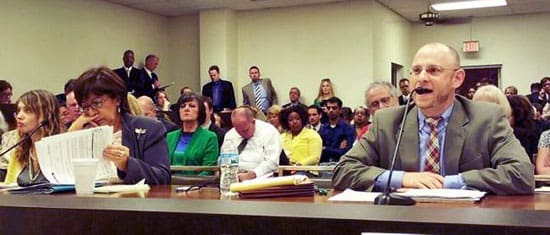
AFC’s John Peller was invited by State Rep. Sara Feigenholtz (D-Chicago) to testify in support of SB 26, which would leverage federal Medicaid funding to cover low-income people, including thousands with HIV. Here’s the testimony John delivered.
Good morning, Madam Chair and members of the committee. I’m John Peller with the AIDS Foundation of Chicago.
I’m here to testify in strong support of SB 26 and to thank Rep. Feigenholtz, Senator Steans, Director Hamos and the HFS team, and Governor Quinn for their leadership on this bill. I also want to thank my colleagues Ramon Gardenhire and Nadeen Israel for organizing the advocates for SB 26.
It’s not often that you see the AIDS Foundation of Chicago and the Illinois Chamber of Commerce at the same witness table supporting the same bill. Don’t get me wrong – we get along just fine. It’s just that our organizations don’t have much in common. But we’re both supporting SB 26 because it’s the right thing to do for the state’s businesses, economy, health care system, communities and most importantly, its residents: your constituents.
SB 26 will allow 342,000 people to gain comprehensive coverage under Medicaid.
Let me give you an example of someone who would be helped by this bill. Harry (not his real name) was uninsured and receiving HIV care at Oak Forest. But he was diagnosed with diabetes and suffered from extreme fatigue due to a heart condition. The doctor struggled to get the patient on the priority list at Stroger Hospital. She was frustrated by having to pick which health condition she could work on at a time; this was further complicated because the meds recommended for his cardiac problems were contraindicated for people on HIV meds. But once he got a Medicaid card, he was able to receive excellent cardiac care at Northwestern Memorial Hospital and has had two coronary procedures there.
There are 342,000 Harrys out there who will gain new health coverage under SB 26 and receive the medication and treatment they need. They’re already using our emergency rooms, hospitals and free clinics. It’s just that they’re using them the wrong way because they have no choice. SB 26 will give them the opportunity to manage their chronic conditions, access preventive care, and over time, reduce spending for all of us.
I want to address a few myths about SB 26.
First, you’ve probably heard concerns that the state will be left holding the bag if the federal government ever drops its share of match below 90 percent. This should not be a concern for us. First, there’s an iron-clad provision on page 412 line 1 that automatically stops coverage of the new Medicaid population if the match drops below 90 percent. Yes, the bill gives the General Assembly time to reverse that decision, and yes, it will be hard for your future colleagues to resist the political pressures to continue coverage. But the fact remains: There is an automatic end to the program that’s written into this bill that provides financial protections for the state.
On a related note, you’ve probably heard the fear that the federal government might cut its match and institute a maintenance of effort requirement. This would force the state to continue to cover the new Medicaid population with less federal funding. This fear ignores history – when the feds have put a maintenance-of-effort requirement in place, it’s been when they increased federal matching rates and didn’t want states to supplant federal funding. And remember who makes up Congress: representatives and senators from our states, many of whom are your former colleagues. It’s hard to see a situation in which they would agree to handcuff the state and cut funding at the same time – and be able to set foot in Illinois again.
Another argument you’ll hear against this bill is that there’s no rush to pass it: Illinois doesn’t need to pass the bill now, we can wait. This is just not true. Every day we delay after January 1 is a day that we leave on the table millions of federal dollars we could be using for better, more comprehensive coverage for people who are already using our community’s hospitals, emergency rooms, and clinics, with no hope of getting ahead of the illnesses they are facing because they can’t afford medications or preventive care.
You’ll also hear that the Medicaid system is broken, and that we shouldn’t put more people into Medicaid. I agree that Medicaid is far from perfect – the rates are too low, and it can be difficult to find specialists. But Medicaid is undergoing a sweeping transformation as it implements care coordination for half of the Medicaid population, in line with the mandate that you established several years ago. HFS is giving responsibility for cost and quality to new managed care and community-based providers systems, and is creating incentives that will establish an entirely new Medicaid system. We’re not putting people into the old Medicaid system that you know; they’re going into a new system that will address many of these long-standing problems.
You’ll also hear that the costs for the new Medicaid population will be higher than HFS anticipates. It’s well documented that newly insured people use quite a lot of medical care. This is due to pent up demand as they see providers for conditions that had been untreated for too long. Fortunately, the federal government will pay 100 percent of the costs during this initial three-year period when pent-up demand will be greatest. More importantly, we will be investing in smart preventive care. And as the pent-up health needs are addressed and health care costs for those folks come down, the remaining costs are still paid for with 90 percent federal funds.
It’s not often in your careers as legislators that you will take as momentous step as you will today. I urge you to vote yes for SB 26 to give 342,000 of your constituents the chance to get new health coverage – and for the rest of your insured constituents the opportunity to reap the benefits from lower spending on uncompensated care and charity care.
Photo credit: Kelly Cassidy
What’s AFC up to in Springfield? 2013 Legislative Session Update

AFC works hard in Springfield to enact sound HIV/AIDS policies. This year, with the help of advocates like you, we passed all three of our target bills! Read more about these bills below.
Current Issues (more information after the jump):
- SB 26 – Medicaid for Low-Income, Uninsured Illinoisans – Senator Heather Steans (D-Chicago) and State Rep. Sara Feigenholtz (D-Chicago)
Allows 342,000 uninsured Illinoisans access life-saving medications and medical care through Medicaid.
- HB 61 – Repeal Principal Notification of HIV Positive Students – Representative La Shawn Ford (D-Chicago) and Senator Iris Martinez (D-Chicago)
Repeals a law that requires state health departments to notify school principals of HIV-positive students.
- HB 2675 – Comprehensive Sexual Health Education for Illinois Students – Representative Camille Lilly (D-Chicago) and Senator Heather Steans (D-Chicago)
Requires public schools to provide medically-accurate, age-appropriate, and comprehensive sexual health education
- Other Legislative Matters – Marriage Equality, Medical Marijuana, State-Run Health Insurance Marketplaces, and Affordable Care Act Navigator Regulations
Want to get updates on these issues and more? Sign up for our Online Action Bulletin to receive email updates, lobbying opportunities, and more!
SB 26 – Medicaid for Low-Income, Uninsured Illinoisans (Senator Heather Steans, D-Chicago, and Rep. Sara Feigenholtz, D-Chicago)

Bill Status: This bill passed the Senate on February 28, 2013 by a vote of 40-19. It passed the House by a vote of 63-55 on May 27, and on May 28 the Senate concurred on the two amendments added in the House. Updated 6/04/13.
Illinois has the opportunity to use its Medicaid program to support 342,000 low-income, highly vulnerable, uninsured individuals, including thousands of people living with HIV. Anyone who earns up to 133% of the federal poverty level, or about $15,282 annually, would be eligible to enroll in Medicaid.
This change will be supported 100% with federal dollars for the first several years, and federal support will never drop below 90%. This important legislation will help the Illinois economy, making health systems stronger and more cost-effective, while ensuring hardworking Illinois residents have access to care.
Click here to see status updates and read the bill.

Click here to see how your Representative voted on SB 26. Click here to see how your Senator voted on SB 26.
To learn more, click on any of the materials below to download information about SB 26.
Read the stories of advocates who lobbied in Springfield for the new Medicaid!
Read more about how the New Medicaid will affect people living with HIV/AIDS on HIVHealthReform.org!
HB 61 – Principal Notification of HIV Positive Students (Representative La Shawn Ford, D-Chicago and Sen. Iris Martinez, D-Chicago)
 Bill Status: This bill passed the full House on March 7, 2013 by a vote of 61-55-1, and passed out of the Senate by a vote of 38-13 on May 23, 2013. Updated 5/28/13.
An outdated law from 1989 makes Illinois the only state in the country in which health authorities must notify school principals the names of HIV-positive students. These principals can then share this information with other school personnel, which puts student privacy at risk and could be a violation of the AIDS Confidentiality Act and the Americans with Disabilities Act.
HB 61 would repeal this law, allowing students and parents to disclose to people they deem necessary for medical reasons. Schools already put into place precautions for blood-borne diseases, and we know today that HIV cannot be transmitted
through biting, fighting, sports, or other school situations.
Click here to see how your Representative voted. Click here to see how your Senator voted.
To learn more, click on any of the materials below to download information about HB 61.
- HB 61 Fact Sheet
- How HB 61 Changes the Current Law
- Additional Information (Q&A)
- Read the AFC/AIDS Legal Council of Chicago press release on House passage of the bill
- Read the Chicago Board of Health letter in support of HB 61
HB 2675 – Comprehensive Sexual Health Education for Illinois Students (Representative Camille Lilly, D-Chicago, and Senator Heather Steans, D-Chicago)
 Bill Status: This bill passed out of the Illinois House by a vote of 66-52 on Wednesday, April 18 and out of the Senate by a vote of 38-13 on May 23, 2013. Updated 5/28/13.
This bill requires that if a public school chooses to teach sexual health education, then the program must be medically accurate and developmentally and age appropriate. It does not apply to private or religious schools, nor does it require specific lesson plans, activities, or materials.
HB 2675 includes information on reducing unintended pregnancies and sexually transmitted infections, stresses abstinence, and applies to grades 6-12. With young people accounting for 39% of all new HIV infections, this bill is a valuable tool to provide students with the information and ability to prevent the spread of HIV.
To learn more, click on the fact sheets below.
Click here to see how your Illinois House Representative voted on HB 2675. Click here to see how your Illinois Senator voted.
Click here to read AFC’s press release on the House action to pass HB 2675.
Marriage Equality (SB 10) – Sen. Heather Steans (D-Chicago) & Rep. Greg Harris (D-Chicago)
Although Illinois lawmakers failed this session to pass SB 10, which would make Illinois the 13th state to embrace marriage equality. Legislative leaders and the community pledge to continue the fight. Click here to read here what David Ernesto Munar, President/CEO of AFC, said about the matter and the struggle for equality.
Medical Marijuana Bill (HB 01) – Rep. Lou Lang (D-Skokie) & Sen. William Haine (D-Alton)
Legislation was approved by the General Assembly that would allow doctors to prescribe medical marijuana to patients with serious illnesses, such as HIV/AIDS, sending the measure to Gov. Quinn.
State-run Marketplace (HB 3227) – Sen. Dave Koehler (D-Peoria) & Robin Gabel (D-Evanston)
House Bill 3227 creates online health insurance marketplaces that will allow individuals, families, and small business employees to shop for health coverage. AFC opposed the legislation base on the poor consumer protections in the bill.
ACA Navigator Regulations (SB 1194) – Sen. William Haine (D-Alton) & Frank Mautino (D-Spring Valley)
Senate Bill 1194 would have created overly restrictive criteria for organizations applying for and performing navigator functions. AFC, consumer advocates and community–based providers recognized these issues, and successfully lobbied state legislators to make changes in the bill.
 The AIDS Foundation of Chicago (AFC) recently made the difficult decision to oppose legislation that creates a state-federal partnership for operating Illinois’ health insurance marketplace. We base this decision on the poor consumer protections in the bill.
House Bill 3227 (Senate Amendment 2) is backed by our partners, including Campaign for Better Health Care (CBHC), and is sponsored by Sen. Dave Koehler (D-Peoria), a long-time friend of AFC and champion for helping people without insurance access health care. Still, we cannot support it.
The Affordable Care Act (ACA), the new national health care reform program established by President Obama and Congress in 2010, creates online health insurance marketplaces that will allow individuals, families, and small business employees to shop for health coverage. Such marketplaces – which will be comparable to, say, Travelocity for health insurance – are a central component to the success of ACA state implementation. Plans sold on the marketplace will be available to anyone, including people with HIV, regardless of their diagnosis or condition, ending decades of legal discrimination by insurance companies against people with HIV. People earning between about $16,000 and $46,000 will be able to receive subsidies to make premiums and out-of-pocket costs more affordable.
States have the option to operate the marketplace themselves, use a marketplace run by the federal government, or operate a state-federal partnership. In 2014, Illinois will employ the state-federal partnership option and use the federal marketplace as the backbone of its system; however, Illinois will directly operate outreach, enrollment, and other programs. Eighteen states are running their own marketplace; seven, including Illinois, will use a state-federal partnership model; and 27 will exclusively use the federal marketplace. (See the Kaiser Family Foundation’s “State Decisions on Health Insurance Exchanges and the Medicaid Expansion” for more information.)
AFC and many other advocates, health care providers, insurance industry officials, brokers, and others believe a state-operated marketplace is best for Illinois. This would allow the state to have the most control over the program and facilitate better coordination with Medicaid, which will cover people earning roughly $16,000 or less.
The ACA will give considerable flexibility to states that operate their own marketplace, allowing them to determine governance and organizational structure, financing, and the ability to establish operational requirements to meet federal standards. These decisions will greatly determine if the marketplace is successful at providing affordable health plans for individuals and small businesses.
HB 3227 would create an Illinois-run marketplace beginning in 2015. The bill created a quasi-government entity to operate the exchange, which would be funded through a tax on the insurance industry.
It’s no secret that the insurance industry has tremendous influence in Springfield. Advocates often joke that consumer-friendly insurance reform bills go to the House and Senate Insurance Committees to die. Moreover, the insurance industry makes significant campaign donations to sitting members of the General Assembly, as detailed in this 2011 State Journal Register article.
The primary reason AFC opposes HB 3227 is that the Illinois General Assembly and its insurance-industry allies would have heavy control over the marketplace. Here are three examples of why this creates an unhealthy system of oversight: 1) the General Assembly would annually approve the budget for the exchange, even though its operating funds are held outside the state treasury; 2) the General Assembly would control even small details, such as the executive director’s salary; and 3) language in the bill limits the exchange’s ability to impose future standards that are more rigorous than the minimums established by the federal government.
Giving significant control of the exchange to the General Assembly is akin to letting the fox design, build, stock, and guard the henhouse. If us chickens are to have a meaningful choice of affordable insurance plans that provide high-quality health care, the exchange needs more independence from the General Assembly and by extension, the insurance industry.
We favor an independent marketplace board of directors that includes strong consumer and small business members, not insurance industry representatives. A board with these standards and statewide representation will be vested in making the best decisions for Illinois health insurance consumers.
In addition, AFC is concerned that the marketplace bill has the potential to leave people with HIV vulnerable to health insurance companies. For example, federal law requires insurance plans to contract with “essential community providers,” which include medical clinics funded by the Ryan White Program. This requirement makes sure people with HIV don’t have to switch health care providers and can obtain high-quality HIV care; however, AFC is concerned that health plans might exclude Ryan White Program providers in order to drive away people with HIV—a potentially discriminatory practice.
Moreover, the Illinois bill simply references the federal standards for essential community providers, which are weak and contain no numerical standards:
§ 156.235 Essential community providers. (a) General requirement. (1) A QHP issuer must have a sufficient number and geographic distribution of essential community providers, where available, to ensure reasonable and timely access to a broad range of such providers for low-income, medically underserved individuals in the QHP’s service area, in accordance with the Exchange’s network adequacy standards. (45 CFR 156.235)
Under the federal-state partnership marketplace that will roll out in 2014, a different set of federal rules requires that plans contract with at least 20 percent of essential community providers in their service area. If they cannot meet that standard, they must submit a written statement, explaining their shortcoming and how they will make sure the network is adequate (see page 7 of this letter to issuers on federally-facilitated and state partnership exchanges). Although we earlier argued that this provision is also weak, we think the specific 20 percent requirement is better than the federal requirement Illinois would follow under HB 3227.
HB 3227 passed the Senate Insurance Committee on May 9 by a vote of eight to five. Tellingly, the Illinois Governor’s Office position was “neutral,” meaning they neither supported nor opposed the bill. The bill awaits a vote in the full Senate, and then must proceed to the House. It’s too soon to predict if the measure will advance in the House by the end of the session on May 31.
Meanwhile, the marketplace, run by the state-federal government, will begin enrolling Illinoisans beginning on October 1, 2013, for coverage starting January 1, 2014.
If HB 3227 does become law, AFC will work to influence regulations to favor consumers, and of course, we will advocate in future General Assembly sessions to improve the law for people with HIV, as well as other vulnerable populations.
FOR IMMEDIATE RELEASE: May 1, 2013
Media contact: Ryan Singleton
Tel. 312-334-0913
Email: [email protected]
AFC Applauds Recommendation
The U.S. Preventive Services Task Force (USPSTF) issued a landmark recommendation on April 29, strongly supporting routine HIV testing for all individuals ages 15 through 65. Because federal law requires health insurance plans to cover preventative measures highly recommended by USPSTF, most public and private insurance carriers will begin to offer routine HIV testing to beneficiaries as early as next year, without copayments.
Previously, USPSTF recommended that only people at risk of contracting HIV test regularly.
The AIDS Foundation of Chicago (AFC) applauds this new recommendation, which will dramatically reduce the financial barrier to regular HIV testing services for insured Americans.
“With this decision, a large portion of the country will have access to free, routine HIV tests,” said David Ernesto Munar, President/CEO of AFC. “This is a gigantic step forward because testing is one of our greatest tools for linking people with HIV to appropriate medical care and other essential services that reduce risk for the individual and community. And routine testing benefits sexually active HIV-negative individuals as well who should regularly monitor their health.”
“In Illinois, we estimate that one in five people living with HIV/AIDS are unaware they have the virus, often because HIV can lie dormant for up to a decade,” said John Peller, Vice President of Policy at AFC. “That’s about 8,500 people. Connecting them with life-saving HIV medications will afford them the opportunity to live longer, more productive lives. It will also keep our communities healthier because people being treated for HIV have a significantly lower risk of transmitting the virus.”
AFC is available to discuss with the media USPSTF’s recommendation and its implications for Chicago’s AIDS community.
####
Founded in 1985 by community activists and physicians, the AIDS Foundation of Chicago is a catalyst for local, national, and international action against HIV/AIDS.