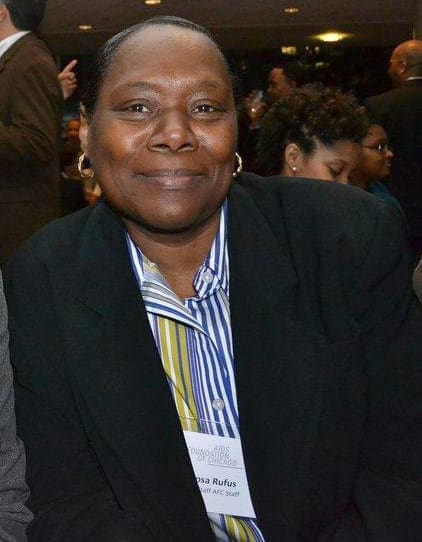
 Rosa Rufus never said a bad word about anyone.
She always had a smile on her face.
Such are the memories shared as her friends and colleagues at the AIDS Foundation of Chicago reel from the loss of her presence.
Rosa Lee Rufus died in the early morning of Friday, Jan. 18. For eight years, Rufus worked in the finance department for the AIDS Foundation of Chicago (AFC), ending her career as contracts coordinator. She was a quiet and deeply private person, but those who knew her remember her as a remarkable and sweet woman who loved to read, cook and spend time with her family.
“She was just a very dear woman, very kind and very gentle,” said Mark Schad, AFC’s contracts manager.
Schad supervised Rufus, who worked with client agencies funded by AFC. It was Rufus’ responsibility to review, audit and file forms documenting proper use and allocation of funding. She was very attentive to detail, helpful those who needed assistance and calm under pressure, Schad said.
“Even when there were disagreements, as happens in the workplace, it was like water off a duck’s back,” he said.
She carried herself with a quiet integrity, Schad said.
“She always said hello when she passed you in the hall, always looked you in the eyes,” he said. “She always said ‘good night’ at the end of every day.”
For Jessica Sianez, who worked near Rufus in the finance department, the smell of Rosa’s lavender lotion was always a pleasant sign she was there. Sianez remembers the little things that would spur conversations, such as books, “American Idol,” motherhood and cooking.
Rufus loved to cook and was known for her spinach lasagna, a highly-requested item at departmental potluck dinners. Arisbel Cruz-Lewandowski, a grants and contracts manager, said they often traded recipes, and though they didn’t work closely together, she was impressed by Rufus’ constant and cheerful demeanor.
Yvette Kilpatrick, AFC’s accountant, also remembers Rosa’s cooking.
“Rosa’s food would make you moan out loud at the first bite … She wasn’t one to toot her own horn though, she would just graciously say thanks and give up the recipe when I would ask, though it never quite tasted like hers,” Kilpatrick said.
She went on: “We would trade trashy love novels, debate the state of the Black Man, discuss tactics on surviving a teenager … She was always willing to listen and give a little insight. I will miss our talks.”
Deena Mansfield, another contracts coordinator for AFC, worked with Rufus for eight years. She was hired on just before Rosa and took her out to lunch on her first day of work. The two women bonded over the television shows “American Idol” and “X Factor,” Mansfield said.
“Rosa was a sweet, dear person that I will miss very much,” Mansfield said.
Perhaps her most lasting legacy at AFC will be her charitable spirit and her unwillingness to speak ill of others.
“She never seemed to concern herself with the gossip world,” said Angela Jordan, AFC’s intake and referral coordinator. “That’s what I appreciated most about her. If I shared something with her, I wasn’t afraid it would hit the rumor mill.”
Though quiet, she was engaging and funny when talking with her work friends.
“Wow, I still can’t believe she’s gone,” said Nicole Doss, a DRS/Part A training associate for AFC. “Rosa was very kind, reserved and hilarious when you got to know her.”
Phyllis Coprich, who works in AFC’s Care department, summed up the sentiments of many AFC staff: “I didn’t have much contact with Rosa outside of AFC. But in the time that I have known her I found her to be a very beautiful soul.”
On Thursday, the day before Rufus died, Fonstella Ross went to the hospital to check in on her.
“I was going to say hi, not goodbye,” said Ross, a gift entry manager at AFC, who remembers her friend Rufus as a very kind woman who valued her privacy and loved her family.
During that last visit, Rufus was too weak to speak at that point, but raised her hand as if to say hello.
“She was a beautiful, private person,” Ross said, “and she will be missed.”
***
Rosa Lee Rufus is survived by her daughter, Latonya Rufus.
The homegoing celebration arrangements for Rosa Lee Rufus are as follows: There will be visitation from 7 to 9 p.m. on Friday, January 25, at the Leak & Sons Funeral Home, 7838 South Cottage Grove, Chicago. The wake will be held Saturday, January 26, from 4 to 5 p.m. at the same location, followed immediately by the funeral service. The funeral procession will depart from Leak & Sons Funeral Home at 8:30 a.m. on Monday, January 28, for the 9 a.m. internment at Beverly Cemetery at 12000 South Kedzie.
 This week, an Illinois legislative body advanced a major piece of the Affordable Care Act (ACA) when the House Human Services Appropriation Committee passed HB 6253, Medicaid Financing for the Uninsured.
Last year, the Supreme Court ruled that the federal government couldn’t force states to cover low-income uninsured people through Medicaid. We knew we’d have to take the fight to the Illinois General Assembly.
This effort brought together an unusual mixture of health care providers, business interests, patients and advocates, demonstrating sweeping consensus that it is right and advantageous for Illinois to accept new federal Medicaid funding. This new opportunity – paid for 100% by the federal government for the first three years – will fill a historic gap in the Medicaid program and provide health care coverage for thousands of low-income Illinoisans who are not now eligible for Medicaid, including many thousands living with HIV/AIDS.
After Tuesday’s committee vote, however, the waning hours of the current term of the General Assembly did not provide enough time to advance the bill further. We thank State Representative Sara Feigenholtz (D-Chicago) and Senator Heather Steans (D-Chicago) for sponsoring the bill, and are grateful for the leadership of Julie Hamos, director of the state agency that runs Medicaid.
Nevertheless, our momentum continues with renewed commitment and excitement. A new Medicaid bill has already been filed, Senate Bill 26, and we have laid a strong foundation to build on in the 98th General Assembly.
As the new General Assembly begins, your voices will need to be heard again with in-district meetings, emails and phone calls to your Senators and Representatives, many of whom will be new in office or serving from redrawn districts. It will be critical that these legislators hear from you.
Thank you for all you have done so far, and especially to the 15 advocates (pictured right) who went to Springfield on Monday to lobby for the Medicaid bill. And thank you, in advance, for all the help you will provide to obtain federal Medicaid funding for the uninsured in Illinois.
Ramon Gardenhire
Director of Government Relations


World AIDS Day is here!
Every year, World AIDS Day is a time of reflection and action.
World AIDS Day, observed every year on December 1, is an opportunity to celebrate the gains made in ending the epidemic, embrace those living with HIV/AIDS and honor those we’ve lost to AIDS throughout the years.
Here are some things you can do this World AIDS Day to make a difference:
- Educate. Chicago has three times the national rate for HIV, and many people do not know they have HIV. That’s why AFC has partnered with Abbott, a global healthcare company committed to HIV testing and treatment for nearly 30 years, to launch “Need2Know HIV,” a social media campaign to educate people about HIV testing. Follow the campaign on Facebook and Twitter (#Need2KnowHIV) starting on Saturday, Dec. 1.
- Watch. Check out David Ernesto Munar, AIDS Foundation of Chicago president/CEO, who spoke as a panelist at the White House World AIDS Day Commemorative Event. The discussion was livestreamed Thursday, Nov. 29, from 12 p.m.-2 p.m., and is available at http://www.whitehouse.gov/live.
- Learn. Do you know what the “fiscal cliff” and the automatic budget cuts will mean for people living with HIV here in Illinois? Please let us explain.
- Mingle. Read this roundup of World AIDS Day events happening right here in Chicago. This list will be continually updated over the next several days.
- Donate. Now is a great time to go the extra mile, like HIV-positive marathoner Teddy Greene, and change someone’s life for the better. Read Teddy’s story and donate today.
Thank you so much for helping us change the story of HIV/AIDS.

You’ve heard about it. It’s coming. And it sounds scary. But what does the “fiscal cliff” really mean for people living with HIV?
According to a new analysis by the AIDS Foundation of Chicago, the impact of the automatic budget cuts will be prove to be both deleterious to public health and costly for taxpayers in the long run.
On January 2, 2013, absent any change in federal law, a process called “sequestration” will cause sweeping across-the-board automatic budget cuts. President Obama and the U.S. House and Senate in 2010 agreed to these budget cuts as part of deficit reduction negotiations in 2011.
The January 2 deadline represents the so-called fiscal cliff, which legislators on both sides of the aisle say they are working to avoid. Discussions are ongoing in Washington to replace sequestration with a balanced package of revenue increases and budget cuts.
In hopes of educating policymakers and the community, AFC recently estimated the impact of sequestration on HIV prevention, treatment, housing and supportive services in Illinois.
There are an estimated 42,700 people living with HIV in Illinois. In 2010, Illinois received $121.4 million in federal funding for HIV prevention, care and housing and other services. Illinois would lose an estimated $10 million in federal HIV funding, based on the scheduled 8.2 percent cut resulting from sequestration.
These funding cuts would further strain access to housing, medical care, HIV prevention services, mental health, substance abuse treatment and other services that lower costs by supporting engagement in care and access to preventive services.
Housing
A $610,227 cut will mean 125 families will lose long-term or short-term housing through the Housing Opportunities for People with AIDS (HOPWA) program.
Ryan White Program
As a result of a $3 million cut to Ryan White Program services, 613 fewer people will receive medications through the AIDS Drug Assistance Program (ADAP).
That deep cut to Ryan White Program services, funded by Part A (services in the Chicago metro area) and B (statewide services), would also mean people with HIV in Illinois would receive:
• 2,500 fewer primary care visits;
• 1,100 fewer dental visits;
• 6,800 fewer mental health visits;
• 3,700 fewer substance abuse treatment visits;
• 2,600 fewer linkage to care, peer, or referral services;
• 2,800 fewer nights of housing;
• 271 fewer legal aid visits; and
• 240,00 fewer meals.
CDC-Funded HIV Prevention Services
A $1.74 million cut to HIV prevention services will mean that:
• 4,300 HIV fewer HIV tests will be conducted;
• As a result, 66 people with HIV will not be diagnosed, losing an opportunity to link them to treatment to reduce their long-term treatment costs;
• 434 newly-diagnosed people will not receive partner services to identify individuals who may have been exposed to HIV to offer them testing and treatment; and
• 52 people will be newly infected because undiagnosed people will not know to prevent HIV transmission, partners will not be identified and linked to care, and high-risk negatives will not receive counseling.
The lifetime medical treatment cost for these 52 newly-infected people is $23.3 million.
For more information, contact John Peller, Vice President of Policy, 312-334-0921 or [email protected].
For complete citations and notes on methodology, please download this document:
The Impact of Sequestration on HIV Services/Programs in Illinois 
| FOR IMMEDIATE RELEASE November 23, 2012 |
MEDIA CONTACT Greg Trotter, 312-314-0913 |
The AIDS Foundation of Chicago (AFC) welcomes the appointment of Nanette Benbow as the new Deputy Commissioner for HIV and STI Services at the Chicago Department of Public Health.
“Nanette brings an impressive record of public service fighting HIV and other sexually transmitted diseases in her nearly 20-year career at the Chicago Department of Public Health,” said David Ernesto Munar, AFC President/CEO. “She possesses a keen understanding of local and national HIV/AIDS trends and the strategies needs to achieve greater progress. These attributes along with her dedication and compassion make Nanette an ideal leader for Chicago’s HIV/STI Services Division.”
As the most recent Director of STI/HIV Surveillance, Nanette applied national modeling strategies to improve local monitoring and planning to control the epidemic. AFC collaborated closely with Nanette to model local outcomes and unmet need at every stage of HIV care and featured her work in its recently released three-year strategic plan called “Road to Health: Charting Health Improvements for HIV-Affected Communities.”
# # #
Founded in 1985 by community activists and physicians, the AIDS Foundation of Chicago is a catalyst for local, national, and international action against HIV/AIDS.
The Illinois Department of Healthcare and Family Services (HFS) is considering options for the Medicaid benchmark Medicaid benefits (pdf) package that will be extended to the new health care reform Medicaid expansion population.
The Medicaid benefits package defines the baseline of services covered by the state for the newly eligible Medicaid recipients under health care reform. The plan will have far-reaching implications for people with chronic diseases like HIV.
Recently the Illinois Department of Public Health (IDPH) proposed adoption of rules for the sexually transmissible disease code.
After consultation with medical providers, agencies that provide services to youth, community members, and persons living with HIV and STDs and other service providers, the AIDS Foundation of Chicago, AIDS Legal Council of Chicago, and Howard Brown Health Center submitted comments on the proposed rules.
AFC, ALCC, and Howard Brown believe that identifying individuals with STIs and HIV and linkage to care is a national and state goal to prevent or avert infections. When individuals have early access to STDs and HIV testing and treatment it dramatically reduces transmission of diseases and increases the likelihood that individuals stay healthier which contains long-term cost for the state.
Read the comments on the proposed rules for the sexually transmissible disease code.
AIDS Foundation of Chicago Lauds Federal Waiver for Early Enrollment in Medicaid in Cook County, Says Reform Will Benefit Those Living With HIV/AIDS
Early implementation of the Affordable Care Act will lead to long-term reduction in
health care costs, but a careful rollout will be necessary to avoid disruptions in HIV care.
Media contact: John Peller, 312-334-0921
The AIDS Foundation of Chicago (AFC) applauds the Obama administration’s approval on Friday of a federal waiver to allow more people to enroll in Medicaid in Cook County, as an early implementation of an Affordable Care Act provision.
The approval of the waiver, which is reported to be worth as much as $100 million a year, will mean more than 100,000 uninsured Cook County residents will be enrolled a year early in the expanded Medicaid program — a crucial part of the health care reform law. The new program has the potential to transform health care access for people living with HIV, promising significant long-term reductions in health care costs and fewer new HIV cases.
AFC estimates that 1,500 to 1,800 people with HIV will be eligible to enroll in the new program.
“We commend the Obama Administration’s approval of the Cook County 1115 Medicaid waiver,” said David Ernesto Munar, AFC’s president/CEO. “We congratulate Cook County Board President Toni Preckwinkle and Dr. Ram Raju, CEO of the Cook County Health and Hospitals System, on achieving this milestone in reinventing the county health system. Thanks to their tireless efforts, tens of thousands of low-income, uninsured people will gain access to comprehensive health coverage.”
The Obama administration is allowing Cook County to implement, a year early, a provision of the ACA that will provide Medicaid coverage to any U.S. citizen earning less than 133% of the Federal Poverty Level (FPL) or about $15,400 per year for a single person. The special program will also require enrollees to be residents of Cook County.
Today, low-income people with HIV can obtain basic primary care and life-saving HIV medications through the federal Ryan White Program, Munar said. But they’re forced to rely on charity care for serious non-HIV conditions, such as cancer, and would have to pay out-of-pocket for medications to treat common conditions such as depression or heart disease.
“Sadly, too many low-income people with HIV can’t obtain these medications, and their co-occurring conditions are often unmanaged,” Munar said.
The new Cook County program will give these individuals access to comprehensive medical coverage for all health conditions. But careful implementation will be important.
“We pledge to work hand-in-hand with Cook County health system leaders to implement the new program,” said John Peller, AFC’s vice president of policy.
If the waiver is not phased in properly, people with HIV stand to lose access to services because of an archaic provision in the Ryan White Program, Peller said. In fact, implementation problems with a similar program in California significantly disrupted access to care for people with HIV.
“We have already had many discussions with Cook County health system officials on the importance of careful implementation for people with HIV, and we are confident they will do everything in their power to avoid disruptions,” Peller said.
Ramon Gardenhire, director of government relations for AFC, noted that the Illinois General Assembly passed legislation in May clearing the way for the new Cook County Program.
“All low-income people in Illinois should have the same access to Medicaid as Cook County residents,” Gardenhire said. “We urge the General Assembly and Governor Quinn to act immediately this fall to change state law to implement the Affordable Care Act, including covering this new Medicaid population.”
Cook County officials have not yet announced when enrollment will begin or how individuals can apply for services. AFC urges HIV service providers and low-income people with HIV to watch closely for information on the new program, and to act quickly when enrollment information becomes available.
Founded in 1985 by community activists and physicians, the AIDS Foundation of Chicago is a catalyst for local, national, and international action against HIV/AIDS.
aidschicago.org
####
UPDATE: The venue for this event has been changed to the large conference room at the AIDS Foundation of Chicago office, located at 200 W. Jackson, Suite 2200.
Please join the AIDS Foundation of Chicago and Amnesty International in welcoming Dr. Arash Alaei and Dr. Kamiar Alaei, Iranian physicians and pioneers in HIV/AIDS treatment and prevention, to Chicago on Tuesday, Nov. 13 at 3:00 PM.
Garnering international praise, the Alaei brothers developed HIV programs to help the most marginalized individuals in Iran, including sex workers, IV drug users and prisoners. Their work was recognized by the World Health Organization as a best practice model for the Middle East and North Africa.
In 2008, Arash and Kamiar were imprisoned in Iran for “communicating with an enemy government.” After serving three and two and a half years respectively, they are now based in New York and continue to work on developing HIV programs for marginalized and stigmatized populations around the world.
Please join us on Nov. 13 to hear Dr. Arash Alaei and Dr. Kamiar Alaei talk about their experiences working to prevent and treat HIV around the world. There will also be an opportunity to ask questions after their presentation.
Tuesday, November 13, 2012
3:00 PM – 5:00 PM
AIDS Foundation of Chicago
200 W. Jackson, Suite 2200
Chicago, Illinois 60606
For more information or questions, contact Daliah Mehdi at [email protected].
 Let’s hear it for the boys!
The AIDS Foundation of Chicago is proud to spotlight a men’s fall fashion event in downtown Chicago hosted by Macy’s, a generous sponsor of AFC’s work.
Macy’s and OUT Magazine invite you to an exclusive preview of the hottest looks for Fall!
Join Macy’s Water Tower Place as we kick off the season in style. Check out the latest trends from Impulse and our top-name designers, including Hugo Boss, Armani Jeans, Michael Kors, Theory, Versace Jeans, Diesel, Tallia Orange and more!
Shop and save 20% on a Designer or Impulse purchase and spend $250 in Men’s Designer or Impulse and receive a complimentary gift!* Plus, shop to the beats of Chicago’s very own, DJ Greg Haus from Berlin Nightclub and visit Fitzgerald’s of Sawyer Mixologist Shade Murray for his exclusive Men’s Designer mocktail creations!*
Confirm your attendance on Facebook by visting http://www.facebook.com/events/158702580941241
Event subject to change or cancellation. *While supplies last.