 Experts, advocates and leaders in the HIV/AIDS community will travel to Chicago from all over the country this weekend for the United States Conference on AIDS. The 15th Annual USCA, facilitated by the National Minority AIDS Council, will be at the Sheraton Chicago Towers and Hotel, Thursday, Nov. 10 to Sunday, Nov. 13.
The AIDS Foundation of Chicago (AFC) is proud to be serving on the Chicago Hosting Committee and will participate in many workshops, panels and presentations throughout the busy weekend.AFC President/CEO David Ernesto Munar will help kick things off on Thursday morning at the opening plenary, as he moderates a discussion with Secretary of Health and Human Services Kathleen Sebelius and the National AIDS Policy Director Jeff Crowley.
If you can’t make the conference, you can read updates from the AFC’s new Inside Story blog as the week progresses.
To view the full schedule for the weekend, download the USCA program.
Here’s an overview of where AFC will be leading up to and during the conference…
AIDS Foundation of Chicago (AFC) before and during the United States Conference on AIDS, Nov. 8-13
*All events are at the Sheraton Chicago Hotel and Towers, 301 East North Water St., unless otherwise noted.
| Tuesday, Nov. 8 | All day – Black Treatment Advocates Network steering committee meeting, @AFC office-200 West Jackson, Blvd., Suite 2200, feat. Keith Green, AFC’s director of federal affairs |
| 5 p.m. |
“Chicago Stories: Our Past and Future Fighting HIV/AIDS – Lessons for Nonprofit Executives at USCA,” @Spiaggia Restaurant Chicago, 980 North Michigan Ave. |
| Wednesday, Nov. 9 | |
| 2:15-2:30 p.m. | “Building and Sustaining Infrastructure Capacity to provide Community-based HIV Testing in Non-Clinical Settings,” w/Cynthia Tucker, AFC’s director of prevention and community partnerships, USCA Pre-conference Institute, @Michigan Room |
| 11 a.m.-5p.m. | “The Inaugural HIV Prevention Justice Leadership Assembly,” @University of Chicago Gleacher Center, w/Julie Davids, AFC’s director of national advocacy and mobilization |
| 6 p.m. |
“When Sex is a Crime and Spit a Dangerous Weapon: Defending Against HIV Criminal Laws,” @AFC offices-200 W. Jackson Blvd., Suite 2200, (hosted by AFC) |
| Thursday, Nov. 10 | |
| 8-10 a.m. | Opening Plenary w/Health and Human Services Secretary Kathleen Sebelius and Jeff Crowley of the White House, moderated by AFC President/CEO David Ernesto Munar, @Chicago Ballroom, 4th level |
| 10:30 a.m.-12 p.m. | AIDS United Institute: Mapping Pathways, @Columbus-lobby level, feat. Jessica Terlikowski, AFC’s director of regional organizing |
| 11:15-11:45 a.m. | “Adverse Childhood Experiences and HIV Risk Behaviors among Chicago Men Who Have Sex With Men: New Frontiers for HIV Prevention Intervention,” @ Chicago VIII, Level 4, feat. Keith Green |
| 2:30-2:45pm | “Put a Ring on It: Promoting the New Female Condom in Chicago,” Jessica Terlikowski, Chicago Female Condom Campaign, @Chicago VIII, level 4 |
| 2:30 p.m. | Harlem United Prevention Panel, Chicago X-4th level, feat. Keith Green |
| 6-8:30 p.m. | Welcome Reception, AFC part of Chicago Hosting Committee, @Chicago Ballroom 4th level |
| Friday, Nov. 11 | |
| 9 a.m.-12 p.m. | AIDS 2012 US Outreach: USCA Seminar, David Ernesto Munar, Chicago X-4th floor |
| 2:15-4:15 p.m. | Gay Men’s Policy Panel, @Michigan-2nd level, feat. Jim Pickett, AFC’s director of prevention advocacy and gay men’s health |
| 4:30-6:30 p.m. | “It’s an HIV Prevention Revolution: Promising New Strategies for Gay Men,” @ Huron-2nd level, co-presenters Keith Green, Jessica Terlikowski and Jim Pickett |
| 4:30 p.m. | Corporate and Foundation Panel, @ Columbus-lobby level, David Ernesto Munar |
| Saturday, Nov. 12 | |
| 9:30-11:30 a.m. | “Good Prison Health is Good Community Health”: Coalition Building for Harm Reduction in Prisons/Jails , @ Colorado- 2nd level, Rev. Doris Green, AFC’s director of correctional health and community affairs, and Laura McTighe from Men & Women In Prison Ministries |
| 9:30-11:30 a.m. | “From Defense to Scale Up – Syringe Exchange and Federal, State and Local Advocacy Effort,” @Missouri-2nd level, Keith Green |
| 9:30-11:30 a.m. | “UN Political Declaration on HIV/AIDS and AIDS 2012: Can these events help advance the future US Domestic AIDS Response?,” @Columbus,-2nd level, David Ernesto Munar |
| 9:30-11:30 a.m. | “Development, Implementation and Initial Evaluation of a Peer Health Navigation Program Targeting Minority MSM,” @ Superior B 2nd level, Roman Buenrostro, Goldie Komai and Tomas Soto |
| 4-6 p.m. | “PrEP protects against HIV! What do we need to know and do before it can be added to the prevention toolbox?,” Jim Pickett, @Mayfair-2nd level |
| 7-9 p.m. | BAI/NBGMAC/CBGMC Town Hall , Chicago Ballroom, Keith Green |
| 5-9 p.m. | “5 Years, 5 Heroes,” feat. David Ernesto Munar, @ the Fairmont Hotel |
| Sunday, Nov. 13 | |
| 9:30-11:30 a.m. | IAS Community Roundtable, @ Huron Room, David Ernesto Munar |
| 7-10 p.m. | Art & Soul featuring Syleena Johnson, C.C. Carter and Tim’m T. West (@ Circuit Nightclub) , Keith Green |
| Monday, Nov. 14 | |
| 5-9 p.m. | Road to AIDS 2012 Chicago Town Hall, 5-9 p.m., Sheraton |
Also, look for AFC booths at the conference:
307 – Policy & Team to End AIDS
309 – Prevention
311 – Housing & Care
313 – HIV Prevention Justice Alliance
It shouldn’t be a crime to help save someone’s life.
That’s why the AIDS Foundation of Chicago (AFC), the Roosevelt University Institute for Metropolitan Affairs, and ACLU of Illinois are advocating for the passage of a bill in the state that would allow friends and families of drug overdose victims to call for help without fear of prosecution. As it stands now, too many people flee the scene of a drug overdose because they’re justifiably scared of being arrested.
Passing the(EMS) Access Act, SB 1701, is a common sense way to save lives, said David Ernesto Munar, AFC president. The bill, sponsored by State Rep. Kelly Cassidy (D-IL) and State Sen. Ira Silverstein (D-IL), is expected to be voted on in this week’s veto session after passing unanimously out of the state Senate.
“AFC supports this effort because we value the lives of drug users,” Munar said. “We’ve made enormous gains in reducing HIV transmission among drug users and helping people suffering from addictions access HIV prevention, medical and addiction treatment services.”
He continued: “Sadly, we’ve also seen the number of people dying of preventable overdoses increase. This bill will help boost survival among drug users — a necessary first step to help them access needed medical and behavioral services in order to rebuild their lives.”
Calling 911 can be the difference between a tragic ending and a second chance. Joining AFC and partners in the fight for EMS Access Act’s passage, Naperville mother Karen Hanneman and former Chicago police captain John Roberts have been telling their own heartrending stories to illustrate how the legislation could save lives.
Watch the CBS story above about the bill and why Hanneman and Roberts are supporting it.
The EMS Access Act will protect from prosecution for drug possession those who call 911 or seek medical attention for drug overdose victims. The protection has limits: If large amounts of drugs are found or a drug-induced homicide occurs, law enforcement could prosecute.
But encouraging calling 911 for overdoses would make an important difference. Illinois is one of 16 states where more people die of drug overdoses than car accidents. And it’s getting worse in some counties. Will and McHenry counties saw an increase of more than 100% in heroin-related deaths from 2006 to 2008.
Eight states (Connecticut, Maryland, New Jersey, New Mexico, New York, Washington, Utah) have similar laws in place.
For more information on the EMS Access Act, SB 1701, check out this fact sheet.
The recently enacted (Exchange) Law calls for the creation of a 12-member Legislative Study Committee to issue a report to the General Assembly and the Governor on establishment of the Illinois Health Benefits Exchange.
As veto session for the Illinois State Legislature approaches next month, the AIDS Foundation of Chicago (AFC) has weighed in on the proposed . On October 5, 2011, AFC provided written comments on how Illinois can best implement an Exchange that will benefit healthcare providers, social service organizations, community residents, and individuals living with HIV/AIDS, who will be directly impacted by the Exchange.
Response to Draft Report by the Illinois Health Benefits Exchange Legislative Study Committee
October 6, 2011
The AIDS Foundation of Chicago (AFC) thanks members of this legislative study committee for undertaking the important task of reviewing and providing recommendations on how Illinois can best implement a Health Benefits Exchange. Thank you also to the staff who contributed towards the draft report and for providing expertise to this process.
AFC’s statewide membership, health care providers, social service organizations, community residents, and individuals living with HIV/AIDS will be directly impacted by the decisions of this study committee and by the enacting legislation to be considered by the General Assembly during the Fall 2011 veto session.
Governance
We reiterate our support for a quasi-governmental Exchange. AFC applauds the report recommendation that the board not include industry representative, brokers, or agents. While we agree with the recommended number (19) of board members, we believe legislators should be allowed on the board as non-voting members. While their expertise can be valuable to the work of the Exchange, we have concerns about conflicts of interest from legislators who have received campaign contributions from the insurance industry, the amount of time that they would have to devote to fully participate in meetings, and the perception among employers and consumers that the Exchange is an arm of the political parties.
To ensure that the Exchange meets the care and treatment needs of people living with HIV and AIDS, stakeholder consultation must include HIV/AIDS providers, consumers, and advocates. We recommend at least three individuals who represent communities of color to also serve on the Exchange board. These members can provide important perspectives to craft an Exchange that best serve these populations, which have higher rates of being uninsured and other barriers to health care.
Financing
We agree with the report that the state should leverage its Medicaid program to finance the Exchange administration– so by including Medicaid plans and providers, the state would be bringing in more federal dollars to support the Health Benefits Exchange.
Additionally, given that the Exchange and other health insurance reforms and regulations will encourage and require more people to purchase and enroll in health insurance programs, enrollment in private plans will increase substantially. Therefore, private plans both inside and outside the Exchange should share in the operational costs. Requiring all Illinois insurance health insurance carriers to help pay for the Exchange will ensure that carriers are not discouraged from participating in the Exchange.
Navigators
We support the Navigator Program, insofar as (1) it ensures that outreach is targeted to hard-to-reach and vulnerable populations (including people living with HIV and AIDS currently receiving care through the Ryan White Program); (2) it is conducted by people trained in low-income programs and working with diverse, hard-to-reach populations; (3) it is provided in a culturally and linguistically competent manner; and (4) it allows non-medical providers who are skilled in outreach and benefits coordination to serve as patient Navigators and to directly enroll individuals into the Exchange.
We recommend that the proposed findings/recommendations prohibit a Navigator from receiving compensation from health insurance issuers for enrolling individuals or employers in non-qualified health plans outside of the Exchange. Such a prohibition would discourage steering to plans outside the exchange.
In addition, the report should explicit state that Navigators should not be required to be licensed insurance brokers.
Additional Exchange Goal
We recommend the addition of a new Exchange goal that focuses on the needs of the Exchange’s ultimate customer, the consumer. While the current seven goals address competition, value, and other factors, consumers—real people who will buy actual health insurance—are barely mentioned. Goal four says, “Health insurers looking to their finances want to market their products to the largest group of consumers possible.” The only way to achieve that goal and others is to making the exchange friendly to consumers and make sure they have a good experience using the exchange, so the come back the next year. This goal should be explicit from the start, not an after-thought. Suggested language is below:
8. The Exchange should make it easy for every Illinoisan to choose a plan that meets their needs.
The power of the Exchange to increase competition and lower costs will be realized only if consumers can easily use the Exchange. The Exchange should be friendly to consumers and above all focused on providing good customer service. It should be written in plain English, accessible for people with disabilities, and available in other languages. Plans should have standard benefits so consumers are not presented with an array of hundreds of plans that all look the same.
Thank you for reviewing these recommendations. If you have any questions, please feel free to contact me at 312-334-0928 or at [email protected].
Sincerely,
Ramon Gardenhire
Director Government Affairs

ATLANTA, August 16, 2011 – Just months after an AIDS drug demonstrated reasonable efficacy in preventing HIV infection in controlled clinical trials, seven leading AIDS organizations are urging the U.S. government to act quickly to determine if the results could translate to the real world. Today, at an HIV prevention meeting hosted by the U.S. Centers for Disease Control and Prevention (CDC), the coalition of AIDS advocates called on officials  from the U.S. Department of Health and Human Services (HHS) to address the shortage of funding and coordination around a new prevention approach known as pre-exposure prophylaxis (PrEP).
“HIV estimates released by the CDC two weeks ago—showing that new HIV infections have risen nearly 50 percent in young black gay men since 2006—make it clear that the status quo is failing to keep the epidemic in check,” said David Evans, director of research advocacy at Project Inform. “PrEP could be one of the more promising new options we have to offer young HIV-negative gay men at the highest risk of infection in the U.S., but until we expand PrEP programs in real-world settings we won’t be able to translate the trial results into public health impact.”
PrEP involves HIV-negative people taking antiretroviral medication before exposure to the virus to prevent infection. Three clinical trials have demonstrated that when used consistently, PrEP is both safe and effective at preventing HIV infection, but it’s unknown if and how results apply outside of clinical trials. Activists are urging the U.S. government to move quickly to fund and coordinate demonstration projects to evaluate PrEP in the real word and determine the best ways to use it.
“We are at a pivotal moment in HIV prevention, and what happens next hinges on a swift, coordinated effort to understand how PrEP can be used effectively by people at highest risk for infection,” said Dr. Judy Auerbach, vice president of research and evaluation at San Francisco AIDS Foundation. “If we do too little, or the demonstration projects aren’t properly designed, there’s a real danger that we could lose the promise of one of the most important scientific breakthroughs in HIV prevention.”
Two PrEP demonstration projects are near launch, and others are under discussion, but funding remains uncertain and participating medical providers and institutions are not being coordinated. The groups issuing the call to action request that HHS respond rapidly to ensure that coordination takes place and that the projects with the highest likelihood of answering key research questions are fully funded. These questions include the feasibility, desirability, uptake, and effectiveness of PrEP in different settings, among others.
“We cannot be content with budget constraints and calls to do more with less,” said Mitchell Warren, AVAC executive director. “Science has given us new ways to potentially significantly blunt the epidemic in the U.S. and around the world. We have an obligation to push to find the best ways to use antiretroviral drugs as prevention – both for HIV-positive people to reduce their risk of passing on HIV to others and for HIV-negative people to protect themselves. The U.S. government and other funders must move quickly to ensure the availability of resources for the essential next steps for PrEP, including demonstration projects and continued research.”
The call to action was issued by Project Inform, along with the AIDS Foundation of Chicago, AIDS United, amfAR: the Foundation for AIDS Research, AVAC: Global Advocacy for HIV Prevention, the Black AIDS Institute, the International Rectal Microbicide Advocates, National Alliance of State & Territorial AIDS Directors, the National Minority AIDS Council and the San Francisco AIDS Foundation. It’s accompanied by a report called “PrEP: Roadmap to the Real World,” in which advocates detail key questions to be answered in demonstration projects.
Read the Call to Action
Read “PrEP: Roadmap to the Real World” (pdf)
Real Stories from People who Chosen to Use PrEP
AFC on June 13, 2011 sent a letter  to Illinois Governor Pat Quinn with recommendations on how to implement the state FY 2012 budget, which begins July 1. The recommendations include implementing a Medicaid expansion for people with HIV and leveraging the National HIV/AIDS Strategy, and touch on issues related to expanding accountability and transparency for state-funded HIV programs.
June 13, 2011
The Honorable Pat Quinn
Governor, State of Illinois
100 W. Randolph, Suite 16-100
Chicago, IL 60601
Dear Governor Quinn:
Thank you for your staunch support of services and funding for the state’s most vulnerable citizens, including people with HIV. Because of your support of the historic tax increase enacted in January, the state’s finances are far more secure than they otherwise would have been. However, we recognize that FY 2012 will be an exceptionally difficult budget year, and you face agonizing decisions about programs to continue or cut.
As you know, state-funded HIV services fared better than expected, but we remain extremely concerned about the potential impact on the lives and health of people with and at risk of HIV. Overall Illinois Department of Public Health () state HIV funding was cut by $1.5 million or 5% from FY 11. However, this funding reduction will be exacerbated by increased pressure on the AIDS Drug Assistance Program (ADAP).
To make long-term headway against the AIDS epidemic in the face of these budget challenges, we urge you to take immediate advantage of two new opportunities:
- Consider applying for a Medicaid Section 1115 waiver to cover people with HIV before they are so sick that they become disabled. On June 6, 2011, the released a streamlined waiver application and approval process to provide early treatment for people with HIV. The waiver would allow Illinois to lower long-term health costs by providing early, more comprehensive treatment services for people with HIV; obtain increased federal matching funds for the state’s HIV Medicaid expenditures; and strengthen safety-net health providers by establishing a source of payment for undercompensated care.
- Fully leverage the , which President Obama released a year ago, to reduce new HIV cases, improve health outcomes for people with HIV, and reduce health disparities. We commend Dr. Mildred Williamson, Chief of the IDPH HIV/AIDS Section, for establishing a comprehensive process to gather community input and develop an implementation plan for Illinois. However, we urge high-ranking members of your Administration to engage other state agencies in the planning process to fully coordinate the state’s fight against HIV. Specifically, we ask you to convene at least two meetings of leaders of key state agencies in the late summer and fall of 2011 to review the draft plan and determine roles for their respective agencies.
State HIV portfolio recommendations: Although we oppose combining all HIV-related budgetary lines in IDPH into one lump sum, as happened in the final budget, we believe this provides IDPH an opportunity to establish new collaborations to maximize available resources. The state’s AIDS response must consist of a comprehensive array of coordinated activities that directs services to hardest-hit communities with an array of evidence-based activities that yield maximum results. We recommend that the state:
- Publicly establish the percentages of state HIV funding that will be allocated to HIV prevention, care, and supportive services such as housing;
- Publicly lay out the criteria and rationale upon which the funding allocation decisions are made;
- Publicly describe targeted investments planned for hardest-hit communities with evidence-based interventions and accountability mechanisms to leverage these investments into population-level results;
- Publicly and transparently publish expected outcomes for each domain, such as the number of high-risk people with HIV who will be identified as HIV positive and linked to care, and report on progress towards achieving those goals.
With declining available resources, the need for heightened transparency and accountability is greater than ever to engender confidence in the strategic investments made by the state to advance the fight against HIV/AIDS.
ADAP recommendations: Earlier this year, IDPH announced that eligibility for new ADAP enrollees would be reduced from 500% of the federal poverty level to 300%. AFC remains staunchly opposed to this change but also recognizes the state’s fiscal challenges. Inadequate federal funding unacceptably weakens the program. We are committed to helping inform state decision-making and the community as Illinois faces these challenges.
SB 1802 will require IDPH to establish a waiting list for individuals who are unable to access ADAP services. We urge IDPH to immediately establish this wait list when FPL is reduced for new applicants above the 300% FPL threshold and release on its website weekly the number of people on the waiting list.
Thanks to a creative collaboration between the Departments of Insurance and Public Health, Illinois can leverage the Illinois Pre-existing Condition Program (IPXP) to provide comprehensive benefits to people with HIV who have been denied ADAP coverage at a significantly lower cost. While we applaud IDPH and DOI for coordinating IPXP and HIV programs, we urge the state to strongly consider setting a cap on the number of people for whom IDPH will provide assistance or providing only limited assistance. We are concerned that additional resources will be diverted from HIV prevention and care programs that assist the most vulnerable clients.
Department of Human Services Programs: Finally, AFC is deeply concerned about cuts to Department of Human Services homeless prevention (reduced by $915,000 or 38%) and emergency housing assistance funding (reduced by $4.38 million, or 52%). These programs help people stay in their homes by assisting with rent, utilities, or other expenses. Thousands of people around the state, including people with HIV, will face homelessness as a result of these budget cuts. We urge you to closely monitor and track the impact of these funding reductions.
Thank you for your long-standing commitment to health care and social services that improve the lives of low-income people. We look forward to further discussing the budget implementation issues mentioned here and others. You can reach me at [email protected] or (312) 334-0933.
Sincerely,
David Ernesto Munar
President/CEO
CC: Mr. Jerry Stermer
Dr. Damon Arnold
Dr. Tere Garate
State Sen. Heather Steans
State Rep. Sara Feigenholtz
State Rep. Greg Harris
State Rep. Camille Lilly
The AIDS Foundation of Chicago (AFC) spearheaded or collaborated on the following bills during the 2011 Illinois General Assembly spring session that will impact the lives of people living with or at risk of HIV/AIDS. The bills are described below.
HB 3027 Comprehensive Sex Education
(D-Chicago) & Rep. Camille Lilly (D-Chicago)
AFC and coalition partners sought to pass HB 3027, which provides that if an elementary or secondary public school in Illinois offers sexual health education, the education must be medically accurate and developmentally and age appropriate, and it must include instruction regarding the benefits of delaying or abstaining from sexual activity. This will ensure that Illinois youth have all necessary tools to prevent teen pregnancy, sexually transmitted infections, and HIV/AIDS. AFC thanks partners ACLU of Illinois, of Illinois, Illinois Caucus for Adolescent Health for their leadership on this issue.
Status: On May 25, 2011, bill passed the Senate by a vote of 30-28-1.The sponsor did not call the bill for a vote in the House before the deadline. AFC and partners will continue to educate legislators on the importance of this bill and the positive impact it will have on the lives of Illinois students across the state.
Fact Sheet 
Bill Status and Co-Sponsor List
SB 1701 – Emergency Medical Services Access Act
Sen. Ira Silverstein (D-Chicago) & Rep. Kelly Cassidy (D-Chicago)
Too many injection drug users die because friends or family fear arrest for drug possession and do not call 911 for emergency medical assistance. SB 1701 will encourage overdose witnesses to call 911 by protecting them from arrest for possession of small amounts of drugs, such as less than 3 grams of heroin or cocaine (less than 80% of the amount that qualifies for Class 4 possession for controlled substances or Class 3 possession for methamphetamines). Law enforcement could prosecute for drug sales or if large amounts of drugs are found. AFC thanks partners Capt. John Roberts (Retired), Chicago Police Department; Roosevelt University Institute for Metropolitan Affairs; and Stepping Stones Treatment and Recovery Center. We are also grateful for the support of original sponsors Sen. John Millner (R-West Chicago) and Rep. Ann Williams (D-Chicago).
Status: The bill unanimously passed the Senate on April 14, 2011. The bill awaits a vote in the full House. AFC will continue to educate lawmakers on the need for this bill.
Fact Sheet
Bill Status and Co-Sponsor List
HB 1748 – Increase HIV Testing in Prisons and Cook County Jail
Rep. Camille Lilly (D-Chicago) & Sen. Emil Jones III (D-Chicago)
HB 1748 would give the Illinois Department of Corrections and Cook County Jail the option of implementing opt-out HIV testing to increase the number of inmates who are tested for HIV. Under opt-out HIV testing, individuals are informed that they will be tested for HIV unless they refuse testing. All inmates will receive HIV pre-test information under the bill, and testing will be conducted by medical staff, not correctional officers, to ensure testing is not coercive. Opt-out HIV testing is recommended by the U.S. Centers for Disease Control and Prevention for correctional settings.
Status: HB 1748 was unanimously passed by the House on March 31, 2011, and unanimously passed the Senate on May 17, 2011. The bill awaits final action by the Governor.
Fact Sheet
Bill Status and Co-Sponsor List
HB 95 – Privacy Protections for Students with HIV
Rep. La Shawn Ford (D-Chicago)
The bill would repeal a 1980s-era law mandating that health departments notify principals that an HIV-positive student has enrolled in their school. The principal may then disclose the student’s HIV status to the classroom teacher, school nurse, and other school personnel. There is no medical need for this outdated law, which results in inappropriate and unnecessary disclosures of a child’s HIV status to school officials. The consequences can be disastrous for the child and family if other teachers or students learn the child’s status. AFC and a large coalition also attempted to repeal this law in 2009.
Status: HB 95 will not be called for a vote this year. AFC and its partners will continue to determine next steps.
Fact Sheet
Bill Status and Co-Sponsor List
SB 1809 – Criminal Transmission of HIV/AIDS
Sen. Michael Noland (D-Elgin)
Thirty-three states and Illinois make it a crime to expose another individual to HIV. These discriminatory and unnecessary laws fail to protect the public health, stigmatize people with HIV as spreaders of disease, and single out HIV as the only communicable disease with a law punishing transmission. Illinois’ law is deeply flawed. Although this bill does not eliminate the criminal transmission law, it will fix significant flaws in the law by requiring specific intent to infect an individual with HIV; creating a new definition of criminal transmission that includes only sexual activities that are likely to actually transmit HIV (insertive vaginal or anal intercourse); and creating an exemption against prosecution for criminal transmission if a person uses a condom.
Status: SB 1809 was defeated in the Senate by a vote of 18-33, on April 14, 2011.
Bill Status and Co-Sponsor List
SB 1123 – Anti-Gay Adoption
Sen. Dave Koehler (D-Peoria)
The bill, an amendment to SB 1123, would have allowed adoption agencies supported by state tax dollars to deny adoptions to couples united by a civil union (including gay and lesbians) if such adoptions went against that agency’s “sincerely held religious beliefs” regarding gays and lesbians.
AFC worked with numerous organizations to defeat this discriminatory legislation, including Equality Illinois, American Civil Liberties Union (ACLU) of Illinois, Planned Parenthood, amongst others. The bill was an initiative of the Catholic Conference of Illinois.
Status: SB 1123 was defeated in the Senate Executive Committee by a vote of 7-7-1 on April 13, 2011.
Fact Sheet
Bill Status and Co-Sponsor List
SB 1729 – Creation of a Consumer and Small Business Friendly Health Benefit Exchange
Sen. David Kochler (D-Peoria)
SB 1729 would create a health insurance exchange that will make costs more predictable by allowing small businesses and individuals to pool their buying power so insurers compete for their business.
While SB 1729 was not called for a vote, SB 1555 an insurance industry bill was voted on and passed both chambers. Varies consumer, public interest and patient rights advocates, have serious concerns with Senate Bill 1555 and encourage a strong health insurance exchange that will provide a more competitive health insurance marketplace for small businesses and individuals.
Status: The bill was not yet been called this session. AFC and its coalition partners will continue to monitor the bill’s progress.
Fact Sheet
Bill status and co-sponsor list
HB 2889 – Mandate Installment of Censorware (Filters) on Public School Computers
Rep. Michelle Mussman (D-Schaumburg)
The proposed legislation mandates that Illinois public schools that accept state funds must install censorware (filters) on school computers. The technology often engages in viewpoint discrimination regarding Gay, Lesbian, Bisexual and Transgendered (GLBT) issues, blocking pro-GLBT websites and allowing access to anti-GLBT sites.
Status: A coalition consisting including ACLU of Illinois, Illinois State Board of Education (ISBE), Planned Parenthood of Illinois, AFC, and others successfully convinced the sponsor not to call HB 2889 this legislative session.
Fact Sheet
Bill status and co-sponsor list
SB 1802 – ADAP Waiting List & IL Cares Rx Changes
Rep. Sara Feigenholtz (D-Chicago) & Sen. Heather Steans (D-Chicago)
The bill requires the Department of Public Health put in place a waiting list for the AIDS Drug Assistance Program (ADAP) if they reduce eligibility for new enrollees while grandfathering current clients. A waiting list is needed to track the health status of individuals who are unable to access the program, link them to other sources of medications, and track the true need for life-saving HIV drugs. Another provision included at the request of AFC and partners from the Make Medicare Work Coalition requires the state to delay until September 1, 2011 changes to Illinois Cares Rx that will make hundreds of low-income people with HIV ineligible for the program. The General Assembly originally proposed that the eligibility reduction take effect July 1, which would have not allowed adequate time for individuals to transition to other programs or prepare to pay for medications themselves.
Status: SB 1802 has passed both the House and Senate and awaits the Governor’s signature for enactment into law.
Bill Status and Co-Sponsor List
HB 204 – Eliminates References to Outdated HIV Tests
Rep. La Shawn Ford (D-Chicago) & Sen. Christine Radogno (R-Lemont)
HB 204 eliminates references to ELISA and Western Blot tests throughout Illinois law. These tests were specifically named but have been replaced newer, more accurate tests.
Status: The bill passed the House and Senate unanimously, and is headed to the governor’s desk.
Bill Status and Co-Sponsor List
HB 299 – Amends the HIV/AIDS Registry Act to Include CD4 and HIV Viral Load Test Results
Rep. La Shawn Ford (D-Chicago) & Sen. Christine Radogno (R-Lemont)
HB 299, which requires reporting by labs of all CD4 and viral load test results, passed the Senate and House unanimously. This bill will allow Illinois monitor the success of linkage to care efforts by measuring community viral load.
Status: The bill passed the House and Senate unanimously, and is headed to the governor’s desk for final action.
Bill Status and Co-Sponsor List
The ended its spring session on May 31, 2011 by approving a state budget that cuts HIV program spending by $1.5 million, or just under 5%. This funding cut, while lower than initially proposed by Governor Pat Quinn, creates significant uncertainty for people living with or at risk of HIV/AIDS.
“We are grateful that the General Assembly restored $2 million in HIV funding,” said David Ernesto Munar, President/CEO of the AIDS Foundation of Chicago (AFC). “A 5% cut is more manageable than the 11% cut that was originally proposed. But over 1,100 people are diagnosed with HIV every year, and Illinois will never stem the tide of new infections if vital prevention and care services continues to be reduced.” Total HIV spending will drop from $30.88 million in FY 11 to $29.39 million in FY 12.
AFC thanks Illinois House and Senate budget leaders, including House Human Services Appropriations Chair Rep. Sara Feigenholtz (D-Chicago), Senate Appropriations Chair Sen. Heather Steans (D-Chicago), and House Human Services Appropriations Minority Spokesperson Rep. Rosemary Mulligan (R-Park Ridge) for partially restoring funding for HIV services.
In a move opposed by AFC, the General Assembly also folded four HIV program funding accounts into one. The four accounts that were consolidated are Minority AIDS Prevention ($3.15 m in FY 11), HIV/AIDS Hotline ($355,000 in FY 11), HIV and Corrections ($1.94 m in FY 11), and HIV Medications, Services and Prevention ($25.4 m in FY 11), which also funds the AIDS Drug Assistance Program.
“The AIDS Foundation of Chicago remains opposed to the state’s decision to consolidate budget accounts,” continued Munar. “Minority HIV prevention, HIV and corrections and the State AIDS Hotline are critical program activities that merit separate dedicated funding allocations. Combining these funding streams risks an anti-HIV portfolio that is less comprehensive or that lacks adequate transparency and accountability measures. We call on the state to maintain a proportional commitment to each of these program areas and full transparency about the array of service activities funded and prioritized next fiscal year.”
Governor Quinn can act on the budget bills by signing them into law, vetoing them, or reducing spending on individual budget items. The new fiscal year starts July 1. IDPH has not yet released information on how funding will be allocated between programs.
The overall 5% funding reduction will unquestionably impact the lives of people with HIV noted John Peller, AFC’s Vice President of Policy. Earlier this year, IDPH announced that eligibility for the AIDS Drug Assistance Program (ADAP) will be reduced starting July 1.
“Because of the state funding cut and other ADAP budget pressure, it’s unlikely that the cuts will be averted. However, we appreciate efforts by IDPH to explore new and creative solutions to the ADAP crisis such as encouraging individuals to enroll in the Illinois Pre-existing Condition Program,” Peller said.
“This was certainly a difficult budget year, but it would have been far worse has the state not raised revenues in January,” continued Peller. “The tax increase provided a necessary jolt of revenue that will allow vital programs to continue.”
Illinois still faces a backlog of $6 billion in unpaid bills, and the General Assembly’s budget will do little to address this problem. A debt restructuring plan proposed by Sen. John Sullivan (D-Quincy) did not clear the Senate. As a result, social service providers, schools, and others will continue to face delayed state payments. The General Assembly also failed to act on several proposals that would increase revenue without raising taxes.
AFC is significantly concerned about several additional areas that face funding challenges:
- Illinois Department of Public Health operations (IDPH): IDPH operations were cut by 10%, or $6 million. More than half of the cuts are from staffing. AFC is concerned that the agency’s ability to oversee and operate programs will be severely impacted by these personnel reductions, and ultimately, the public’s health could be harmed.
- Illinois Cares Rx: Governor Quinn proposed eliminating Illinois Cares Rx, which helps low-income Medicare beneficiaries—including people with HIV—afford medications. Fortunately, the House and Senate restored $50 million for the program. Eligibility will be cut from 235% of the federal poverty level to 200%, effective September 1, 2011, and other changes will be made to deductible and co-pay amounts. As many as 200 people with HIV are expected to turn to ADAP for assistance affording medications, increasing ADAP costs by more than $1 million.
- Homeless prevention & emergency housing assistance funding: AFC is deeply concerned about cuts to homeless prevention (reduced by $915,000 or 38%) and emergency housing assistance funding (reduced by $4.38 million, or 52%). These programs help people stay in their homes by assisting with rent, utilities, or other expenses. Thousands of people around the state, including people with HIV, will face homelessness as a result of these budget cuts.
In one of several bright spots, supportive housing funding was trimmed by just 1%, although funding was not provided for new programs that are starting in FY 12.
Stay tuned to www.aidschicago.org for updates on the state budget and other policy issues impacting people living with and at risk of HIV.
“Mayor Emanuel provided hopeful signs for an aggressive reform agenda on HIV and related concerns.”
By Keith R. Green, AFC Federal Affairs Director
 On May 16, 2011, I had the privilege of attending the City of Chicago’s inauguration ceremony where 50 City Council members, citywide officials, and the Honorable Rahm Emanuel, Chicago’s newest Mayor, took the oath of office.
In his remarks, Mayor Emanuel assured the public of his keen understanding of this great city’s enduring assets and pressing challenges. For me and tens of thousands of other HIV-affected Chicagoans, how the new Mayor confronts HIV and other public health concerns will be an important measure of his Administration’s leadership.
Throughout the campaign and transition process, Mr. Emanuel provided hopeful signs for an aggressive reform agenda. His response to the AIDS Foundation of Chicago’s (AFC) mayoral candidate questionnaire affirms a commitment to expand HIV prevention among Black gay and bisexual men, and other populations hard hit by the epidemic. Equally inspiring were his remarks and written reply to questions posed by a coalition of LGBT organizations that polled mayoral candidates on LGBT community priorities (for full disclosure, I participated in the coalition as both an officer of the Chicago Black Gay Men’s Caucus and as AFC’s new Director of Federal Affairs).
Emanuel named AFC President/CEO David Ernesto Munar, adolescent health expert Dr. Lisa Henry-Reid of Stronger Hospital, and disability rights advocate Kevin Irvine to his transition team. His transition plan includes laudable goals:
- Create a citywide health agenda to keep city government accountable for greater progress on HIV and other pressing health concerns
- Increase reliance on the city’s non-profit sector to deliver essential health, housing, food, and other vital services, and streamline what has become a Byzantine, ineffective city bureaucracy
- Improve the lives of young Chicagoans who suffer from poverty, bullying, unstable homes, violence, and unsupportive schools. For transgender and gay youth, these challenges only heighten their risk for HIV and other STDs.
Emanuel is also exploring synergies between the city and Cook County to maximize scarce resources and improve the delivery of clinical and public health services. Whatever becomes of these efforts must afford the people of Chicago—in all of its diverse neighborhoods—greater access to high-quality, accessible and affordable safety-net services.
However, negotiations must include input from non-governmental experts, and especially Chicagoans who rely on safety-net clinical services. Increasing the availability, accessibility and quality of the city’s HIV testing, care and surveillance, STD/TB, adult health, mental health, immunization, family planning, and other clinical areas must be a driving metric guiding any decisions around consolidation.
The hard work of governing begins immediately. AFC allies Dr. Bechara Choucair, Emanuel’s Public Health Commissioner, and Evelyn Diaz, the Mayor’s pick to lead the Department of Family and Support Services, must capitalize on renewed energy at City Hall to fill the record number of vacant positions. For example, the health department’s HIV office has more than two dozen vacant positions—including many that are 100% funded by the federal government—that must be filled immediately with proven public health leaders. The office of LGBT Health has also lacked a director for nearly a year.
Ending longstanding contracting and payment delays for delegate agencies—and other bureaucratic inefficiencies—will also require skilled leadership on behalf of the new Administration.
In these difficult economic times, Mayor Emanuel will need to review, evaluate, and strengthen accountability measures to ensure the financial viability and sustainability of HIV/AIDS prevention and care services in our city. Unquestionably, this will require him to make an extra effort to target funds to the most impacted populations. Many uncomfortable conversations will have to take place to determine where the best and most impactful investments must be made.
I believe that Chicagoans elected Rahm Emanuel because he will confront such critical conversations like allocation of resources. With an extensive (and impressive) history of public service, Emanuel’s track record demonstrates that he is of course well qualified for the job.
Nearly thirty years into the AIDS epidemic, with no significant public health improvements within communities most impacted by HIV/AIDS, the question that remains to be answered is not whether Emanuel can do the job, but will he. We are soon to find out.
More information on Rahm, HIV and LGBT Issues:
- AFC’s recommendations for Mayor Emanuel
- Rahm’s mayoral candidate questionnaire on HIV and public health
- Rahm’s mayoral candidate questionnaire on LGBT issues, including HIV
- Transcript of Rahm’s questions and answers from the 2011 mayoral candidate forum on LGBT issues
- Rahm’s fact sheet on LGBT issues
- Rahm’s transition plan
Great news! The Illinois House on Tuesday, May 10, 2011 released a proposed public health budget for next fiscal year that would restore $2 million in HIV funding. This higher amount would reduce funding cuts to cost-effective HIV prevention, care and housing programs.
We couldn’t have done it without your advocacy—and the leadership of State Rep. Sara Feigenholtz (D-Chicago) and the members of the House Human Services Appropriations Committee.
Tell the House: Thank you for restoring HIV funding!
Yeah, we know. Even if this funding level becomes law, it’s still a 5% funding cut from this year. But we think a 5% cut is much better than the 11% cut the Governor and Senate proposed. Don’t get us wrong – we’re still pushing for full funding. In the meantime, join us in urging the Senate to adopt the House’s higher funding amount.
Tell the Senate: Restore proposed HIV funding cuts… Adopt the House funding level!
We’re also not pleased that the House and Senate propose combining four funding accounts into one. Our community worked hard to get separate state funding for minority HIV prevention and HIV and corrections. We’re concerned that the state might not continue to invest in those priorities at the same levels in the future.
The House budget is far from perfect. More revenue is needed to improve it and head off reductions in other critical human service programs. Tell your legislators what you think! The end of the session is less than three weeks away.
Read the proposed FY 2012 human services budget bill (HIV starts on p. 113)
AFC Urges to Reverse Funding Cut, Identify Revenue
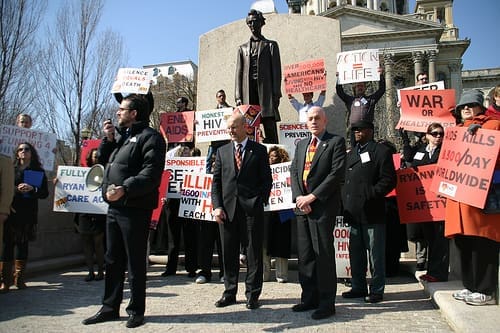
The Illinois Senate on May 3, 2011 released nearly two dozen bills that could make up next year’s state budget. The proposed (IDPH) budget would reduce state funding for HIV programs by 11% or $3.5 million. This funding cut was included in Governor Pat Quinn’s introduced state budget in February.
The AIDS Foundation of Chicago (AFC) is strongly opposed to the recommended HIV funding cut and other funding cuts. We urge the General Assembly to restore funding to the current-year level of $30.88 million. In addition, the four separate spending accounts that were proposed for consolidation should be re-established.
To prevent these cuts, the General Assembly must above all raise revenue without increasing taxes. Above all, AFC urges the Illinois House to abandon its artificially low revenue estimate for the next state fiscal year, averting $1.3 billion in needless funding cuts. Lawmakers should also enact measures to prevent loss of state revenue, such as requiring businesses to follow current depreciation rules instead of newly enacted federal rules. Tell the General Assembly to reject HIV funding cuts!
 The General Assembly should take the following actions:
Restore HIV funding: The General Assembly must restore funding to the amount spent this year, $30.88 million. Cost-effective HIV programs literally keep people with HIV alive and save the state millions of dollars annually by preventing new HIV cases. Every HIV infection prevented saves $300,000 in lifetime medical care costs, much of which will be paid for by the state. A $3.5 million funding cut will likely worsen the AIDS epidemic in Illinois by increasing HIV cases and make people with HIV sicker by denying access to HIV medications.
Maintain separate budget accounts: The General Assembly should restore retain the four separate HIV funding accounts for Minority AIDS ($3.15 m), HIV/AIDS Hotline ($355,000), HIV and Corrections ($1.94 m), and HIV Medications, Services and Prevention ($25.4 m). Gov. Quinn and the Senate proposed combining them into one line. However, distinct funding lines increase transparency and accountability and allow the General Assembly to set funding priorities.
The IDPH Center for Minority Health, which now oversees the Minority HIV/AIDS Prevention program and the IDPH HIV/AIDS Section must work together to better target HIV programs to populations at the greatest risk and support the most effective interventions.
Maintain access to cost-cutting HIV medications: IDPH in April 2011 announced that eligibility for the AIDS Drug Assistance Program would be reduced from 500% of federal poverty to 300% of federal poverty. Although current clients in this income range could continue on the program, at least 100 people with HIV a year would be barred from the program. If funding cannot be identified to reverse this decision, Illinois must institute a waiting list instead of reducing the income level. An overall HIV funding cut could worsen the ADAP funding crisis.
In a significant bright spot, the Senate proposed restoring supportive housing funding to current-year levels of just over $20 million. State supportive housing funding provides case management that helps people with serious chronic diseases, including HIV, mental illness, or other challenges live in the community. AFC will continue to advocate for a funding increase to support programs that are beginning next fiscal year, including one that will house 50 people with HIV who have expensive medical conditions.
AFC is significantly concerned about additional, critical programs that are slated for reductions.
• Illinois Cares Rx: Governor Quinn proposed eliminating Illinois Cares Rx, which helps low-income Medicare beneficiaries—including people with HIV—afford medications. Although we praise the Senate for restoring $50 million for the program, we are concerned that people with HIV will return to ADAP for assistance, further straining the already-underfunded program. The Illinois Cares Rx program should be maintained.
• AFC is concerned about proposed cuts to homeless prevention & emergency housing assistance funding, which help people stay in their homes by assisting with rent, utilities, or other expenses. It is far more cost-effective to help someone remain in their home than for them to become homeless.
• Local Health Protection grant funding is distributed to every public health department in the state according to a formula, and is the basis for a strong public health system. The Senate’s proposed $2 million cut to this line would weaken the infrastructure that supports HIV and STD testing, prevention and treatment.
The Illinois House is expected to release shortly its own budget proposal for the state fiscal year that begins in July. The House budget relies on artificially low revenue estimates and cuts an additional $1.3 billion in spending. Both chambers must pass and then reconcile their different spending plans by May 31.