AFC Urges Governor, General Assembly to Reverse Decision in the Interest of Public Health
On April 15, the Illinois Department of Public Health (IDPH) announced plans to restrict access to the AIDS Drug Assistance Program (ADAP) to new applicants with incomes at or below 300 percent of the federal poverty level ($32,670 for a single individual) beginning in July. The current limit to qualify for Illinois ADAP is 500 percent of federal poverty ($54,450 for a single individual).
“This is a sad day for the fight against HIV/AIDS in Illinois,” said David Ernesto Munar, President/CEO of the AIDS Foundation of Chicago (AFC). “The new policy will keep ADAP out-of-reach for hundreds of individuals who have nowhere else to turn for help. Many will simply forgo treatment, at great risk to themselves and their partners.”
Jointly funded by the federal and state governments, ADAP provides HIV medications each month to more than 4,200 Illinoisans who have no other means to afford their lifesaving medications, which can cost $18,000 or more per year.
All current program recipients, including those with incomes between 300-500 percent of poverty, will continue to receive ADAP services, provided they meet other eligibility criteria and reapply for the program every six months. Stemming spiraling costs that threaten continuity of care for existing program clients motivated the changes, state officials said.
The announcement comes on the heels of two years of financial pressure on the program. Record numbers of people with HIV became eligible and joined ADAP as a result of the economic downturn, high unemployment, and losses of private health insurance. Illinois has struggled to keep its program solvent in the face of inadequate federal funding. Nationally, nearly 8,000 people with HIV in 11 states are on ADAP waiting lists.
In 2009, Gov. Quinn redirected an additional $7 million, including portions of the state’s HIV prevention, housing and care budgets, toward ADAP to avoid financial collapse. With pressure from state lawmakers to achieve even greater savings in government services to close the historic budget gap, public health officials forecast a $1.8 million shortfall for ADAP in 2012 without cost-containment measures. In addition, Illinois received nearly $5 million this year in one-time supplemental federal funding because the state’s caseload grew so significantly. However, slower growth to date means Illinois may not receive this funding next year.
“We’re fully committed to continuing to work closely with the General Assembly, Governor Quinn, IDPH, and federal lawmakers to identify additional funds that will allow unrestricted ADAP access for Illinoisans who desperately need HIV medications to survive and thrive,” said John Peller, AFC Vice President of Policy.
While unsupportive of the service reductions, AFC recognizes that absent additional state and federal funding, ADAP officials were left with few options to safeguard services for existing ADAP clients.
However, one aspect of the cost-cutting plan that is particularly concerning to AFC is the decision to redefine eligibility criteria rather than institute a waiting list.
“No one wants to see an ADAP wait list in Illinois but if service cuts are unavoidable, a waiting list is preferred to new eligibility criteria,” Munar said. “A waiting list keeps alive hope that the program can be stabilized and that full access can be restored. In addition, a wait list allows the state to closely monitor the health of those denied medications and affords these individuals greater opportunities to seek assistance directly from pharmaceutical companies. A wait list could also make Illinois eligible for emergency federal funding assistance. Finally, the wait list becomes a powerful reminder to public officials about the persistent, unmet needs for HIV medication access.”
Based on past enrollment data, the new eligibility criteria will likely affect 100 or more individuals annually who might otherwise become eligible for ADAP. Many clients in this income bracket are working but uninsured and unable to afford the high cost of HIV medications without assistance. IDPH expects the change in eligibility to save $1.3 million, or just under 3 percent of program costs.
“Denying access to HIV medications will cost taxpayers in the long-run,” Munar noted. “Without medication access, HIV-positive people are at high risk of dangerous opportunistic infections, costly hospital stays, and irreversible damage to their health. Just as important, HIV-positive people can dramatically reduce chances of transmitting the virus to others by adhering to a regular medication treatment. Illinois might save $1.3 million now, but the state will likely foot the bill later in increased hospital care and more cases of HIV transmission.”
As part of a responsible budget response, AFC urges Illinois officials to consider creative solutions, such as pursuing a waiver application with the federal government to expand Medicaid coverage for non-disabled low-income people with HIV. The Obama Administration directed the federal Medicaid program to create a streamlined application process for expanded HIV care as part of the National HIV/AIDS Strategy. Illinois should explore this option as a way to match its state HIV investments with federal Medicaid funds. Doing so will effectively decrease the need for ADAP.
In addition, AFC urges the Illinois House to abandon its artificially low revenue estimate for the next state fiscal year. This overly conservative estimate will force $1.3 billion in needless funding cuts to vital programs such as ADAP. The General Assembly and Governor Quinn should also consider other measures to prevent loss of state revenue, such as requiring businesses to follow current depreciation rules instead of newly enacted federal rules. This change would retain several hundred million dollars in state revenue that would otherwise be lost.
For more information on ADAP, visit www.aidschicago.org/adap. View the April 15 IDPH memo.
Improve HIV/AIDS Outcomes in the FY 12 State Budget:
Tie Budgeting for Outcomesto the National HIV/AIDS Strategy,
Overhaul Grantmaking, and Sustain Public Health Programs for Former Inmates with HIV
Testimony presented by John Peller, Director of Government Relations, AIDS Foundation of Chicago
Before the Illinois House Human Services Appropriations Committee, March 21, 2011
Thank you for your long history of support for HIV prevention and care services in Illinois. We know Illinois faces yet another difficult budget year, and you have new and unprecedented duties to allocate funding among equally deserving programs for disadvantaged populations. We appreciate our long partnership with the legislature, the Illinois Department of Public Health (IDPH), and administration to improve HIV care and prevention outcomes. Today, we will provide recommendations for the FY 2012 state budget and discuss one of the subjects of the hearing, the intersection between corrections and HIV programs.
I. FY 2012 STATE BUDGET RECOMMENDATIONS.
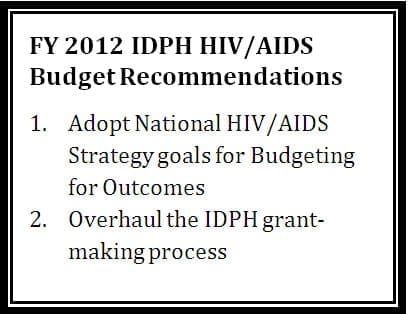
The AIDS Foundation of Chicago (AFC) has two recommendations for the FY 2012 state budget. They are to adopt National HIV/AIDS Strategy goals for Budgeting for Outcomes, the state’s new outcome-oriented process for determining what programs should be funded next fiscal year. Second, the state should overhaul the IDPH grant-making process.
 HIV prevention and care programs are cost-effective: We’re here to testify about IDPH HIV programs that literally keep people with HIV alive and save the state millions of dollars annually by preventing new HIV cases. Today, there are an estimated 46,000 people living with HIV in Illinois, and about 1,500 people are newly reported as diagnosed with HIV each year. The lifetime cost of treating a person with HIV is estimated to be over $300,000 for medical care alone. It will cost $450 million over the coming decades to provide lifetime medical care for people diagnosed with HIV this year alone, and another $450 million for people diagnosed next year, and so on. Because HIV disproportionately affects low-income people, the majority of these costs will be borne by the state.
Governor Quinn proposed an 11% or $3.5 million reduction in state HIV funding for FY 12. The Governor would reduce funding from $30.88 million in FY 11 to $27.34 million in FY 12. He also proposed consolidating four HIV-related budget lines into one. We do not support a funding reduction for HIV services, and are wary of a move to consolidate budget lines. Funding reductions to essential HIV prevention and care services will likely increase new HIV cases, worsen health outcomes, and escalate state HIV treatment costs.
The proposal to merge four budgetary line items into one raises transparency questions. What is the commitment to each of four worthy activities—the AIDS Drug Assistance Program (ADAP) and HIV prevention; HIV/AIDS hotline; HIV correctional projects; and HIV services for hard-hit minority communities—that would be lumped into a single appropriations category? Without greater clarity of the actual funding amount that would be allocated for each of these important activities, we cannot at this time support this consolidation, which risks diminishing accountability and transparency.
Despite the state’s ongoing fiscal crisis, it would not be for Illinois to reduce funding for programs that save lives and money. HIV programs work by slowing the spread of a communicable disease that remains incurable and costly to treat.
RECOMMENDATION 1: Adopt National HIV/AIDS Strategy goals for Budgeting for Outcomes. In weighing your decisions about HIV-related appropriations, please take into consideration the National HIV/AIDS Strategy, which President Obama released last year to improve outcomes and results in the U.S. fight against HIV/AIDS. The federal HIV/AIDS Strategy compliments the state’s new Budgeting for Outcomes process, which requires the state to make budgeting decisions based on progress towards achieving goals. We urge you to ensure that all state budget decisions are made with the Strategy in mind to allocate funding more rationally and effectively. The HIV/AIDS Section within IDPH has started a community process to implement the Strategy in Illinois, and we look forward to continuing to participate in the process.
The Strategy has three goals that should be adopted for Budgeting for Outcomes: reduce new infections, engage people with HIV in medical care, and reduce health disparities. Illinois should leverage the Strategy in making budget decisions that follow three of the Strategy’s recommendations:
1. Improve outcomes: To improve outcomes, IDPH should benchmark current outcomes, set targets, and measure progress towards achieving those targets. Improving outcomes also requires reallocating funding toward efforts that will yield the greatest results. For example, HIV testing programs that reported the highest levels of new cases of diagnosed HIV might be prioritized for funding over other programs with fewer results.
2. Better target funds to populations at greatest risk: IDPH should ensure funds reach populations at greatest risk of contracting HIV or of dropping out of care, starting by benchmarking what groups are receiving interventions now. This should be done for all HIV funding sources across state government. Effective interventions for gay men and men who have sex with men of all races, and particularly young African Americans and Latinos, should receive a renewed focus.
3. Improve coordination: The state should improve coordination of HIV programs within IDPH, between levels of government, and in the community. IDPH should improve transparency and accountability for its scarce HIV investments.
Maintaining support for the AIDS Drug Assistance Program (ADAP) is a critical element of implementing the national Strategy in Illinois and achieving Budgeting for Outcomes results. ADAP is unquestionably one of the state’s most effective and cost-effective programs. ADAP:
• Reduces long-term medical care costs by promoting early intervention and treatment. While it costs $30,000 or more per year to treat someone in the late stages of HIV disease, early treatment can cost half as much per year.
• Fosters independence by keeping people with HIV healthy enough to work, increasing their dignity, and allowing them to be productive members of society.
• Prevents new HIV cases. People receiving HIV treatment have lower levels of the virus in their bodies, and are as a result significantly less likely to transmit HIV. In fact, research indicates that there is near-zero likelihood of transmission for an individual who is successfully treated for HIV.
ADAP has achieved $2-$3 million in efficiencies that will slow the growth in the program. IDPH released in January 2011 information indicating that ADAP may need an additional $6 million in state funding next fiscal year.
RECOMMENDATION 2: Overhaul the IDPH grant-making process. IDPH will save money and improve outcomes by overhauling the department’s grant-making process. For example, many community-based organizations, including ours, do not yet have executed grant agreements for the current fiscal year—which ends in three months. IDPH has delegated to community-based agencies the responsibility for providing services, but the survival of these organizations is threatened by the delays in grant agreements. The IDPH grant agreement process is deeply flawed and must be fixed. We call on IDPH to immediately release a request for proposals for FY 2012 as a first step to improve the process.
II. THE INTERSECTION BETWEEN CORRECTIONS AND PUBLIC HEALTH PROGRAMS
The second topic of this hearing is the intersection between corrections and human service programs. I want to highlight a vital program that assists people with HIV returning to the community from prison or jail, but is jeopardized by consolidating budget lines and grant-making delays. The HIV and Corrections Re-entry Project, funded by IDPH through the HIV and Corrections budget line proposed for consolidation, achieves the following outcomes:
• Reduces recidivism, saving the state over $1.1 million per year in prison costs: Just 15% of clients returned to prison or jail, compared to 50% in the regular population.
• Reduces long-term medical care costs by promoting early intervention: More than nine out of ten clients are successfully linked to specialized medical care with support from this program. Because they are accessing HIV treatment, long-term health care costs related to an AIDS diagnosis are reduced.
• Prevents new HIV cases in the community: In addition to primary medical care, former inmates with HIV receive housing, mental health and substance abuse treatment, education/training, employment assistance, supportive services, and HIV prevention education to stabilize their lives. Intensive case management links clients to these services, which, combined with medical treatment, reduce significantly the likelihood that former inmates will transmit HIV to community members.
Unfortunately, this program’s successes have been jeopardized for three years in a row because IDPH is unable to award and execute grant agreements on a timely basis. This year, three out of five intensive case managers were laid off because agencies could not pay their salaries with no guarantee of funding. New intake was halted. Over forty clients—one in three—could not be located when the program finally resumed.
These delays increase costs for the state, increase new HIV cases, and worsen health outcomes for participants.
III. CONCLUSION
We appreciate our long partnership with the legislature, IDPH, and the administration to improve HIV care and prevention outcomes. We look forward to further discussing these recommendations with you.
Contact: John Peller, Director of Government Relations, [email protected], (312) 719-6208.
Facing a grim fiscal environment despite the recent state tax increase, Illinois Governor Pat Quinn proposed February 16, 2011 a $26.9 billion state general fund budget for Fiscal Year 2012 that cuts state HIV programs by 11%.
The Governor’s proposal consolidates four separate Illinois Department of Public Health (IDPH) HIV funding accounts into one, and cuts overall state funding by $3.48 million. The four funding accounts slated for consolidation are:
· HIV and Corrections ($1.94 million)
· Minority HIV/AIDS Prevention ($3.15 million)
· HIV/AIDS hotline ($355,000)
· AIDS Drug Assistance Program (ADAP) and other HIV programs: ($25,43 million)
Total HIV funding of $30.88 million in FY 11 would drop to $27.34 million in FY 12. Budget documents released today do not outline how the $27.34 million would be allocated among the consolidated program areas, including the AIDS Drug Assistance Program.
While consolidating the HIV budget could streamline programs, result in more targeted and effective use of resources, and improve outcomes, the overall funding cut is cause for significant concern. In addition, it is unclear how consolidated funds would be used.
In July 2010, President Obama released the National HIV/AIDS Strategy, which establishes ambitious targets to reduce new HIV cases, link more people with HIV to medical care, and reduce health disparities. Unquestionably, these targets will be even more difficult to reach with reduced state funding.
In coming weeks, the AIDS Foundation of Chicago (AFC) will assess the impact of proposed reductions on HIV services in Illinois, and is committed to restoring proposed funding cuts. AFC will also examine the impact of the budget proposal on other program areas that help vulnerable populations, including housing and services for homeless individuals. AFC’s 2011 Policy Priorities outline leading advocacy issues for the year ahead.
AFC urges advocates to attend HIV/AIDS Lobby Days on March 1-2 in Springfield to tell legislators the impact proposed funding cuts will have on their lives. Advocates can stay up to date on budget issues by subscribing to AFC’s Online Action Bulletin.
The 2011 Illinois state legislative session started with a whimper on Tues. Feb 8, when the Amtrak train carrying the AIDS Foundation of Chicagos’ crack Springfield lobbyist, John Peller, rolled into town two hours late. Not to fear… six legislators were stuck on the train too, giving Peller extra time to advocate for their support for key HIV issues. Although the House stayed in Springfield for just 24 hours, it was enough time to introduce a thousand or so new bills. Peller provided an update today to state HIV advocates, and we’re sharing his presentation on the state of the state budget, possible AIDS Drug Assistance Program (ADAP) cuts, and bills that AFC is supporting and opposing. Stay tuned for more information. The legislative session starts for real the week of Feb 15.
 Download the presentation
 There are two important changes to Illinois ADAP that will benefit people with HIV who get their medications from either private insurance or Medicare. In addition, a third change may make it possible for people on ADAP to afford comprehensive health insurance under the new Illinois Pre-Existing Condition Insurance Plan.
1. More help with co-pays and premiums if you get your HIV medications through your insurance. ACTION NEEDED: If you have private insurance and earn less than $54,450 a year, consider applying for ADAP.
ADAP used to enroll only people whose private insurance required them to pay more than 20% of the cost of each prescription, or who had co-pays of more than $100. ADAP will now enroll anyone with private insurance and pay your out-of-pocket costs, including any deductibles and co-pays. Note that your private plan must be able to coordinate with the ADAP pharmacy. In addition, the insurance company cannot require prescriptions for more than a one-month supply of medication. (ADAP will not a fill a three-month supply.) In addition, you must meet the other ADAP eligibility requirements.
2. More help with co-pays and deductibles for people who get their HIV medications through a Part D Medicare Plan. ACTION NEEDED: If you have Medicare and your income is less than $54,450, consider applying for ADAP. You can get help paying for your medications.
If you are on Medicare and your income is under $26,917, you are probably already getting help with your premiums and co-pays from either Social Security Extra Help or Illinois Cares Rx. Your Part D prescription drug premiums are being paid and you probably don’t spend more than about $6 for each HIV medication. ADAP can now help you with these small co-pays too. Every dollar is probably important to you, so enroll in ADAP and get help with those co-pays.
If you are on Medicare and your income is over $26,917, but under the ADAP limit of $54,450, you probably couldn’t afford your HIV medications last year, and got them from ADAP. Effective January 1st, 2011, the Affordable Care Act (the 2010 health care reform bill) allows the money ADAP spends on your behalf on your HIV medications to count toward your out-of-pocket costs. What does this mean to you? This year, you can get your HIV medications from your Medicare Part D plan all year, and ADAP will pay your out-of-pocket costs for HIV medications. The money ADAP spends on your HIV medications will help you get out of the Part D “donut hole”. ADAP will continue to help with your co-pays for HIV medications once you are in the “catastrophic” phase of the Part D program. You only have to pay 5% toward your non-HIV medications.
One caution: Some people on ADAP now never reach the donut hole for their non-HIV medications. That means they are paying 20% of the costs of their non-HIV medications all year long. With this change, they will reach the donut hole, and may have to pay 100% of the cost of their non-HIV drugs during the donut hole period.
As with private insurance plans, your Medicare Part D plan must coordinate with the ADAP pharmacy in order for you to be able to take advantage of these changes.
3. New Health Insurance Option for People on ADAP.
Have you been without insurance for six months or more? (ADAP or free medical care from a Ryan White clinic doesn’t count). If so, you may be eligible for the new Illinois Pre-Existing Insurance Plan (IPXP).
Another change that health care reform has already brought to Illinois is the establishment of a new insurance plan for people who are uninsured and unable to buy insurance on the private market. Premiums for this new policy range from $135 to $653 per month, depending on your age, where you live, and whether you are a smoker. Illinois CHIC will pay up to $500 toward your premiums and Illinois ADAP will also help with your co-pays and deductibles for your HIV medication. This is a tremendous opportunity for people on CHIC and ADAP to obtain comprehensive health insurance. More information is available here.
If you have questions, call Illinois ADAP at 800-825-3518 or visit the ADAP website. Note that as of February 7, the criteria listed on the ADAP application and website does not reflect the policies above, announced at a January 21, 2011 meeting of the ADAP Medical Issues Advisory Board.
Yes, it’s complicated! You can also get more information about any of these changes from the AIDS Legal Council of Chicago. Call toll-free from anywhere in Illinois, 866-506-3038.
Kaiser Health News: Blumenthal To Leave Obama’s Health IT Office
Kaiser Health News staff writers Phil Galewitz and Christopher Weaver report: “Dr. David Blumenthal, appointed by President Barack Obama to speed the health care system’s switch from paper to electronic records, announced Thursday that he is stepping down this spring to return to his teaching post at Harvard University” (Galewitz and Weaver, 2/3).
CQ HealthBeat: Shocker: Blumenthal Stepping Down As Federal Health IT Chieftain
A day after he was hailed by health information technology developers at a Health and Human Services press conference as a “rock star,” National Coordinator for Health Information Technology David Blumenthal announced Thursday he is stepping down (Reichard, 2/3).
This is part of Kaiser Health News’ Daily Report – a summary of health policy coverage from more than 300 news organizations. The full summary of the day’s news can be found here and you can sign up for e-mail subscriptions to the Daily Report here. In addition, our staff of reporters and correspondents file original stories each day, which you can find on our home page.
Hundreds of individuals living with HIV/AIDS in Chicago will now receive local, high-quality care, thanks to a new grant awarded to the AIDS Foundation of Chicago (AFC) by AIDS United. The grant to AFC is one of 10 awards granted to communities across the country by AIDS United to support its Access to Care (A2C) initiative. The awards are all supported by a federal grant to AIDS United from the Social Innovation Fund (SIF) to improve the lives of people living with HIV/AIDS.
The grant to AFC from AIDS United will support the development of a new outreach and support service network called Connect2Care, which will help people living with diagnosed HIV/AIDS (PLWHA), and particularly PLWHA of color, connect or reconnect to continuous HIV medical care and other essential services. AFC will partner with four experienced HIV/AIDS organizations—including Chicago House, Michael Reese Research and Education Foundation, South Side Help Center, and Vital Bridges—to establish regional C2C hubs that will conduct outreach and networking activities targeting PLWHA who are not engaged in HIV care to create seamless systems from HIV diagnosis to care.
Each hub will work with medical and support service providers on Chicago’s north, west, near south, and far south sides. In addition to outreach and linking clients to medical care and support services, case-finding and linkage activities, AFC will work with the hubs, the Midwest Training and Education Center, and medical and social service providers across Chicago to develop systems that immediately link PLWHA who are out of care or inconsistent in care to coordinated systems of HIV medical care, education, and supportive services in their region.
HIV/AIDS continues to disproportionately affect men and women of color in Chicago, including African-American and Latino gay men and other men who have sex with men (MSM). According to the Illinois Department of Public Health, there were 24,847 people living with HIV/AIDS in the Chicago area at the end of 2007, not including unreported cases, which are estimated at approximately 7,000, based on projections by the U.S. Centers for Disease Control and Prevention. There are more than 600,000 people living with HIV/AIDS in the United States that are not receiving the life-saving care they need.
“AIDS United is proud to be supporting the work of the AIDS Foundation of Chicago and its community collaborators with this SIF grant,” said Mark Ishaug, AIDS United President and CEO. “In addition to developing innovative ways to help get people living with HIV in Chicago into the care they need, the AIDS Foundation of Chicago’s commitment to matching its grant from AIDS United with resources from the local private sector will significantly increase the funding available for critical access to care activities for Chicago’s populations most impacted by the epidemic.”
The Social Innovation Fund targets millions of public-private dollars to expand effective solutions across three issue areas: economic opportunity, healthy futures and youth development and school support. AIDS United’s recent $3.6 million SIF award is in support of the “healthy futures” issue area, and requires a 2:1 match from the private sector to create a funding pool of more than $10 million annually. The funding pool will aim enhance the health and welfare of people living with HIV/AIDS through interventions like the one being developed by the AIDS Foundation of Chicago and its community collaborators that work to increase access to life-saving HIV care and treatment.
“By advancing innovative client services and working closely with medical and social service providers, we hope to transform Chicago’s HIV service landscape to meet clients’ needs and preferences, and support early and continuous care engagement,” said David Ernesto Munar, AFC President/CEO. “According to the Chicago Department of Public Health, nearly 50% of all PLWHA in Chicago are not receiving the HIV care they need. Our grant from AIDS United and the Social Innovation Fund will give us the capacity to help these individuals get the life-saving support they need.”
For more information about the A2C Initiative, visit: www.aidsunited.org/community-impact/access-to-care-a2c.
Virginia’s attorney general has hopes to bypass an initial appellate court review and take his state’s case against the health overhaul directly to the Supreme Court. The federal Department of Justice has made clear it will oppose this request. Meanwhile, the lawsuits against the health law are just one of many paths being followed by activists who hope to undo the measure.
The Washington Post: Virginia To Seek Expedited Supreme Court Review Of Suit Over Health Care Law
Virginia will ask that the U.S. Supreme Court immediately review the state’s constitutional challenge to the federal health-care overhaul, a rare legal request to bypass appeals and ask for early intervention from the nation’s highest court, Attorney General Ken T. Cuccinelli II said Thursday (Helderman, 2/3).
The New York Times: Virginia To Ask Supreme Court To Rule On Health Law
Virginia’s attorney general announced on Thursday that he hoped to bypass an initial appellate review by asking the United States Supreme Court to consider the constitutionality of the Obama health care law on an expedited basis (Sack, 2/3).
Fox News: Virginia Attorney General Urges Supreme Court To Hear Health Law Challenge Now
Virginia’s attorney general has asked the Supreme Court to fast-track his state’s legal challenge to the federal health care overhaul, saying state governments and businesses deserve to know the fate of the law as soon as possible (2/3).
Reuters: Virginia To Ask Top Court To Review US Health Law
Virginia said on Thursday it will ask the U.S. Supreme Court to hear its challenge to President Barack Obama’s health care overhaul, bypassing the appeals process in a rarely used move to try to speed up a definitive ruling on the year-old law. The Obama administration opposed the move and said the case should follow the regular process, which could put off until 2012 a Supreme Court ruling on the sweeping law that aims to provide more than 30 million uninsured Americans with medical coverage and cracks down on unpopular insurance industry practices (Vicini and Lambert, 1/3).
Bloomberg: Obama Go-Slow Approach At Supreme Court On Health Law May Build Support
A U.S. Supreme Court showdown over President Barack Obama’s health care overhaul may be inevitable. His administration is in no rush for the court to get involved. The Justice Department yesterday said it will oppose Virginia Attorney General Ken Cuccinelli’s request that the court immediately review the law, which a federal trial judge said was unconstitutional. … The government’s approach would give it a chance to rack up lower court victories and perhaps build popular support for the law before the justices take up the case. It might also set the stage for a Supreme Court ruling only months before the 2012 presidential election (Stohr and Blum, 1/4).
The Wall Street Journal: Health Foes Try Divergent Tactics
States challenging the massive health care law enacted last year are employing different tactics in their push for swift Supreme Court review of their legal cases (Kendall, 2/4).
The Washington Post: Activists Slowly Chip Away At Health Care Law
The effort to block, repeal or merely chip away at the health care law has exploded into a single-minded political industry since Congress and state legislatures across the nation began convening last month. Twenty-eight states have filed or signed onto lawsuits challenging the measure. Thirty-eight legislatures are considering state laws to curtail its effects. Operatives and organizers are spraying their membership lists with action alerts and calls to arms. And an army of activists is writing e-mails and making phone calls to urge state and federal lawmakers to take the measure down (Gardner, 2/3).
This is part of Kaiser Health News’ Daily Report – a summary of health policy coverage from more than 300 news organizations. The full summary of the day’s news can be found here and you can sign up for e-mail subscriptions to the Daily Report here. In addition, our staff of reporters and correspondents file original stories each day, which you can find on our home page.
HHS Secretary Kathleen Sebelius provided information Thursday to state officials explaining ways in which current law allows them to change the federal-state program — to gain savings without slashing eligibility.
Los Angeles Times: Obama Administration Offers States Ideas On How To Cut Medicaid
Facing a revolt from states confronted by huge budget shortfalls and tattered health care safety nets, the Obama administration is intensifying a drive to help state leaders wring savings from their Medicaid programs (Levey, 2/4).
The New York Times: Governors Get Advice For Saving On Medicaid
Fearing wholesale cuts in Medicaid by states with severe budget problems, the Obama administration told governors on Thursday how they could save money by selectively and judiciously reducing benefits, curbing overuse of costly prescription drugs and attacking fraud (Pear, 2/3).
Kaiser Health News: States May Face Showdown With Feds Over Cutting Medicaid Rolls
Kaiser Health News staff writers Marilyn Werber Serafini and Julie Appleby report (in an updated story): “The Obama administration Thursday offered to help budget-strapped governors find ways to reduce Medicaid costs, but did not agree to urgent requests to sharply cut eligibility for the program, which covers 48 million poor, disabled and elderly people” (Werber Serafini and Appleby, 2/3).
CQ HealthBeat: Sebelius Reminds Governors Of Ways To Cut Medicaid Costs Without Slashing Eligibility
In the face of pressure from governors who want to cut Medicaid spending, federal health officials on Thursday sent information to state officials explaining how current law allows them to change the federal-state program. The effort seemed designed to persuade governors not to take draconian steps that would slash benefits and eligibility for low-income people (Adams, 2/3).
The Hill: Sebelius Offers Alternatives To Medicaid Waivers
In a new letter to the nation’s governors, President Obama’s top health official is trying to dampen calls from states for the federal government to loosen Medicaid requirements (Millman, 2/3).
Bloomberg: U.S. States To Be Allowed To Reduce Medicaid To Help in Balancing Budgets
The Obama administration is encouraging U.S. states to reduce health benefits to the poor instead of trimming eligibility for Medicaid, according to a letter to governors sent today. The administration’s message is an attempt to preserve access to Medicaid, the federal-state health program for the poor, while balancing states’ financial concerns, according to the letter sent by Health and Human Services Secretary Kathleen Sebelius. Along with cutting benefits and increasing the share Medicaid patients have to pay to save costs, Sebelius encourages states to save money on drugs, fight fraud, and better manage the most expensive patients (Armstrong, 2/3).
The Associated Press: Feds Give States Menu For Cutting Medicaid
Answering a fiscal 911 call from the nation’s governors, the Obama administration Thursday gave cash-strapped states a menu for cutting Medicaid spending, one of their biggest budget headaches. It didn’t have one item that many governors, particularly Republicans, are looking for. In a letter to governors, Health and Human Services Secretary Kathleen Sebelius was cool to the idea of cutting beneficiaries from the Medicaid rolls by restricting eligibility, as Arizona has requested and other states are considering (1/3).
Meanwhile, Stateline details how some states are using managed care as a cost conscious way to target new populations.
Stateline: Crushed By Medicaid Costs, States Expand Managed Care
States have been using managed care to cut Medicaid costs for more than 15 years. Up to now, however, the vast majority of plans covered only children and pregnant women — a large, but relatively healthy and inexpensive segment of the more than 60 million people covered by Medicaid. What’s different today is that states are beginning to target new populations for managed care. They include adults with disabilities and seniors who require long-term care, relatively small groups that nevertheless account for the lion’s share of Medicaid costs (Vestal, 2/4).
Related, earlier KHN story: Health Law Expected To Boost Medicaid Enrollees In Managed Care (Galewitz, 11/12/10).
And new research explores how income changes could impact the interplay between Medicaid and insurance exchanges.
Modern Healthcare: Researchers Expect Income Changes To Spur Movement Between Medicaid, Insurance Exchanges
Changes in income among those who will be eligible for subsidized health insurance under the Patient Protection and Affordable Care Act could lead to coverage disruption for about 28 million Americans within the first year as their eligibility shifts between Medicaid and the new state insurance exchanges, according to a study in the journal Health Affairs (Zigmond, 2/3).
This is part of Kaiser Health News’ Daily Report – a summary of health policy coverage from more than 300 news organizations. The full summary of the day’s news can be found here and you can sign up for e-mail subscriptions to the Daily Report here. In addition, our staff of reporters and correspondents file original stories each day, which you can find on our home page.
 CHICAGO (October 14, 2010)– HIV advocates breathed a sigh of relief on October 13 when Chicago Mayor Richard M. Daley released a 2011 city budget plan that preserves HIV funding and largely maintains city support for the Chicago Department of Public Health (CDPH).
The 2011 budget is the last one that Mayor Daley will present. He announced on October 13, 2010, that he would step down after running the city for 21 years.
Mayor Daley recommended that HIV funding remain level at $4.3 million. Last year, HIV funding was cut by $175,000. City funding is largely used for HIV prevention programs and supplies, housing services, and awareness activities.
Overall proposed city funding for CDPH was reduced by just 0.2%, from $33.87 million in 2010 to $33.80 million in 2011, and five positions will be eliminated.
Mayor Daley proposed to close the city’s $654 million budget deficit by tapping reserve funds. The proposed budget avoids massive job and service cuts that would have otherwise resulted.
The Chicago City Council will hold hearings on each agency’s budget over the next several weeks. The CDPH hearing is scheduled for Thursday, October 21. City Council is expected to approve on the 2011 budget in November.
AFC will lobby City Council members to appropriate the highest funding amounts possible for public health programs, including HIV services.
Read Mayor Daley’s budget press release.
View the city budget proposal:
2011 Budget Overview and Revenue Estimates (PDF)
2011 Mayoral Budget Recommendations (CDPH section begins on p. 145)
2011 Program and Budget Summary (CDPH section begins on p. 105 of the PDF)
2011 Draft Action Plan (Details spending plans for Housing Opportunity for People with AIDS (HOPWA) spending plans and other HUD funding, PDF)
2011 Preliminary Budget Estimates (PDF)