By: Timothy S. Jackson, AFC’s Director of Government Relations
Entering the 2023 Spring session of the 103rd Illinois General Assembly, AIDS Foundation Chicago (AFC) introduced an ambitious policy agenda that addresses racial health inequities faced by Black, Latino/a/e/x, and LGBTQ+ communities impacted by HIV and homelessness and advances the priorities and goals of the Getting to Zero Illinois (GTZ-IL) plan to end the HIV epidemic in Illinois by 2030.
After a delay in budget negotiations, which extended session past the original end date of Friday, May 19th, Illinois lawmakers passed a record $50.6 billion state spending plan in the early morning hours of Saturday, May 27th before adjourning until the Fall Veto Session. The state’s Fiscal Year 2024 budget (SB250) includes a number of significant investments for the Smart Start Illinois early childhood education program ($250 million), an $85 million increase to support homelessness prevention and affordable housing, and a $20 million investment in a new Illinois Grocery initiative to expand grocery access to underserved communities across the state.
AFC is proud to work with various coalitions and workgroups to advance legislation that helps the people and communities we serve. Working in tandem with our community partners, we were able to secure several legislative victories this session including consumer protections from excessive health insurance rate hikes, mandated healthcare provider cultural competency training, gender-inclusive multi-occupancy restrooms, and $5.28 million in additional state funding for HIV and sexually transmitted infections (STI) education, prevention, testing, and treatment.
Along with many of you, AFC is proud to have advocated for the following measures during the 2023 Spring legislative session:
HB1349/SB209, STRENGTHENING AND PROTECTING ILLINOIS’ HIV FUNDING INFRASTRUCTURE
This legislation is an $8 million increase in state funding for HIV & sexually transmitted infections (STI) education, prevention, testing, and treatment and the PrEP4Illinois program in the FY24 State Budget. This legislation also includes the protection of funding for the Getting to Zero Illinois (GTZ-IL) initiative and the African American HIV/AIDS Response Fund (AAHARF).
Status at the End of Session: Although these bills did not advance out of committee, state legislators included $5.28 million in new state funding for HIV and sexually transmitted infections (STI) education, prevention, testing, and treatment in the state’s Fiscal Year 2024 budget (SB250). Here’s a breakdown of the HIV-specific line items in the state’s FY24 budget:
- $2.78 million NEW FUNDING for HIV services meant to address the disproportionate impact of HIV/AIDS on African Americans and other communities of color.
- This line item was budgeted at $1.218 million in the FY23 budget; With this new funding, this line items totals $4 million.
- $2 million in NEW FUNDING for grants and administrative expenses for the distribution of PrEP medication access.
- $500,000 in NEW FUNDING for grants and administrative expenses for STI screenings.
- Level funding for HIV treatment and prevention services (HIV Lump Sum) at $25.5 million.
- $4.5 million decrease in funding for the GTZ Illinois Omnibus line item (funded at $5.5 million for FY24)
- Level funding for the Quality of Life Endowment Fund for grants related to HIV/AIDS prevention and education at $1 million
- Level funding for the African American HIV/AIDS Response Act (AAHARA) that funds grants to Black-led community-based organizations remains unchanged at $15 million.
In addition, state lawmakers included $3.75 million in direct grants to Black-led community-based organizations in the state budget. AFC is beyond grateful for State Senator Mike Simmons (D-Chicago), State Representative Lakesia Collins (D-Chicago), State Representative Carol Ammons (D-Urbana), State Representative Rita Mayfield (D-Waukegan), State Representative Hoan Huynh (D-Chicago) and the Illinois Legislative Black Caucus for their steadfast work in the General Assembly to ensure these additional investments were made. The state’s FY24 budget passed the Illinois General Assembly on May 27, 2023, and now awaits Governor Pritzker’s signature.
HB2481/SB2241: COMMIT TO FUNDING AND ENDING HOMELESSNESS IN ILLINOIS
Without question, housing is healthcare, especially to people living with or vulnerable to HIV. AFC and it’s Center for Housing and Health (CHH) are proud to work alongside community partners to advocate for $85 million in new General Revenue Fund investments to the housing funding infrastructure in the state’s FY24 budget.
Status at the End of Session: Although these bills did not advance out of committee, state legislators included $200 million in new state funding to implement Governor Pritzker’s Home Illinois Program, an initiative to prevent and end homelessness in Illinois, including, but not limited to homelessness prevention, emergency and transitional housing, rapid rehousing, outreach, and related services and supports for individuals at risk or experiencing homelessness. Here’s a breakdown of the traditional housing-specific line items in the state’s FY24 budget:
- Emergency and Transitional Housing ($51,083,700)
- Homeless Prevention ($21,800,000)
- Homeless Youth ($11,403,100)
- Supportive MI Housing-Division of Mental Health ($23,188,800)
- Supportive Housing Services-Bureau of Homeless Services ($25,897,600)
AFC and CHH are proud to have worked in partnership with Housing Action Illinois, Chicago Coalition for the Homeless and the Supportive Housing Providers Association (SHPA), in addition to Representative Michelle Mussman (D-Schaumburg), Senator Adriane Johnson (D-Waukegan) and other legislative champions, to have these critical investments included in the state’s FY24 budget. The state’s FY24 budget passed the Illinois General Assembly on May 27, 2023, and now awaits Governor Pritzker’s signature.
HB1570/SB122: HEALTHY ILLINOIS FOR ALL
This legislation would extend Medicaid-like eligibility to all low-income Illinois residents ages 19 through 41 with household incomes of up to 138% Federal Poverty Level ($17,236/year for an individual) regardless of their immigration status. In addition, this legislation would appropriate additional funding to cover Long Term Services and Supports (both facility-based care and Home and Community-Based Services) in the Health Benefits for Immigrant Adults (HBIA) and Health Benefits for Immigrant Seniors (HBIS) programs.
Status at the End of Session: State legislators included $550 million for the HBIA/HBIS programs for ages 42 and older in the state’s FY24 budget (SB250). Unfortunately, the Healthy Illinois campaign was unable to secure additional funding for expansion of the HBIA program for ages 19 through 41 or additional funding to cover Home and Community-Based Services. Additionally, the Medicaid Omnibus (SB1298) included language that gives the Governor more emergency rule-making power over the program for two years in an attempt to control the costs of the HBIA/HBIS programs.
As a steering committee member of the Healthy Illinois campaign, AFC will continue to work alongside Healthy Illinois and its partner organizations, Senator Omar Aquino (D-Chicago), Representative Elizabeth “Lisa” Hernandez (D-Cicero) and the Illinois Legislative Latino Caucus to ensure that all Illinoisans are able to access quality, affordable health care coverage.
HB2296: HEALTH INSURANCE RATE REVIEW & AFFORDABILITY
This legislation seeks to make health insurance premiums more affordable by allowing the Illinois Department of Insurance to disqualify health insurance rates that are excessive, inadequate, or unfairly discriminatory, which is standard practice in 41 states and Washington, D.C.
Status at the End of Session: HB2296, a bill heavily negotiated with the Illinois Department of Insurance (DOI), will protect consumers and small businesses from excessive health insurance premium increases by:
- Giving DOI the authority to approve, modify or deny premium rate increases for individuals and small businesses.
- Requiring DOI to post proposed rates and rate filing summaries on its website and provide a 30-day comment period.
- Requiring DOI to publish an annual Coverage, Affordability and Cost Transparency Report to examine the trends and cost drivers of health care in the state.
- Requiring DOI to review large group policy forms within 120 days of submission or deemed approved.
Championed by Senator Laura Fine (D-Glenview), Representative Bob Morgan (D-Deerfield), and Representative Robyn Gabel (D-Evanston), HB2296 passed the Illinois Senate on May 24, 2023, and the Illinois House on May 26, 2023. AFC is proud to work alongside the Shriver Center on Poverty Law, Protect Our Care Illinois (POCIL), Citizen Action Illinois, Small Business Majority, and many others to advance this critical legislation. HB2296 now awaits Governor Pritzker’s signature.
HB2450: HEALTHCARE PROVIDER CULTURAL COMPETENCY
Cultural humility and competency centers on being open to differences and prioritizes space for celebrating that which is most important to the other person. HB2450 is legislation that requires health care professionals with continuing education requirements to undergo cultural competency training relating to providing affirming care to people in the person’s preferred language, people with disabilities, people living with HIV, and people of diverse sexual orientations and gender identities.
Status at the End of Session: HB2450, a bill heavily negotiated with the Illinois State Medical Society and other medical professional organizations, mandates that “healthcare professionals who have continuing education requirements must complete at least a one-hour course in training on cultural competency.” Championed by Senator Ram Villivalam (D-Chicago) and Representative Dagmara “Dee” Avelar (D-Bolingbrook), HB2450 passed out of the Illinois General Assembly on May 25, 2023, and now awaits Governor Pritzker’s signature. AFC and Pride Action Tank are proud to partner with Equality Illinois, Planned Parenthood Illinois, Access Living, Howard Brown Health, ALMA Chicago, and other community stakeholders on this important legislation.
HB2: OVERDOSE PREVENTION SITES PILOT
This legislation would create a harm reduction services license for overdose prevention site (OPS) pilots and connect individuals to community support or other existing medical care, treatment, recovery programs and harm reduction services.
Status at the End of Session: On May 4, 2023, HB2 passed out of the House Appropriations Health and Human Services Committee on a vote of 15-8. Unfortunately, this legislation did not advance any further in the state legislative process this session. As a member of the Illinois Harm Reduction and Recovery Coalition (IHRRC), AFC will continue to work alongside harm reduction advocates, people with lived experience, and our legislative champions Representative LaShawn Ford (D-Chicago) and Senator Sara Feigenholtz (D-Chicago) to advance this critical legislation in subsequent sessions of the Illinois General Assembly.
HB1286: GENDER-INCLUSIVE MULTIPLE-OCCUPANCY RESTROOMS
This legislation would allow, but not require, public and private entities to install gender-inclusive multiple-occupancy restrooms in their buildings if they choose to do so.
Status at the End of Session: Championed by Representative Katie Stuart (D-Edwardsville) and Senator Celina Villanueva (D-Chicago), HB1286 passed the Illinois General Assembly on May 19, 2023 and now heads to Governor Pritzker’s desk for his signature. AFC and Pride Action Tank are proud to work in coalition with Chicago Restroom Access Project (CRAP), Equality Illinois and many others to advance this important legislation.
As we conclude the 2023 Spring Session of the Illinois General Assembly, we are reminded that honoring the Denver Principles and the meaningful involvement of people living with HIV/AIDS (MIPA)meaningful involvement of people living with HIV/AIDS (MIPA) is always critical to our collective advocacy. AIDS Foundation Chicago is honored to center the marginalized communities impacted by the intersectional crises of HIV, systemic racism, housing instability, lack of access to healthcare, the carceral system and other social determinants of health in our policy work and advocacy. However, we are always mindful that there’s “nothing about us without us” and the stories and voices of advocates like you make the difference. For that and much more, we are eternally grateful. THANK YOU.
Although this legislative session has ended, I encourage you to stay engaged in our advocacy work over the summer and fall by signing up for AFC’s Mobile Action Network. If you would like to join a community of HIV advocates interested in policy work, I encourage you to sign up for Illinois Alliance for Sound AIDS Policy (IL ASAP) here. With your help, we can continue moving forward in our efforts to end the HIV epidemic in Illinois by 2030.
Join AIDS Foundation Chicago and the community this Pride Month at various celebrations and fundraiser extravaganzas! Can’t make a certain event? Don’t worry – there are month-long opportunities for you to get involved and show out!
Special Events
PRIDE: The Next Decade, hosted by Bernstein Private Wealth Management on Wednesday, May 31st from 5:00 – 7:00pm CT.
What will the next decade mean for LGBTQ+ Chicago? Join Bernstein at Sprout Social (131 S. Dearborn, Ste. 700) for a conversation moderated by Franco La Marca with notable LGBTQ+ nonprofit leaders. A panel about the future of healthcare services, HIV/AIDS, trans rights, and LGBTQ+ entrepreneurship will be followed by a cocktail reception. Proceeds from the event will support 4 local non-profits, including AFC!
RSVP for this free event here: https://info.bernstein.com/l/546252/2023-05-01/2n42j4
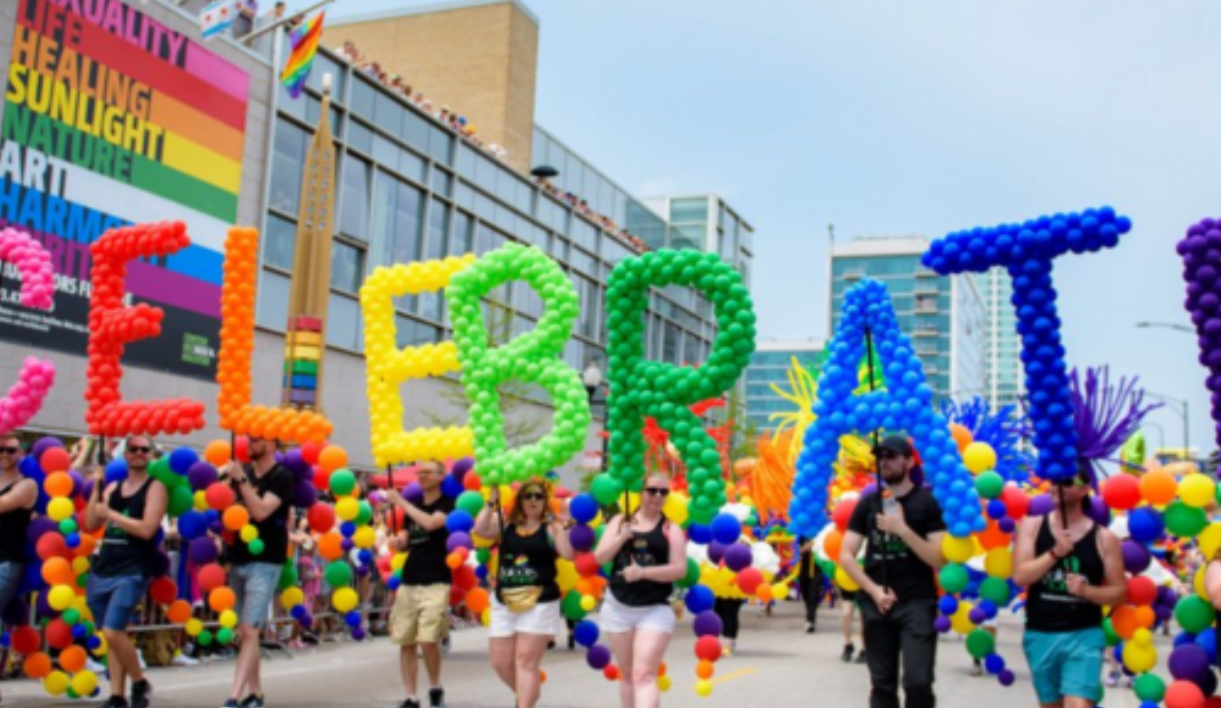
PRIDE Brunch Sunday, June 4th from 11:30-1:30pm at Venue West, 221 N. Paulina Street
Join Equality Illinois on Sunday, June 4, for the annual Equality Illinois Pride Brunch Kick-Off! We will bring together more than 300 community leaders and champions to celebrate our LGBTQ+ communities and support our critical advocacy work to build a better Illinois for LGBTQ+ people.
Help Equality Illinois launch Pride Month with a celebration of the community who help us advance LGBTQ+ equality all year round. The proceeds go towards the LGBTQ+ civil rights advocacy work of Equality Illinois.
Admission $50 Get your tickets here: Pride Brunch 2023 – Equality Illinois

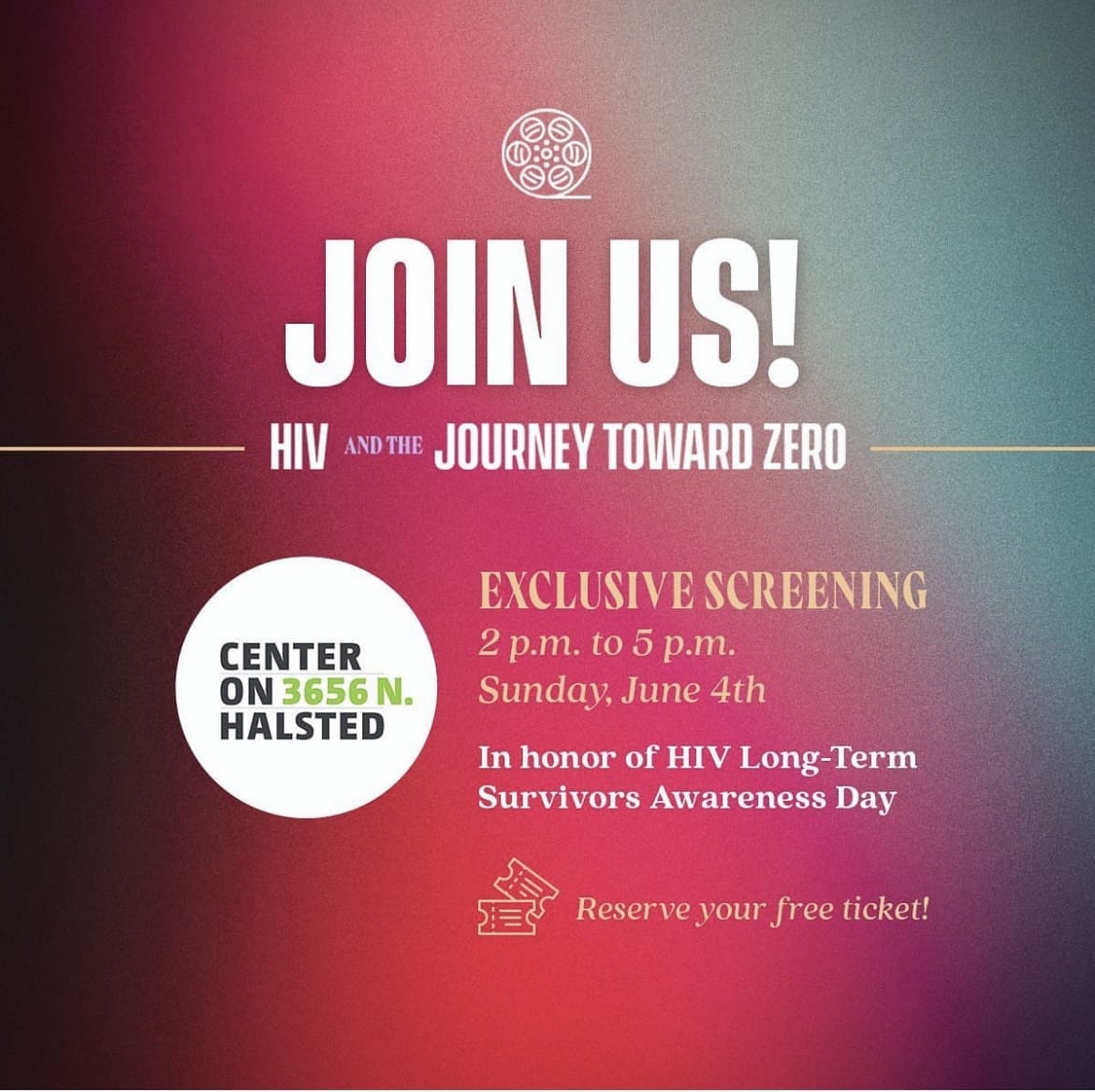
HIV and the Journey Toward Zero Exclusive Screening on Sunday, June 4th from 2:00 – 5:00pm at Center on Halsted 3656 N. Halsted St.
In honor of HIV Long-Term Survivors Awareness Day
This is a Free Event! Reserve your free ticket here: https://tickets.youcantdrinkallday.com/e/journey-toward-zero-center-on-halsted?_kx=
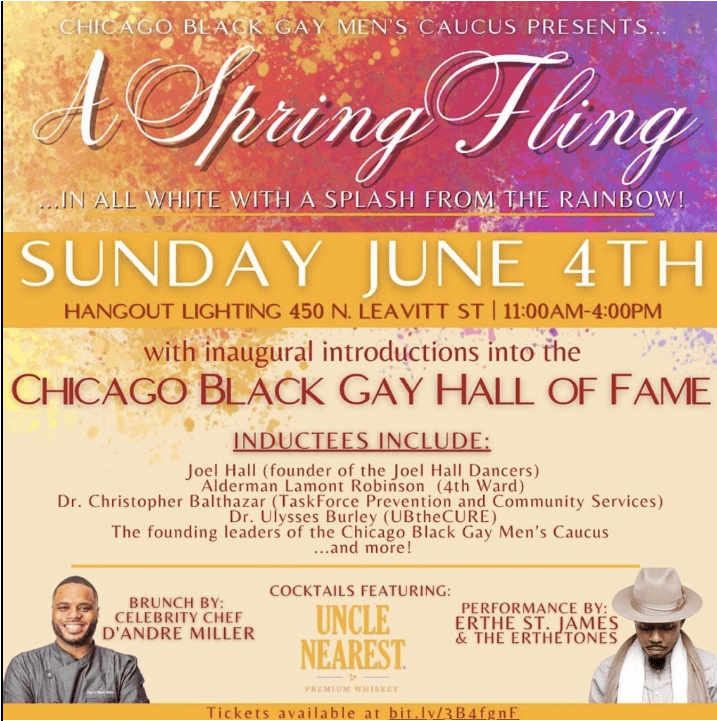
Spring Fling Fundraiser Extravaganza for the Chicago Black Gay Men’s Caucus on Sunday, June 4th from 11:00-4:00pm at 450 N. Leavitt St.
Celebrate the start of Pride Month with the induction of the newest members into the Chicago Black Gay Hall of Fame! AFC is proud to sponsor this event. Join for celebrations, food, and cocktails!
Get your tickets here: CBGMC Presents: A Spring Fling Tickets, Sun, Jun 4, 2023 at 11:00 AM | Eventbrite
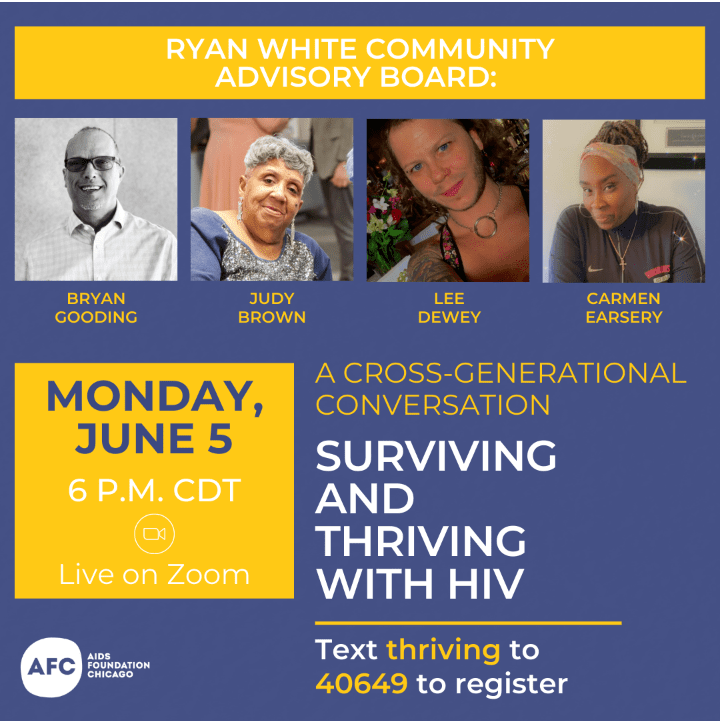
Community Conversation: Surviving and Thriving with HIV on Monday, June 5th from 6:00-7:00pm CT on zoom.
To commemorate HIV Long-term Survivor’s Awareness Day, join the Ryan White Community Advisory Board for a cross-generational discussion on what their experiences have been like surviving and thriving with HIV.
RSVP for this free event here: https://aidschicago-org.zoom.us/meeting/register/tZMlcumuqz4sGNUg-uDYeZjI6mWN4Rq7BU4K
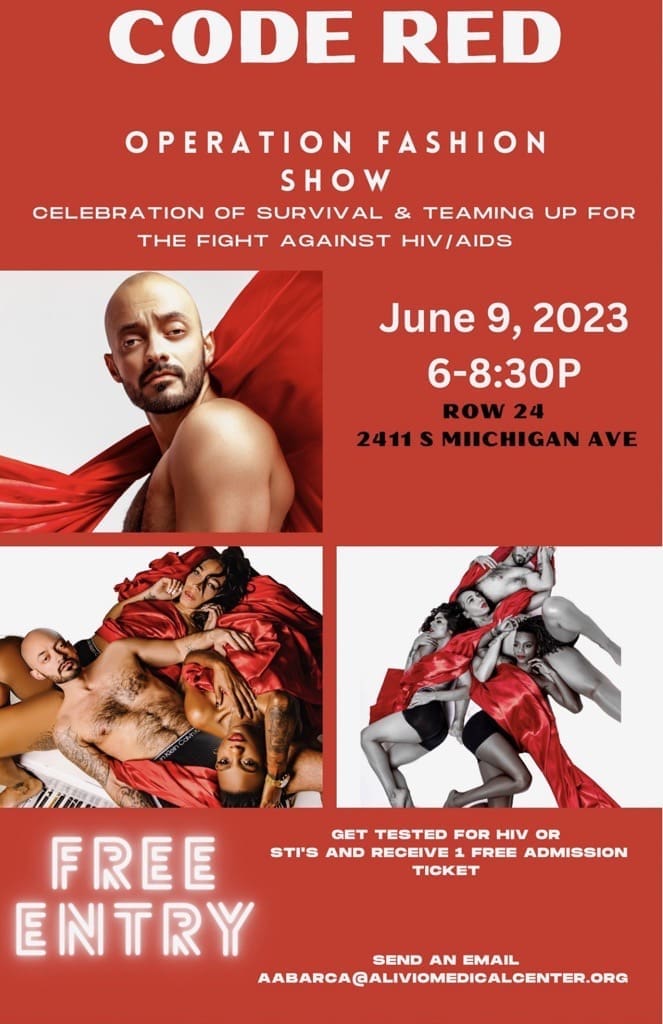
CODE RED Operation Fashion Show Friday, June 9th from 6:00pm -8:30pm at Row 24 2411 S. Michigan Avenue
Celebration of survival and teaming up for the fight against HIV/AIDS. Get tested for HIV or STI’s and recieve 1 Free Admissions Ticket
This is a Free Event!!
Send an email to: [email protected]
Southern Illinois Pride Saturday, June 10th from 8:00am – 10:00am at Carbondale, IL
This is a Free Event! For more information visist here

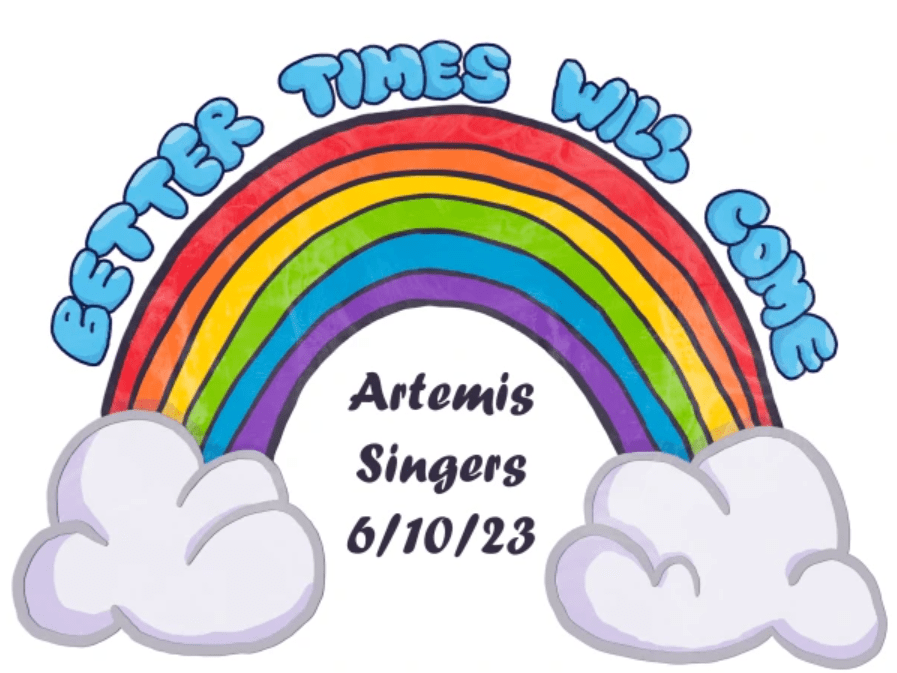
Artemis Singers Concert: Better Times Will Come Saturday, June 10th at 7:00pm at The Irish American Heritage Center in Chicago 4626 N. Knox Ave
Join us this June for our Pride Concert and Dance: Better Times Will Come.
The concert will mark a return to our format of a Pride Concert followed by a Dance.
A wealth of woman-generated work, performed by a chorus focused on performing music written or arranged by women. This concert aims to be an uplifting, upbeat evening — a celebration of hopefulness highlighting our opportunities to create a better world and our better selves in it. Please make a plan to attend!
General Admission: $25, w/ Student ID: $20, Children under 12 FREE
For Tickets and more info visit here: Artemis Singers – Chicago’s Lesbian Feminist Chorus since 1980
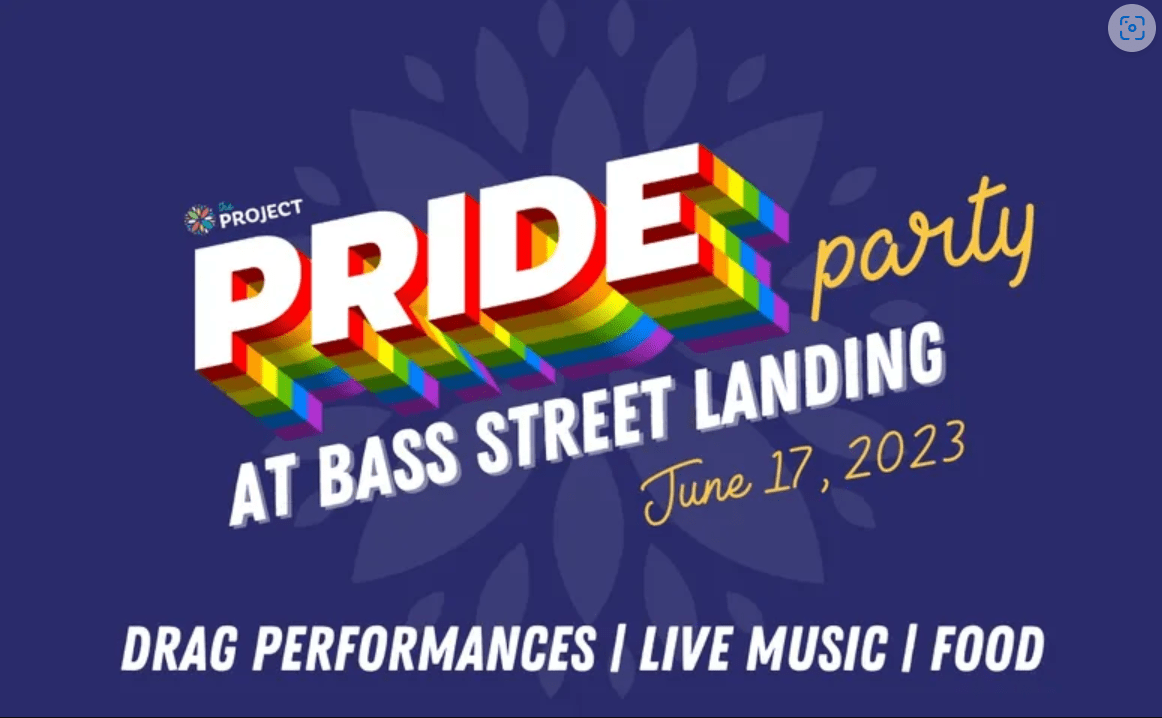
Quad Cities Pride: Pride Party at Bass Street Landing Saturday, June 17th 1601 River Dr #306, Milione, IL, 61265
Please join us for Drag Performances, Live Music and Food. This is a Free Event!! For more information please visit: Unity Pride Week (qcunitypride.org)
Pridefest from Saturday, June 17th through Sunday, June 18th on Halsted between Belmont and Grace Street.
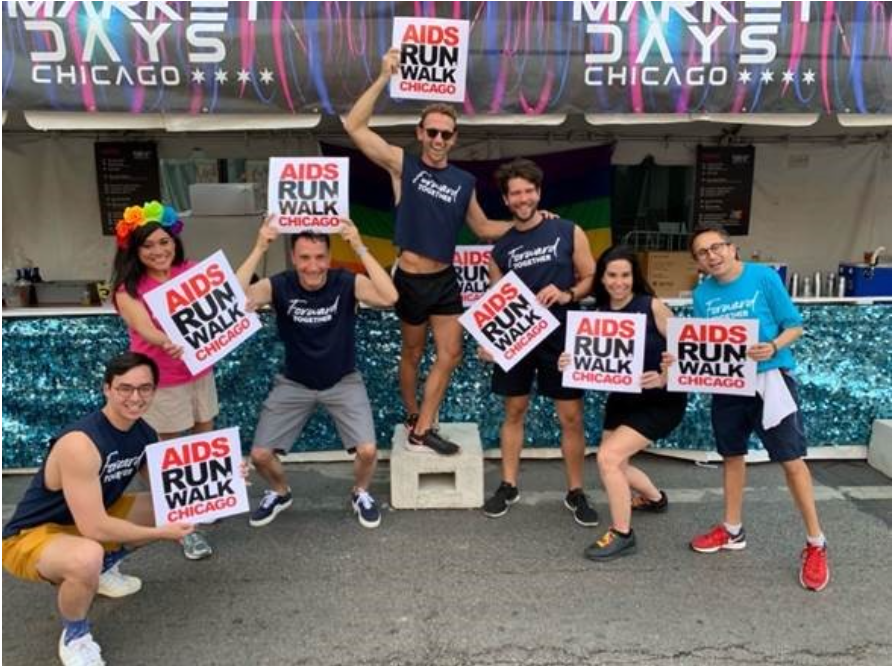
Volunteer with AFC at Pridefest! We are still seeking fun and enthusiastic people to volunteer for a 4 hour shift (or two!) at the north gate entrance. It’s fun on your feet, welcoming folks into the festival and collecting donated entrance fees. A percent of entrance fees will benefit AIDS Run & Walk Chicago.
Unable to volunteer? Visit our beverage tent while at the festival and tip our fabulous volunteers to support AIDS Run & Walk Chicago.
Volunteer sign-up here: https://forms.office.com/r/2fbLxr6Riv
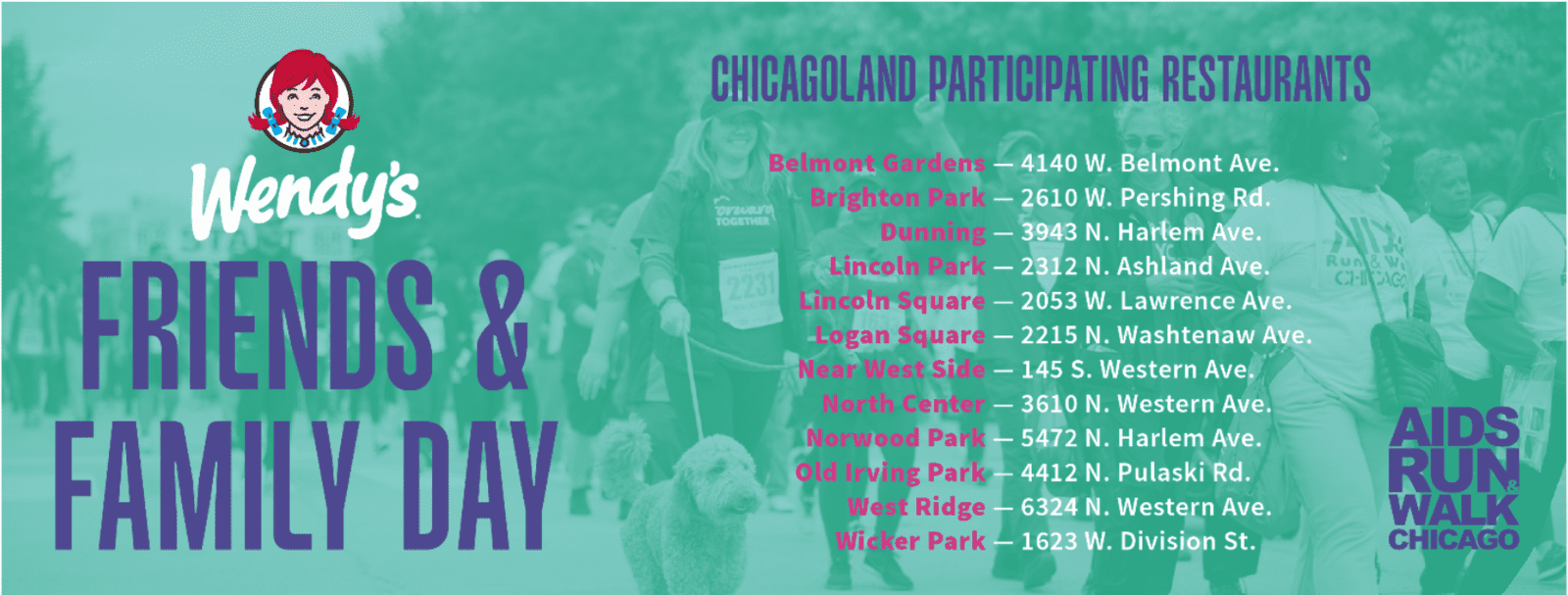
Wendy’s Friends & Family Fundraiser on Wednesday, June 21st from 4:00 – 8:00pm CT
Join us at any of the listed participating Wendy’s locations and 15% of all sales will benefit AIDS Run & Walk Chicago!
RSVP here: https://fb.me/e/2XEts0eAt
Sounds Of Pride: A Celebration of Pride Benefiting Chicago Fringe Opera & The Voice Lab on Friday, June 24th from 6:00pm – 8:00pm CT The Wagner & Zeng Residence 1312 N. Leavitt St.
Returning for a third year, Chicago Fringe Opera will celebrate the immeasurable contributions of the LGBTQ+ community to the world of performing arts with a pride party featuring specialty cocktails by Spice Note Tequila, & a brief, intimate musical program composed and performed by members of the LGBTQ+ community, featuring new music by composer Lucas Van Linden.
All proceeds will go directly to support the missions of Chicago Fringe Opera & to establish a new scholarship at The Voice Lab, designated for queer/non-binary/trans voice students.
For tickets please: https://www.chicagofringeopera.com/event/sounds-of-pride-2023/

MLK Jettie Rhodes Neighborhood Event on Friday, June 24th from 12:00 noon – 4:00pm CT
FREE Community Event! Food, Raffle & Prizes, Live Entertainment, Local Talent, Fun & Games, Cook-Off Contest, Family, Friendly, Diverse Atmosphere and More. Celebrating the legacy of the late Mrs. Jettie Rhodes and her commitment to serve her community. Help us pack the park!!
This is a Free Event!! For more information please visit: MLK Jettie Rhodes Neighborhood Day | City of Urbana (urbanaillinois.us)
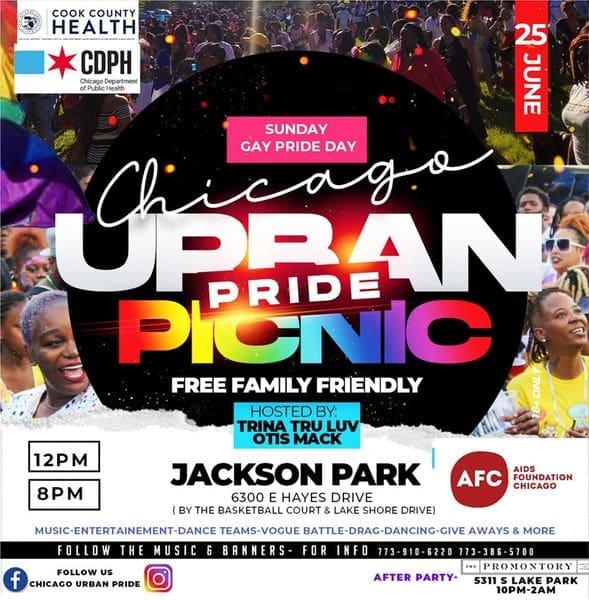
Chicago Urban Pride Picnic on Saturday, June 25th from 12:00 noon – 8:00pm CT at Jackson Park 6401 S. Stony Island Ave
This is a Free Event!! Learn more here: <span style=”color: rgb(68, 68, 68); font-family: Calibri, sans-serif, ” mongolian=”” baiti”,=”” “microsoft=”” yi=”” “javanese=”” text”,=”” “yu=”” gothic”;=”” font-size:=”” 14.6667px;=”” white-space:=”” pre-wrap;”=””>https: https://www.facebook.com/ChicagoUrbanPride
Southside Pride on Saturday, July 1st from 12:00 noon – 7:00pm CT at The Dusable Museum 740 E. 56th Pl.
For the past 5 years, Pride South Side has been a myriad of Black and brown bodies living in our truth and celebrating who we are as a collective! Come show your Pride spirit and Join us this year on Saturday, July 1, 2023 We are excited for Our 5th annual Pride South Side: Present and Beyond. Join us as we embark on a journey to a #fearless future of LGBTQI+ folks on the Southside of Chicago.
This is a Free Event!! for tickets and more information please visit here: Pride South Side | LGBTQ+ | Bronzeville, Chicago, IL, USA

AFC sponsors The Esteem Awards on Saturday, July 1st from 1:00pm – 3:00pm CT
A free event to recognize National and Local Award finalists at Sidetrack (3349 N. Halsted street), open to the public. Since 2007, the Esteem Awards have honored local and national organizations and individuals for their continued support of African American and LGBTQ+ communities in entertainment, media, civil rights, business, and art.
Learn more here: www.TheEsteemAwards.com

Month-Long Opportunities
Molson Coors’ Tap Into Change program, June 1st through August 31st
Purchase a Molson Coors beverage (or a few) at Splash! (3339 N. Halsted) this summer to support AIDS Foundation Chicago. Molson Coors has committed to donating $50,000 to Chicagoland LGBTQ+ non-profits, including AFC, during the 12th year of their Into Change program. Cheers, friends!

Dessert (and a donation!) at Ocean Prime, June 1st through June 30
Purchase a rich and delectable slice of coconut cake at Ocean Prime (87 E. Wacker Drive) this Pride month to support AIDS Foundation Chicago. $3 per slice will benefit AFC and all staff members will wear our new strategic plan pin to spread the word about Unifying for Impact.

Scoot while supporting AFC with Lime Scooters, June 1st through June 30
Scoot around the city this Pride month utilizing Lime Scooters! A limited number of AFC branded scooters will be available city-wide—if you spot one, be sure to tag @aidsfoundationchicago on Instagram and @aidschicago on Facebook. Lime Scooters has also committed to donating $5,000 this Pride month to AFC.
By Livvie Avrick
Did you know just under half of people newly diagnosed with HIV in Illinois are young people ages 13-29, and youth living with HIV are disproportionately Black? Yes! Read that again. This data from the Getting to Zero Illinois Dashboard collected in 2020 highlights the impact of racism as a public health crisis on young people in the state.
We know that housing is healthcare and having stable housing leads to better health outcomes. Part of AFC’s 2022-20224 strategic plan is uniting to end homelessness as we work towards ending the HIV epidemic in Illinois by 2030. One of AFC’s programs, Keep Empowering Young Adults to Succeed (KEYS), is a three-year rapid rehousing program that focuses specifically on young people living with HIV.
Individuals within the KEYS program are between 18 – 30 years old and living with HIV. Kelvin Easterling, program manager for KEYS, oversees the referrals sent to partners, meets weekly to discuss and identify where there may be barriers, and ensures partners have what they need to provide wrap around services to all clients that get accepted into the KEYS program. “I’m working with a budget – these funds make sure clients get beds and other household needs as well as transportation,” said Kelvin.
Some of the barriers program participants face in getting housed are not having an ID or proof of HIV status or falling out of contact because of losing phone access. Six individuals are already housed through KEYS and 3 are working with partners to find housing. Our goal is to overcome these barriers and have 40 clients housed by June 2023.
Young people aged 13-19 have the lowest rate of viral suppression of all age groups, followed by people aged 20-29 (Getting to Zero Illinois Dashboard). Maintaining viral suppression is one of the key ways to ending the HIV epidemic – viral suppression supports one’s individual and community health, as someone who is virally suppressed is healthier and cannot pass HIV sexually to their partners. This is known as U=U, or Undetectable = Untransmittable.
The KEYS program is unique compared to other rapid rehousing programs, not only because it focuses on young people, but because it is a systems change program. KEYS participants have access to an employment program designed for LGBTQ+ individuals impacted by HIV and/or living with a disability. This looks like job search assistance, career exploration, assistance with maintaining employment, 1-1 career counseling and group programming while working in collaboration with a housing navigator.
One of the goals of KEYS is to track clients’ progress throughout the program to see how access to housing affects them. The evaluation will focus on HIV care retention, social support, quality of life, and optimism about the future. This program not only gives young people the keys to a home, but also keys to a successful future.
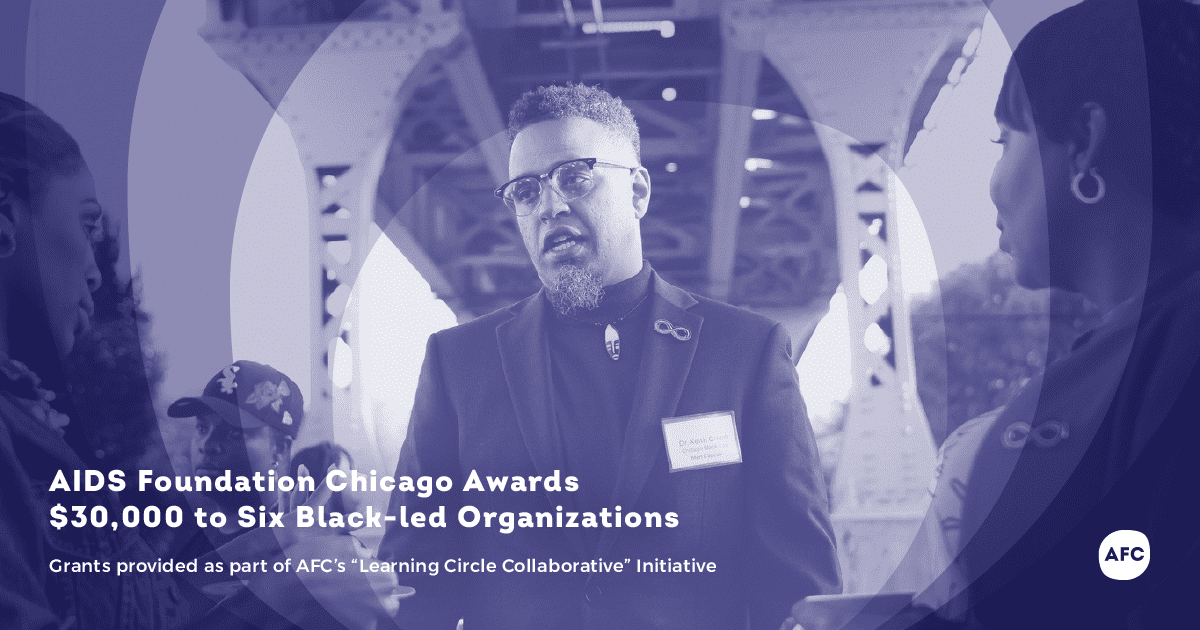
Grants provided as part of AFC’s “Learning Circle Collaborative” Initiative
(Chicago, IL) AIDS Foundation Chicago (AFC) proudly announces members of its 2023 Learning Circle Collaborative (LCC)—a capacity-building and technical assistance program for Black-led social service providers and organizations to improve agency infrastructure. A collection of grants totaling $30,000 was awarded to six, Black-led organizations across Chicago, including Black Alphabet, Chicago Black Gay Men’s Caucus, Life is Work, Lighthouse Foundation of Chicagoland, Nefuse and Project Vida.
The six grantees were selected through a competitive open application process reviewed by AFC staff, expert consultants and community review panel members representing various backgrounds. Each organization will receive a one-time award of $5,000 for participating in the LCC to build leadership and organizational infrastructure over the next six months. In addition to the funding, each of the agencies will receive capacity building (worth up to $15,000) in the form of trainings, one-one tailored coaching and mentoring from subject matter experts. They will have the opportunity to network with each other and with other funders.
“Equitable funding for Black-led organizations is imperative to achieving racial and health equity and ending the HIV epidemic by 2030,” said John Peller, AFC President and CEO. “We must work together to identify the disparities and needs for resources for communities, and organizations on the frontline of the epidemic. There are so many Black-led organizations in need of this funding and capacity building, and AFC is fully committed to increasing direct funding and finding new funding to support these organizations.”
The funds will go towards achieving the following core objectives:
- Increase capacity for fundraising and board development;
- Develop and facilitate effective communication strategies;
- Develop and institute strategic planning processes;
- Expand capacity for public health programming and design
“It was a competitive process with each organization identifying a variety of needs across challenge areas such as fund and board development, communications, and HR/talent management,” said Dr. Cynthia Tucker, AFC Senior Vice President Community Partnerships and Special Projects, who launched the program in 2016.
As stated in AFC’s Race Equity Action Plan, which was published in 2022, the organization is deeply committed to increasing revenue for Black-led organizations directly and through funding partners. To date, AFC has granted more than $2 million in awards to 19 Black-led organizations.
“The Learning Circle Collaborative has been a welcoming space for me as a Black leader navigating organizational leadership and the challenges of systemic barriers to resources,” said Jerome Montgomery Jr., Executive Director of Project VIDA, who has been part of the cohort since its inception. “There is also so much power in peer-to-peer learning and collaboration and it is truly one of the most valuable aspects of being part of this cohort program. Because of the access to new, relevant and beneficial information and funding, I feel more confident in my leadership and the positive growth of our organization to achieve our goals.”
Thank you to the following individuals who are the subject matter experts for the Learning Circle Collaborative: Johnathon Briggs, Blank Canvas, Inc., Diana Beasley, Management Synergistics, Inc., Jerome’ Holston, J.R. Holston Consulting and Dr. Ulysses W. Burley III, with UBtheCURE, LLC.
Visit aidschicago.org/page/our-work/capacity-building to learn more about AFC’s capacity building programs and initiatives.
###
About Learning Circle Collaborative (LCC)
The Learning Circle Collaborative forges partnerships with Black and Brown-led organizations and provides systemic capacity building. The LCC is a collaborative that works with agencies on identified needs by providing technical assistance, tailored coaching specific to agency needs and training and workshops on specific challenge areas such as fund and board development, communications, and HR/talent management. In addition, we provide a safe space for leaders to share lessons learned, build leadership and trust.
About AIDS Foundation Chicago (AFC)
For more than 36 years, AFC has led the fight to create health equity and justice for people living with and disproportionately impacted by HIV and AIDS. AFC brings together service providers and funders to develop systems that meet the needs of those living with HIV/AIDS and to maximize the use of scarce resources. AFC is committed to working with policymakers and service providers to increase funding for prevention services and programs that work.
AFC mobilizes communities to create equity and justice for people living with and vulnerable to HIV or chronic conditions. AFC aspires to create a world in which people living with HIV or chronic conditions will thrive, and there will be no new HIV cases. More at: https://www.aidschicago.org/
 (Photo Credit: Louis Velazquez)
By: Omar Martinez Gonzalez, Sr. Manager, Policy & Advocacy
CHICAGO, IL – AIDS Foundation Chicago condemns in the strongest terms the dangerous bill to raise the debt ceiling which was passed by the Republican majority in the U.S. House of Representatives on Wednesday, April 26, 2023. This bill, which passed by the razor thin margin of 217-215 and with all Democrats and four Republicans opposed, raises the debt ceiling only until March 2024 in exchange for slashing and freezing for ten years funding to federal health care, education, science and labor programs, prohibiting President Biden from waiving up to $10,000 from students’ loan debts, and imposing harmful and misguided work requirements for our lowest-income and most vulnerable citizens in order to keep their Medicaid and food stamp benefits.
This bill is dead on arrival in the Democrat-controlled Senate, and President Biden has vowed to veto it if it reaches his desk. Failing to deliver a budget plan to cut federal spending as they promised, the Republican majority chose instead to waste taxpayer money and critical time forcing through a senseless bill that demonstrates how little they value the well-being of the American people, and their blatant disregard for the economic security of our country.
AFC thanks all 14 Democratic Representatives from Illinois who voted against this bill and is disappointed that the three Republican Representatives from our state voted in favor. We urge you to call your Representative to ask them to pass a clean debt ceiling bill, and to not hold the country’s fiscal security hostage for political posturing. To find out who your congressional representative and senators are, click here.
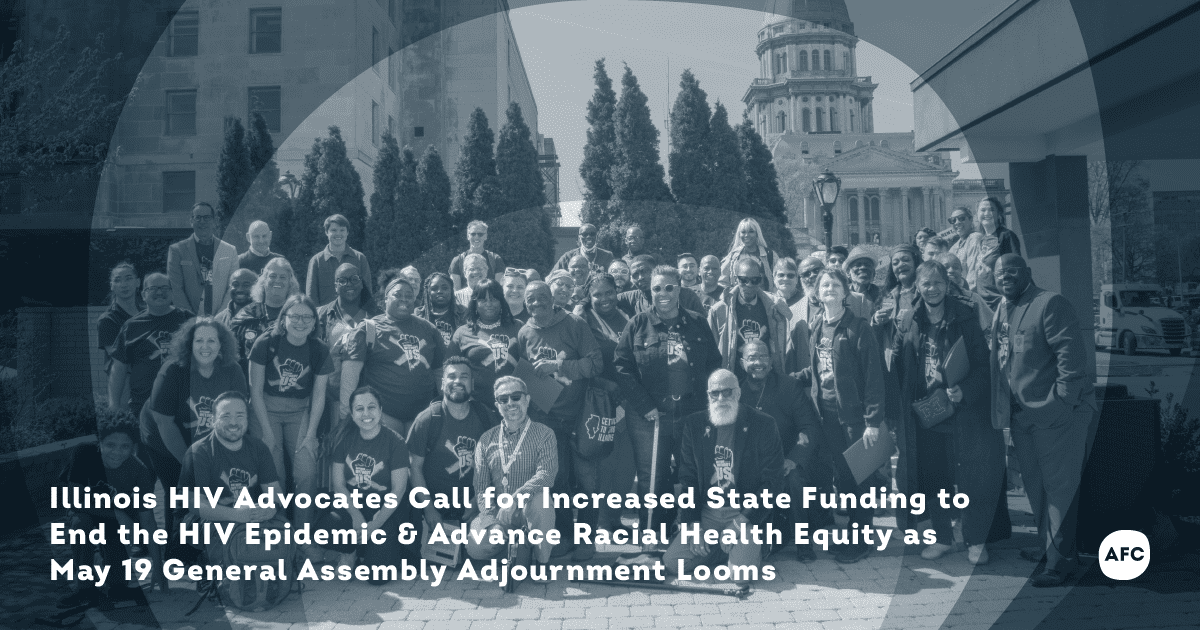
As the Illinois General Assembly enters the final weeks of the 2023 spring legislative session, AIDS Foundation Chicago (AFC) urges legislators to include additional funding in the state’s Fiscal Year 2024 budget that will advance the state’s goal of ending the HIV epidemic by 2030.
In total, advocates are calling for legislators to appropriate an additional $8 million to the current allocation of state funding of $50.5 million. Advocates are proposing:
- $2 million increase to the state’s primary HIV funding account to support increased need for HIV medications through the AIDS Drug Assistance Program
- $15 million for the African American HIV/AIDS Response Fund (level funding)
- $10 million for the Getting to Zero Illinois Initiative (level funding; the Governor proposed a 50% cut to this budget line item)
- $5 million increase for the PrEP4Illinois program. PrEP is an HIV prevention medication that is up to 99% effective at preventing new HIV cases, but too few people from the populations most vulnerable to HIV are taking PrEP
- $1 million in new state funding to address the increased rates of sexually transmitted infections in Illinois
These funding amounts are included in HB 1349 (Rep. Lakesia Collins, D-Chicago) and SB 209 (Sen. Mike Simmons, D-Chicago). AFC thanks Rep. Collins and Sen. Simmons for their unwavering leadership of this funding request. Please send a message to your legislator asking them to support the funding request here.
“The goal of ending the HIV epidemic by 2030 is just seven years away,” said Nadeen Israel, AFC’s Vice President of Policy & Advocacy. “We were disappointed that Governor Pritzker proposed a 50% cut to the state’s $10 million Getting to Zero Illinois budget line, which was first appropriated last year. Legislators must restore this funding cut in this year’s state budget.”
People living with and newly diagnosed with HIV in Illinois are vastly disproportionately Black and Latinx. Over 52% of people newly diagnosed with HIV are Black, despite only representing 14.7% of the state’s population. Latinx people are 18% of the state’s population but 21.4% of people newly diagnosed with HIV, according to AIDSVu.org.
“Despite the effects of COVID-19, we’ve been able to make progress in ending the HIV epidemic in Illinois. However, HIV continues to disparately impact Black, Latinx and LGBTQ+ communities,” said Timothy S. Jackson, Director of Government Relations at AFC. “Investing in HIV care and prevention services is the right thing to do and ultimately saves the taxpayers of Illinois valuable money and resources. Prioritizing these needed investments will allow HIV providers to reach the communities that have too often been left out and left behind.”
“Without question, HIV is a racial health justice issue,” continued Jackson. “New HIV diagnoses among Black and Latinx people are driven by a number of factors including stigma, lack of access to care, and racist systems and policies. The funding we are calling for can serve as an antidote to these racist policies, by for example, helping people living with HIV find stable housing.”
AFC Details Racial Equity Funding Analysis
AIDS Foundation Chicago (AFC) understands that meaningfully addressing racial equity in HIV shouldn’t only be limited to government. AFC has publicly committed to improving racial equity through our Racial Equity Action Plan, which details specific steps AFC is taking to change policy, strengthen programs and internally transform the organizational.
A critical approach to improving racial equity as outlined in our plan is benchmarking and then working to increase the amount of funding AFC grants to Black-led organizations. In 2022, AFC and our subsidiary Center for Housing and Health (CHH), provided $2.9 million to 19 Black-led organizations, or 20% of our grants and contracts to community partners. AFC and CHH support 19 of the estimated 25 Black-led organizations engaged in HIV work in the state of Illinois.
AFC performed a detailed analysis of the government funding it receives to support people living with HIV across the Chicago area. AFC holds contracts with the Chicago Department of Public Health (CDPH) and Illinois Departments of Public Health (IDPH) for HIV care, housing, and prevention services. As lead agent for IDPH Regions 7 and 8, as well as the coordinating entity for the Northeastern HIV Case Management Collaborative, AFC is responsible for training, data management, evaluation, reporting, and overall coordination of services. Funding sources include the federal government, City of Chicago, and a small amount of state general revenue funds. In 2023-2024:
- AFC expects to provide over $564,034 in CDPH funds to five Black-led organizations. That represents 13% of funding that AFC provides to subcontractors. AFC increased this amount by 15% and added one new organization in FY23.
- AFC expects to provide $888,976 in IDPH funds to nine Black-led organizations. This total represents 13% of funding that AFC provides to subcontractors. AFC increased this amount by 68% and added three new organizations in FY23.
In total, AFC expects to provide over $1.43 million to Black-led organizations from IDPH and CDPH funding in FY23. AFC recognizes that this is not enough and is committed to increasing funds for Black-led organizations by at least 10% in FY 23 and continuing to support and provide capacity-building and technical assistance to Black-led organizations. AFC awards these funds through an open and transparent process.
“Increasing funding for Black-led organizations is a key priority as AFC works to close racial health gaps in HIV and ultimately end the HIV epidemic,” said John Peller, President & CEO of AFC. “Black-led organizations are vital to reaching people living with and vulnerable to HIV and have an extraordinary power to provide a leading role in ending the HIV epidemic here in Illinois and across the nation.”
With community as the North Star, AIDS Foundation Chicago calls upon Governor Pritzker, IDPH and the General Assembly to center the communities most impacted by HIV by directing more funding and resources to Black-led and Latinx-led community-based organizations. Doing so will expand equity and ensure that Illinois addresses the harmful impact of HIV in our communities and invests in ending the HIV epidemic.
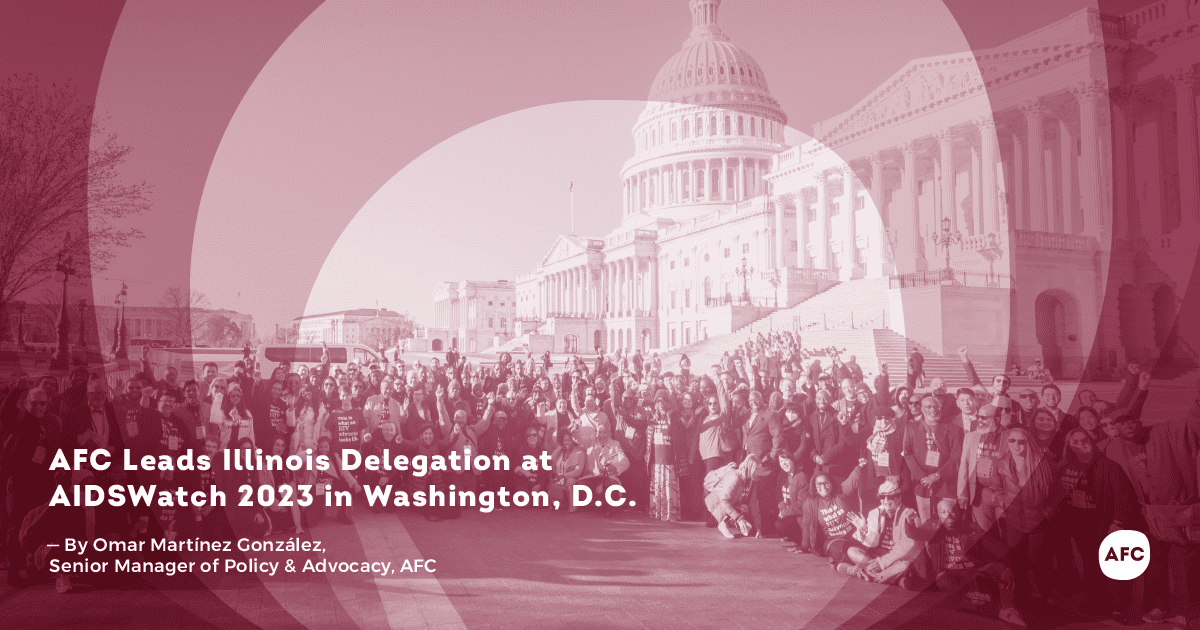
(Photo Credit: AIDS United, Denis Largeron Photography)
CHICAGO, IL – AIDS Foundation Chicago attended AIDSWatch 2023 in Washington, D.C., from March 19-21, 2023. Held in-person for the first time since the start of the COVID-19 pandemic, AIDSWatch convened over 360 advocates from across the nation for community building, education and advocacy on behalf of people impacted by HIV.
Attendees reconnected with new and old friends at the AIDSWatch reception on Sunday, where the U.S. People Living with HIV Caucus presented their Persistent Advocate awards to Martha Cameron and Achim Howard. Monday was filled with insightful and energizing presentations by community leaders and experts from across the nation, including remarks from current Office of National AIDS Policy (ONAP) Director Harold J. Phillips, and eighteen policy and advocacy workshops that ranged from reproductive health and justice to anti-Blackness in HIV policy and more. Finally, on Tuesday, advocates descended on Capitol Hill for advocacy day, kicking off the day with a rally in the Capitol Hill Lawn before breaking to meet with elected officials and their staff.
Omar Martínez González, Sr. Manager of Policy & Advocacy at AFC , led the Illinois delegation of six advocates in meetings with staff members from the offices of Senator Tammy Duckworth, Representative Jan Schakowsky (IL-09), and Representative Chuy Garcia (IL-04). Participants drew from their lived experiences to call for urgent funding to programs that people who are living with HIV (PLWH) depend on to remain healthy, such as the Ryan White HIV/AIDS Program which funds vital medical care for low-income Americans to receive HIV care; the Housing Opportunities for Persons with AIDS (HOPWA) program, which is the only federal housing program dedicated for PLWH; the Minority AIDS Initiative for dedicated funding to Black- and Latinx-led HIV/AIDS organizations; and funding for risk reduction services across various agencies and programs for people who struggle with substance use.
In addition to these vital programs for PLWH, advocates called on Congress to enact President Biden’s proposed national PrEP program for people who are uninsured and underinsured. President Biden in his budget request to Congress for FY23 and FY24 called for the creation of such a program to increase access to this vital medication, which has been approved for the prevention of HIV since 2012, and which remains financially inaccessible to those most impacted by HIV, including Black and Latinx same gender-loving men, Black and Latinx transgender women, and cis-gender Black women. Beyond PrEP, advocates urged Congress to fund other testing and prevention programs such as the Ending the HIV Epidemic initiative across various agencies, funding for the Centers for Disease Control and Prevention’s (CDC) HIV, Hepatitis, STD and TB programs, and the CDC Opioid Related Infectious Disease line item.
While unable to meet with Illinois advocates during AIDSWatch, the offices of Senator Richard Durbin and Representative Delia Ramirez (IL-03) met with advocates virtually in April. AFC looks forward to engaging Congressional offices on these important issues over the next few months as the appropriations process moves forward, and to continue to work with national partners such as AIDS United to advocate on behalf of people living with and vulnerable to HIV.
By: Omar Martínez González, Sr. Manager of Policy & Advocacy
CHICAGO, IL – AIDS Foundation Chicago attended AIDSWatch 2023 in Washington, D.C., from March 19-21, 2023. Held in-person for the first time since the start of the COVID-19 pandemic, AIDSWatch convened over 360 advocates from across the nation for community building, education and advocacy on behalf of people impacted by HIV.
Attendees reconnected with new and old friends at the AIDSWatch reception on Sunday, where the U.S. People Living with HIV Caucus presented their Persistent Advocate awards to Martha Cameron and Achim Howard. Monday was filled with insightful and energizing presentations by community leaders and experts from across the nation, including remarks from current Office of National AIDS Policy (ONAP) Director Harold J. Phillips, and eighteen policy and advocacy workshops that ranged from reproductive health and justice to anti-Blackness in HIV policy and more. Finally, on Tuesday, advocates descended on Capitol Hill for advocacy day, kicking off the day with a rally in the Capitol Hill Lawn before breaking to meet with elected officials and their staff.
Omar Martínez González, Sr. Manager of Policy & Advocacy at AFC , led the Illinois delegation of six advocates in meetings with staff members from the offices of Senator Tammy Duckworth, Representative Jan Schakowsky (IL-09), and Representative Chuy Garcia (IL-04). Participants drew from their lived experiences to call for urgent funding to programs that people who are living with HIV (PLWH) depend on to remain healthy, such as the Ryan White HIV/AIDS Program which funds vital medical care for low-income Americans to receive HIV care; the Housing Opportunities for Persons with AIDS (HOPWA) program, which is the only federal housing program dedicated for PLWH; the Minority AIDS Initiative for dedicated funding to Black- and Latinx-led HIV/AIDS organizations; and funding for risk reduction services across various agencies and programs for people who struggle with substance use.
In addition to these vital programs for PLWH, advocates called on Congress to enact President Biden’s proposed national PrEP program for people who are uninsured and underinsured. President Biden in his budget request to Congress for FY23 and FY24 called for the creation of such a program to increase access to this vital medication, which has been approved for the prevention of HIV since 2012, and which remains financially inaccessible to those most impacted by HIV, including Black and Latinx same gender-loving men, Black and Latinx transgender women, and cis-gender Black women. Beyond PrEP, advocates urged Congress to fund other testing and prevention programs such as the Ending the HIV Epidemic initiative across various agencies, funding for the Centers for Disease Control and Prevention’s (CDC) HIV, Hepatitis, STD and TB programs, and the CDC Opioid Related Infectious Disease line item.
While unable to meet with Illinois advocates during AIDSWatch, the offices of Senator Richard Durbin and Representative Delia Ramirez (IL-03) met with advocates virtually in April. AFC looks forward to engaging Congressional offices on these important issues over the next few months as the appropriations process moves forward, and to continue to work with national partners such as AIDS United to advocate on behalf of people living with and vulnerable to HIV.
AIDS Foundation Chicago (AFC) is deeply saddened by the shooting of Ralph Yarl, a 16-year-old Black boy from Kansas City. We stand in solidarity with Ralph’s family, friends, and the entire Black community in Kansas City and across America who continue to experience systemic racism and violence. We demand justice for Ralph, and for all victims of gun violence and racial injustice.
As an organization committed to fighting for change that centers the Black community, AFC recognizes the urgent need for transformative approaches to achieving justice and equity. We acknowledge the deep-seated history of racism and white supremacy that underpins this tragedy and so many others like it.
We believe that dismantling systemic racism and white supremacy requires listening to the voices and experiences of the Black community and following their leadership. We commit to working alongside community organizers, activists, and advocates to amplify their voices and push for meaningful change.
As we continue to keep Ralph Yarl and their family in our thoughts, we renew our commitment to fight for justice and equity for all. Racism is a public health crisis. We call on all members of our community to join us in this fight, to hold those in power accountable, and to create a more just and equitable world for future generations.
By: Omar Martínez González, Sr. Manager of Policy & Advocacy, AIDS Foundation Chicago
CHICAGO, IL – On Thursday, March 30, 2023, U.S. District Judge Reed O’Connor of the United States District Court for the Northern District of Texas issued final judgement on the Braidwood v. Becerra lawsuit, striking down a key provision of the Affordable Care Act (ACA) which provides lifesaving, free preventive care to millions of Americans, ranging from cancer screenings to pre-exposure prophylaxis (PrEP) to prevent HIV.
AIDS Foundation Chicago (AFC) calls on the Biden-Harris administration to immediately appeal this flawed decision, and on Congress to further protect the preventive health provisions of the ACA, in particular the important role of the U.S. Preventive Services Task Force (USPSTF).
Braidwood v. Becerra sought to strike down free, mandated coverage of PrEP by private insurances and employers based, in part, on religious freedom claims. The suit made the blatantly homophobic and patently false argument that PrEP encourages gay sex, when in fact PrEP is a powerful public health tool used by Americans of all ethnic backgrounds, religious creeds, and sexual orientations, to prevent HIV. This decision goes beyond the initial scope of the lawsuit, and now threatens access to other vital prevention services for all Americans.
Since the FDA approved PrEP to prevent HIV in 2012, hundreds of thousands of people around the world have used it to stay HIV negative, and yet, it remains out of reach for some our most vulnerable communities here in the U.S. Black and Latinx same gender-loving men, transgender women of color, people struggling with substance use disorder, and cis-gender, heterosexual Black women continue to be disproportionately impacted by HIV, and lack the same access to PrEP as cis-gender white males. This flawed judicial decision creates a new barrier for these individuals to access PrEP, and dangerously jeopardizes the progress we have made to end the HIV epidemic in the U.S.
It is estimated that, on average, every new HIV transmission costs the U.S. over $420,000 in lifetime medical costs. By limiting access to PrEP, researchers estimate that the Braidwood v. Becerra decision will cause 1,140 new HIV cases a year among same-gender loving men for every 10% drop in PrEP coverage. These cases are entirely preventable. Not only will this decision fundamentally change the lives of thousands of Americans who will receive an HIV diagnosis, it will further strain our already overstretched and underfunded public health and safety net institutions.
This is the latest injury to Americans in a growing list of threats to public health and health care access, which include the attack on reproductive rights, and the recent announcement by the state of Tennessee that it would reject federal grants to provide HIV and STI prevention services to individuals in that state.
We cannot end the HIV epidemic if our most vulnerable communities cannot access safe, effective and preventive health care services. As a nation, we can and must do better.
My Marathon Journey of Recovery at the Chicago Triathlon
By David Biele
I fell in love with endurance sports in 2001, the same year I fell in love with crystal meth. The first love affair began during my training for the Heartland AIDS Ride, a 550-mile bike ride from St. Paul to Chicago. The second took off during a night of partying in Boystown. My relationship with endurance sports continued and deepened for 10 years and included a second AIDS Ride, 6 marathons, and four triathlons, plus countless 5K, 10K and other races. My relationship with crystal meth progressed and deepened over that decade as well. As they say in one of the meeting readings for a recovery program I attend, “What started out as weekend or occasional use became daily use, and we soon found ourselves beyond human aid.”
There were times when the two affairs intermingled. I actually used 3 hours before starting the 2009 Chicago Triathlon (my last until this year), my clouded mind telling me I needed the pick-me-up and that it would be out of my system by the time the race started. It most definitely was not. When I jumped into the water at 6 am I started hyperventilating and almost drowned before getting my breathing under control and continuing the race. By the time I ran the New York City Marathon in 2011, I was a daily user. I brought meth with me to the Big Apple and used the weekend of the race. Somehow, I finished, although it was by far my slowest time of all six marathons.
After that, the balance tipped in favor of my drug of choice, and I lost the discipline, perseverance, and commitment required for endurance sports. For the next seven years, I didn’t compete in a single long-distance event, never swam, and only went on short runs a couple times per year.
In the fall of 2018, I hit bottom in my addiction and started my recovery. Immediately, my love for endurance sports resurfaced. Since my life was no longer consumed by finding, using, and recovering from my drug of choice, I suddenly had all this extra time to fill and energy to expend. I biked over 7,000 miles in 2019.
The following year, during Chicago’s shelter in place order, I started running again so as not to gain the COVID 19 (pounds). The first time I ran 3 miles I could only run for three minutes before needing a one-minute walk break. I did that for the entire distance. Run Three. Walk One. Run Three. Walk One. Until the three miles were complete. Over the next six months I ran 5 – 6 days per week and gradually increased my run/walk ratio and distance. Eventually, I could run an entire 10K (6.2 miles) without stopping.
I was just as committed to my recovery as I was to get back in shape. I threw myself into 12-step programs. From June 2019 until July 2022, I didn’t miss a single day of meetings—going even on Christmas, New Years, and Thanksgiving. Through the worst of the pandemic when in-person meetings were non-existent and human connection so tenuous, I would go to two or even three virtual meetings per day. Also, within weeks of starting my recovery program, I got myself a sponsor and began working my way through the 12 steps. I took on service commitments, got sponsees, went to sobriety conferences, and joined the board of the Chicago Roundup, a 3-day sober conference for LGBTQ+ folk held every summer at Center on Halsted. During this time not a day went by that I didn’t actively engage in my recovery.
By January 2020, I felt my physical, mental, emotional and spiritual recovery had progressed enough for me to once again train for an endurance event, and I signed up for the Chicago Triathlon, but Miss Rona got in the way and canceled it. In 2021, I considered doing the Tri, but the Roundup was the same weekend, and I decided not to do both. This year, however, there was no stopping me. I signed up in January, and over the next 8 months I put in over 150 workouts in the pool, on my bike, and on my feet—logging close to 2,500 miles total in the process.
As I trained, I also raised money with Team 2 End AIDS to help Illinois “Get 2 Zero” new HIV infections by 2030. Because my drug of choice often leads many people like myself to engage in risky sexual behavior, many, many of the people I have met in my recovery have been HIV+ and/or are living with AIDS. So many of these people have helped me get and stay sober. Raising funds to support them and others is one way I can give back to those who have given me so much and helped me become the person I have always wanted to be.
Finally, Chicago Triathlon weekend finally arrived. I competed in both the Super Sprint Triathlon on Saturday and the International Distance Triathlon on Sunday. Saturday went great for me—I gave it my all and finished with a time I was proud of. Sunday was another story. Still a bit drained from Saturday’s race and thrown off my game due to the choppy water and hundreds of other triathletes swimming all around me, I was unable to catch my rhythm and quickly became out of breath. Panic quickly set in. I swam to a lifeguard boat and hung on desperately trying to calm my racing heart and slow my shallow breaths. When I thought I had succeeded, I started out again.
I didn’t get far however before the same doubt and anxiety returned, and I found myself reaching for the lifeguard’s oar at a second boat. I hung on again, trying to decide whether to keep going or call it a day. I had only made it a quarter of the 1500 meters I needed to cover? How could I possibly finish? The lifeguard asked if I wanted to be brought to shore. I said yes. I hung on to a floatation device as he swam me in. I got out of the water and a medical team converged around me asking if I was okay. Physically, I was, but mentally and emotionally I was a mess. I so badly wanted to finish. I asked them if they would let me skip the swimming and just do the bike and run and was told that was not allowed. “Fuck that!” I said to myself. There was no way I was going to give in this early in the game and back in the water I went.
Ever so slowly, I started swimming again. Adapting some of my recovery program’s mottos, I took it “one stroke at a time” and rather than focusing on the entire race, I kept my mind centered on “the next right thing.” I never was able to get my anxiety under control or my heart rate or breathing down to normal, and thus had to stop many, many times to hang on to the sea wall, the barnacles growing on it cutting major gashes on both my feet, but finally 1 hour and 35 minutes after jumping into the water, I pulled myself out and limped over to my bike for the second portion of the race.
As I stripped my wet suit off and got into my bike shoes, I knew that getting a time I would be proud of was already out of reach. When I finished, if I finished, I was sure I would have one of the slowest times of all 7,000 participants. But that was okay with me. Finishing became my new goal. Finishing would be more than enough because in my mind, my recovery and this triathlon had become inextricably linked. By completing this triathlon, no matter how slowly, I would at long last officially be reclaiming a part of myself I had lost to my addiction. By finishing, no matter how long it took me, I would know in my heart of hearts that I might fallen, and stayed fallen for a long, long, time, but here I was standing once again on my own two (and now very bloody) feet. Oh no, there was no way I was going stop.
By this point I was already exhausted. I knew that if I was going to finish the 25-mile bike ride, I would need to pace myself. I decided to pedal five rotations, then take a break for a count of five. Pedal another five rotations, and then take another break for a count of five. In this way I gradually made my way up Lake Shore Drive to Hollywood. Pedal five, break five. Other riders passed me right and left, but I did not let them deter me. I focused on what I needed to do. Pedal five, break five. I reached the turnaround at Hollywood. Pedal five, break five. I made it back to the start point and got onto Lower Wacker. Pedal five, break five. My leg muscles were really starting to burn by this point. How many miles were left? I did not know. Pedal five, break five. I exited lower Wacker and got onto the McCormick Place Busway. Out of the shade, I suddenly noticed how much hotter the day was getting—and that I was nearly out of water. Pedal five, break five. I reached the turnaround at McCormick Place and headed into the home stretch. Pedal five, break five. Finally, I saw the volunteers ahead motioning me to slow down, dismount, and walk my bike into the transition area.
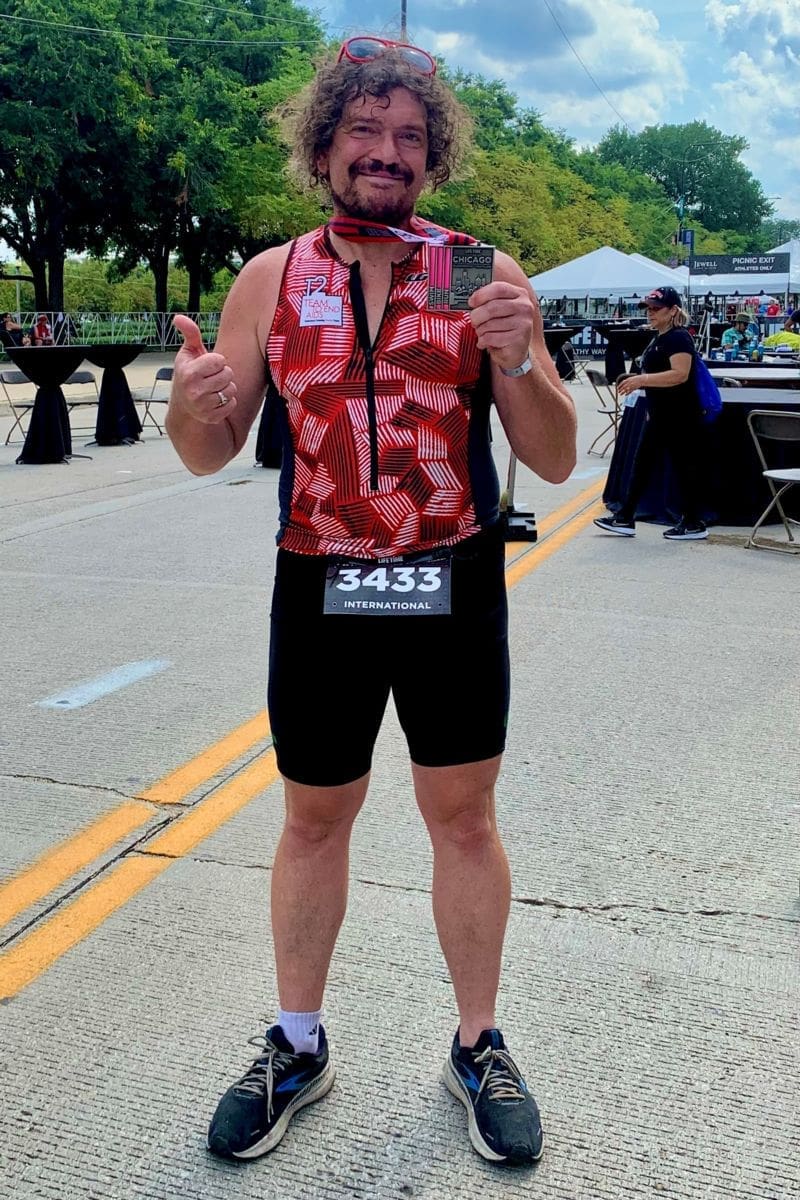
As I switched from bike shoes to running shoes, I wondered how I would make it the final 6.2 miles on foot. My worry grew when I realized that somehow, despite all my pre-planning efforts, it turned out that I only had one sock with me, and both my feet were still bleeding in several places from getting torn up on the sea wall. On top of this, the temperature by this point had reached what I later learned to be 94 degrees. The last time I ran the Chicago Marathon in 2008 they cancelled the event mid-run and closed the course when the temperature reached 90 degrees, but triathletes are a different breed. This event was still going strong. After downing an energy gel packet, I grabbed my water bottle, left my bike, and headed out.
It was now close to 10 am. I’d been on the course for nearly 4 hours. Earlier in the week, based on my training, I had estimated it would take me a little more than 3 and half hours to finish. Also, there were runners doing the sprint triathlon (1/2 the international distance) on the course with me. The first sprint triathlon wave started two hours after I did. I refused to let either piece of information get me down and kept going.
The further south I went down the lakeshore path, the fewer spectators I encountered along the way. Without their cheers and words of encouragement, the course became quieter and quieter. The Chicago Triathlon does not allow participants to wear earphones or play music on the course, so eventually the only sound I heard was my own breathing, footsteps, and heartbeat as I headed down the lakefront path. Once I passed the turnaround point for the sprint triathlon, there were even fewer people around me. After passing south of McCormick Place, there were times when I was the only triathlete I could see ahead or behind me.
I stopped twice at medical tents where I got bandages and gauze for my bloody feet. The volunteers at the aid stations refilled my water bottle with Gatorade or water depending on what I needed at the time and provided much needed encouragement and emotional support. Although I had developed a low-grade headache, possibly an early sign of heat stroke, I was doing a great job staying hydrated, as evidenced by the fact that I was sweating unceasingly and regularly needed to pee. There were only a couple porta-potties on the entire route however, and I was too exhausted to find a secluded spot off course to urinate, so sometimes I just let the pee roll down my leg. The race had turned me into a bloody, sweaty, and most of all, smelly mess–but one that could not be stopped.
Finally, around 12:30 pm, I made it back to Grant Park, headed up the last hill, rounded the final turn, and gave everything I got down the home stretch. As I crossed t
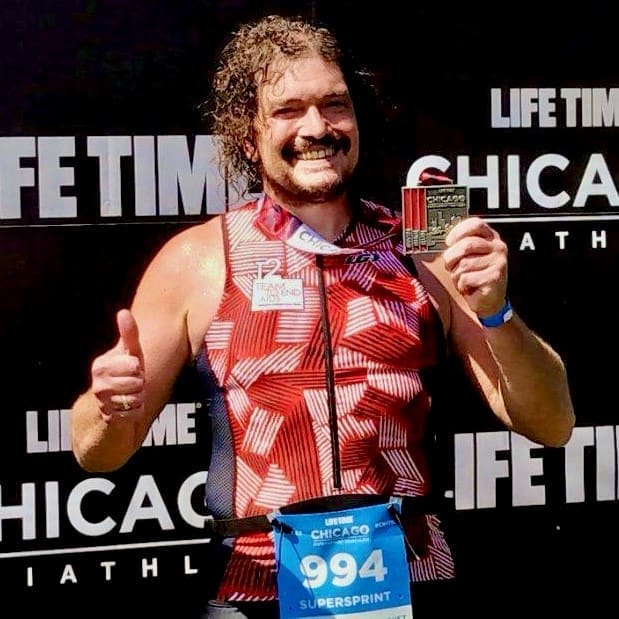
he finish line, I heard the announcer call my name. Volunteers came up to me and put a medal around my neck. I lost it and burst into tears. My parents, who had flown in from Maryland to support me, found me moments later and snapped pic after pic of me, their hearts bursting with pride. And despite the fact that it had taken me nearly twice as long to finish the course as I had expected, so was mine. I had literally given my blood, sweat and tears to make it to the finish line, but I had made it there. And that’s all that mattered to me.
Although this year’s triathlon journey is complete, my journey as a triathlete is far from done. I know I’ll be back next year—and the year after that. And who knows? I may even have another marathon in me. And similarly, my recovery journey is far from over. My dedication to that path is stronger than ever. I know all I have is a daily reprieve, and if I want to live a life free from active addiction, I need to engage in my recovery every day. So to borrow a phrase from the 12-step programs in which I am involved, when it comes to triathlons and my recovery, I’m gonna “keep coming back”… and back and back and back.