ACT UP Chicago emphasized urgent, intersectional, and direct action to advance the rights of people living with HIV and AIDS in an era of neglect and persecution by a private national healthcare system and neoliberal government. Today, we see striking parallels between the activism of ACT UP Chicago throughout the 1990s and the environment of government hostility of 2026. What can be learned from the successes and failures of ACT UP Chicago?
As the Trump administration continues their offensive against FDA regulation, Medicaid, and the general belief in medical empiricism, those directly in the path of destruction are left wondering what can be done to stop or at least fight back against this hostility. As many who lived through the rise of the neoliberalism of the 80s and 90s can attest, this is not the first presidential administration to embark on a crusade against public health infrastructure under the doctrine of privatization and further enrichment of the wealthy. When looking back at history to seek inspiration and aid for our present struggles, in the spirit of the great civil rights leader John Lewis, great leaders of the past weren’t afraid to make noise and get in “good trouble, necessary trouble.” In the context of 1980s and 1990s Chicago, this principle of making noise and getting in good trouble was wholly embodied by ACT UP Chicago.
The roots of ACT UP Chicago lie in DAGMAR (Dykes and Gay Men Against Racism and Repression), a coalition of young activists in Chicago concerned with the complacence and outright hostility towards PWA (People with AIDS) from both public and private institutions, including health insurance companies, state and local government, and pharmaceutical manufacturers. DAGMAR’s earliest reported organizational efforts are highlighted by an August 1987 protest around then-Illinois Governor Jim Thompson’s home in opposition to proposed bills which sought to criminalize people living with AIDS through repressive tracing, outing, and quarantining measures. The 100-person vigil featured protesters chaining themselves to the gate which surrounded the Governor’s home. (Sun Times, 1987)
Less than two months later, DAGMAR joined an estimated 750,000 activists from across the U.S. in Washington D.C. for the 2nd National March on Washington for Lesbian & Gay Rights. This six-day event featured the first public unveiling of the Cleve Jones’ NAMES Project AIDS Memorial Quilt, a mass commitment ceremony for same-sex couples on the steps of the IRS building, and addresses by public figures ranging from prominent LGBTQ+ activists like Whoopi Goldberg & Ginny Apuzzo, to civil & worker’s rights activists such as Jesse Jackson & Cesar Chavez. (Herrera, 2022)
The 1987 march remains a cornerstone of the greater movement of LGBTQ+ liberation and AIDS activism not only for its sheer size, but due to its media coverage and the resulting conversation around stigma towards HIV, AIDS, and LGBTQ+ people being brought to national attention. With increased visibility on the demand for rights and protections for people living with AIDS, The AIDS Coalition to Unleash Power (ACT UP) first appeared in national media coverage. DAGMAR witnessed the strong campaigning by the ACT UP chapters of New York & San Francisco to amplify the voices of people impacted by AIDS and ignored by their government, and responded in kind by reestablishing themselves as Chicago for AIDS Rights (CFAR). CFAR was to be led by a 30-year-old Chicago political cartoonist named Danny Sotomayor. After attending a protest at the FDA in Washington D.C. in 1988 alongside other chapters of ACT UP, Sotomayor returned to Chicago and reformed CFAR into ACT UP Chicago.
The Radicalization of Danny Sotomayor
Daniel “Danny” Sotomayor was born in 1958 east of the Humboldt Park neighborhood of Chicago. A gay man of Puerto Rican and Mexican descent, Danny’s childhood was marred by parental abuse. He was assaulted by his mother when he came out to her at the age of 19, an event which for him was the final straw. Danny decided to leave his Humboldt Park home and moved to the burgeoning LGBTQ+ neighborhood of North Halsted, an area which would eventually be known colloquially as “Boystown” due to its prominence as a hub for queer, particularly gay life. As Victor Salvo, executive director of Legacy Project and friend of Danny Sotomayor describes, Boystown in the 1980s had a “furtive quality to it.” The societal ostracization of gay people predating the onset of the AIDS epidemic led to spaces like Boystown encompassing a spirit of subversion and countercultural defiance. This sentiment was embraced by the inhabitants of the neighborhood, and eventually served as a bedrock for the political mobilization of LGBTQ+ people in the lead up to and during the AIDS epidemic (WTTW, 2025).
Danny had developed an affinity for art, which was a space where he could express himself freely. He made money at street fairs as a caricature artist, a hobby which underscored a deeper instigative spirit. Danny liked to test people and “see what he could get away with,” which is reflected in the exaggerated features of his caricature art, and later in his political cartoons (WTTW, 2024). Danny was diagnosed with AIDS at the age of 30, at a time when he “didn’t have a political bone in his body.” The lack of consideration and direct hostility toward people living with AIDS from the public and government enraged him. Danny’s provocative nature would become a hallmark of his ACT UP leadership and public image.
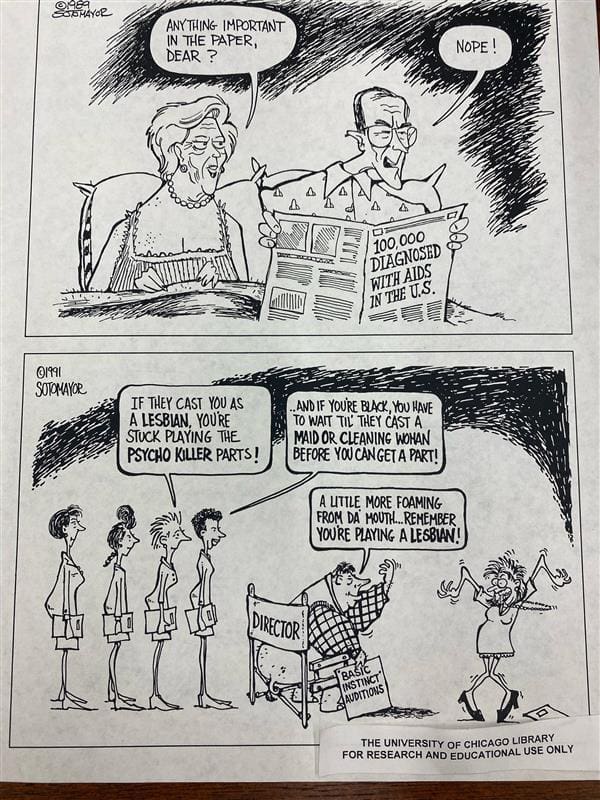
Danny’s furious dedication led him to take up the mantle as ACT UP Chicago’s de-facto leader. His fiery and charged rhetoric galvanized the core of ACT UP, and coupled with his natural affinity for public attention, Danny became impossible to ignore. It seemed wherever there was a camera, Danny found his way in front of it to speak truth to power. In only four years from his diagnosis to his eventual passing in 1992, Danny’s leadership of ACT UP Chicago led to remarkable achievements including the removal of harmful ad campaigns on CTA vehicles, the tripling of Chicago’s and doubling of Illinois’ dedicated AIDS funding, and a 1990 demonstration demanding a litany of healthcare changes for people living with AIDS, which stands historically as one of the largest AIDS demonstrations ever held in the United States. Danny and ACT UP Chicago are remembered among the most successful and notable HIV/AIDS movement leaders in history.
How ACT UP Chicago Planned, Executed, and Won
While ACT UP’s activism conjures images of die-ins, fiery speeches, and slogans delivered via megaphone to a crowd of thousands of banner waving demonstrators, this was only one element of the group’s resistance. ACT UP’s successes were the result of a well-rounded, organized, and multifaceted strategy which utilized policymaking, artistic resistance, and direct action.
There is a misconception given the size and overwhelming presence of ACT UP’s demonstrations that the organization had membership into the thousands. In reality, ACT UP was overwhelmingly orchestrated by a few dozen committed and experienced street activists. Among these were a handful of LGBTQ+ advocates who were politically connected and provided invaluable inroads to the halls of power. Danny Sotomayor and others at ACT UP understood that there were policymakers and other powerful political figures who would do their best to tune out their street actions, and that long lasting change had to be include infiltrating the halls of power and fighting on the policy front. One of these advocates, Laurie Dittman, became a staunch ally of Danny and ACT UP. Dittman describes the “good cop, bad cop” methodology which ACT UP utilized to advance their agenda. Dittman and other advocates would present their agenda and attempt to hold meetings with policymakers, and if these officials were non-compliant, they could expect Danny Sotomayor and hundreds to thousands of angry activists on the street outside their office. In the words of City Hall lobbyist and ACT UP strategist Rick Garcia, “the suits and the activists were in constant contact” (WTTW, 2025).
This relationship between lobbyists and advocates behind the scenes and loud, aggressive activism on the streets was not only advantageous, it was essential for the progress and success of the movement. Lobbyists and advocates within government were a key aspect of change, but there needed to exist some kind of public pressure to advance the slow, bureaucratic process. A main character was needed as an engine to maintain and drive momentum toward success. Danny Sotomayor and ACT UP were that main character. And this delicate dance between policymaking and performance reached its crescendo on April 20, 1990, when the call was made to AIDS activists groups across the country to come to Chicago for National AIDS Actions for Health Care; a three day conference including a full itinerary of conferences, meetings, action proposals, and vigils, culminating on April 23rd with a demonstration march to the American Medical Association building.
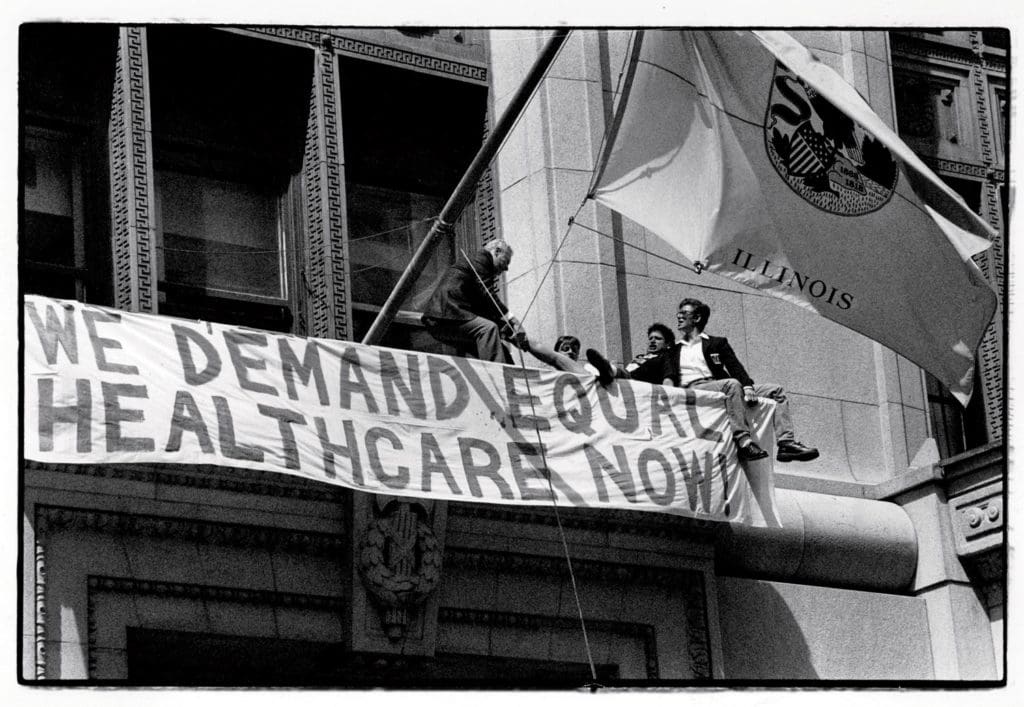
The demonstration on April 23 1990 began at the iconic Prudential building in downtown Chicago. The insurance company (as well as other insurance companies based in Chicago) had been doubling and sometimes tripling insurance premiums for people with AIDS. Thousands of marchers gathered opposite a line of latex gloved Chicago Police on horseback. Posters, banners, chants, and even guerrilla theatre flooded the streets as demonstrators marched to the headquarters of Blue Cross Blue Shield and finally the American Medical Association, where protestors staged a die-in. ACT UP organizers had stashed mattresses in alleyways and other drop sites around the AMA building and dragged them in front of the entrance where protestors donned hospital gowns and delivered a clear message toward Cook County Hospital demanding they allow women into their AIDS ward for care. Danny Sotomayor and other key protestors, dressed in a businessman attire, were able to sneak past security in the County building and climb onto a third-floor balcony where they unfurled a banner reading “WE DEMAND EQUAL HEALTHCARE NOW!”
Chicago Police did not take these acts of civil disobedience lightly. Many protestors were beaten and dragged into custody, many more receiving slurs and profanities from officers. In the end, 129 people, including Danny Sotomayor, were arrested. Members of ACT UP New York stated they would never come back to Chicago due to how cruel the police were toward them (Makkai, 2020). The drama and spectacle of the protests added an increasing pressure and urgency to the demands laid out by lobbyists and sympathetic lawmakers, and despite arrests, the demonstrations were impactful: for example, after the die-in at Cook County hospital, women were allowed admission to the AIDS ward the very next day. More victories for ACT UP began to roll through, as ACT UP was able to procure vital information from the City’s budget and mapped out exactly how to redistribute funding toward AIDS care. After presenting this information to Mayor Daley, the City’s AIDS budget was tripled.
ACT UP Chicago was successful in getting their demands met. The dual strategy of building legislative power through local government advocacy and amplifying that power through organized direct-action campaigns proved to be extremely effective. ACT UP Chicago was able to give direction to the palpable anger, frustration, and hopelessness of people living with AIDS and synthesize these sentiments into passion for change. The bravery and unwavering commitment of people living with AIDS was essential to ACT UP and its success.
What can be learned from ACT UP Chicago?
ACT UP Chicago’s successes did not come easily. They were not a popularly supported group, even within the LGBTQ+ community. Many ACT UP activists recall being treated as obnoxious and immature provocateurs by members of the LGBTQ+ community; people thought they were too loud and too intimidating in their presentation and rhetoric, causing more harm than good with their less than polite optics. As Art Johnston, LGBTQ Bar Owner and key ACT UP organizer, said of ACT UP: “[it] scared the f*** out of most people in our community” (WTTW, 2025).
Despite the achievements of ACT UP Chicago, there existed an inherent contradiction within the organization. The slow, methodical, and bureaucratic process of policy and advocacy caused friction with the members of ACT UP who didn’t have the luxury of being able to wait for said process to unfold. A majority of the members of ACT UP, as well as the activists who showed up to meetings and marched in the streets, were living with terminal diagnoses of AIDS. In ultimate acts of bravery and resistance, they used their final months of life to fight for change to the inadequacies and injustices of the public health system. These activists could not afford the luxury of patience for the political machine to slowly churn out results. Due to this fundamental conflict, fissures began to show within the base of ACT UP Chicago.
At the same time, Danny’s health began to deteriorate, but he did not slow down. Danny began to target Mayor Richard M. Daley as a figurehead for the City’s lackluster AIDS budget. Mayor Daley wasn’t particularly oppositional to ACT UP Chicago, in fact he was unusually cooperative with LGBTQ+ rights organizations compared to other leaders of the time. Danny’s focus on Mayor Daley was justifiable, but it led to poor optics: ACT UP began to appear to many in the mainstream as a sensational ambush group, rather than an organized coalition seeking to advance public policy and public health. Danny would follow the mayor to public appearances and unfurl a banner, shouting at the mayor to “TELL THE TRUTH ABOUT AIDS” until either Daley left, or Danny was removed from the area.
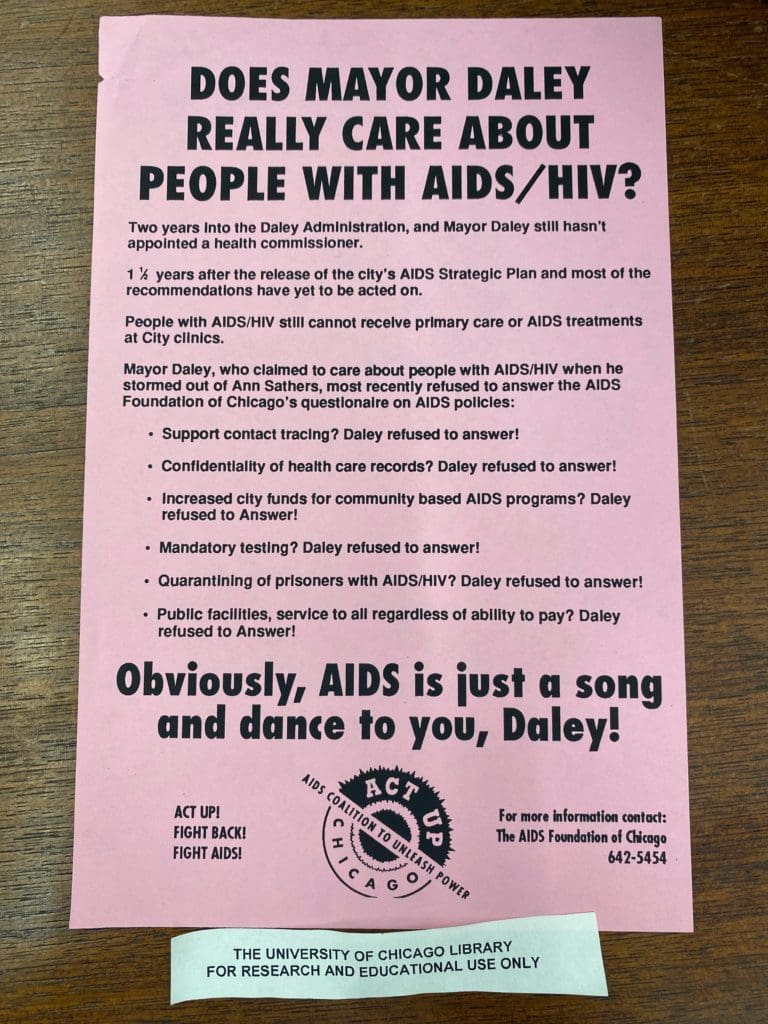
Danny’s guerilla tactics were not unjustified, and they did increase attention to HIV/AIDS in Chicago. But divided opinion over these tactics exacerbated the greater friction within the movement. Danny Sotomayor’s entire life of activism from the time of diagnosis with HIV to his death in 1992 was only four years long. Danny had to fight every minute of every day for change because he had no alternative. His intentions were true, despite sometimes poor optics, and his was a voice echoing thousands of other people living with AIDS who had no time to spare for slow-moving procedural change.
ACT UP Chicago officially dissolved as an organization in 1995 after a long period of declining momentum due to a lack of direction, core members passing, and a general exhaustion among veteran activists after years of fighting. ACT UP Chicago was by no means a failure. On paper, they remain one of the most successful organizations in the realm of AIDS activism considering the achievements made within a timeframe of a few years.
ACT UP Chicago can and should be studied to draw inspiration for strategy as we carry the fight against stigma, denial of healthcare access, denial of housing, and an onslaught of cuts and persecution at the federal level today. Those who fought, lived, and died before us left behind invaluable lessons to carry on the pursuit of justice for all marginalized people. They taught us that activism is not a trend or a one-time thing. Movement building requires discipline, sustained pressure, and a vanguard of experienced and dedicated activists to lead and develop strategy and messaging. ACT UP Chicago also exemplifies the necessary symbiotic relationship between policymakers and advocates from within the halls of power, and on-the-street activists from outside. Without a network of well-connected allies in the political system, demands will go unheard. Likewise, without a loud, disruptive force of activists constantly applying pressure for change, policy will lack a sense of urgency and responsiveness to present-day needs.
The history of ACT UP Chicago also highlights the importance of visbility and optics. It was the shock of witnessing the AIDS Memorial Quilt, the seemingly endless panels of fabric, each measuring the length of a coffin, laid end-to-end across the White House lawn that exposed the humanity of the AIDS crisis to the public consciousness. This installation, representative of the death of so many, ultimately gave life to ACT UP Chicago and the lifesaving achievements of the HIV movement to come. ACT UP Chicago’s demonstrations were not simply chants and marching, although there was plenty of that. These demonstrations displayed queer life in defiance. There was drag, martial arts board breaking, same-sex wedding ceremonies, art shows, and countless other acts which drew attention and expressed joy and hope in the midst of suffering. These demonstrations were loud and angry, but were also an autobiographical performance of what LGBTQ+ life was, and what it could be. Optics were, and remain crucial to how a message is digested by the public, which ultimately reflects how the movement itself is viewed and thereby supported.
In the year 2026 and onward, we face new challenges, many of which eerily rhyme with those faced by ACT UP Chicago. A federal government which is neglectful at best, and often persecutorial. A future in which hope seems like a commodity few can afford. A fight for access to healthcare, housing, and basic human rights that must be fought by an increasingly exhausted base of the most marginalized in American society. Nevertheless, we must persist, and the lessons found in the successes and failures of ACT UP Chicago’s can guide us toward a better future.


