The Pride Action Tank (PAT), a new, results-driven group that addresses challenges facing individuals and groups within LGBTQ communities through a collaborative process of inquiry, advocacy and action, is launching this month as a project of the AIDS Foundation of Chicago (AFC).
 Kim L. Hunt, former executive director of Affinity Community Services, will be PAT’s executive director. Tracy Baim, founder of PAT, will be the president of its advisory board.
The work of PAT focuses on six overlapping issue areas: housing, health, safety, financial security, youth and aging.
“I am very excited to build on this movement moment by leading this new and innovative initiative, focused on research, policy and action in the LGBTQ and intersecting communities,” said Hunt.
John Peller, president/CEO of AFC, said the new project will “enhance the coalition-oriented work that AFC has been known for since our founding 30 years ago. We believe PAT will be a contributor to the dialogue and work needed to help the LGBTQ community focus on core areas of need.”
PAT will bring together and support the work of subject matter experts as well as people directly impacted by challenges facing the LGBTQ community to envision and realize practical and longer-term policy solutions. Moreover, PAT will fuel collaborations among organizations, departments, experts, policy-makers and community members in order to fill in gaps and ensure better supports for all people in LGBTQ communities.
The mission of PAT is to “improve the health, safety and progress of individuals and groups within the LGBTQ community by inspiring, supporting and leading collaborative action that improves policy, service, access and community dynamics in the core areas of housing, health, safety, financial security, youth and aging.”
Since the Windy City Times summit on youth homelessness in 2014, Baim has been attending meetings and developing partnerships with a wide range of individuals and agencies, especially in the area of youth homelessness and housing. These activities provided the framework to launch projects from the summit, including one on youth storage, an upcoming tiny homes summit, and a November 20 “sleepout” to benefit 18 area nonprofits serving youth experiencing homelessness. Details on these projects will be released soon.
“Our community has come together for major events and issues in the past,” Baim said. “Whether around the March on Washington, the Gay Games, the March on Springfield and the critical work that continues around HIV awareness and services. We can do great things and solve big problems by working in partnerships. We want PAT to help facilitate these kinds of solutions for issues that affect LGBTQ people, but that can lift all boats, including on youth homelessness and affordable housing alternatives.”
Register to receive information about Pride Action Tank here.
“Today, we have the technology and the knowledge to end AIDS!” AIDS Foundation of Chicago President/CEO John Peller kicked off the fourteenth annual AIDS Run & Walk Chicago on Saturday, Sept. 26 with these words, setting the stage for a day of hope and remembrance.
The event welcomed more than 2,500 runners, walkers and volunteers who, at press time, had raised more than $386,000 in individual donations for 36 organizations that support people living with HIV and AIDS in the Chicago metropolitan area.
5k and 10k runners and 5k walkers streamed in to Soldier Field’s south lawn under a sun-drenched sky, writing on signs honoring their loved ones, checking in with sponsors and community organizations at more than 40 booths and stretching before they hit Chicago’s Lakefront Trail.
After Peller and WGN-TV entertainment reporter Dean Richards kicked off the event’s opening ceremonies, attendees were graced with a performance of “Seasons of Love” from Broadway musical RENT by the cast of Artists Giving Back’s Dec. 1 production of the musical. Longtime HIV activists Patricia Johnson and Evany Turk closed the opening ceremonies with a rousing call to continue to advocate for people living with HIV in Illinois — especially in the wake of the continued budget stalemate in Illinois.
The 5k winners were Chicagoans Christopher Phillips and Colleen Rogers, and the 10k winners were Chicagoans Preston Lockwood and Caroline Zent. A full list of participant finish times is available at aidsrunwalk.org.
After the race, runners and walkers viewed the stoic NAMES Project AIDS Memorial Quilt panels on display. Many guests participated in free HIV screening at testing trucks south of Soldier Field and no-cost meningitis vaccinations sponsored by the Chicago Department of Public Health.
Funds raised through AIDS Run & Walk Chicago will benefit programs and services for the AIDS Foundation of Chicago and 35 other metropolitan organizations that provide life-saving services to people living with and vulnerable to HIV and AIDS. Since it was established in 2001, AIDS Run & Walk Chicago has netted nearly $5 million to battle the epidemic.
Fundraising totals for AIDS Run & Walk Chicago will continue to grow, as donations will be accepted throughout autumn. To donate or learn more, visit aidsrunwalk.org or call 312-334-0946.
CONTACT: Brian Solem, [email protected] or 224-623-4508
PHOTOS: aidschicago.org/aidsrunwalk2015
Over 2,500 Chicagoans enjoyed a beautiful Saturday and raised over $377,000 at AIDS Run & Walk Chicago. In its fourteenth year, thousands of walkers, runners and volunteers from all walks of life gathered to put an end to the stigma associated with HIV and AIDS at our largest grassroots fundraising event. Take a peek at 10 tweets from Saturday that capture the energy, optimism and new voices that emerged at this year’s
#AIDSRunWalkChicago.
1.
AFC leader John Peller #aidsrunwalkchicago pic.twitter.com/qmtrJdV5s7
— Windy City Times (@WindyCityTimes1)
September 26, 2015
2.
HOORAY! @prettyrickyroo & I finished @AIDSRunWalkChgo 5K & we’re both still walking! #AIDSRunWalkChicago #jroorunclub pic.twitter.com/x4nBL4aV2v
— The Messinger of Joy (@joydelivery)
September 26, 2015
3.
Advocates filling out buck slips at booth #60! Make sure to stop by and tell Gov Rauner to #BBHMM #aidsrunwalkchicago pic.twitter.com/h6kEcBNlKi
— AIDSRun&WalkChicago (@AIDSRunWalkChgo)
September 26, 2015
4.
Had an amazing time running the #AIDSRunWalkChicago 5K this morning. I love supporting great causes like this. pic.twitter.com/b8pDLF3u8c
— Eric Lueshen (@Elueshenary)
September 26, 2015
5.
#Aidsrunwalkchicago pic.twitter.com/aqbwT3HbMF
— chris wyatt (@wyatt22)
September 26, 2015
6.
They’re off! #AIDSRunWalkChicago participants start to put their feet down for #HIV awareness & services in #Chicago! pic.twitter.com/yziqig6wGj
— AIDS Fdn. of Chicago (@AIDSChicago)
September 26, 2015
7.
#AGBChicago performing “Seasons of Love” from #RENT at #AIDSRunWalkChicago #putyourfootdown #RENT pic.twitter.com/sJ6BjuKtiK
— AIDSRun&WalkChicago (@AIDSRunWalkChgo)
September 26, 2015
8.
PHOTOS: #AIDSRunWalkChicago http://t.co/JJLy69Ejpt #chicago #gaychicago #boystown #lgbt @AIDSRunWalkChgo @AIDSChicago http://t.co/jisxxb7WRU
— ChicagoPride.com (@GoPride)
September 27, 2015
9.
Photo: I ❤ CHICAGO!!! #AIDSRunWalkChicago #WalkingForACure #Chicago #AIDSFoundation #TheChicagoLifestyle… http://t.co/MgWgpYSiNw
— Oh So Fuzzy™ (@OhSoFuzzy)
September 26, 2015
10.
Thousands at Chicago AIDS Run & Walk: VIDEO and photos from today’s event http://t.co/YFsOrFILWn @AIDSChicago @AIDSRunWalkChgo
— Windy City Times (@WindyCityTimes1)
September 26, 2015
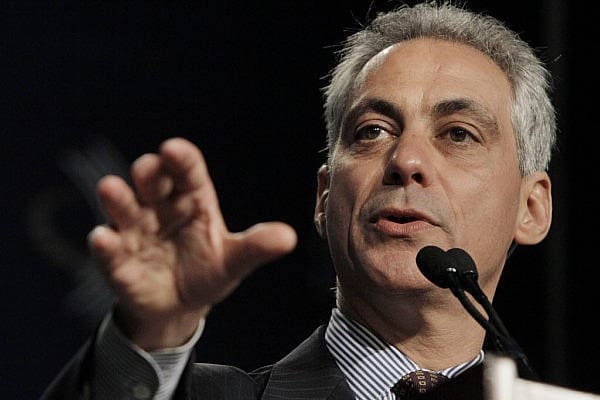 Today, the AIDS Foundation of Chicago (AFC) and members of its Service Providers Council discussed Mayor Rahm Emanuel’s budget proposal for 2016 and the city’s proposed transition of the Uptown and Englewood HIV primary care clinics run by the city to community-based service providers. This would follow the model of the successful transition of Chicago Department of Public Health (CDPH) primary care clinics to Federally Qualitied Health Centers several years ago.
It is our understanding that the transition would not be in effect until Spring 2016. AFC supports this proposed change, which would make $1.5 million in federal Ryan White funds available to community-based providers. However, we will vigorously advocate for CDPH to ensure that clinic patients do not drop out of care in the switch. Click here to read our testimony on the issue.
The mayor also proposed reducing the amount of city HIV prevention dollars from this year’s allocated amount of $4.3 million and replacing them with federal prevention funding freed up by internal staffing changes. City officials assured providers that the amount of prevention funding for delegate agencies will remain the same.
We will continue to work with Chicago’s City Council and mayor’s office to ensure investment in HIV prevention services remains intact — and these services are fully funded. We will keep you updated as the city budget process continues.
Do you believe in miracles? One AIDS Run & Walk Chicago team does. Team I Believe in mIRAcles is rallying around their friend Ira Katzman, who will run his first 5k on Sept. 26 after experiencing brain cancer and a series of subsequent surgeries that kept him in the hospital for a year.
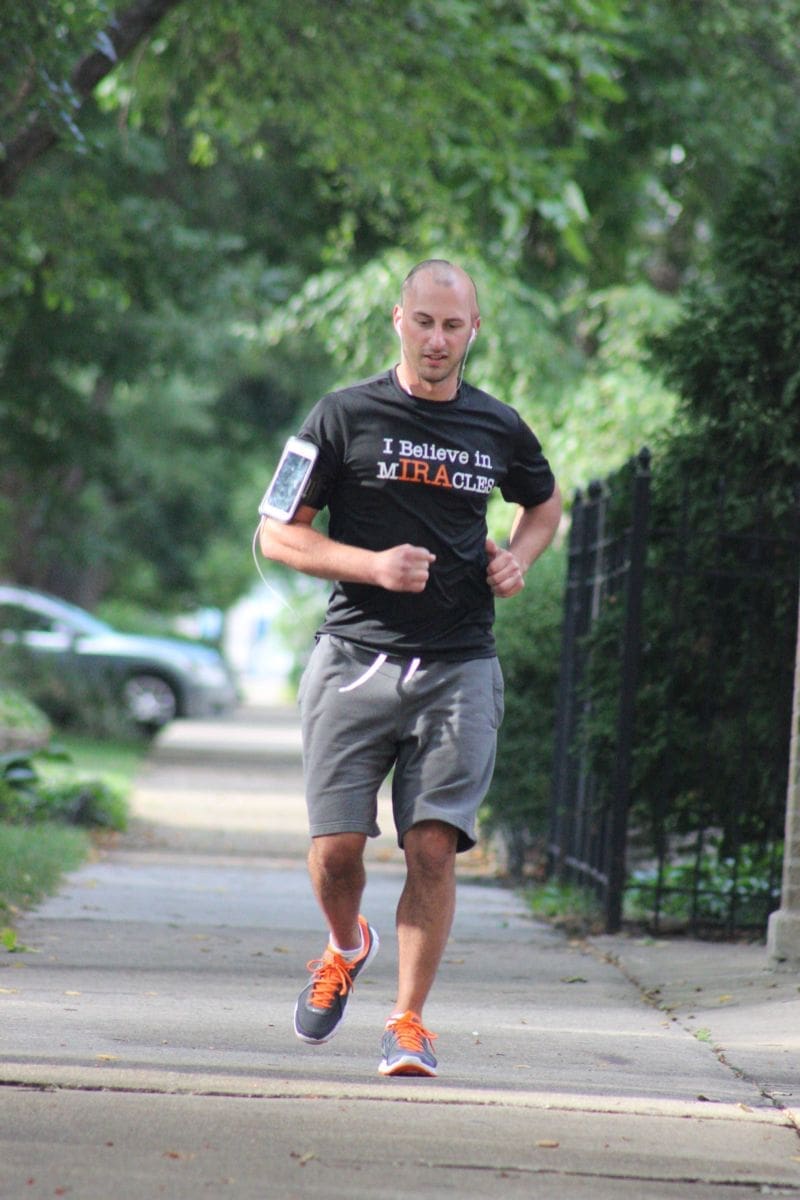 Two years ago, Ira was a “happy camper.” He went to the gym regularly; he was a personal injury attorney with his family practice; he was enjoying life with his husband, Casey.
But then on Sept. 17, 2013, Ira’s life changed. He was working out at the gym when his right arm went completely limp. He went home and still wasn’t feeling right, so he headed to Northwestern Memorial Hospital. As he was walking in to the emergency room, he collapsed.
When he awoke two days later, his body had been through a lot. The doctors discovered a brain tumor and removed it. He recovered well with support from his friends and family, but then a series of infections in his brain resulting from the initial surgery took him back and forth from the hospital for the next year and a half.
“Ten surgeries, infections, skin grafts, chemo, radiation — you name it, I think I’ve been through it,” Katzman recalled. “In 2014, I spent more time in the hospital than out of it.”
Recovery is a day-to-day process for Katzman now. He goes to a trainer to help the process and is figuring out his next step toward getting back into the workforce. “I’m just trying to have fun and reclaim where I was.”
But he still has struggles with the little things every day. Tying his shoes, clipping his nails — “the little things present a day-to-day challenge.”
But he’s working to overcome those challenges. They’re getting better each day. AIDS Run & Walk Chicago will mark a huge milestone for him when he runs his first 5k since his brain tumor was removed.
“Last week, I ran a complete mile without stopping. I had no idea I could do that, so I feel like I am a third of a way from completing the full 5k!” said Katzman. He’s training with a couch-to-5k program and hopes to incrementally add distance to his run every week.
Katzman won’t be alone on Sept. 26 at Soldier Field for the event — Team I Believe in mIRAcles, made up of his closest friends, his father and his husband, will be there with them. Together, they’re raising money to support the AIDS Foundation of Chicago (AFC). So far, they have raised almost $4,000 in honor of Katzman’s amazing recovery from one life-threatening illness — and to support continued support for another life-threatening illness, HIV.
“I have many friends — close friends — who are affected every day by HIV. I have a strong connection to our community,” said Katzman. He has shown that commitment through supporting AFC and traveling to Springfield this spring to speak with legislators about HIV funding in the state budget.
But for now, Katzman’s main focus is meeting his personal goal at AIDS Run & Walk Chicago and continuing to raise funds for Team I Believe in mIRAcles.
“I want to go all the way to the finish line — and drink a beer!” joked Katzman.
Support Katzman’s team and make a difference in the HIV epidemic in Chicago. Click here to make a donation.
 Yesterday, Governor Bruce Rauner signed SB 2042 into law to become Public Act 99-0409. This bill appropriates federal funds to state run programs, allowing those programs to continue to function. The bill contained $55 million in Ryan White funds that is estimated to allow the AIDS Drug Assistance Program (ADAP) to continue to function, likely through February. These dollars were essentially sitting dormant in the state funds, but they required an appropriation bill in order for the state to have the legal authority to spend those dollars.
While the state continues to operate on this bill, the K-12 budget, and various litigation and consent decrees, 90% of the state budget is operating at present. The sector facing the impact of this shutdown now are nonprofit human service providers, including HIV/AIDS service and provider organizations. Capacity is already being diminished, and many organizations estimate that their reserves will be wiped out in the very near future. While there appears to be no end to the stalemate around funding these operations, there are very real consequences around the corner for many Illinoisans who depend on the services these agencies provide.
Contact your legislators and the governor today to urge them to enact a full budget that funds vital services for Illinoisans. Tell them we cannot and will not accept a budget that does not fully fund the critical services that Illinois relies on.
The AIDS Foundation of Chicago (AFC) is pleased to announce the release of the FY 2016 Request for Proposals (RFP) for Ryan White HIV/AIDS Treatment Modernization Act Parts A & B. AFC is requesting proposals from community-based organizations, HIV service organizations and other eligible health and social service providers to deliver high-quality, cost-effective Ryan White HIV/AIDS Program services.
Please visit aidschicago.org/RyanWhite2016 to download a copy of the RFP and to learn more.
Questions can be directed to Bashirat Osunmakinde at 312-334-0951 or [email protected].
AFC’s Community Organizer Maxx Boykin attended the first Movement for Black Lives Convening on July 24-26 in Columbus, OH, a weekend-long gathering of people uniting to bring racial justice for Black Americans to fruition. He captured photos throughout the weekend, including a moment when he and several other Convening attendees were pepper-sprayed by local police. HIV’s disproportionate impact on the Black community was one of many topics discussed at the Convening.
Shouts of unity, chants against an immoral budget and a kaleidoscope of signs graced the James R. Thompson Center Plaza on July 22 as 200 people gathered to lambast Governor Bruce Rauner and the Illinois state legislature for not yet passing a budget in the state.
The shouting wasn’t relegated to the Thompson Center, though. Online, #PositiveBudgetIL was trending on Twitter among people at the rally and those who showed solidarity from home or elsewhere. Here are 10 Tweets that tell the story of AFC’s Rally for a Positive Budget:
By Elijah McKinnon, Digital Communications Coordinator
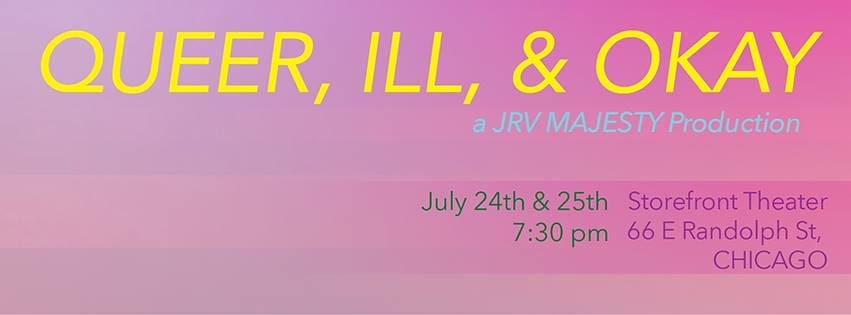
This time last year, I sat across the table from Joseph Varisco as he introduced me to Queer, Ill & Okay — a performance series that examines chronic illness in a new light. Located in a crowded café in Logan Square, the Chicago-based performance artist, producer, documentarian and teacher unpacked the intricate details that make up the multidisciplinary performance series. He hoped then that Queer, Ill, & Okay would become a lasting event in Chicago that is continually evolving.
Fast forward to the present. Queer, Ill & Okay has transformed to that and more. Now in its third year of production, QIO has immensely expanded beyond its initial concept. “Since first appearing, Queer, Ill & Okay has reached over 1,500 artists and audience members,” Varisco says proudly. Through partnerships with organizations like Howard Brown Health Center, he and his team have “presented over a dozen educational workshops at universities around Chicago. In addition to showcasing a brand-new series of artists from across the city of Chicago [in the latest iteration], the production continues to sell out to standing-room-only audiences.”
I briefly caught up with Oil Rodriguez and Amir Rabiyah — two performers in the production — as they prepare for opening night this Friday. Read about their pieces that explore the relationship between queerness, the body and chronic illness. Tickets can be purchased here for the performances on Thursday, July 24 and Friday, July 25. Don’t miss out!
Oli Rodriguez is an interdisciplinary artist working in video, photography and performance. His projects conceptually intersect and dialogue within consent, queerness, childhood and sexuality.
It’s often very difficult for individuals to discuss chronic illnesses without tokenizing a person; how has QIO provided you with a safe space to freely address and explore [your] chronic illnesses?
Although HIV/AIDS has changed drastically over the past thirty years, we still have a lot of work to do when it comes to reversing stigma. Yes, the illness has changed; however, the illness is still chronic. I strongly feel that Queer, Ill & Okay allows individuals like myself to explore these conversations in an open venue. This is especially important when considering that stigma is often rooted in the creative silence.
Now in its third year, QIO has allowed a handful of artists to share very intimate thoughts and perspectives. What are you most eager to convey to audience?
I’m super honored and flattered that Joe [Joseph Varisco] has invited me to participate and share myself this year. And I’m also very excited to share some of the writings from my project [The Papi Project], as well as the unique perspectives I have to offer, especially when factoring in my upbringing. In this instance, I look forward to showcasing alternative family dynamics and how the images from the initial HIV/AIDS epidemic have changed significantly.
Amir Rabiyah is a queer, disabled and two-spirit writer of Lebanese, Syrian, Cherokee, and European ancestry. Their work explores the complex and beautiful intersections of multiple identities and is a call for social justice for all oppressed people.
Can you share how you arrived at the development of your piece for Queer, Ill & Okay?
I’ve been writing more and more about my chronic illness over the past couple of years. But one part I haven’t really explored is how isolation is directly connected to chronic illnesses. Sadly, I don’t think that people, especially the queer community, understand that this is a very serious issue that is affecting a lot of people. It is really concerning that so many people in my community are on the verge of homelessness and are barely staying alive. In my writings I address that we need to do something as a larger community. We should be sharing our resources with one another. With my piece, I really want to break the silence that surrounds chronic illnesses because there is so much taboo and shame around talking about depression.
There are many taboos associated with mental and physical illnesses; how does your performance break barriers, reduce stigma and introduce new determinations?
I think that some of the stigmas will be broken down just by focusing on some of the emotional challenges associated with chronic illnesses. Breaking the silence and sharing it with the audience is my largest determination. I think that opening myself up and speaking my truth will shed a new light on what is means to be chronically ill. There is an immense power in sharing raw emotion; it encourages others to break the silence.